How to Perform a Half-Halt

What is a half halt horse riding actually needs is not a mysterious feel you either have or don’t, it is a specific sequence of aids in a specific order. Here is that sequence, the timing that makes it work, and the mistakes that quietly cancel it out.
A half-halt is a brief, coordinated aid, leg first, then seat, then a momentary closing of the outside hand, that rebalances a horse’s weight back onto its hindquarters and rebalances its attention onto the rider. It is not an actual halt and it does not slow the horse down on its own; used correctly, it recycles forward energy into better balance for whatever comes next, a transition, a change of bend, or simply reestablishing rhythm. The whole sequence lasts about one stride, then releases completely.
If you have asked a trainer what is a half halt horse riding actually requires and gotten a vague answer about “squeeze and release,” you are not alone. It is truly one of the most explained-badly concepts in riding, mostly because it is a feel-based coordination of three aids happening almost simultaneously, not a single discrete action you can isolate and practice in slow motion the way you can a leg yield.
This guide breaks the half-halt into its actual components, in the order they happen, and covers the timing mistakes that cancel it out even when each individual aid is technically correct.
- →A half-halt is leg, then seat, then a brief closed outside hand, in that order, lasting about one stride
- →It rebalances weight onto the hindquarters and recycles forward energy rather than slowing the horse down
- →Pulling back with the hand before engaging the leg is the most common mistake and turns it into a brake instead of a rebalancing aid
- →Every transition, gait change, and movement in dressage depends on a half-halt happening just before it
- →The release matters as much as the aid itself; holding the aid too long turns a half-halt into constant restriction
Table of Contents
What a half-halt actually does
Picture a horse’s weight distributed roughly evenly between its front and hind end while moving forward on a loose rein. A half-halt shifts that balance backward, more weight onto the hindquarters, for a moment, which is exactly the balance a horse needs to execute a clean transition, a lateral movement, or simply to stay in a consistent, adjustable rhythm rather than falling onto its forehand. Without regular half-halts, a horse drifts increasingly onto the forehand over the course of a ride, which makes every subsequent movement heavier and less responsive.
The name is misleading. There is no actual halting involved in a correctly ridden half-halt, and thinking of it as a mini brake is one of the more common reasons riders perform it incorrectly, usually by pulling on the reins first instead of engaging the leg and seat before the hand ever gets involved.
The sequence, in order
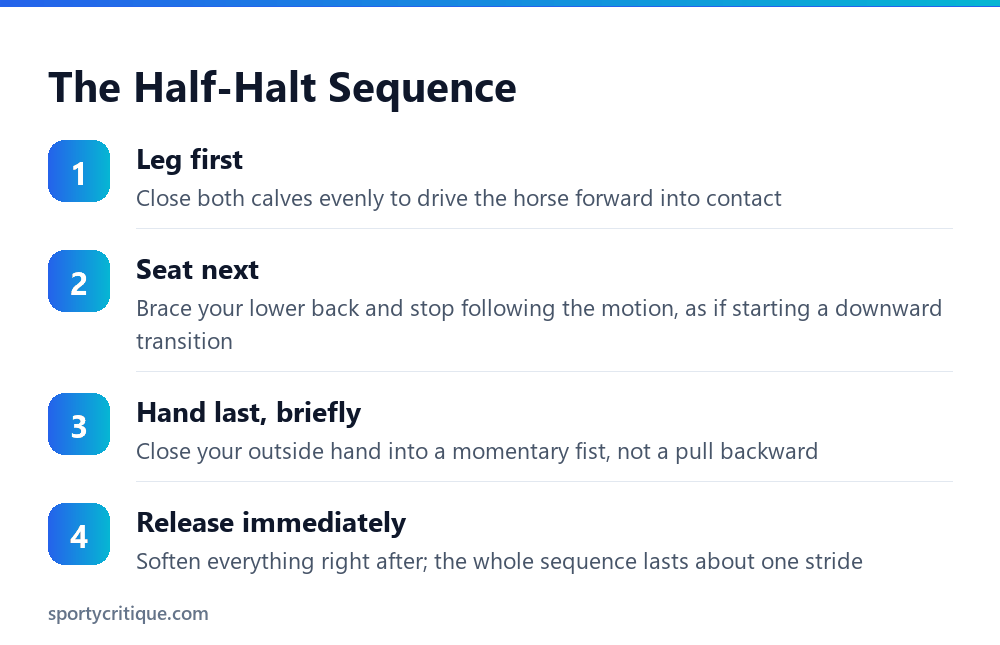
Leg first. Close both calves evenly against the horse’s sides to drive energy forward from the hindquarters into a steady, even contact. This is not a kick, it is sustained pressure that says keep coming forward, which matters because the half-halt only works if there is forward energy available to redirect. Skipping this step and going straight to the hand is the single most common error, and it turns the half-halt into a plain rein aid with none of the rebalancing effect.
Seat next. Brace your lower back and momentarily stop following the horse’s motion with your seat, similar to how your seat would feel at the start of a downward transition, without actually asking for one. This seat aid is what shifts the horse’s weight backward onto the hindquarters; it is subtle and it is genuinely a feel-based skill that takes time to develop, which is part of why the half-halt is hard to teach through verbal instruction alone.
Hand last, and briefly. Close your outside hand into a momentary fist, capturing the energy your leg just created and recycling it back toward the hind legs rather than letting it spill out the front. This is a closing of the fingers, not a pull backward on the rein. The whole sequence, leg, seat, hand, lasts roughly one stride before you release everything and return to a normal following seat and soft contact.
The release matters as much as the aid
A half-halt that never releases is not a half-halt, it is constant restriction, and a horse ridden with permanently braced hands and seat eventually stops responding to either because there is no contrast between the aid and its absence for the horse to react to. The release after roughly one stride is what makes the aid meaningful: it tells the horse the rebalancing request has been heard and answered, and it resets the aids so the next half-halt actually registers as a new request instead of more of the same constant pressure.
⚠️ Watch out: Pulling back on both reins simultaneously, rather than closing one hand briefly after the leg and seat have already engaged, is the most common half-halt mistake at every level. It produces a horse that either braces against the hand or drops behind the contact entirely, neither of which is the rebalancing effect a correct half-halt is meant to create.
Using a whip to reinforce, not replace, the leg aid
A light tap from a dressage whip just behind your leg, applied at the same moment as the leg aid rather than instead of it, can sharpen a sluggish response when the leg alone is not generating enough forward energy for the half-halt to have anything to recycle. The whip reinforces the leg, it does not substitute for it. If you find yourself reaching for the whip on every half-halt, that is usually a sign the horse needs more basic forward-response training before half-halts specifically are the thing to drill.
💡 Pro tip: Practice the sequence first at the walk, exaggerating each component slightly so you can feel the order clearly: leg, then seat, then hand. Once the timing feels natural at the walk, the same sequence compresses naturally into the shorter stride length at trot and canter without needing to consciously slow anything down.
When to use a half-halt
Why the half-halt feels different at each gait
At the walk, a half-halt is the easiest to feel and the easiest to overdo, since the slower stride gives you time to consciously run through leg, seat, and hand rather than coordinating them almost instantly. Riders often accidentally hold the aid too long at the walk simply because there is more time available to hold it, which is exactly the habit worth breaking before moving up to trot.
At the trot, the half-halt compresses into a much shorter window and starts to feel more like a single coordinated impulse than three separate steps. This is usually where riders first genuinely feel the difference between a correct half-halt and a rein check, since a poorly timed hand-first aid at rising trot disrupts the rhythm noticeably more than it does at walk.
At the canter, timing matters most of all, since the aid works best applied during a specific phase of the stride, generally as the horse’s outside hind leg is about to leave the ground, so the rebalancing lands exactly when that leg can step further underneath the body. This timing takes real mileage to develop by feel, and it is one of the clearer reasons half-halts are usually taught in a specific gait order, starting at the walk, rather than introduced cold at the canter.
Troubleshooting a half-halt that isn’t working
If the horse hollows or throws its head up in response, the hand is almost certainly arriving before the leg and seat have done their job, turning the aid into a pure rein check the horse is bracing against. Go back to walk and deliberately exaggerate the leg-then-seat sequence before the hand closes at all.
If nothing seems to happen, the horse is not in front of your leg to begin with, meaning there is no forward energy for the half-halt to redirect in the first place. A half-halt cannot rebalance energy that was never created; check basic forward responsiveness with transitions and a light whip reinforcement before troubleshooting the half-halt sequence itself.
If the horse slows down and stays flat rather than rebalancing, the aid is probably being held too long rather than released after roughly one stride, which turns a half-halt into a slow, constant drag rather than a brief rebalancing request the horse can clearly identify and respond to.
Common myths about the half-halt
Building the feel
- ✓Lead with the leg every time, even when the rebalancing feels like it should come from the hand
- ✓Practice the sequence slowly at the walk before expecting it to work at trot or canter
- ✓Release completely after about one stride so the next half-halt registers as a new request
- ✓Use a whip only to reinforce the leg aid, never as a substitute for it
- ✕Pulling back with both reins as the first move instead of the last
- ✕Holding the aid for several strides instead of releasing after about one
- ✕Expecting the timing to feel natural immediately; it is a feel-based skill that takes real repetition
- ✕Skipping the leg and seat components and calling a rein check a half-halt
Bottom line
A half-halt is leg, then seat, then a brief closed hand, released after about one stride, used to rebalance a horse’s weight and attention before whatever comes next. Get the order right, leg and seat before hand, and the release as deliberate as the aid itself, and the half-halt stops being a mysterious feel-based concept and becomes a tool you can reach for before every transition without having to think through each component separately.
What is a half-halt in horse riding, in simple terms?
A half-halt is a brief, coordinated aid, leg, then seat, then a momentary closed hand, that rebalances a horse’s weight onto its hindquarters for about one stride before releasing completely. It is not an actual halt; it recycles forward energy into better balance rather than slowing the horse down.
What order do the aids go in for a half-halt?
Leg first, to keep forward energy available. Seat next, bracing the lower back to shift weight backward. Hand last, a brief closing of the outside fingers rather than a pull. Leading with the hand instead of the leg is the most common mistake.
How long should a half-halt last?
Roughly one stride. A half-halt that is held for several strides stops being a half-halt and becomes constant restriction, which eventually causes the horse to stop responding to the aid because there is no contrast between the aid and its release.
Do I need a whip to perform a half-halt correctly?
No, a whip is optional and only useful for reinforcing a sluggish leg aid, applied at the same moment as the leg rather than instead of it. If a whip is needed on every half-halt, the horse usually needs more basic forward-response training first.
As an Amazon Associate, we earn from qualifying purchases through links on this page.