Best Shuffleboard Tables for Small Apartments and Condos

A 12-foot shuffleboard table looks great in a game-room photo, and it will not fit in most apartments. Here’s what actually does, and which real tables at that size are worth buying.
The best shuffleboard table for apartment or condo living is almost always a 9-foot model pushed against one wall, since that setup needs about 13 feet of total room length including player standing space, versus 16 to 18 feet for a full 12-foot table. Five real, currently stocked 9-foot tables are compared below, from $575 to $900, along with the actual room measurements that decide whether a table fits before you ever pull out a tape measure.
Most shuffleboard buying advice is written for a game room or a finished basement, where 20 feet of clear floor is a given. An apartment or a condo doesn’t work that way. You’ve got a living room that also has to fit a couch, a dining table that already eats half your square footage, and a landlord who is not going to be thrilled about a 12-foot slab of hardwood showing up in a third-floor unit with no elevator.
This guide skips the general “how to choose a shuffleboard table” advice and answers a narrower question: what actually fits, what actually plays well at that size, and which real tables on the market right now are worth the money once you’ve ruled out anything over 9 feet.
- →A 9-foot table is the real sweet spot for apartment and condo rooms; 12 and 14-foot tables need 16+ feet of clear room length
- →Pushing one long side of the table against a wall saves roughly 18 inches of floor space without shortening the playing surface
- →A 2-in-1 shuffleboard and bowling combo table is worth a look if you only have room for one game table
- →Poly-coated playfields cost less and need less upkeep than lacquered hardwood, which matters more in a space with regular foot traffic nearby
- →Measure your doorway and hallway width before buying; a one-piece 9-foot table runs close to 30 inches wide and needs a straight path in
Table of Contents
Why table length is the real decision here
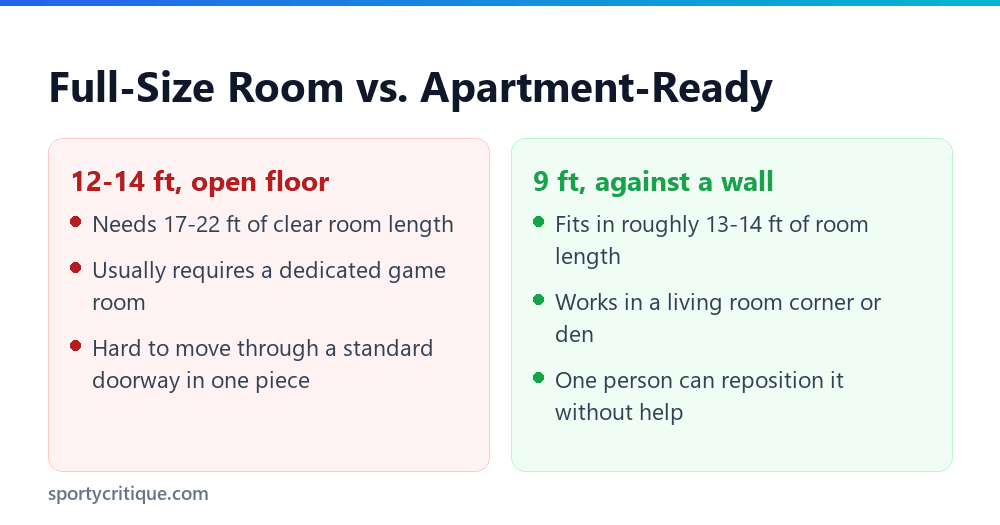
A shuffleboard table’s playing surface is only part of the space it needs. Add standing room for both players and anyone walking a puck back after a shot, and the real footprint runs 4 to 5 feet longer than the table itself on each end if the table sits in the open. That’s where a 14-foot tournament table turns into a 22-foot room requirement, which very few apartments have.
The fix that actually works: push one long side of the table flush against a wall. You lose nothing on playability since players stand at the ends, not the sides, and it takes roughly 18 inches of open floor out of the equation. Combined with a 9-foot table instead of a 12 or 14-foot one, that’s the difference between needing a dedicated game room and fitting the table into a living room corner.
Five real 9-foot tables worth buying, across price
Every table below is a genuine 9-foot model, currently listed and in stock, checked for live price and availability before publishing this guide. Prices move, so treat these as a snapshot rather than a promise.
For a straightforward budget pick, the Hathaway Avenger 9 Ft Shuffleboard Table covers the basics without extra bulk: a poly-coated playfield that doesn’t need periodic waxing as often as a lacquered wood surface, plus a built-in scorer so you’re not hunting for a separate scoreboard on a crowded shelf.
If floor space is tight enough that you’re only getting one game table, the VEVOR 9 Ft Shuffleboard and Bowling Combo is worth the extra cost over a single-purpose board. It plays as a standard 9-foot shuffleboard table and converts to a compact bowling setup, which matters more in a one-table apartment than it would in a basement with room for both games separately.
On the premium end, the Hathaway Daulton 9-Ft Shuffleboard Table and the GoSports Premium 9 Ft Shuffleboard Table both justify their price with padded sidewalls and a finish that reads more like real furniture than game-room equipment, which matters when the table is sitting in your living room instead of a basement nobody sees.
What actually matters when floor space is tight
- ✓Measure the full room, including standing clearance, before buying anything
- ✓Push one long side against a wall to reclaim roughly 18 inches of floor space
- ✓Check your hallway and doorway width; a one-piece 9-foot table is close to 30 inches wide
- ✓Budget for rewaxing every few months if the table sits near a kitchen or gets regular dust
- ✕Buy a 12-foot table because it’s on sale without measuring your actual room first
- ✕Assume a listing labeled “compact” is under 9 feet; check the actual spec, not the adjective
- ✕Use a generic silicone spray instead of dedicated shuffleboard wax; it gums up the surface over time
- ✕Ignore your building’s floor-load or noise rules if you’re on an upper floor with neighbors below
⚠️ Watch out: Apartments run drier or more humid than a house depending on HVAC setup, and a hardwood playfield reacts to both. If your unit runs a window AC that cycles hard in summer, keep the table away from direct airflow and out of a spot that gets full afternoon sun through a window, both of which speed up warping on a wood surface faster than in a climate-controlled basement.
Poly-coated vs. lacquered hardwood, and why it matters more here
A poly-coated MDF playfield, like the one on the budget pick above, costs less up front and shrugs off the occasional bumped drink or dust buildup that’s more common in a living space than a dedicated game room. Lacquered hardwood plays a little faster and looks better up close, but it needs more careful climate control and more frequent rewaxing to stay smooth, upkeep that’s easier to skip when the table doubles as a piece of living room furniture rather than something you visit in a finished basement.
💡 Pro tip: If you’re deciding between a 9-foot and a shorter 7-foot option purely to save space, go with the 9-foot table unless your room simply cannot fit the extra 2 feet. Puck control gets noticeably harder on anything shorter than 9 feet, since there’s less runway for weight and spin to settle before the puck reaches the scoring zones.
Getting it up the stairs, and moving it later
A one-piece 9-foot table is long, not particularly heavy for its size, but awkward enough that moving it alone is a bad idea. Plan on two people for the trip up a stairwell or into an elevator, and measure any tight turns in the hallway the same way you’d check a doorway for a couch. Most tables in this size ship in a single boxed unit rather than flat-packed panels, so there’s no assembly step to worry about beyond attaching and leveling the legs.
If you move apartments often, factor that into which table you buy. A poly-coated playfield in a simpler cabinet tolerates being tipped on its side or transported in a moving truck better than a lacquered wood finish, which can pick up scuffs or chips at the corners during a move. None of that means avoid wood finishes entirely, just budget a padded moving blanket if you know another move is coming within a year or two.
Setting one up without a dedicated game room
A 9-foot table against a wall works in a living room corner, along the long wall of a dining area, or at the end of a hallway-adjacent den, as long as there’s a straight approach on both ends for players to stand. If you’re on a floor above other units, put a thin rug or furniture pads under the legs; the legs themselves don’t make much noise, but a puck sliding the full length of the table does carry a low knock that’s worth softening for downstairs neighbors.
Once the table’s in place, keeping the playfield fast and even takes very little effort: a light dusting before each session and a fresh coat of the right speed wax every couple of months. Our full walkthrough on
covers the maintenance side in more detail than fits here.Bottom line
For an apartment or condo, stop shopping by table length alone and start with your actual room measurement plus standing clearance. A 9-foot table against a wall fits almost any living room that can already hold a couch and a coffee table, and the five options above cover that size from $575 to $900 depending on how much finish quality and extra features you want to pay for.
What size shuffleboard table fits in an apartment?
A 9-foot table is the realistic size for most apartments and condos. It needs about 13 to 14 feet of room length when pushed against a wall, which fits in a typical living room or den. A 12-foot or 14-foot table needs 17 feet or more and usually requires a dedicated room.
Do I need to bolt a shuffleboard table down, or can it sit freely?
Most home shuffleboard tables sit freely on leg levelers and don’t need to be bolted to the floor. Leveling the legs correctly matters more than anchoring; an unlevel table makes pucks curve toward one side regardless of how well you shoot.
Can a shuffleboard table go on carpet?
Yes, as long as the legs have adjustable levelers, which every table in this guide includes. Carpet can make leveling slightly trickier since the legs sink unevenly into thicker pile, so check the level with a bubble level after the first week and adjust if needed.
Is a poly-coated or wood table better for a humid apartment?
Poly-coated MDF handles humidity swings better than lacquered hardwood, since the coating seals the surface against moisture more consistently than lacquer alone. If your apartment runs humid without central AC, that’s a real reason to pick the poly-coated option over a premium wood finish.
Will a 9-foot shuffleboard table fit through a standard doorway?
Most one-piece 9-foot tables are around 28 to 30 inches wide, which clears a standard 32-inch doorway, but tight turns in a hallway or a narrow stairwell can still be a problem. Measure your actual path, not just the doorway itself, before buying.
Is a 9-foot table too short for real shuffleboard play?
No. Nine feet is a recognized home-table length, not a compromise size invented for small spaces. Regulation bar and tournament tables run longer, but a 9-foot table plays a full, legitimate game and is what most manufacturers sell as their standard home model.
As an Amazon Associate, we earn from qualifying purchases through links on this page.