Jump Cue vs Break Cue vs Playing Cue: Do You Need All Three?


The jump cue vs break cue vs playing cue question comes up for almost every player once they stop borrowing house cues and start building their own case. The honest answer: most recreational players get real value out of two of the three, and the third is optional depending on how often a specific shot actually comes up in your games.
A playing cue (your everyday cue for position and finesse) and a break cue (heavier, stiffer, built for maximum force on the opening shot) cover the vast majority of what recreational players need. A dedicated jump cue only pays off if you regularly face shots where the cue ball is snookered behind a blocking ball, which is a situational need rather than a constant one. A combined jump/break cue is a reasonable middle ground that covers both specialty roles in a single case slot, at some compromise to how well it does either job compared to a dedicated cue.
- →A playing cue and break cue cover most recreational players’ actual needs
- →A dedicated jump cue is situational: only worth it if you regularly face snookered position
- →Breaking with your playing cue risks warping the shaft or loosening the joint over time
- →A jump/break combo cue is a real compromise option, not a fully equal substitute for two dedicated cues
- →Weight and tip hardness, not price, are what actually separate these three cue types functionally
Table of Contents
Playing Cue: The One You Actually Use Most
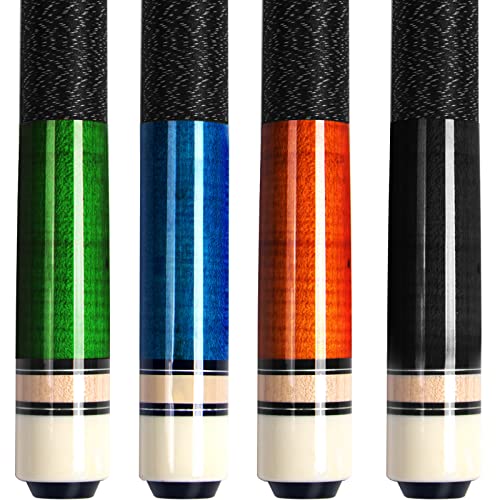
Your playing cue is the tool for everything that isn’t the break or a jump shot: position play, finesse, spin control, and finishing racks. It’s built for feel and feedback over raw force, typically a moderate weight (18-20oz is common) with a shaft flex and tip that give consistent, readable feedback on contact. If you only ever buy one cue, this is it, and everything else on this list is an addition to it, not a replacement for it.
The mistake worth avoiding here is using this same cue to break every rack. It works, plenty of casual players do exactly that for years without an issue, but the repeated high-force impact of breaking is exactly the kind of stress a playing cue’s joint and shaft aren’t optimized to absorb repeatedly. A loose joint or a shaft that’s lost some of its original straightness after months of hard breaks is a real, if slow-developing, cost.
Break Cue: Built for One Job
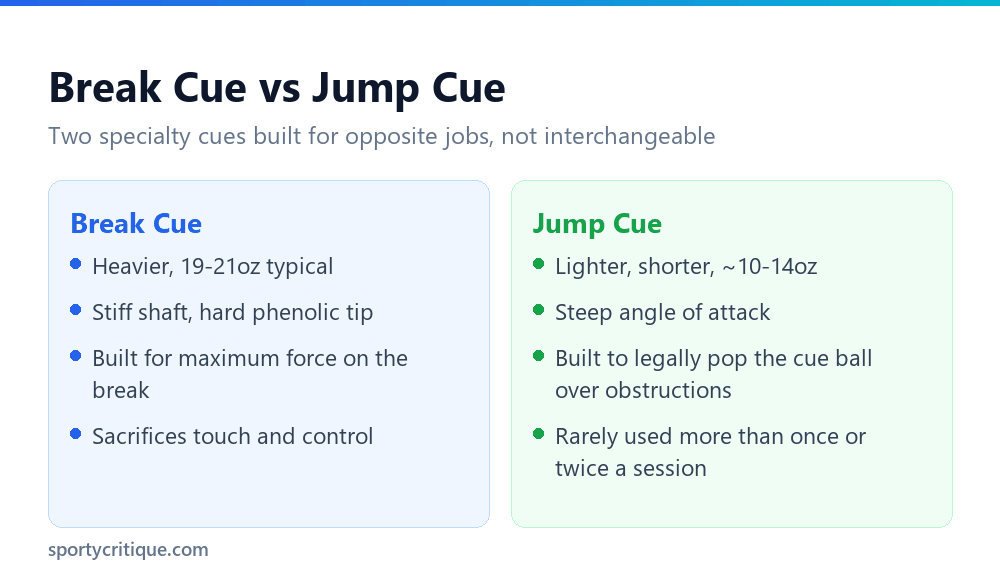
A break cue exists to transfer maximum force into the rack on the opening shot, and everything about its build reflects that single job. Most break cues run heavier than a playing cue, commonly 19-21oz, with a stiffer shaft and a harder tip, often phenolic rather than leather, since a hard tip transfers energy more efficiently than a soft one built for spin control. The tradeoff is real: a break cue sacrifices touch and control specifically because it isn’t meant to be used for anything after the opening shot.
⚠️ Watch out: Heavier isn’t automatically better on a break cue. Past a certain point, extra weight adds momentum you can’t fully control with a normal stroke, and plenty of players actually break harder and more consistently with a 19-20oz cue swung well than a 21oz-plus cue swung awkwardly because it’s too heavy for their natural stroke speed.
Jump Cue: The Specialist
A jump cue solves one specific problem: legally popping the cue ball up and over a ball that’s blocking your direct path to the object ball. It’s shorter and lighter than either a playing or break cue, typically in the 10-14oz range, which lets you generate the steep downward angle of attack and quick acceleration through the cue ball that makes a legal jump possible without excessive force.
How often this situation actually comes up depends heavily on how you play and who you play against. Casual players in relatively open games might go entire sessions without a genuine need to jump. Players in tighter, more tactical games, or against opponents who play good safeties specifically to snooker you, see the shot far more often. That’s the real test for whether a dedicated jump cue earns its case slot: how often does this specific shot actually come up in your games, not how often you’ve seen a pro use one on video.
💡 Pro tip: Before buying a dedicated jump cue, count how many times a genuine jump shot came up across your last several sessions. If the honest answer is rarely, a jump/break combo covers the occasional need without a separate purchase and case slot.
The Jump/Break Combo: A Real Middle Ground
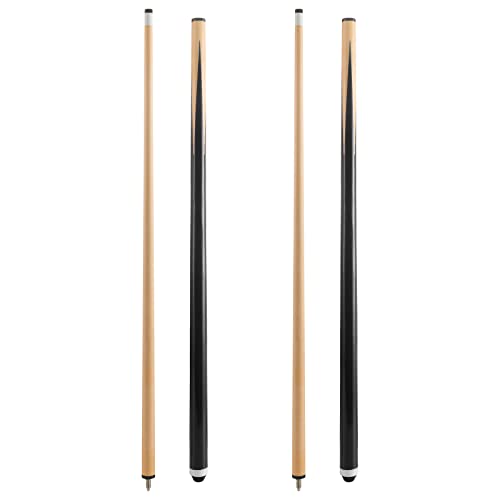
A combined jump/break cue, like the Billmart 25oz Heavy Hitter jump/break cue, uses a quick-release joint system to convert between a full-length break cue and a shorter jump cue configuration, covering both specialty roles from one case slot. It’s a genuine compromise: neither function performs quite as well as a cue purpose-built for just that one job, but for a recreational or intermediate player who needs both occasionally and doesn’t want to carry three separate cues, it’s the more practical answer than owning nothing but a playing cue and hoping for the best.
Where a combo cue starts to fall short is at a more competitive level, where players shooting for real money or ranking points want each cue optimized for exactly one job rather than splitting the difference. For most rec league and casual money-game players, that difference isn’t large enough to justify carrying and paying for three cues instead of two.
Shaft Stiffness and Tip Hardness, Explained
The functional difference between these cue types comes down to two specs more than anything else: shaft stiffness and tip hardness. A playing cue uses a shaft with enough flex to give you readable feedback on contact, paired with a leather tip soft enough to hold chalk well and grip the cue ball for spin. That combination is exactly what a break or jump cue doesn’t want, since flex and grip both bleed energy that a break shot needs transferred straight into the rack, and a jump shot needs concentrated into a short, sharp downward strike.
A break cue’s stiffer shaft and harder phenolic tip minimize energy loss on a full-force hit, at the direct cost of the touch and feedback a playing cue provides. A jump cue’s tip is usually also harder than a playing cue’s, though the bigger factor for jumping is the cue’s short length and light weight, which let you get a steep enough angle and quick enough acceleration to pop the ball legally without excessive force that could be ruled a foul.
Testing Before You Buy
If a pool hall or retailer has house break cues or jump cues available to try, use them before buying your own. Break cue weight preference in particular is personal enough that a spec sheet number doesn’t tell you much; swinging a 19oz and a 21oz break cue back to back for even ten minutes usually makes the right choice obvious in a way reading reviews doesn’t.
For a jump cue specifically, check that you can actually execute a clean, legal jump with it before committing to a purchase. Jump shot technique (elevating the butt, striking down and through) takes some practice regardless of the cue, and a cue that feels awkward in your hands on a test swing generally stays awkward after you own it.
Case and Storage Considerations
Adding a break or jump cue means thinking about case capacity, which is easy to overlook until you’re standing at checkout with a cue and nowhere to put it. A basic 2×2 case (two butts, two shafts) is enough for a playing cue plus one combo jump/break cue. Once you’re carrying three genuinely separate cues, a 3×5 or similar larger case stops being an upgrade and starts being a practical requirement, since jamming a third cue into a case built for two risks warping a shaft against the case’s internal padding.
📊 Note: If you’re only adding a break or jump cue occasionally rather than every session, a single-cue soft case that fits in a bag alongside your main case is often more practical than buying a larger multi-cue case you’ll mostly carry half-empty.
So, Do You Need All Three?
For most recreational players, the honest answer is two cues, not three: a playing cue for everything and a break cue (dedicated or combo) to protect it from repeated high-force impact. A dedicated standalone jump cue is worth adding once you can point to genuine, regular need for it, not because a case with three cues looks more serious at the pool hall. Reassess after a season of regular play; needs and habits shift as your game develops.
Buying Mistakes to Avoid
- ✓Buying a break cue before your playing cue shows signs of joint or shaft wear from breaking
- ✓Testing a jump cue’s weight and length against your actual stroke before buying
- ✓Considering a combo cue first if jump shots come up only occasionally in your games
- ✓Matching break cue weight to what your stroke can actually control, not just the heaviest option
- ✕Assuming you need all three cues on day one just because pros carry full cases
- ✕Buying the heaviest break cue available without testing whether you can control that weight
- ✕Using a hard-tipped break cue for regular position play, which hurts spin and touch
- ✕Skipping a break cue entirely and accepting shaft wear on your primary playing cue indefinitely
Common Myths
Can I use my regular playing cue to break every rack?
You can, and many casual players do without issue for years. The tradeoff is gradual: repeated high-force breaking is more likely to loosen the joint or affect the shaft’s straightness over time than the finesse shots a playing cue is otherwise built for.
Is a jump/break combo cue worth it compared to buying both separately?
For most recreational and intermediate players, yes. It covers both occasional jump shots and regular breaking from one case slot at a real but manageable compromise in performance versus two dedicated cues, which mainly matters at a more competitive level.
What weight should a break cue be?
Most break cues run 19-21oz, but the right weight is whatever you can control with a full, clean stroke. A cue too heavy to swing accurately often breaks worse than a moderately weighted cue swung well.
Do I really need a dedicated jump cue as a recreational player?
Only if genuine jump shots come up regularly in your games. If they’re rare, a jump/break combo cue or even standard playing-cue technique covers the occasional need without a separate purchase.
As an Amazon Associate, we earn from qualifying purchases through links on this page.