Best Pool Cue Extensions for Long Shots


A cue ball parked dead center with the object ball on the far rail is the one shot a standard cue can’t quite reach comfortably. Here are five real pool cue extensions, checked for current price and stock, so you can add the inches without wrecking your stroke.
For most players, a rear-weighted extension like the Balance Rite BRRR ($77.40) keeps your cue’s balance close to normal while adding reach. If you only need extra length once or twice a rack, a plain screw-on extender under $30, like the RiToEasysports 8-inch, does the job without the extra cost.
A center-table shot with the cue ball wedged against a rail is the moment every extension buys back. You either bridge with your hand flat on the felt and lose most of your stroke, reach for the house mechanical bridge and lose feel entirely, or you screw a few inches onto the butt of your own cue and keep shooting with the stroke you already know. That third option is what this guide is about.
Extensions are a small accessory category, and most of what’s sold under that name is a plastic or aluminum tube with a screw thread on one end. The differences that actually matter are length, added weight, and how securely the thing locks onto your cue without wobbling mid-stroke. Below are five real extensions, checked for current price and stock, spanning a $17 aluminum tube up to a $90 quick-release system.
- →A screw-on extension under $30 covers occasional long shots fine; it just shifts your balance point
- →Rear-weighted extensions cost more but keep the cue feeling close to normal because they add counterweight, not just length
- →Match extension length to how far you actually reach, not the longest option available; 2-4 inches solves most center-table shots
- →Test the fit before a match; a loose thread that wobbles mid-stroke is worse than no extension at all
- →Carbon fiber options add length with less added weight than aluminum, which matters if you already play a heavier cue
Table of Contents
What a cue extension is actually solving
A standard cue runs 57 to 58 inches. On a 9-foot table, that’s enough for almost every shot except when the cue ball sits dead center and the object ball you need is on the far rail. That specific geometry, cue ball in the middle third of the table with your shot line running the long way, is where your own arm and a normal bridge hand stop being enough. An extension adds 2 to 12 inches to the butt end, which moves your grip hand back far enough to close that gap without abandoning your stance.
It’s a narrow problem to solve, which is part of why the category stays cheap. You’re not buying shaft technology or tip performance here, you’re buying a length adapter that has to grip your cue’s joint or butt cap securely enough not to slip under the force of a real stroke.
When you actually need one
If you’re using the mechanical bridge on the table maybe once a rack, an extension isn’t solving a real problem for you yet. It earns its place in your case once you notice you’re reaching for the house bridge two or three times a session, or once you play on a table where the rail height or your own reach makes that stretch shot uncomfortable every single time. League and tournament players tend to carry one for exactly that reason: a bridge changes your stroke mechanics, and an extension doesn’t.
⚠️ Watch out: An extension changes your cue’s balance point every time you attach it. Practice with it before you need it in a match. A cue that suddenly feels back-heavy mid-game will throw off your stroke worse than the shot it was supposed to fix.
Screw-on versus rear-weighted: the real trade-off
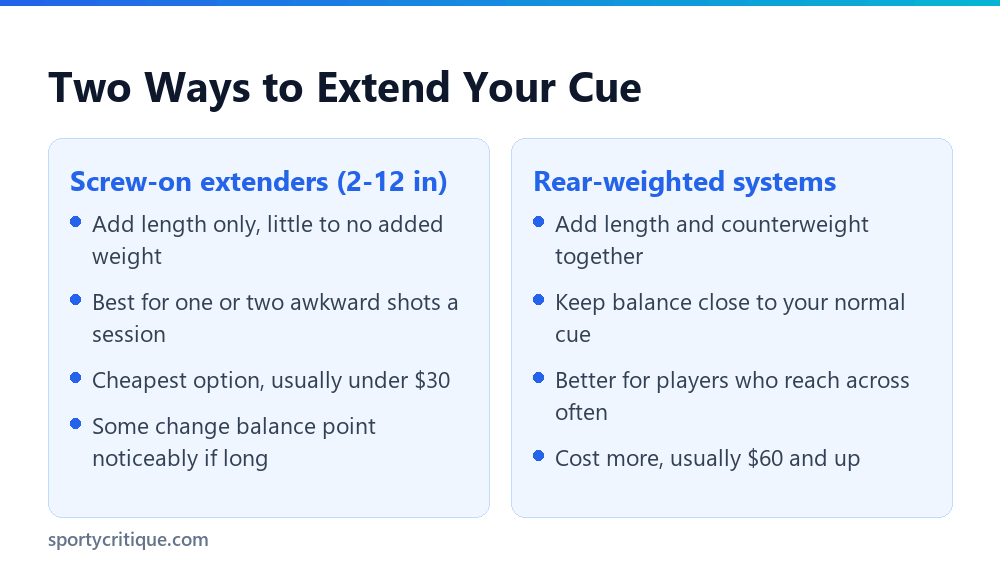
Cheap screw-on extenders, the aluminum or plastic tubes that thread onto your butt cap, do one thing: they add length. They don’t add meaningful weight, so a 6 or 8-inch extender on a 19-ounce cue can leave the back end feeling hollow and front-heavy, especially on a longer piece. That’s fine for a shot you’ll take once and unscrew immediately after. It’s less fine if you’re leaving it on for several shots in a row.
Rear-weighted systems, like the Balance Rite line, solve that by building actual mass into the extension itself, not just length. The cue still gets longer, but the balance point stays closer to where it normally sits, which is why players who reach across the table more than occasionally tend to spend the extra money on this style instead of the plain tube.
Five extensions worth considering
All five were checked for live price and stock status before this guide was published; prices move on Amazon regularly, so treat these as a starting point rather than a guarantee.
The 11.8-inch Aluminum Cue Extender is the cheapest real option here and it’s a fair one for someone who needs a fix a few times a year rather than a permanent piece of gear. At 11.8 inches it’s longer than most players actually need for a single shot, so expect to feel the weight shift more than you would with a shorter piece.
The RiToEasysports 8-inch Extension with Rubber Plug sits in the middle of the budget tier. Eight inches covers most center-table shots without going so long that the balance shift becomes unmanageable, and the rubber plug at the base gives you a grip surface instead of bare metal.
The Brilluxa 2-inch Carbon Fiber Butt Extender is the smallest change on this list, and that’s the point. Two inches is enough to close a borderline reach without meaningfully altering how the cue feels, and carbon fiber keeps the added weight lower than an aluminum tube of the same length would.
The Balance Rite BRRR Rear Weighted Extension is the pick if you’re buying one extension to actually solve the balance problem instead of just the length problem. It costs roughly four times the cheapest option on this list, but players who use it regularly describe the cue feeling like itself again almost immediately, which the plain screw-on tubes don’t manage.
The Viking Pool Cue Joint Extension tops this list at $90 and earns it with a quick-release joint that threads on and off in a couple of turns, no tools, without the wobble that cheaper threads can develop after repeated use. It’s aimed at players who’ll attach and remove it multiple times in a single match, not just once.
💡 Pro tip: If you only ever hit this shot once or twice a session, buy the cheapest option that fits your cue’s joint size correctly. The expensive rear-weighted systems earn their price through repeated use, not occasional use.
Matching length to your actual reach
Most players overestimate how much extra length they need. Stand at the table where your hardest realistic shot happens, cue ball dead center, and measure how far short your normal bridge falls. For the vast majority of adult players on a standard 9-foot table, that gap is 3 to 6 inches, not the 10 or 12 inches some extenders offer. Buying more length than you need just means a bigger balance shift for no real benefit.
If you’re shorter than average or play mostly on a bar-box 7-foot table, you may never need more than a 4-inch extension, if you need one at all. Measure before you buy rather than guessing from the product photos.
Fit and thread compatibility
Extensions generally thread onto a standard joint or screw into the removable weight bolt at the butt of the cue, and thread sizing isn’t fully universal across brands. Most listings state which joint styles they fit; if yours isn’t listed, message the seller before buying; a mismatched thread either won’t seat fully or will feel loose no matter how hard you tighten it.
📊 Note: Cues with a removable bumper at the very end of the butt are the easiest to extend, since most screw-on extenders are designed to replace that bumper directly.
Installing and using one without hurting your stroke
Screw it on fully, snug but not forced, before you get down on the shot, not after. Trying to thread an extension while you’re already bent over the table wastes time and usually ends with it under-tightened. Take one or two practice strokes off the table before committing to the shot; the extra length changes your pivot point slightly even on a good extension, and you want to feel that before the cue ball is moving.
Remove it as soon as the shot is done. Playing an entire rack with an extension attached, unless it’s a rear-weighted model built for exactly that, will make every other shot feel off, because you’ve changed your cue’s balance for the one situation that didn’t need it.
Who should skip an extension entirely
- ✓You play in a league or run tables regularly enough to hit this shot most sessions
- ✓You’ve tried the house mechanical bridge and consistently miss with it
- ✓You already know your reach gap is 3 inches or more on your usual table
- ✓You want a tool-free option you can attach and remove mid-match without breaking rhythm
- ✕You play casually and the house bridge already works fine for you
- ✕You’re not sure your cue’s joint or bumper is compatible; check before buying
- ✕You’d rather practice bridging technique than add another accessory to your case
- ✕Your reach gap is under 2 inches; a proper hand bridge usually still covers that
Care and storage
Keep the threads clean and free of chalk dust, which is the most common cause of an extension that suddenly feels gritty or won’t seat fully after a few months of use. A soft cloth wipe after each session is enough; avoid oiling metal threads, since that attracts more dust than it prevents. Store it in your case’s accessory pocket rather than loose, both to keep it from scratching your shaft and so you actually have it on hand when the shot comes up.
Bottom line
If center-table shots come up occasionally, a $17 to $30 screw-on extension solves the problem for less than the cost of a rack of balls. If you’re reaching across the table often enough to notice your stroke changing with a plain extender, the $77 to $90 rear-weighted or quick-release options are worth the jump because they keep your cue feeling like your cue, not just longer.
See also: Best Cheap Pool Cues Under $40 for the cue itself, or How to Hold and Bridge a Pool Cue Properly if you want to fix your bridge technique before buying more gear.
Do pool cue extensions actually work?
Yes, for the specific problem they solve. They add 2 to 12 inches of reach so you can keep your normal grip and stroke on a center-table shot instead of switching to a hand bridge or the house mechanical bridge. They don’t improve accuracy on their own; they just remove the need to change your mechanics for that one shot.
Will an extension throw off my normal shots?
Only if you leave it on. A screw-on extension shifts your cue’s balance point noticeably, so it should go on for the long shot and come off immediately after, unless you’re using a rear-weighted model designed to keep balance close to normal throughout a session.
What length extension do most players actually need?
3 to 6 inches covers the majority of center-table shots on a standard 9-foot table. Measure your own reach gap at your usual table before buying; the longest option isn’t automatically the most useful one.
Are expensive rear-weighted extensions worth it over a cheap screw-on tube?
If you use an extension only occasionally, no; a $17 to $30 screw-on tube does the job. If you reach across the table often enough to notice, the $77 to $90 rear-weighted options keep the cue’s balance closer to normal and are worth the extra cost.
As an Amazon Associate, we earn from qualifying purchases through links on this page.