How to Store a Pool Cue to Prevent Warping


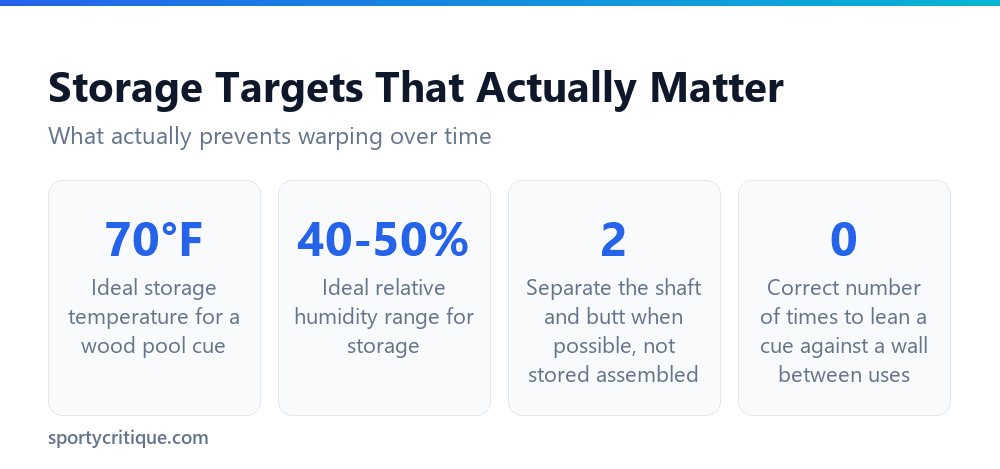
To store a pool cue and prevent warping, keep it in a climate-controlled space around 70 degrees Fahrenheit and 40 to 50 percent relative humidity, separate the shaft and butt if the case allows it rather than storing the cue assembled, wipe down both joint surfaces before putting it away, and store the case upright rather than lying flat or leaning against a wall. Avoid a hot car trunk, a damp basement corner, or anywhere near a heater, AC unit, or window with direct sun exposure.
Warping isn’t usually a single dramatic event; it’s the cumulative result of repeated exposure to heat, humidity swings, or sustained side pressure, most commonly from a cue left leaning against a wall between sessions. By the time a warp is visible, months or years of small, repeated exposures have usually already done the damage, which is exactly why storage habits matter more than any single dramatic incident most players worry about.
- →Target roughly 70 degrees Fahrenheit and 40 to 50 percent relative humidity for storage
- →Separate a two-piece cue’s shaft and butt for storage when the case allows it
- →Never leave a cue leaning against a wall or in a hot car; both cause slow, cumulative warping
- →The popular rolling test for checking straightness is unreliable; sighting down the cue is the real method
- →Wipe both joint surfaces before storing, and avoid lubricants unless the manufacturer specifically recommends one
Table of Contents
Temperature and Humidity: The Real Targets
Wood responds to both temperature and humidity, expanding and contracting in ways that, over repeated cycles, can produce a permanent warp. Roughly 70 degrees Fahrenheit and 40 to 50 percent relative humidity is the commonly cited target range that keeps a wood cue stable, the same general range that shows up in guidance for other wood game equipment like shuffleboard tables.
High moisture causes wood to swell, sometimes unevenly if one side of the cue is exposed to more humidity than another, while dry air causes shrinking and can introduce twisting stress. A cue that repeatedly cycles between these extremes, humid summer storage followed by dry winter heating, for example, accumulates stress over multiple seasons even if no single exposure looks dramatic enough to cause immediate, visible warping.
💡 Pro tip: A small hygrometer, something like the ThermoPro TP50 Digital Hygrometer ($12.99), gives a real number to check a storage space against instead of guessing by feel. This matters most for a garage, basement, or closet used specifically for cue storage, where conditions can drift well outside the ideal range without anyone noticing until a problem shows up.
Where Not to Store a Cue
A hot car trunk is one of the most common, entirely avoidable causes of cue damage, since trunk temperatures on a warm day can climb far beyond anything a wood cue should tolerate regularly. A damp basement corner, a spot near a heater or AC unit, and anywhere near a window with direct sun exposure all present the same underlying risk: extreme or fluctuating conditions the cue has to absorb every time it sits there.
⚠️ Watch out: Leaning a cue against a wall, even for what feels like a short period between games, is one of the two most frequent causes of warping, since it puts sustained, uneven pressure along one side of the cue. A rack or a case, not a wall corner, should be the default resting spot any time the cue isn’t actively in use.
Separating Shaft and Butt for Storage
Storing a two-piece cue broken down into its shaft and butt, rather than assembled, removes stress at the joint that can build up if a case puts any pressure on an assembled cue over time. Most quality cue cases are specifically designed with separate compartments for a disassembled cue for exactly this reason, not simply to save space.
Wipe both the male and female parts of the joint with a soft, dry cloth before storing, removing dust and any residue that’s accumulated during play. Avoid applying lubricant to the joint unless the specific cue’s manufacturer recommends one; an unnecessary or incorrect lubricant can attract more dust and grit than it prevents, working against the goal rather than helping it.
Case Selection and Orientation
A hard case protects against impact and pressure meaningfully better than a soft case, which matters most for a cue that travels or gets stored somewhere with any real risk of being bumped, sat on, or leaned against. For a cue that stays entirely at home in a controlled space, a soft case or a rack is a reasonable, lower-cost option, since the impact-protection benefit of a hard case matters less in a stable, controlled environment.
Storing a case upright rather than lying flat, and definitely not leaning against a wall the same way a bare cue shouldn’t, avoids introducing the same kind of sustained pressure a case is otherwise meant to prevent. An upright case in a closet or a dedicated stand keeps the cue supported evenly rather than resting under its own weight against one side.
Storage Do’s and Don’ts
- ✓Store in a climate-controlled space near 70°F and 40-50% humidity
- ✓Separate shaft and butt for storage when the case allows it
- ✓Wipe joint surfaces clean before storing, no lubricant unless specified
- ✓Store cases upright, not flat or leaning
- ✕Leaving a cue leaning against a wall between sessions
- ✕Storing a cue in a hot car trunk or a damp, uncontrolled basement
- ✕Storing an assembled two-piece cue in a case not designed for it
- ✕Applying lubricant to the joint without manufacturer guidance
Checking a Cue for Warping, the Right Way
Sighting down the cue is the more reliable method: hold it at eye level, looking down its length from the butt end toward the tip the way a shooter would sight down a rifle barrel, and slowly rotate the cue a full 360 degrees while watching for any visible curve or bend along its length. This method isn’t affected by table felt variation or the cue’s natural taper the way the rolling test is.
📊 Note: Checking straightness periodically, not just when a problem is already suspected, catches a developing warp early, while it’s still minor enough that adjusting storage habits can prevent it from getting worse, rather than discovering a significant warp only after it’s already affecting play.
Traveling With a Cue
A cue traveling in a vehicle should never sit loose on a seat or in a trunk where it can roll against other objects or absorb direct heat from a hot trunk surface. A hard case secured so it can’t shift during transit protects against both impact damage and the kind of heat exposure that a trunk in direct summer sun produces within a surprisingly short time.
Air travel introduces its own considerations: checked baggage handling is rough by design, and cargo holds experience temperature swings during flight that a cue sitting in a passenger cabin never would. A cue case built specifically for air travel, with reinforced protection beyond a standard soft case, is worth the investment for anyone who travels regularly with a cue they actually care about, tournament players and serious hobbyists most commonly.
💡 Pro tip: Never check a cue as loose, unprotected baggage, even briefly between connecting flights or during a quick trip. The combination of rough handling, temperature swings, and pressure changes in a cargo hold represents a worse combination of risk factors than almost any home storage scenario.
A Seasonal Storage Check
Building a habit of checking storage conditions and cue straightness at each seasonal transition, particularly moving into and out of heating season, catches problems at the exact point where humidity swings the most in a typical home. This is the same seasonal-transition logic that applies to shuffleboard table climatic adjusters and other wood game equipment sensitive to the same underlying environmental factors.
A quick seasonal routine, checking the storage space’s actual temperature and humidity, sighting the cue for straightness, and wiping down the joint if it’s been assembled for travel or repair recently, takes only a few minutes but catches developing problems long before they become a visible, difficult-to-reverse warp.
📊 Note: A cue that’s been stored correctly but still develops a slight, gradual curve over several years isn’t necessarily a sign of a storage mistake; some warping can happen slowly even with reasonable care, since wood is a natural material that changes over time regardless. The goal of good storage habits is minimizing that risk, not guaranteeing permanent, absolute straightness forever.
Storage in a Shared or High-Traffic Space
A cue kept in a shared game room, a bar, or any space with regular foot traffic faces additional risk beyond climate and leaning, namely accidental knocks, being handled by someone unfamiliar with proper care, or simply getting bumped while other activities happen nearby. A secured rack or a case that closes, rather than an open, easily disturbed resting spot, reduces this risk in a busier environment specifically.
For a household or venue with multiple cues and multiple users, labeling or otherwise identifying which cue belongs to which player also reduces the chance of a personal cue getting mishandled or stored incorrectly by someone else who doesn’t know its specific care history or any existing issues worth being careful about.
Frequently Asked Questions
What’s the single most common cause of a warped pool cue?
Leaning it against a wall between sessions and temperature extremes, most commonly a hot car trunk, are the two most frequently cited causes. Both involve sustained, uneven stress or heat exposure that a proper case or rack avoids.
Can a warped cue be fixed, or does it need to be replaced?
Minor warps can sometimes be corrected by a professional cuesmith using specialized straightening techniques, though success isn’t guaranteed and depends on the severity and cause of the warp. Prevention through proper storage remains far more reliable than counting on a fix after the fact.
Is the rolling test completely useless for checking straightness?
It’s not completely useless, but it’s unreliable enough that a cue passing the roll test isn’t a guarantee it’s actually straight, and a cue that wobbles on the roll test isn’t necessarily warped either. Sighting down the cue is the more dependable method.
Do carbon fiber shafts need the same storage care as wood?
Carbon fiber is generally less susceptible to humidity and temperature-driven warping than wood, which is part of its appeal, but it isn’t fully immune to damage from extreme heat or physical stress. Reasonable storage care still applies, even if the risk profile differs somewhat from a traditional wood shaft.
Is it safe to check a cue into checked airline baggage?
It’s risky and best avoided when possible. Rough handling combined with temperature and pressure changes in a cargo hold represents a worse combination of stressors than most home storage scenarios. A carry-on-friendly travel case is a safer option when air travel is unavoidable.
None of these habits demand special skill or much time. They demand consistency, applied the same way every time the cue goes back into storage, which is exactly what separates a cue that stays straight for decades from one that develops a slow, avoidable warp.
As an Amazon Associate, we earn from qualifying purchases through links on this page.