Best Pool Cue Racks and Wall Storage


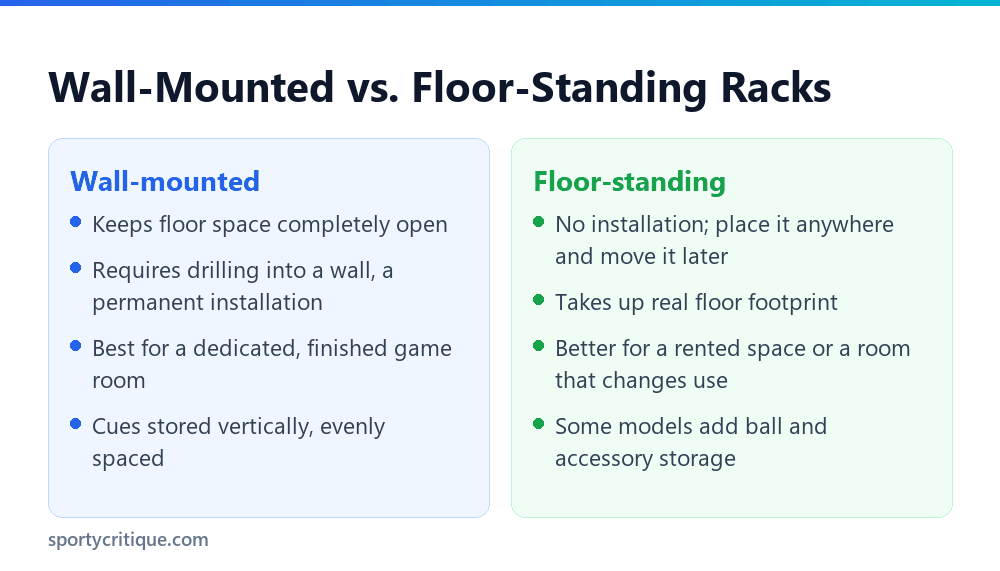
The best pool cue rack depends on whether the space is a permanent, dedicated game room or a multi-use room that needs flexibility. Wall-mounted racks keep the floor completely clear and look more finished but require drilling into a wall; floor-standing racks need no installation and can be repositioned or moved to a new home entirely, at the cost of taking up actual floor space. Four real racks, from a $9.99 basic wall mount to a $259 finished wood rack with integrated ball storage, are compared below.
Cues left leaning in a corner or propped against a wall between games aren’t just an eyesore; they’re actively more likely to develop a warp over time, since a cue leaning under its own weight against a hard surface bends slightly in whatever direction gravity and the contact point push it. A proper rack, wall-mounted or floor-standing, holds cues vertically and evenly supported, which matters more to a cue’s long-term straightness than most owners realize until a cue actually starts to warp.
- →Wall-mounted racks keep the floor clear but require drilling and permanent wall installation
- →Floor-standing racks need no installation and can be moved or repositioned freely
- →Storing cues upright and properly supported, rather than leaning in a corner, protects them from warping
- →Capacity ranges widely, from 6-cue basic racks to larger units with integrated ball storage
- →Material and finish quality track price closely; a $10 rack and a $260 rack serve very different rooms
Table of Contents
Why Proper Storage Actually Protects a Cue
A cue leaning against a wall or propped in a corner is under constant, uneven pressure at its point of contact, and wood shafts respond to that sustained pressure over weeks and months by developing a slight bend. It’s a slow enough process that most owners don’t notice until the cue is visibly warped and no longer rolls true on the table, well past the point where the problem could have been prevented cheaply.
A rack, wall-mounted or floor-standing, holds each cue vertically with even support along its length rather than a single contact point bearing all the weight. That’s the entire mechanical reason a $10 rack is worth owning even for someone who only has a single cue: it’s protecting an investment that costs considerably more than the rack itself in most cases.
Wall-Mounted vs. Floor-Standing: Which Fits Your Room
Wall-mounted racks make sense for a dedicated, finished game room where the wall space is already committed to that purpose and drilling in mounting hardware isn’t a concern. They keep the floor completely open, which matters in a smaller room where every square foot of walking space counts.
Floor-standing racks make more sense for a multi-use room, a rented space where drilling into walls isn’t an option, or simply for anyone who wants the flexibility to rearrange a room without needing to patch and redrill wall anchors. The trade-off is real floor footprint, which matters more in a tighter space than in a dedicated game room with room to spare.
4 Real Racks, Compared
Buying for the Cues You’ll Actually Own
A 6-cue rack covers most households, even ones with a couple of regular players and a spare cue or two for guests. Larger 8-to-10-cue racks make more sense for a household that hosts regular game nights, a serious collector, or anyone who already owns or plans to own multiple cues for different purposes, a playing cue, a break cue, a jump cue, kept separately.
💡 Pro tip: Buying slightly more capacity than currently needed is a reasonable hedge against future cue purchases, since replacing an undersized rack later costs more in total than buying the larger option once. This matters less at the budget end of the price range, where upgrading later is a minor expense either way.
Choosing the Right Rack
- ✓Choose wall-mounted for a dedicated, finished game room with floor space at a premium
- ✓Choose floor-standing for a rented space or a room used for multiple purposes
- ✓Buy slightly more capacity than currently needed if collecting cues over time
- ✓Store cues vertically and evenly supported, never leaning in a corner
- ✕Leaving cues propped in a corner between sessions
- ✕Drilling a wall-mounted rack into a rented space without checking the lease terms
- ✕Buying a rack sized exactly to current cue count with no room to grow
- ✕Assuming any rack protects a cue equally well regardless of build quality
Where to Place a Rack in the Room
Placement matters beyond just fitting the rack into available space. Direct sunlight through a window, proximity to a heating vent or radiator, and locations prone to humidity swings, a basement wall against an exterior foundation, for example, all accelerate wood movement in cues over time, the same underlying issue that affects shuffleboard tables and pool table slate beds in extreme conditions.
A rack positioned on an interior wall, away from direct sun and heating or cooling vents, keeps stored cues in a more climate-stable environment than one mounted on an exterior wall or near a window. This is a small consideration relative to choosing the rack itself, but it compounds over years of storage in a way that’s worth accounting for when deciding exactly where in a room to install or place a rack.
📊 Note: A rack near a frequently used doorway or high-traffic path risks cues getting bumped or knocked during normal room use, which defeats some of the protective purpose of the rack in the first place. A slightly less convenient but lower-traffic wall or corner is often the better long-term choice, even if it means the rack isn’t the very first thing a visitor sees on walking into the room.
Installing a Wall-Mounted Rack Correctly
Locating wall studs before mounting, rather than relying purely on drywall anchors, matters more for a rack loaded with several cues than it does for a lightweight picture frame. The combined weight of a full rack of cues is modest individually but adds up across 6 to 10 cues, and a rack that pulls loose from drywall anchors damages both the wall and every cue that falls with it.
Most wall-mounted racks include basic mounting hardware, but checking the stated weight rating against the actual number and type of cues intended for storage avoids overloading a rack rated for fewer or lighter cues than what ends up hung on it. This is a five-minute check before installation that prevents a much bigger problem after the fact.
Cleaning and Maintaining the Rack Itself
Wood racks benefit from the same basic dusting and occasional wood-safe cleaning as any other wood furniture in the room, since dust and grime accumulation isn’t just cosmetic; it can transfer onto cue shafts during insertion and removal over time. A simple dry or slightly damp cloth wipe-down periodically keeps this from becoming an issue.
EVA foam or rubber clip inserts, common on budget wall-mounted racks, can compress or wear over years of repeated use, loosening their grip on stored cues. Checking that cues sit snugly rather than loosely in their slots, and replacing a rack whose grip has genuinely degraded rather than continuing to use one that no longer holds cues securely, keeps the protective function intact rather than just assuming the rack still works as well as it did when new.
Material and Build Quality
Solid wood racks, like the mahogany and finished wood options above, generally hold up better over years of use and look more intentional as a permanent fixture in a finished room. Basic wire or plastic-clip racks, like the budget wall mount above, function perfectly well for protecting cues but won’t match a nicer table or room’s finish the same way a wood rack does.
For a purely functional need, protecting cues from warping, without concern for matching a room’s décor, the cheapest option that reliably holds cues upright and supported does the job just as well as a $259 finished rack. The price difference above the functional floor is almost entirely about appearance, finish quality, and added storage features like integrated ball compartments, not about how well the rack protects the cues themselves.
That said, a room built around a nicer table and matching cloth choice, the kind covered elsewhere in this site’s buying guides, generally benefits from a rack that matches that same level of finish. A $10 wire rack in an otherwise carefully furnished game room stands out for the wrong reasons, even though it protects the cues just as effectively as a nicer option would.
Frequently Asked Questions
Do I really need a cue rack, or is leaning fine for occasional use?
For truly occasional use, a few times a year, the risk is lower, but any cue stored leaning for extended periods between uses is at some risk of developing a slight warp. A rack removes that risk entirely for a relatively small cost.
Is a wall-mounted rack hard to install?
Most wall-mounted racks install with basic wall anchors or screws into studs, a straightforward job for anyone comfortable with basic home tools. Following the specific weight rating and mounting instructions for the chosen rack matters more than the installation being difficult.
Can a cue rack hold cues of different lengths or styles?
Most standard racks accommodate the typical range of cue lengths without issue, since cues don’t vary as dramatically in length as, say, golf clubs. Extra-long cues or unusually shaped cases are worth double-checking against a specific rack’s stated capacity before buying.
Should I buy a rack with built-in ball storage?
It’s a convenience feature worth considering if the room doesn’t already have a dedicated spot for balls, but it’s not essential. A separate ball case or the table’s own storage compartment, if it has one, works just as well functionally.
Do I need to find wall studs before installing a wall-mounted rack?
Yes, ideally. A rack loaded with several cues carries enough combined weight that anchoring into studs, rather than relying purely on drywall anchors, reduces the risk of the rack pulling loose over time.
How do I know if my rack’s grip has worn out?
If cues sit loosely rather than snugly in their slots, or slide out more easily than they did when the rack was new, the foam or rubber clip inserts have likely compressed or worn down. At that point the rack no longer provides the secure support it’s meant to.
A rack is a small, one-time purchase relative to the cues it protects, and the choice between wall-mounted and floor-standing matters more to the room than to the cues themselves, since either type does the actual protective job equally well once installed and used consistently, and neither one requires ongoing cost or effort beyond the occasional wipe-down described above.
Pick the type that fits the room, install it correctly, and use it consistently.
As an Amazon Associate, we earn from qualifying purchases through links on this page.