Cue Tip Hardness Explained: Soft vs Medium vs Hard

Cue tip hardness is a real tradeoff, not a simple ranking from worse to better. Here’s what soft, medium, and hard actually change, and which verified tips represent each grade.

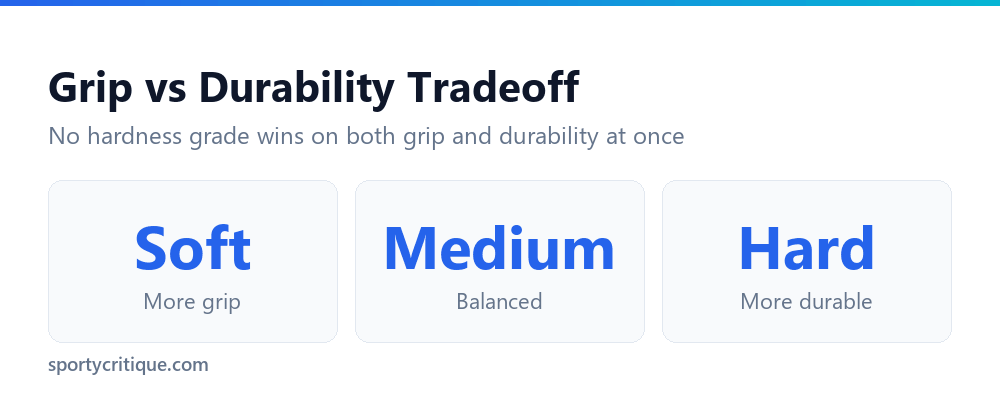
Cue tip hardness comes down to a straightforward tradeoff: soft tips grip the cue ball slightly better and hold spin a bit more forgivingly, but mushroom and lose their shape faster. Hard tips hold their shape and last far longer between reshaping sessions, but grip marginally less and transmit more feedback through the cue on off-center hits. Medium hardness splits the difference and is the reasonable default if you’re not sure which side of that tradeoff matters more for how you play.
Every cue tip listing mentions a hardness grade, but most don’t explain what it actually changes about how the tip plays, and buyers often default to whatever a listing calls “recommended” without understanding the tradeoff underneath it. This guide breaks hardness down as a buying decision: what changes physically between grades, which play style each one suits, and three verified tips representing different points on that scale.
- →Soft tips compress more on contact, grip the ball marginally better, but mushroom faster
- →Hard tips hold their shape and last longer between reshaping, but grip slightly less
- →Medium hardness is the common default recommendation if you’re not sure which tradeoff matters more to you
- →Hardness is a spectrum across brands, not a fixed standard, a ‘medium’ from one maker can play closer to another’s ‘soft’
- →Playing style matters more than skill level when choosing: finesse and spin favor softer, power and consistency favor harder
Table of Contents
What hardness actually changes physically
A tip’s hardness describes how much the leather compresses under the impact of the cue ball. A softer tip flattens slightly more at the moment of contact, which increases the surface area and duration of contact between tip and ball by a small but measurable amount. That extra contact translates into marginally more spin transfer and a softer feel through the cue, often described as more “feedback” or “feel” on the shot. A harder tip barely deforms at all, transmitting the hit more directly and predictably but with less of that compression window to work with on finesse or spin shots.
⚠️ Watch out: Hardness grading isn’t standardized across brands the way a physical measurement like millimeters is. A “medium” tip from one manufacturer can play noticeably closer to another brand’s “soft” or “hard” rating. Read player reviews for how a specific tip actually feels rather than assuming the label alone tells you everything.
Three verified tips across the hardness range
For soft, the Kamui Genuine Pool Cue Tip, Soft runs $21.75 and was in stock at the time of writing. Kamui’s soft line is a common pick for players who prioritize spin and finesse position play over raw durability, and the premium price reflects the laminated construction that partially offsets how fast softer tips normally wear.
For medium, the Triangle Med/Hard Pool Cue Tips, 13mm runs $4.84 and was in stock at the time of writing. Triangle tips are a budget-friendly, widely used option, and this medium-hard grade is a sensible default if you want to try the middle of the hardness range without spending much to find out whether it suits your game.
For hard, the Triangle Billiard Pool Cue Tips, 13mm (Hard) runs $4.89 and was also in stock at the time of writing. It’s the same brand and price point as the medium option above, making it an easy, low-cost way to directly compare hard against medium on your own cue without a large investment either way.
For a premium hard option, the Predator Victory Hard Cue Tip runs $28.99 and was in stock at the time of writing. Predator’s laminated construction at the hard end of the scale is aimed at players who want maximum shape retention and consistency shot to shot, particularly useful for a cue that sees heavy, frequent use where reshaping often is inconvenient.
Matching hardness to how you actually play
- ✓Choose softer if you rely on heavy english or finesse position play regularly
- ✓Choose harder if you break often or want minimal reshaping maintenance
- ✓Start with medium if you genuinely don’t know which tradeoff matters more to you yet
- ✓Try a cheap tip first (like the Triangle options) before committing to a premium laminated one
- ✕Assume the hardest tip is automatically the “most durable” choice for every play style, it’s a tradeoff, not a strict upgrade
- ✕Buy the softest available tip for a break cue, it will mushroom fast under break-shot force
- ✕Compare hardness labels across brands as if they were a standardized measurement
- ✕Ignore chalk and shape maintenance just because you picked a specific hardness grade
💡 Pro tip: If you’re not sure which hardness suits you, the cheap Triangle medium and hard tips above are a low-cost way to test both directly. At under five dollars each, trying both on the same cue over a few sessions tells you more about your actual preference than any amount of reading about the tradeoff in the abstract.
How hardness interacts with tip shape
Hardness and shape (the dime, nickel, or quarter radius profile) work together rather than independently. A softer tip in a rounder dime radius gives the most forgiving off-center contact for spin shots, since both factors favor grip over raw power transfer. A harder tip shaped to a flatter profile favors power and consistency on straight shots at the cost of tolerance for off-center hits. If you’re choosing hardness specifically because of an interest in applying more spin, pairing it with the right shape matters as much as the hardness grade itself, which our dedicated guide to tips for english covers in more depth.
📊 Note: If you’re seeing frequent miscues and aren’t sure whether hardness, shape, or simple wear is the cause, check your current tip’s condition before assuming a hardness change will fix it. Our tip diagnostic guide walks through how to tell the difference.
How long each hardness grade actually lasts
There’s no universal number since play frequency and stroke force vary enormously between players, but the relative pattern holds consistently: a soft tip under regular play typically needs reshaping noticeably more often than a hard tip on the same cue under the same use. This doesn’t mean hard tips never need attention, just that the interval between reshaping sessions tends to stretch longer as hardness increases. Factor this into cost comparisons too: a cheaper soft tip that needs replacing twice as often isn’t necessarily saving money over a pricier, longer-lasting hard tip.
Laminated versus single-piece construction, and how it interacts with hardness
Hardness grade and construction type are two separate specs that often get conflated. A single-piece tip is cut from one piece of leather, while a laminated tip stacks several thin layers under pressure. Lamination affects how evenly a tip wears and how consistently it holds its hardness across repeated impacts, independent of whether that hardness is graded soft, medium, or hard. A laminated soft tip, like Kamui’s, tends to hold its shape noticeably better than a single-piece soft tip of similar hardness, since the layered structure resists the uneven compression that causes mushrooming.
This is part of why a laminated tip costs more even within the same hardness grade as a cheaper single-piece alternative. You’re not just paying for a hardness rating, you’re paying for more consistent performance at that hardness over a longer period. For a budget test of where your hardness preference lands, single-piece tips like the Triangle options above are the more sensible starting point; once you know your preference, moving to a laminated tip at that same hardness is where the extra cost usually pays off.
A simple way to test your own preference without guessing
Buy a cheap tip at each end of the range you’re considering, install one, play several normal sessions, then swap to the other and do the same. Pay attention to two specific things rather than a vague overall impression: how often you’re reaching for chalk between shots, and whether your position play on soft cut shots feels noticeably different. A harder tip that needs chalking less often but leaves position shots feeling less controllable is telling you something concrete about where your preference actually sits, more reliably than reading hardness descriptions in the abstract ever will.
Keep notes on which tip was installed for which session if you’re testing this seriously, since the difference between grades is often subtle enough over a single session that it’s easy to misattribute a good or bad session to the tip when stroke consistency, table conditions, or simple variance actually explain most of it. A week or two on each hardness, not a single game, gives a fairer read.
Climate and storage effects on tip feel
Leather tips, regardless of hardness grade, respond somewhat to humidity. A tip stored or played in a humid environment tends to feel slightly softer and grips marginally better than the same tip in a dry environment, where it can feel harder and less forgiving than its rated hardness suggests. This is a minor effect compared to the actual hardness grade itself, but it’s worth knowing about if a tip that played well for you in one season starts feeling different in another, since the tip material itself hasn’t necessarily changed, the ambient conditions have.
Bottom line
Cue tip hardness is a real tradeoff between grip and durability, not a simple better-or-worse scale. Soft tips like Kamui’s suit spin-focused finesse play, hard tips like Predator’s Victory Hard suit power and low-maintenance durability, and Triangle’s cheap medium and hard options are a low-cost way to figure out where your own preference actually lands before spending more on a premium pick.
Is a harder or softer cue tip better overall?
Neither is universally better, it’s a tradeoff. Softer tips grip the cue ball slightly more and suit finesse or spin-heavy play; harder tips hold their shape longer and suit power play or players who don’t want to reshape often.
What hardness should a beginner start with?
Medium is a reasonable default for most beginners since it doesn’t lean hard into either tradeoff. Hardness relates more to play style than skill level, so there’s no strict rule that beginners need one grade over another.
Are hardness ratings the same across different tip brands?
No. Hardness grading isn’t standardized industry-wide, so a “medium” tip from one manufacturer can feel noticeably different from another brand’s “medium.” Reading reviews for how a specific tip actually plays is more reliable than comparing labels alone.
Does a harder tip mean fewer miscues?
Not directly. Miscues relate more to chalk coverage, tip shape, and how far off-center you’re striking than to hardness alone. A worn or poorly shaped hard tip can miscue just as easily as a soft one in good condition.
As an Amazon Associate, we earn from qualifying purchases through links on this page.