How to Take a Slap Shot in Hockey

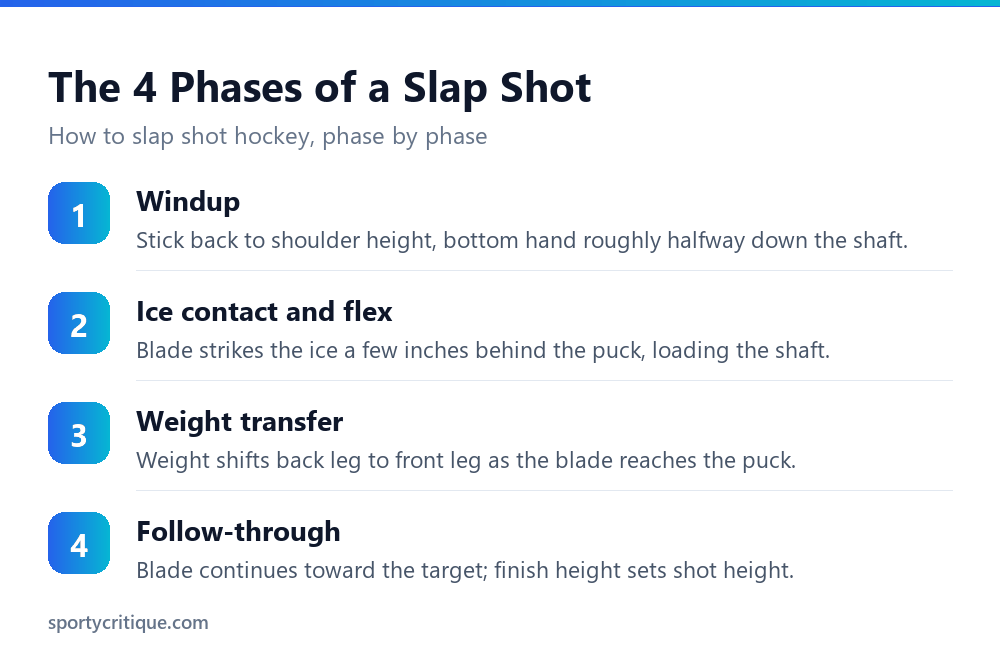
To slap shot hockey style, the short version: wind the stick back to shoulder height, then swing down so the blade strikes the ice a few inches behind the puck, not the puck itself. That ice contact loads the shaft with stored energy. As the blade reaches the puck a split second later, the flexed stick snaps back straight and releases that energy through the blade, while your weight shifts from your back leg to your front leg at the same moment. The stick does most of the work; your legs supply the power that loads it.
Most players learn the slap shot backward. They watch a pro wind up huge and swing as hard as possible, so they copy the big backswing and skip the part that actually generates the power: hitting the ice in the right spot behind the puck so the shaft flexes before it ever touches the puck itself. A slap shot with no flex loaded into it is just a wrist shot with worse accuracy and more places for the timing to go wrong.
The mechanics break into four connected phases: the windup, the ice contact and flex, the weight transfer, and the follow-through. Miss the timing on any one of them and the shot either loses power, sails high and wide, or both. None of the four require unusual strength to learn, but the sequencing has to be right before speed gets added.
- →Power comes from the stick’s flex, not raw arm strength; hitting the ice behind the puck loads that flex
- →Puck placement matters: line it up a few inches in front of your back foot, not centered under you
- →Weight shifts from your back leg to your front leg during the downswing, not before it
- →Your bottom hand should sit roughly halfway down the shaft for the windup, giving the stick room to flex
- →Follow-through direction controls shot height: finish low for a low shot, finish high for elevation
Table of Contents
The Windup: Building the Backswing
Bring the stick back to shoulder height or slightly above it, keeping your top hand near the butt end and your bottom hand about halfway down the shaft. A straight backswing, not an arced one, keeps the blade traveling in a predictable line on the way down, which matters more for accuracy than for power.
Your stance should be roughly shoulder-width, knees bent, weight starting on your back leg. Squaring your shoulders and hips toward the target before you start the windup makes the whole motion repeatable; players who open their stance mid-swing are usually the ones missing the net wide instead of just short on power.
Puck Placement and Where the Stick Should Hit the Ice
Set the puck a few inches ahead of your back foot, roughly in the middle of your stance, not centered between your feet and not out past your front foot. The blade needs to strike the ice a short distance behind that spot, generally a few inches to a foot depending on stick flex and swing speed, so the shaft has already started bending by the time the blade reaches the puck.
💡 Pro tip: Stick flex rating changes how far behind the puck you should aim. A stiffer stick, something like an 85-flex model such as the StringKing Composite Pro Senior (85 Flex) ($129.99), needs more ice contact and a harder downswing to load properly, while a lower-flex junior or intermediate stick loads with less effort. Buying a stick that’s stiffer than a player can actually flex is one of the more common reasons a slap shot feels weak despite a big swing.
This is the part that actually generates power, and it’s counterintuitive the first time it’s explained: the goal is not to hit the puck as hard as possible. The goal is to hit the ice at the right spot so the stick does the hitting a split second later. A shaft that flexes and releases correctly returns far more energy to the puck than an arm swinging at full speed with a straight, unloaded stick.
Weight Transfer: Where the Power Actually Comes From
As the blade contacts the ice and starts to flex, weight should already be shifting from the back leg to the front leg, with the knees bending deeper through the motion. This isn’t a separate step tacked onto the swing; it happens during the ice contact and flex, not before or after it. Players who transfer their weight too early end up swinging with their arms alone once the legs have already finished moving.
Core engagement matters too. Rotating the torso toward the target as weight shifts adds another source of power beyond the arms and legs, and it’s the piece most players skip because it’s the hardest to feel in the moment. A slap shot that uses legs, core, and stick flex together produces meaningfully more velocity than one that relies on arms alone, without requiring the shooter to swing any harder.
Follow-Through: Where It Determines Direction and Height
The follow-through should continue straight toward the target, with the blade pointing at where the shot is meant to go by the time the motion finishes. Height is controlled almost entirely by follow-through angle: finishing with the blade low keeps the shot along the ice, while finishing higher, with the toe of the blade rolling upward through contact, lifts the puck off the ice.
A follow-through that stops short, common among players still building shoulder and core strength, cuts off a meaningful amount of the energy the windup and flex just built. The stick should keep moving through the puck rather than stopping at it.
Common Slap Shot Mistakes
- ✓Hit the ice a consistent distance behind the puck every time
- ✓Keep the backswing straight, not arced out to the side
- ✓Let weight transfer happen during the downswing, not before it
- ✓Finish the follow-through pointed at the target
- ✕Swinging as hard as possible with a straight, unloaded stick
- ✕Hitting the puck first, then the ice (kills the flex load entirely)
- ✕Opening the stance mid-swing to generate more arm speed
- ✕Using a flex rating stiffer than actual strength can load
⚠️ Watch out: A slap shot with poor ice-contact timing is also one of the more common ways sticks break, since mishitting the ice hard and short of the puck puts uneven stress through the shaft. If a stick is snapping regularly on slap shots and not on wrist or snap shots, ice-contact timing is worth checking before assuming the equipment is defective.
Practicing the Motion Before Adding Speed
Slow the whole motion down before trying to shoot hard. Walking through the windup, ice contact, weight transfer, and follow-through at half speed, without a puck at first, builds the sequencing that full-speed practice tends to paper over. Once the order feels automatic, adding speed is mostly a matter of committing to the same motion with more force behind it, not changing the mechanics.
Off-ice practice on a synthetic shooting pad or in a driveway works for grooving the motion, since the flex and ice-contact principle is the same on any hard, slick surface. What doesn’t translate well off-ice is puck-speed feedback, so pairing dry-land reps with on-ice sessions catches timing issues that a driveway alone won’t reveal.
Slap Shot vs. Wrist Shot vs. Snap Shot: When to Use Each
The slap shot isn’t the shot most goals actually come from, and that’s worth knowing before spending a season drilling it exclusively. Wrist shots and snap shots release faster, because there’s no windup to telegraph, which is exactly why a goalie has less time to read them coming. A slap shot trades that quick release for raw velocity, and the long windup gives a goalie and any defender in a shooting lane plenty of warning.
That trade-off is why slap shots show up most from the point on a power play, off a clean faceoff win, or any situation with space and time to load the shot without immediate pressure. In open play, closer to the net, with a defender closing fast, a wrist or snap shot usually beats a slap shot on pure decision-making, even for a player who can shoot the puck harder off the slapper.
How Blade Curve and Lie Affect a Slap Shot
Blade curve changes how the puck releases off a slap shot more than most players expect. A deeper curve tends to launch the puck higher and adds more natural loft, which helps get low-to-mid shots up and over a sprawled goalie but can also cost accuracy on shots meant to stay low along the ice. A shallower, more open curve keeps shots flatter and is generally easier to control on a slap shot specifically, since the blade has less tendency to twist open or closed on contact.
Lie, the angle between the shaft and the blade, matters for whether the blade sits flat on the ice at the moment of contact. A lie that’s too low for a player’s height and stance tips the heel of the blade down; too high tips the toe down. Either way, an incorrect lie changes where on the blade the puck actually makes contact, which shows up as inconsistent shot direction more than as a power problem.
📊 Note: A stick that’s the right flex but the wrong lie for a player’s stance will still produce an inconsistent slap shot. If puck placement and ice-contact timing both look correct and the shot direction is still unpredictable, lie is worth checking before assuming it’s a swing fault.
Adjustments for Younger or Newer Players
Younger players and true beginners usually get more consistent results learning the slap shot on a shortened windup first, bringing the stick back to waist height instead of shoulder height. The full mechanics, ice contact behind the puck, weight transfer, and follow-through, stay identical; only the size of the backswing changes. A smaller windup is easier to control and still teaches the ice-contact timing that actually matters, without the extra variable of a big swing a newer player hasn’t built the coordination for yet.
USA Hockey and most youth development programs also generally hold off on introducing the full slap shot until a player has a solid wrist and snap shot, partly for safety around other players and partly because the flex-loading mechanic is easier to feel once a player already has a sense for how a stick transfers energy into the puck on a shorter shot.
Frequently Asked Questions
Why does my slap shot have no power?
The most common cause is hitting the puck directly instead of the ice a few inches behind it. Without that ice contact, the stick never flexes and loads, so the shot relies entirely on arm speed rather than stored energy released through the shaft. Check puck placement first before assuming it’s a strength issue.
How far behind the puck should the stick hit the ice?
Generally a few inches to about a foot, depending on stick flex and how hard the swing is. A stiffer stick and a harder swing need more ice-contact distance to load fully; a shorter distance works for a lower-flex stick or a slower, more controlled shot.
Do I need a stiffer stick for a harder slap shot?
Not necessarily. Flex should match the player’s actual strength: a stick too stiff to load properly produces a weaker shot than a correctly matched flex, even though it feels like it should be more powerful. Most adult recreational players do better on 75 to 85 flex than on anything stiffer.
Is the slap shot faster than the wrist shot?
At the top level, yes, slap shots typically clock faster than wrist shots because of the stored energy from stick flex. But wrist shots release faster and are harder for a goalie to read coming, which is why most goals in a real game come off wrist and snap shots rather than slap shots.
What’s the best age to start learning a slap shot?
There’s no single required age, but most youth programs introduce it after a player has a reliable wrist and snap shot, often somewhere in the 10-13 range depending on the player and the program. Starting with a shortened, waist-height windup makes the transition easier at any age, since the ice-contact timing is the same skill regardless of swing size.
As an Amazon Associate, we earn from qualifying purchases through links on this page.