How to Sit the Trot Without Bouncing

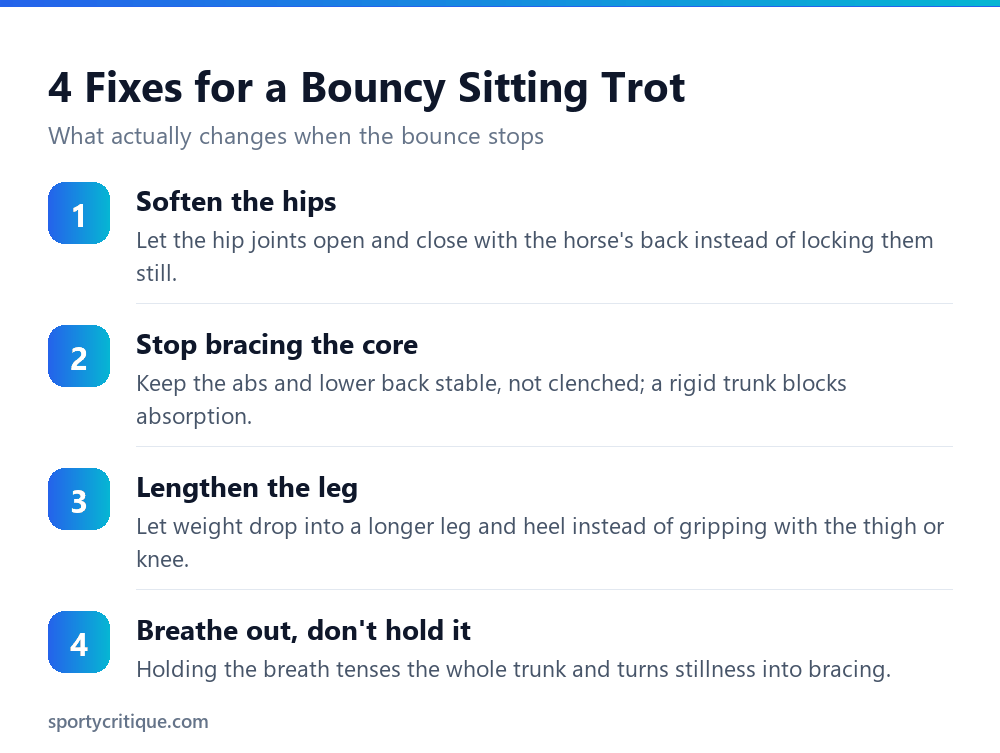
To sit the trot without bouncing, keep the hip joints soft and mobile so they open and close with the horse’s back on every stride, rather than locking the pelvis still. The core should stabilize the trunk without clenching, the leg should hang long instead of gripping with the knee or thigh, and the breath should stay steady, not held. Bouncing is almost always caused by tension somewhere in that chain, not by a lack of balance or an insufficiently strong core.
The instinct when a rider starts bouncing at the sitting trot is to grip harder and try to hold the body still. That instinct makes the bounce worse, not better. A locked joint anywhere in the body has to pass the horse’s motion somewhere else, and it usually ends up jarring through the lower back or launching the rider out of the saddle on every stride. A quiet seat at the sitting trot comes from absorbing the movement, not from resisting it.
This is also why raw core strength alone doesn’t fix a bouncy sitting trot, and why some strong, fit riders still bounce while some less conditioned riders sit smoothly. The missing piece is usually hip mobility and the willingness to let the pelvis move, combined with a core that stabilizes without bracing rigidly.
- →Bouncing is almost always caused by tension and locked joints, not weak balance or a weak core
- →Hip joints need to stay soft and mobile, opening and closing with the horse’s back on every stride
- →The core should stabilize the trunk without clenching; a braced core blocks shock absorption
- →Gripping with the knee or thigh raises the center of gravity and makes bouncing worse
- →A longline lesson with no stirrups and no reins is one of the fastest ways to build this feel
Table of Contents
Soften the Hip Joints First
The hips are the primary shock absorber at the sitting trot. Each stride, the horse’s back rises and falls under the seat, and the hip joints need to open and close to follow that motion without the rider’s upper body getting thrown along with it. A rider who locks the pelvis in one position is fighting the horse’s motion on every single stride, and the lower back usually ends up absorbing what the hips didn’t.
Tight hip flexors and tight adductors are common limiting factors here, independent of a rider’s fitness level or riding experience. Stretching and mobility work off the horse, not just riding more, is often what actually unlocks a sitting trot that’s been stuck for a season or longer.
Engage the Core Without Bracing It
Core engagement gets misunderstood as tightening the abs as hard as possible. That’s not the goal, and it actively works against sitting the trot smoothly. The core should act as a stable connection between the upper and lower body, secure enough that the torso doesn’t collapse or sway, while staying soft enough that the pelvis and hips can still move freely underneath it.
💡 Pro tip: A useful check: exhale fully while sitting the trot. If the exhale is hard to do, or the ribs feel locked in place, the trunk is probably braced rather than engaged. A soft, low breath that keeps moving through the stride is a better sign of correct core engagement than how tight the abs feel.
Holding the breath is one of the most common, least discussed causes of bouncing. It tenses the entire trunk at once, turning what looks like stillness into full-body bracing. Breathing out steadily, especially through the moments where bouncing usually starts, keeps the trunk engaged without locking it.
Let the Leg Lengthen Instead of Gripping
Many riders try to stay in the saddle by gripping with the knee, thigh, or lower leg and heel. That grip raises the center of gravity up and away from the horse’s back, which is the opposite of what actually keeps a rider seated through a bouncy stride. The leg should hang long and relaxed, with weight settling down through a stretched leg and into the heel, rather than clamping onto the horse’s sides.
A rider gripping with the lower leg often ends up asking the horse to speed up without meaning to, since leg pressure is also a forward aid. A faster, choppier trot then makes the bounce worse, which triggers more gripping. Breaking that cycle usually starts with deliberately relaxing the leg first, even if it feels less secure for a stride or two.
Common Sitting Trot Mistakes
- ✓Let the hips open and close with the horse’s back
- ✓Keep a soft, stable core, not a rigid one
- ✓Let the leg hang long, weight settling into the heel
- ✓Breathe out steadily through the stride
- ✕Locking the pelvis still and hoping to outmuscle the bounce
- ✕Bracing the abs as hard as possible
- ✕Gripping with the knee or thigh to stay on
- ✕Holding the breath through the bouncy strides
⚠️ Watch out: Forcing a full session of sitting trot when the bounce isn’t improving usually reinforces the tension pattern rather than fixing it. Mixing sitting trot with rising trot, and stopping to reset before fatigue sets in, keeps practice productive instead of just repeating the same brace over and over.
Unmounted Exercises That Carry Over
Hip mobility work off the horse, things like hip circles, deep squats held for time, and seated pelvic tilts, directly targets the joint stiffness that shows up as bouncing in the saddle. None of it requires equestrian-specific equipment; general mobility and core-stability work used by riders of other sports carries over the same way.
A stability ball is one of the more direct at-home tools, since sitting on one and rolling the pelvis in circles or figure-eights mimics the hip motion needed at the sitting trot without a horse involved at all. Ten minutes of that a few times a week builds the same hip independence that a longline lesson builds on horseback, and the two forms of practice reinforce each other.
📊 Note: Clothing that lets a rider feel the saddle clearly also matters more than it gets credit for. Full-seat grip tights, something like the Harrison Howard Full Seat Silicone Grip Riding Tights ($30.99), reduce the tendency to grip with the leg to stay put, since the seat itself holds better contact. That’s not a substitute for the mobility and breathing work above, but it removes one reason riders default to gripping in the first place.
Upper Body Alignment Affects the Bounce Too
A rider’s alignment from ear to shoulder to hip to heel changes how much work the hips have to do. Leaning forward from the waist, a common habit when a rider is anxious about bouncing, shifts weight onto the horse’s shoulders and makes the seat less stable, not more. An upper body that stays tall and centered over a soft, following seat gives the hips room to absorb the motion without the rider also fighting to stay balanced.
Shoulders rounding forward or collapsing to one side has a similar effect, usually because the rider is unconsciously bracing against an anticipated bounce before it even happens. That anticipation itself often causes the very tension that produces the bounce, which is part of why sitting trot improves faster with confidence and repetition than with willpower alone.
Sitting Trot vs. Rising Trot: What Changes
Rising trot lets a rider rise out of the saddle for every other stride, using the stirrups and legs to manage the horse’s motion instead of absorbing it through the seat. Sitting trot asks the body to stay in continuous contact and absorb every single stride through the hips, core, and breath instead. Neither is inherently more advanced; they’re different skills used for different purposes, and most riding programs teach both from early on.
Why a Longline Lesson Works Faster Than Riding Alone
A lesson on the longe line, with no stirrups and no reins, removes the two things riders lean on most to fake a secure seat: gripping the reins for balance and bracing against the stirrups. With both removed, the only way to stay balanced through the sitting trot is to let the hips and core do the job they’re actually supposed to do, which is exactly the feel most riders are trying to find.
It also lets a rider focus entirely on their own body without managing steering, speed, or direction at the same time. Even a handful of longline sessions tend to produce a faster improvement in sitting trot quality than months of trying to fix it while also riding a full lesson pattern.
A trained instructor watching from the ground also catches things a rider can’t feel alone, like a hip that’s locked on one side but not the other, or a shoulder that’s collapsing without the rider noticing. Sitting trot problems are frequently asymmetrical rather than uniform tension through the whole body, and that kind of one-sided pattern is genuinely hard to self-diagnose from the saddle.
None of this happens instantly, and that’s worth setting expectations around before getting frustrated with slow progress. Hip mobility built over years of sitting at a desk or driving doesn’t reverse in a single lesson, and the habit of bracing against a perceived loss of balance is deeply ingrained for most adult riders in particular. Consistent, short sessions focused specifically on softness tend to beat occasional long sessions focused on endurance.
Frequently Asked Questions
Why do I bounce at the sitting trot even though I ride regularly?
Regular riding builds general fitness and balance, but it doesn’t automatically build hip mobility or teach a rider to stop bracing the core. Bouncing often persists in experienced riders specifically because the tension pattern gets reinforced through repetition rather than corrected.
Is it normal to bounce when first learning the sitting trot?
Yes. Nearly every rider bounces when first learning it, since the instinct to grip and brace is strong and takes deliberate unlearning. It’s a normal part of the learning curve, not a sign of poor balance or an unsuitable horse.
Does the horse’s gait affect how hard it is to sit the trot?
Significantly. A horse with a bigger, more suspended trot is objectively harder to sit than one with a shorter, quicker stride, especially for a less experienced rider. Practicing on a horse with a smoother, more compact trot first, then progressing to bigger movers, is a reasonable way to build the skill.
How long does it take to stop bouncing at the sitting trot?
It varies widely by rider, but consistent hip mobility work combined with regular longline practice tends to produce a noticeable improvement within a few weeks to a couple of months. Riders who only address one piece, core strength alone, for example, tend to plateau sooner.
Can a saddle cause bouncing even with correct technique?
Yes. A saddle that doesn’t fit the horse or the rider changes the angle and depth of the seat, which can make even a technically correct rider feel unstable. If bouncing shows up suddenly on a horse the rider previously sat well, saddle fit is worth checking before assuming the technique has regressed.
As an Amazon Associate, we earn from qualifying purchases through links on this page.