How to Split Dodge Past a Defender

A split dodge only works if the defender is actually squared up, and it only stays clean if the hand switch happens tight to your body instead of out where a check is waiting. Here’s the exact footwork, the timing, and the mistakes that turn this move into a turnover.
A split dodge beats a defender who is squared up and not overplaying either side. Attack one shoulder to make them commit their weight, then switch your stick to the opposite hand close to your torso and accelerate through the gap their hips just opened. It lives or dies on the hand switch happening tight to the body, not out to the side where a check can strip it.
The split dodge is the first real dodge most lacrosse players learn because it works against the most common defensive posture: a defender squared up, weight even, not forcing you left or right. If your defender is already overplaying a side or shading you toward the sideline, a different dodge fits better. This one is specifically for the defender who hasn’t committed yet.
- →Works best against a squared-up defender, not one already overplaying a side
- →The hand switch happens close to the torso; letting the stick drift outward is the most common way to get checked
- →A short stutter step and a hard jab step load the direction change before the actual crossover
- →Against a long pole, bring the stick over the top or underneath instead of across the face
- →The dodge fails if you decelerate through the switch; the whole point is to gain ground, not just change hands
Table of Contents
What the split dodge actually beats
Every dodge in lacrosse is answering a specific defensive shape. The split dodge answers a defender who is balanced, both feet roughly even, stick in a neutral position, not yet leaning one way. That balance is exactly what you’re attacking. You threaten one shoulder hard enough that the defender’s hips open to cover it, and the moment those hips turn, the other side is open. The dodge is really a weight-shift read more than a footwork trick.
This is also why the split dodge stops working the instant a defender learns to sit back and wait. Attackers who rely on it exclusively become predictable, and a patient defender will let the fake die instead of committing. Mixing in a face dodge or a hesitation move keeps the split dodge live as a real threat instead of a tell.
The footwork, in order
Start in your non-shooting hand. That sounds backwards until you remember the whole move ends with a hand switch, so you want to finish in your shooting hand, not start there. From an athletic stance, a couple of short stutter steps keep your weight centered and your feet under you rather than stretched into a long stride you can’t redirect out of.
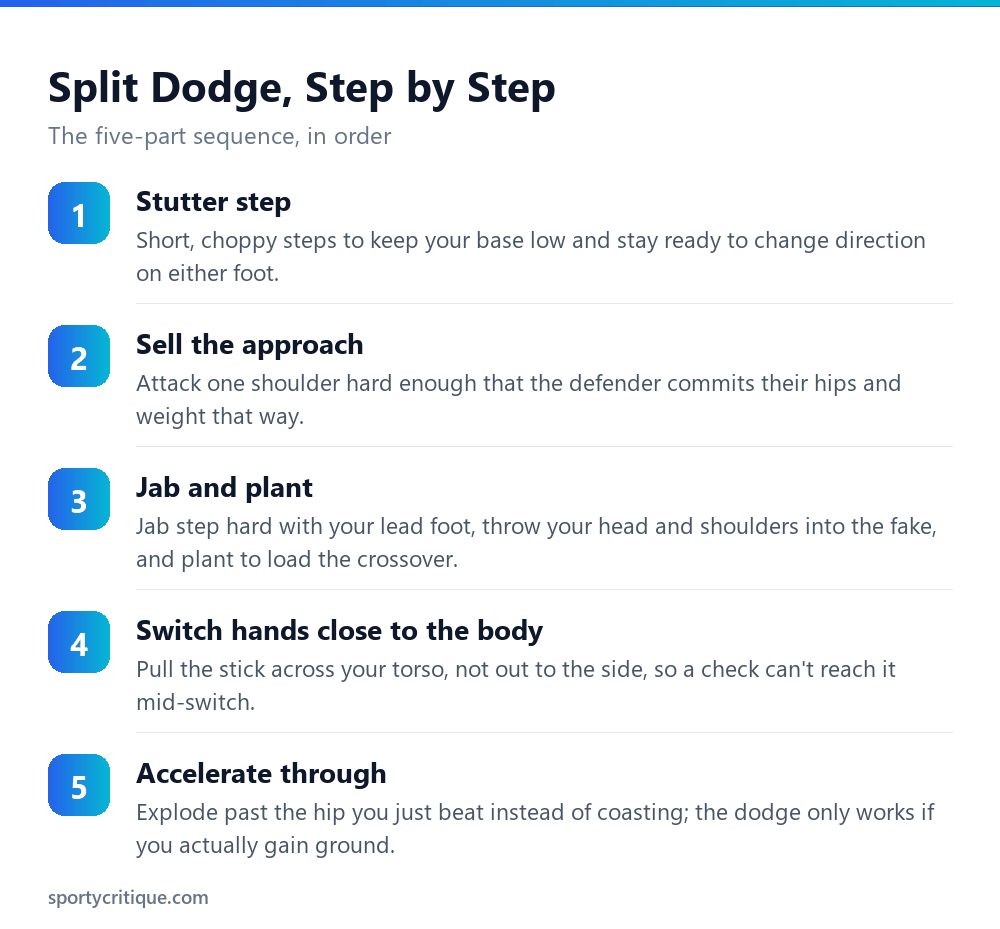
The jab step is what actually sells the fake. Plant your lead foot hard toward the shoulder you’re threatening and let your head and shoulders lean into it, not just your feet. A jab step that’s only in the feet reads as hesitant to an experienced defender; the upper body has to commit too, even though you’re about to reverse out of it.
⚠️ Watch out: The single most common technical flaw in a split dodge is letting the stick drift away from the torso during the hand switch. If the stick head moves out to the side as you cross it over, it sits in exactly the spot a defender’s check is already traveling toward. Keep the stick parallel to your body and close through the entire switch, not just at the start and end of it.
The hand switch and protecting the ball
Use your body as a shield during the switch, not your stick. As you cross the stick from one hand to the other, your torso should be between the ball and the defender for a half-second, which is exactly the window a check is looking to exploit if it’s open. Turning your back hip slightly toward the defender during the switch, rather than staying fully square, buys you that shield without slowing the move down.
Grip matters more here than most players expect. A pair like the STX Stallion 75 Lacrosse Gloves with a snug, low-bulk palm makes it easier to feel exactly where the stick is during a fast hand switch, which is the moment most turnovers on this move actually happen: not from getting checked, but from losing feel for the shaft mid-switch and fumbling the catch in the new hand.
Adjusting for the defender in front of you
- ✓Bring the stick across close to your face and chest against a short-stick defender
- ✓Go over the top or underneath the pole against a long-stick defender
- ✓Sell the fake with your shoulders and head, not just your feet
- ✓Accelerate through the gap immediately after the switch
- ✕Let the stick swing wide during the switch, where a check can reach it
- ✕Use this dodge against a defender who is already overplaying one side
- ✕Decelerate right after switching hands; that’s when the defender recovers
- ✕Rely on this as your only dodge; predictable attackers get shut down
Against a short-stick defenseman, the pole isn’t in your way, so you can pull the stick across quickly and tight. A longpole is a different problem: the head of that stick is often right out in front of you at the exact height your switch would normally travel through, so bringing the stick over the top or underneath instead of straight across avoids running your switch directly into it.
Common mistakes that turn this into a turnover
Timing it to the shot clock and the slide
Where you try a split dodge in a possession matters almost as much as how you execute it. Early in a possession, with help defense set and a slide already loaded, beating your man just hands the ball to a second defender who’s been waiting. The split dodge does the most damage after the offense has already moved the ball enough that the slide package is stretched thin, or against a defender isolated on an island with no quick help behind him.
Watch the crease defender’s feet, not just your own matchup. If he’s flat-footed and square to the ball before you even start your approach, a slide is coming the instant you beat your man, and you’ll want a pass ready off the dodge rather than committing to a shot. If he’s shaded away or occupied by an off-ball cutter, the lane you create with the split dodge is more likely to stay open long enough to finish.
Building it into a real possession, not just an isolated move
Practiced in isolation, the split dodge looks like a two-second move. In a live possession it’s usually the third or fourth thing that happens, after a pass, a cut, and a re-read of the defense. That sequencing changes the tempo you should carry into the dodge. Coming off a catch where you’re already moving downhill, the stutter step can be shorter, almost skipped, because your feet are already loaded. Coming off a stand-still catch, skipping the stutter step and going straight to the jab tends to look rushed and telegraphs the direction too early.
📊 Note: A split dodge attempted from a dead stop, with no momentum already built into your stance, gives the defender an extra half-beat to read your hips before you’ve committed. Catching the ball already moving, even slightly, compresses that read window in your favor.
Drills that build this specific move
Shadow reps without a defender build the footwork pattern first: stutter step, jab, switch, accelerate, five yards, reset. Once that’s automatic, add a cone or a coach standing in defender position who reacts to your jab step, so you’re practicing the actual read (did the hips open?) instead of just the choreography. The read is the part that transfers to a real defender; the footwork by itself doesn’t.
💡 Pro tip: Film a few reps from behind the defender’s position, not from the side. From the side it’s hard to tell whether your stick actually stayed tight to your body during the switch; from directly behind, a wide switch is obvious immediately.
Practice checklist
Bottom line
A split dodge is a weight-shift read wearing a footwork move’s clothing. Attack a squared-up defender’s balance, keep the stick tight to your body through the switch, and finish by accelerating rather than coasting. Get those three things right and the move works against most defenders you’ll actually see; skip any one of them and it turns into an easy check.
None of this requires elite speed. Youth and high school players get real value out of a clean split dodge before they’re fast enough to just outrun a defender in a straight line, because the move is built on reading balance and protecting the stick rather than on foot speed alone. Coaches who teach it early, before adding hesitation moves and face dodges on top of it, usually see fewer turnovers from younger attackers simply because the hand switch habit is already automatic.
What’s the difference between a split dodge and a face dodge?
A split dodge switches the stick to the opposite hand as you change direction. A face dodge keeps the stick in the same hand and pulls it across your face to protect it while you cut the other way. Split dodges generally cover more ground; face dodges are faster and lower-risk but travel less distance.
Why does my split dodge keep getting checked?
Almost always because the stick drifts away from your torso during the hand switch. Check film from directly behind your dodge, not from the side, since that angle makes a wide switch obvious immediately. Keep the stick parallel to your body from the start of the switch to the end.
Should beginners learn the split dodge first?
It’s usually the first dodge taught because it answers the most common defensive posture, a squared-up defender. Face dodges and hesitation moves come next once the footwork and hand switch are automatic enough that a player isn’t thinking through each step mid-move.
Does the split dodge work against a longpole defender?
Yes, with an adjustment. The pole is often right in front of you at switch height, so bring the stick over the top or underneath instead of straight across your face to avoid running the switch directly into the pole’s reach.
When in a possession is the best time to try a split dodge?
After the defense has already had to react once, whether that’s a pass, a cut, or a re-look. Trying it immediately on the catch, before any help defense has been stretched, usually just runs you into a slide that’s already loaded and waiting.
How do I know if I should pass or shoot after beating my man?
Watch the crease defender’s feet before you even start the dodge. Square and flat-footed usually means a slide is coming the moment you beat your matchup, so have a pass ready. Shaded away or occupied elsewhere means the lane is more likely to stay open for a shot.
As an Amazon Associate, we earn from qualifying purchases through links on this page.