What Does a Setter Do in Volleyball? Role, Reads & Decision-Making


What does a setter do in volleyball beyond just touching the ball second? They run the offense: reading the pass, choosing a hitter, and delivering a set accurate enough to hit, all inside a window that’s often under a second. Here’s the role broken down play by play.
A setter’s job is to take the second contact and deliver an accurate, hittable set, almost always to a teammate rather than over the net. That single touch controls tempo, decides which hitter gets the ball, and has to adjust instantly to however clean or messy the first pass was. Everything else in the position, footwork, hand shape, rotation reads, exists to make that one touch reliable under pressure.
What does a setter do in volleyball, beyond just touching the ball second? They run the offense. Think quarterback in football or point guard in basketball: the setter decides who gets the ball, when, and in what shape, and a team’s entire attack lives or dies on how well that decision gets made touch after touch, often with less than a second to read the situation.
- →The setter takes the second contact and delivers a hittable set, almost always to a teammate
- →Footwork starts the instant the pass leaves the passer’s hands, not when it arrives
- →Hand shape is a triangle above the forehead; contact is fingertips, not palms
- →A good setter adjusts to a bad pass rather than forcing the offense they planned to run
- →Communication before the rally, not just during it, is what actually prevents collisions and confusion
Table of Contents
The core job: running the offense
Every volleyball possession follows a simple pattern: pass, set, attack. The setter owns the middle step, and that position touches nearly every offensive rally a team plays. Across a full match, a setter might handle several dozen sets, and the team’s hitting percentage tracks closely with how consistent those sets are, not just how hard the hitters can swing.
A smart set matches a teammate’s strength against the defense’s weakness. That means feeding the hitter who’s on a roll, going away from a blocker who’s cheating early, or slowing the tempo down when the pass is too shallow to run a fast attack safely. None of that is instinct alone; it’s a read made in real time off information the setter has to actively collect, not wait to be given.
Footwork and hand shape, touch by touch
Good setting starts before the ball arrives. The instant a passer makes contact, the setter is already moving toward the target zone, usually a spot a few feet off the net near the right sideline, so they can square their feet, hips, and shoulders to the target hitter before the ball gets there. Arriving late and reaching for the ball is one of the most reliable ways to lose accuracy on a set.
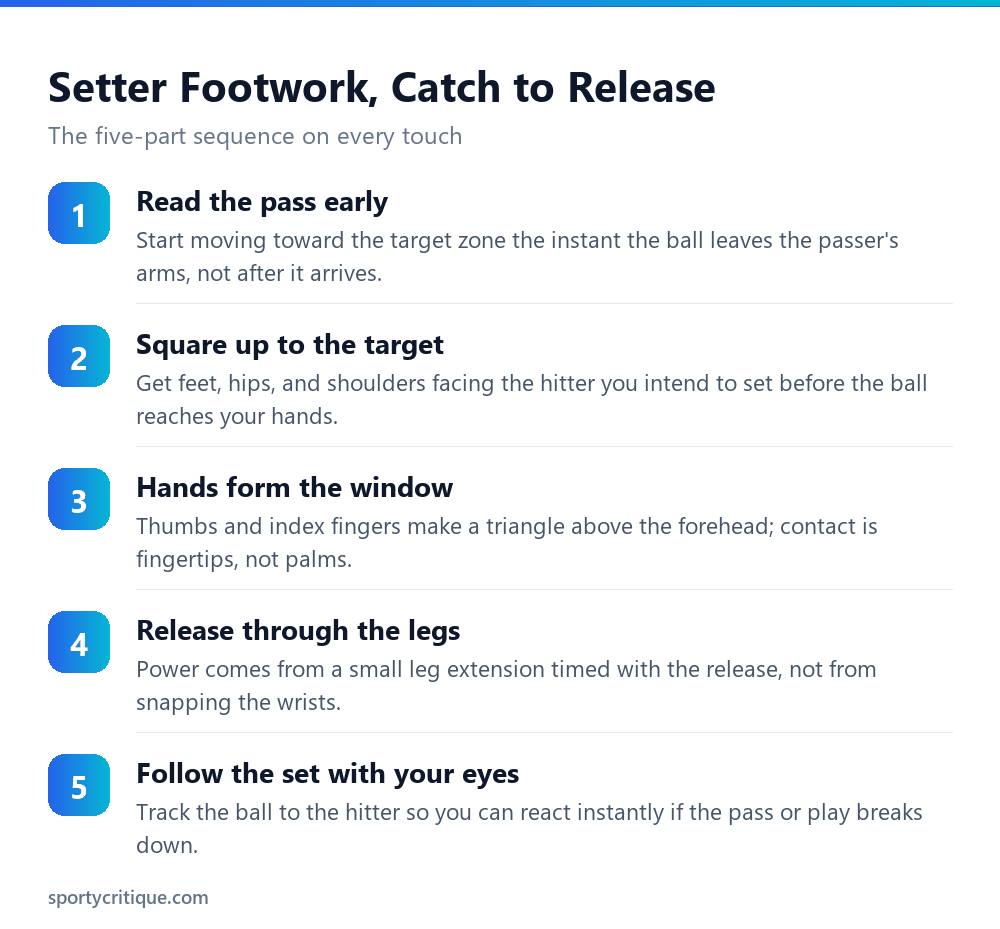
The hand shape itself is specific: thumbs and index fingers form a triangle held above the forehead, and contact happens on the fingertips, not the palms. Power comes mainly from a small extension through the legs timed with the release, not from snapping the wrists, which is the habit that usually draws a double-contact call from referees at higher levels of play.
⚠️ Watch out: A setter who reaches sideways or backward for a bad pass, instead of getting their feet under the ball first, almost always produces a set that’s off-speed or off-target. Footwork discipline matters more on a bad pass than a good one, because that’s exactly when there’s no margin left to correct with the hands alone.
Reading the pass before choosing a hitter
The set a setter chooses depends heavily on how clean the pass was. A tight pass close to the net opens up faster tempo options, quick sets to a middle hitter that are much harder for a defense to read and block in time. A pass that lands short, wide, or deep forces a slower, higher set that gives the hitter more time to adjust but also gives the block more time to set up and read where the ball is going.
This is the decision-making layer that separates a setter who’s just accurate from one who’s actually running an offense. Two setters can have identical hand technique and still produce very different results, because one is defaulting to the same comfortable set on every touch while the other is reading the pass, the block, and the score to pick the option that actually creates a kill.
How rotations change the setter’s job
In a 5-1 system, one setter runs the offense on every rotation, which means they’re setting from the front row on some rotations and backing all the way up to serve-receive on others, but always the one making the call. A 6-2 system uses two setters who alternate, always setting from the back row so each rotation gets an extra front-row attacker; the tradeoff is less consistency, since hitters are adjusting to two different setters’ timing and tendencies instead of one.
📊 Note: This site has a separate deep-dive on 5-1 versus 6-2 rotation rules if you want the full breakdown of how each system affects lineup construction; here the short version is enough context to understand why a setter’s job changes shape depending on which system their team runs.
Communication is part of the technique, not separate from it
A setter calls plays before the serve, not during the scramble after a bad pass. Hand signals behind the back tell hitters what’s coming, quick, high, a combination play, so the attack is synchronized before the ball is even served. Communication that starts only after the pass is late; by then hitters are already committing to an approach based on guesswork instead of a plan.
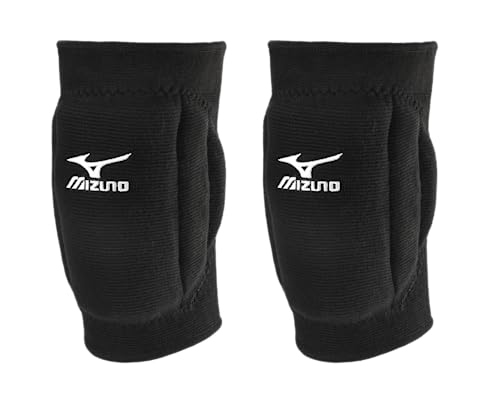
Knee pads matter more for setters than the position gets credit for. A setter who’s diving and shuffling constantly for off-target passes needs something like the Mizuno LR6 Volleyball Kneepad, low-profile enough not to interfere with the quick footwork the position demands, but with real padding for the volume of floor contact a busy setter racks up over a season.
Decision-making under pressure
- ✓Feed the hitter who’s swinging well, even if it isn’t the called play
- ✓Set away from a blocker who’s cheating early toward one hitter
- ✓Slow the tempo down on a bad pass instead of forcing a fast set
- ✓Call plays before the serve so hitters know the plan in advance
- ✕Default to the same comfortable set on every touch regardless of the read
- ✕Force a quick tempo set off a pass that’s too far off target to support it
- ✕Wait until after a bad pass to start communicating with hitters
- ✕Ignore the block’s positioning when choosing where to send the set
💡 Pro tip: Track which hitter is actually converting kills, not just who’s getting the most sets. A setter watching the scoreboard and shot chart, even informally, adjusts distribution mid-match instead of sticking with a rotation of sets that stopped working two points ago.
Common misconceptions about the position
The setter dump: when the setter attacks instead of sets
On a clean pass, a setter can send the ball over the net themselves on the second contact rather than setting a hitter, usually tipping or pushing it into an open seam the defense left uncovered while expecting a normal set. It only works as a surprise, and it depends on the block reading set instead of attack; a setter who dumps too often loses the element of surprise and starts getting blocked or dug easily.
Reading when a dump is available takes the same skill as reading a hitter matchup: is the block committed to covering the outside hitter, is there a gap in the back row, has the defense’s positioning left a seam. It’s a small part of the total offense for most teams, but it’s one more example of how much of the setter’s value comes from decisions made in a fraction of a second rather than from any single physical skill.
Drills that build the position
Wall sets, repeatedly setting a ball against a wall from a few feet away, build the hand shape and consistency without needing a full court or other players. Target-zone footwork drills, where a coach or partner tosses balls to different spots and the setter has to get their feet square to the target hitter before catching each one, build the movement pattern that matters most under game speed: getting there early instead of reaching late.
Pair those with live reps against an actual pass, even an imperfect one from a teammate who isn’t a trained passer, since that’s the only way to practice the actual decision-making layer. A setter who only ever trains against perfect tosses never builds the judgment needed to adjust tempo and target on the passes that show up constantly in real matches.
What makes a setter trustworthy to hitters
Hitters build their approach timing around a specific setter’s tendencies: how high they set, how far off the net, how consistent the ball’s spin and speed are. A setter who’s technically accurate but wildly inconsistent in shape from one set to the next forces hitters to guess and adjust mid-approach, which shows up as mistimed swings that have nothing to do with the hitter’s own technique. Consistency, more than sheer set height or speed, is what earns a setter a hitter’s trust over a season.
That trust compounds. A hitter who knows exactly what to expect from a set can commit fully to an aggressive approach instead of holding back to adjust late, and that confidence alone raises a team’s hitting percentage independent of any change in raw physical ability. It’s one of the clearer examples in volleyball of a support position directly creating production for someone else’s stat line.
Bottom line
A setter’s job is to turn whatever pass arrives into the best available attack, touch after touch, which is a mix of specific hand and footwork technique and a constant read of the pass, the block, and which hitter is actually producing. The technique is teachable in a season; the decision-making is what separates a good setter from a great one, and it keeps developing for years.
What does a setter do in volleyball during a normal rally?
They take the second contact after the pass and deliver an accurate set, almost always to a teammate, choosing the hitter, tempo, and location based on how clean the pass was and how the block is positioned.
Is the setter the most important position in volleyball?
It’s one of the most influential, since nearly every offensive rally runs through that touch. That said, a great setter with poor passing in front of them still struggles; the position depends heavily on the team around it.
What’s the difference between a 5-1 and 6-2 setter system?
A 5-1 uses one setter for every rotation, setting from both front and back row depending on position. A 6-2 uses two setters who alternate and always set from the back row, trading some consistency for an extra front-row attacker on every rotation.
Do setters need to be tall?
Less than hitters or blockers do. Height helps at the net on a second-ball attack or a block, but the core skills, footwork, hand technique, and decision-making, don’t require elite height the way middle blocking does.
What’s the biggest mistake new setters make?
Reaching for a bad pass instead of moving their feet to get under it first. That single habit causes more off-target sets than any flaw in hand technique, and it’s usually the first thing coaches correct.
As an Amazon Associate, we earn from qualifying purchases through links on this page.