How to Spike a Volleyball: Approach Footwork, Timing & Arm Swing Mechanics


🏐 Volleyball Hub: Explore all 44 guides, court shoes, and drills in our Complete Volleyball Resource Hub.
A volleyball spike is three movements chained together: a progressive 4-step approach (Right–Left–Right–Left for right-handers), an explosive two-foot vertical plant, and a high-reach arm whip that contacts the ball slightly in front of your hitting shoulder. Beginners rarely miss because of arm strength—they miss because they run in too early. Wait until the set leaves the setter’s hands, accelerate into your plant, snap your wrist over the top of the ball for topspin, and land softly on both feet.
Watch any competitive match and you immediately notice the sound: a sharp, explosive crack when a hitter catches a ball cleanly at full extension. It looks like pure upper-body muscle. Because of that, almost every newcomer makes the same mistake: they stand at the net, flex their shoulder, and swing as hard as they can, wondering why the ball keeps catching the white tape or sailing twenty feet out of bounds.
After watching hundreds of rec-league and club players run drills, the truth is clear: the players with the heaviest bench press rarely hit the hardest. The best hitters are the ones who arrive at the hitting window on time with room to extend. Your footwork and timing dictate whether you get to use your arm at all. The arm swing is simply the final release of energy built from the floor up.
- →Late Beats Early: Do not sprint toward the net while the ball is still going up. Wait until the set reaches its peak trajectory so your feet can adjust to the ball’s location.
- →Rhythm Dictates Height: Right-handed hitters finish Right–Left; left-handed hitters finish Left–Right. Your penultimate (second-to-last) step must be your longest, lowest, and fastest.
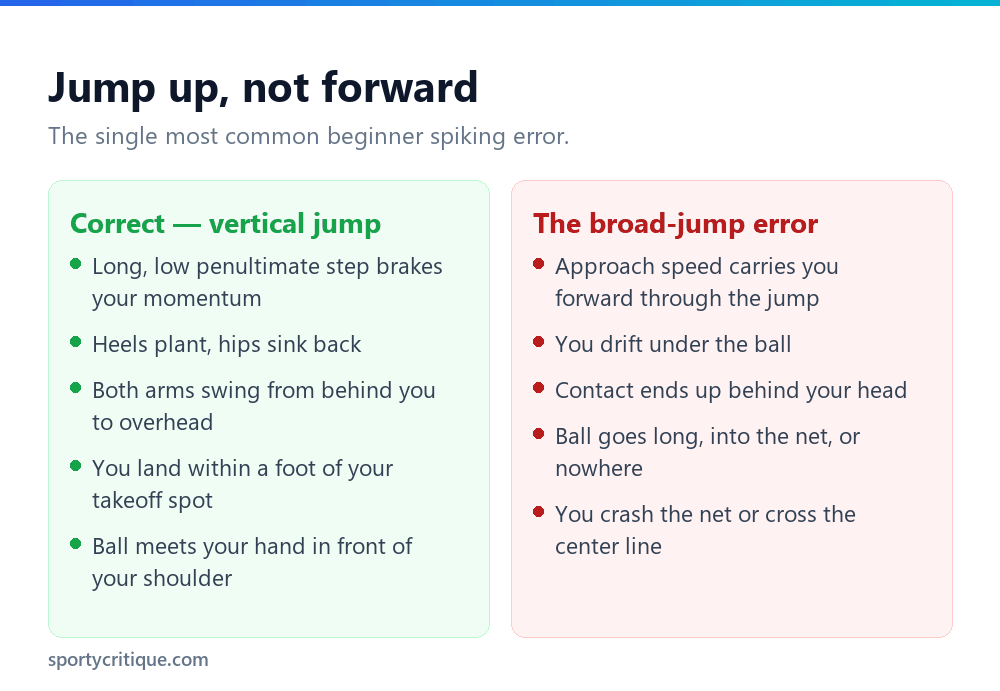
- →Jump Up, Not Forward: Converting horizontal speed into vertical lift prevents you from drifting under the ball or committing a net violation.
- →Cup and Snap: Shape your hand into a firm contour, strike the upper-back center of the ball, and snap your wrist downward to create sharp diving topspin.
- →Two-Foot Landings Save Knees: Decelerate through both feet with flexed knees to absorb 4x bodyweight shock and eliminate patellar tendon strain.
Table of Contents
1. Net Heights & The Reality of Contact Geometry
Before analyzing footwork, let’s address the physics of the net. To drive a volleyball sharply downward into the opponent’s court, your hand contact point must be higher than the top of the net. If your contact height is level with or below the tape, attempting to spike downward will drive the ball directly into the net every time.
If your vertical leap plus standing reach does not clear the top tape by at least 8 to 12 inches, focus on hitting deep flat drives into the corners, sharp cross-court roll shots, or tooling the blocker’s hands. Hitting straight down is a function of reach height, not swing effort.
2. The 4-Step Approach: Turning Run Speed into Vertical Lift
The approach is not a casual jog toward the net. It is a calculated rhythm designed to brake forward speed and launch your body upward. While a 3-step approach works in fast scramble plays, the standard 4-step approach gives hitters the most consistent rhythm and power.
Left-handed hitters mirror this sequence: Left (step 1) – Right (step 2) – Left (penultimate step) – Right (block plant). Remember the universal coaching rhythm: Slow to Fast, Small to Big.

3. Jump Execution: Vertical Launch vs. Broad Jump Drift
The single most common flaw in amateur volleyball is turning a spike approach into a long jump. When hitters fail to dig their heels in on the penultimate step, their forward speed carries them directly under the ball. When that happens:
- The ball ends up behind your hitting shoulder, forcing an awkward push that sails long.
- You lose vertical jump height because energy continues traveling horizontally.
- You drift forward into the net or step across the center line, risking severe sprains from landing on opposing blockers’ feet.
The Quick Diagnostic Test: Check where you land after hitting. On a standard high set, you should land within 6 to 12 inches of where your toes left the floor. If you take off behind the 10-foot line and land 4 feet in front of it, you broad-jumped.
4. Contact Mechanics: The Bow-and-Arrow & Wrist Snap
As your feet leave the court, both arms swing upward past your face. Once airborne, split your arms into the classic “bow-and-arrow” posture:
Non-Hitting Arm (The Guide): Points up toward the descending volleyball. It balances your upper body in the air and acts as your visual sights on the ball.
Hitting Arm (The Loaded Bow): Draws back with the elbow high and level with your ear. Your wrist remains relaxed and your hand cocks behind your head with an open palm.
The Kinetic Chain: Core Crunch Over Pure Shoulder
If you swing using only your rotator cuff, your spikes will lack pop and your shoulder will ache after two sets. True attacking power generates from a kinetic chain:
- Hip Rotation: As you begin the swing, your hips uncoil toward the net.
- Abdominal Crunch: Flex your abdominal core forward. This pulls your chest through and whips your hitting shoulder into the shot without taxing the joint.
- Elbow Lead: The elbow drives forward first, followed by the forearm.
- Open-Hand Cupping & Wrist Snap: Contact the ball with an open, strong hand shaped like a shallow salad bowl (conforming to the sphere). Make contact with the heel of the palm slightly in front of your hitting shoulder, then aggressively snap your fingers and wrist over the top of the ball.
That wrist snap creates rapid forward topspin. Topspin creates downward aerodynamic pressure (the Magnus effect), forcing hard-driven balls to dive sharply inside the baseline rather than floating out of bounds.
5. Back-Row Attacks: The 10-Foot (3-Meter) Line Rule
Spiking is not restricted to front-row players. Outside hitters and opposites frequently execute devastating back-row attacks (the “Pipe” or “D-ball”). However, strict FIVB and USA Volleyball rules govern back-row hits:
The Takeoff Rule: When a back-row player attacks a ball that is completely above the top of the net, their feet must take off strictly behind the 10-foot (3-meter) attack line. If any part of your shoe touches or crosses the line during takeoff, it is an immediate fault.
The Landing Rule: Once you have cleanly contacted the ball in the air, you are fully permitted to land inside the front zone (across the 10-foot line). The rule applies solely to your point of takeoff.
6. Safe Landing: Centerline Rules & Knee Deceleration
What happens after contact is just as vital as the hit itself. Ankle sprains and knee injuries in volleyball almost universally occur during sloppy landings:
- Centerline Penetration Fault: Under official rules, your foot may touch the centerline under the net, but if your entire foot crosses completely over the line into the opponent’s court, or if you interfere with an opposing player, the referee will blow the whistle. Landing past the centerline is the #1 cause of catastrophic ankle rolls when landing on a blocker’s shoe.
- Two-Foot Shock Absorption: Never land on a single stiff leg. Distribute landing forces equally across both feet, landing on the balls of your feet and rolling to your heels while bending your knees to at least 45 degrees.
7. Diagnostic Table: Fix Your Spike by Symptom
If your spike is consistently failing, identify your exact mistake below:
8. Solo Drills You Can Run Without a Setter
You do not need a gym full of players to build high-level spiking mechanics. These three solo drills groove timing and contact:
- Wall Snap Spikes: Stand 10–12 feet away from a gymnasium or brick wall. Toss the ball slightly up with your left hand, jump off two feet, and spike the ball downward into the floor so it bounces sharply up into the wall. Catch and repeat for 3 sets of 25 reps. This builds muscle memory for hand cupping and wrist snap.
- Approach Rhythm Shadowing: Practice your 4-step approach on a basketball court or open floor without a ball. Focus on taking a wide, low penultimate step, driving both arms backward, and landing smoothly on both feet. Film yourself from the side to verify zero forward drift.
- Self-Toss Down-Balls at the Net: Stand 5 feet off the net. Toss a high ball to yourself, take your final two steps (Right–Left), jump, and hit over the net into the deep corner. This isolates the timing of a descending ball.
9. Gear Essentials for Spikers: Footwear & Training Balls
Aggressive approaches require shoes with high-friction lateral gum rubber to stop your penultimate slide, along with responsive forefoot cushioning to protect your joints during repeated jump landings.
Frequently Asked Questions
Can a back-row player spike a volleyball?
Yes. A back-row player can legally attack a ball at any height as long as their feet leave the floor behind the 10-foot (3-meter) attack line. Touching or stepping on the line during takeoff is an illegal attack fault. They are permitted to land in front of the line after contact.
How do I spike a volleyball harder?
Spike power comes from kinetic arm speed and torso rotation, not arm bulk. Accelerate your arm through the ball using your core abdominal crunch, hit the ball at full extension slightly in front of your shoulder, and snap your wrist to generate forward topspin.
Can short players spike effectively?
Yes. Smaller hitters excel by arriving on time, attacking at sharp cross-court angles, utilizing high roll shots over blocks, and intentionally tooling the outside hands of opposing blockers so the ball ricochets out of bounds.
Should you spike with an open hand or a closed fist?
Always hit with a firm open hand shaped slightly concave to the ball’s curve. A closed fist provides a small, erratic contact surface that cannot generate topspin, resulting in unpredictable trajectories.
Have questions about jump mechanics or hitting shoes? Explore our Vertical Jump Training Program or reach out to our team on our Contact Us page.