Vertical Jump Training for Volleyball Hitters

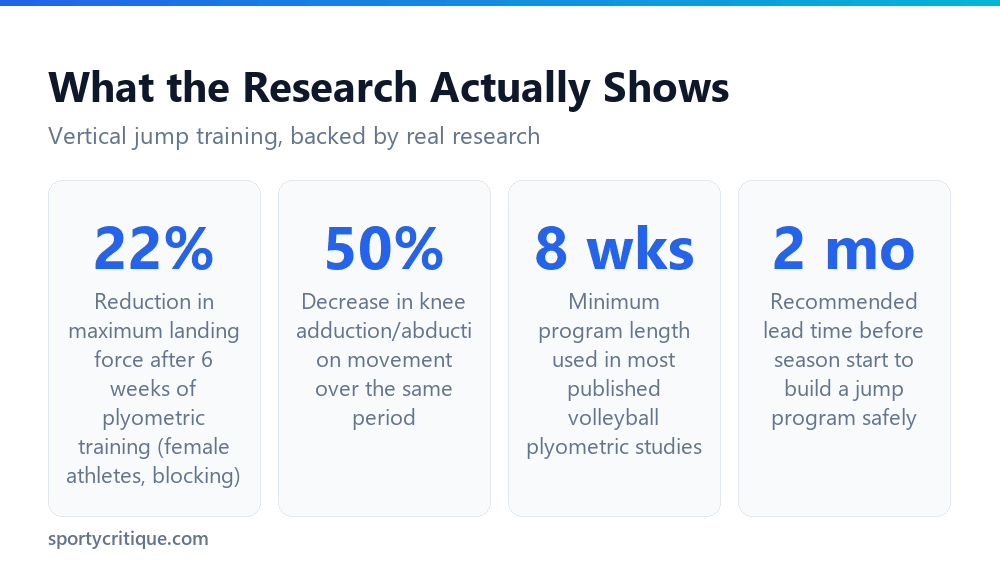
A real vertical jump program for volleyball hitters combines plyometric exercises (box jumps, depth jumps, broad jumps, tuck jumps) with lower-body strength work (squats, lunges, deadlifts) and, critically, dedicated landing mechanics training, done consistently over at least 6 to 8 weeks, ideally starting about two months before the season. Landing technique isn’t a footnote to jump training; published research shows structured landing work cuts peak landing forces by roughly 22 percent and cuts the knee-collapsing movement linked to ACL injuries by around 50 percent.
Most vertical jump content for volleyball treats landing as an afterthought to the jump itself, when the actual injury and long-term durability data says the opposite: how a player lands matters as much as how high they jump, arguably more, since a hitter jumps and lands dozens of times in a single match. A jump program that ignores landing mechanics is building power on top of an unaddressed injury risk.
- →Plyometric training builds explosive power specifically, not just general leg strength
- →Landing mechanics training measurably reduces injury risk, cutting peak landing forces by roughly 22 percent in research
- →Strength work (squats, lunges, deadlifts) and plyometrics work together, not as alternatives to each other
- →Programs should run at least 6 to 8 weeks, ideally starting about two months before the season
- →Excessive knee valgus (the knee caving inward) on landing is a specific, coachable fault linked to ACL injury risk
Table of Contents
Why Plyometrics, Not Just Strength Training
Standard strength training, squats, lunges, deadlifts, builds the raw muscular force a jump needs, but plyometric exercises train something different: the ability to generate that force quickly, in the split second a volleyball approach and takeoff actually allows. A strong player with poor plyometric development can squat a lot of weight and still jump unremarkably, since jumping height depends on rate of force production, not just total force available.
This is why an effective program includes both pieces rather than leaning entirely on one. Strength training raises the ceiling on how much force is available; plyometric training teaches the nervous system and muscles to access that force explosively, in the very short ground-contact window a real approach jump actually provides.
The Program: Core Exercises
Box jumps and broad jumps build raw explosive power in slightly different directions, vertical and horizontal, both of which contribute to an actual approach jump that combines forward momentum with a vertical takeoff. Depth jumps specifically train the reactive strength, the ability to absorb landing force and immediately redirect it into another jump, that a real blocking sequence or a quick transition demands.
💡 Pro tip: Step down from a box rather than jumping down after a box jump; jumping down adds unnecessary landing stress without training anything a controlled step-down doesn’t already provide. This is a small detail that matters more than it seems for keeping cumulative joint stress reasonable across a full training block.
Landing Mechanics: The Part Most Programs Skip
Landing on a stiff, straight leg with the knee caving inward, a pattern called knee valgus, is strongly linked to ACL tears and is one of the most common, correctable faults in untrained jumpers. The fix is coachable: land with knees tracking over the toes, not collapsing inward, and with enough knee and hip bend to absorb force through the muscles rather than the joint structures themselves.
Research specifically measuring this found that six weeks of targeted plyometric and landing training reduced peak landing forces during blocking by roughly 22 percent and cut the excessive inward knee movement linked to ACL risk by about 50 percent in the athletes studied. That’s not a marginal improvement; it’s a substantial, measurable reduction in the exact mechanical pattern most associated with one of volleyball’s more serious injuries.
⚠️ Watch out: A program that only counts jump height and ignores how a player lands is missing the half of the training that actually protects the knees, ankles, and lower back from the cumulative stress of the hundreds of jumps a competitive season demands.
Structuring the Program Over Time
Starting a dedicated jump program roughly two months before the season begins gives enough time to build volume and intensity gradually, rather than compressing plyometric loading into a shorter window where injury risk from doing too much too fast rises sharply. Programs studied in published research typically run a minimum of six to eight weeks before showing measurable jump and landing improvements, which is a reasonable floor to plan around.
Frequency matters more than single-session intensity for plyometric work specifically. Two to three dedicated sessions per week, with adequate recovery between them, produces better results than daily maximal-effort jump training, since plyometric exercises place real stress on tendons and joints that needs recovery time to actually adapt and strengthen rather than simply accumulate fatigue.
📊 Note: A dedicated plyo box, something like the Epic Fitness 3-in-1 Foam Plyometric Jump Box ($144.98), with multiple adjustable heights makes it practical to progress box jump height gradually over the course of a program rather than being stuck with a single fixed height that’s either too easy early on or too aggressive as a starting point.
Program Do’s and Don’ts
- ✓Combine plyometrics with lower-body strength training, not one or the other
- ✓Include dedicated landing mechanics coaching, not just jump-height tracking
- ✓Start roughly two months before the season for adequate progression time
- ✓Allow real recovery between plyometric sessions, 2-3 per week rather than daily
- ✕Treating landing technique as an afterthought to jump height
- ✕Jumping down from box jumps instead of stepping down
- ✕Compressing a full program into the final weeks before the season
- ✕Training maximal-intensity plyometrics daily without recovery
Age and Experience Considerations
Younger or less physically mature players benefit from building a solid strength and movement-quality foundation before adding high-intensity plyometric work like depth jumps, which place significant stress on tendons and joints still developing. A general progression from basic bodyweight strength and simple jump-and-land drills toward more advanced plyometric exercises, rather than starting an advanced athlete’s program immediately, reduces injury risk for developing players specifically.
Experienced, physically mature hitters can generally handle a more aggressive plyometric volume from the start, though the landing-mechanics component remains just as important regardless of experience level or existing jump height. Even elite jumpers benefit from ongoing landing mechanics attention, since the injury risk from poor landing mechanics doesn’t disappear once a player reaches a high performance level.
Warming Up Before Plyometric Work
Plyometric exercises ask tendons and muscles to absorb and redirect force rapidly, which makes a proper warm-up more important here than before a typical strength session. A general warm-up (light cardio, dynamic stretching) followed by a few progressively harder submaximal jumps prepares the nervous system and tissues for the higher-intensity work that follows, rather than asking cold muscles and tendons to handle maximal-effort jumps immediately.
Skipping or rushing this warm-up phase to save time is a common shortcut that increases injury risk without saving meaningful time, since a proper dynamic warm-up typically takes only 10 to 15 minutes. That’s a small time investment relative to the actual training session and a smaller one still relative to the cost of a soft-tissue injury that sidelines a player for weeks, sometimes right through the middle of a competitive season.
Tracking Progress Beyond Just Jump Height
Standing reach and approach jump height are the obvious metrics to track, typically measured with a simple vertical jump test against a wall or a jump mat, repeated every few weeks to gauge progress. Tracking landing quality alongside jump height, even informally through video review checking for the knee-valgus pattern discussed earlier, gives a fuller picture of whether the program is actually improving durability, not just output.
A player who gains two inches of vertical jump while landing mechanics stay poor or worsen hasn’t actually improved their overall readiness the way the jump-height number alone suggests. Tracking both dimensions, power output and landing quality, keeps a program honest about what it’s actually accomplishing rather than optimizing for the one number that’s easiest to measure.
Recovery Between Sessions
Plyometric training creates real mechanical stress on tendons, which adapt and strengthen during recovery, not during the training session itself. Sleep quality and total sleep duration have a direct, measurable effect on how well that adaptation actually happens, making adequate sleep a legitimate part of a jump training program rather than a separate lifestyle consideration unrelated to it.
Soreness that persists well beyond the typical one-to-two-day window after a plyometric session is a signal to scale back volume or intensity temporarily, not a sign to push through regardless. Persistent, worsening soreness specifically in tendons (the Achilles, the patellar tendon below the kneecap) rather than muscles deserves particular attention, since tendon issues develop and resolve more slowly than typical muscle soreness.
Frequently Asked Questions
How long before I see results from a jump training program?
Published research typically shows measurable improvements after six to eight weeks of consistent training, though individual results vary based on training age, consistency, and starting point. Rushing results by increasing volume beyond a reasonable progression increases injury risk without necessarily speeding up gains.
Should I do plyometrics before or after strength training?
Most programs place plyometric work earlier in a session, when the nervous system is freshest and can produce the fastest, most explosive movements, with strength training following. Doing plyometrics on fatigued legs after heavy strength work increases injury risk and reduces the quality of the explosive training itself.
Is knee valgus (knees caving in) something I can actually fix?
Yes, it’s a specifically coachable landing pattern, not a fixed trait. Targeted landing mechanics training, cueing the athlete to keep knees tracking over the toes on landing, measurably reduces this pattern in published research.
Do I need a plyo box, or can I use stairs or a sturdy bench?
A sturdy bench, low wall, or stable stairs can substitute for basic box jumps at lower heights. A dedicated plyo box becomes more valuable specifically for progressing height gradually and safely as a program advances, since improvised surfaces aren’t always available at multiple heights.
How much sleep actually affects jump training results?
Meaningfully. Tendon and muscle adaptation happens during recovery, not during the training session itself, and sleep quality is one of the biggest levers available for that recovery. Consistently poor sleep can blunt the results of an otherwise well-designed program.
What should I do if soreness persists for more than a couple of days?
Scale back volume or intensity temporarily rather than pushing through. Persistent soreness, especially in tendons like the Achilles or patellar tendon rather than muscles, deserves particular caution since tendon issues resolve more slowly than normal muscle soreness.
Treated as a genuine training program rather than a collection of jump drills borrowed from a highlight video, vertical jump work pays off in both performance and durability, which is exactly the combination a hitter needs across a full, demanding season of repeated jumps, landings, and the cumulative wear that comes with both.
Consistency over months, not a single intense week, is what actually moves the needle.
As an Amazon Associate, we earn from qualifying purchases through links on this page.