Best Golf Shoes for Wide Feet

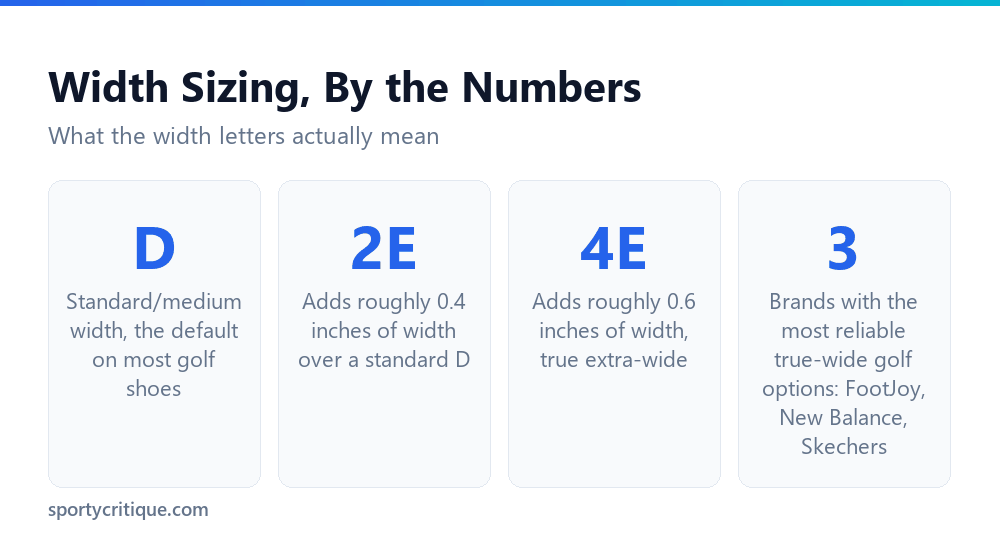
The best golf shoes for wide feet come from brands that manufacture genuine wide and extra-wide lasts, not just a roomier standard shoe. FootJoy, New Balance, and Skechers all offer true wide-width golf shoes: 2E adds roughly 0.4 inches of width over standard, and 4E adds roughly 0.6 inches for a genuinely extra-wide fit. Four real options across these brands are compared below.
Golf shoe fit gets overlooked more than almost any other piece of golf equipment, despite the sport requiring hours of standing and walking on uneven ground, often in wet or hot conditions. A golfer with wide feet squeezed into a standard-width shoe deals with pinching, hot spots, and genuine discomfort by the back nine, problems that a properly sized wide shoe eliminates entirely rather than just tolerating with a slightly looser lace job.
- →2E width adds roughly 0.4 inches over standard D width; 4E adds roughly 0.6 inches
- →FootJoy, New Balance, and Skechers all manufacture genuine wide and extra-wide golf shoe lasts
- →Buying a size up in standard width is not the same as buying true wide width; length and width are separate measurements
- →New Balance offers the widest range, up to 4E and even 6E in some models
- →Always check width availability at the specific size needed, since not every size is stocked in every width
Table of Contents
What 2E and 4E Actually Mean
Width sizing on athletic and golf shoes uses a letter system, with D representing standard or medium width for men’s shoes. Moving up from there, 2E adds roughly 0.4 inches of width across the widest part of the foot, and 4E adds roughly 0.6 inches, a genuinely noticeable difference for anyone whose standard-width shoes feel tight across the ball of the foot.
A golfer who finds 2E still feels snug shouldn’t assume wide sizing simply doesn’t work for them; 4E provides substantially more room, and some brands, New Balance in particular, extend even further to 6E for particularly hard-to-fit feet. The width letter matters as much as the numerical size, and skipping straight to a half-size-up standard shoe instead of trying the correct wide width is a common, avoidable mistake.
Sizing Up Isn’t the Same as Sizing Wide
Buying a half or full size larger in standard width adds length, not width, which solves nothing for a foot that’s uncomfortably wide rather than uncomfortably long. A too-long shoe in the wrong width actually makes things worse in some ways, adding heel slip and instability on top of the width problem that was never actually addressed.
⚠️ Watch out: If a standard-width shoe feels tight specifically across the ball of the foot while the toe box length feels fine, that’s a width problem, not a length problem, and sizing up won’t fix it. Look specifically for a wide or extra-wide width option in the correct length instead.
4 Real Wide-Width Options, Compared
📊 Note: Width availability varies by specific size within the same shoe model; a size 10 might be stocked in 2E and 4E while a size 13 in the same model is only available in 2E. Always check width options at the exact size needed rather than assuming the full width range applies across every size.
Which Brands Actually Deliver on Wide Sizing
New Balance has built a reputation specifically around wide and extra-wide athletic footwear generally, and that carries over directly into their golf line, with true 2E, 4E, and occasionally 6E options and a noticeably roomier toe box design, not just a wider label on the same last.
FootJoy, the most widely recognized golf-specific footwear brand, offers wide and extra-wide versions of several core models including the HyperFlex line, giving golfers who prefer a more golf-focused (rather than athletic-crossover) shoe a legitimate wide option without switching to a less golf-specialized brand entirely.
Skechers’ GO GOLF line, built on the same comfort-focused platform as their popular walking and athletic shoes, extends that comfort-first design philosophy into wide-width golf options as well, appealing specifically to golfers who prioritize all-day comfort over a more traditional golf shoe feel and appearance.
Shopping Checklist
- ✓Check width availability at your exact shoe size, not just the model generally
- ✓Try 4E if 2E still feels tight, rather than assuming wide sizing doesn’t work
- ✓Shop FootJoy, New Balance, and Skechers first for the most reliable true-wide options
- ✓Distinguish a width problem (tight across the foot) from a length problem (toe box crowding)
- ✕Buying a half-size-up standard shoe to compensate for width discomfort
- ✕Assuming every size in a model is stocked in every advertised width
- ✕Giving up on wide options after trying only 2E without checking if 4E is available
- ✕Ignoring in-round comfort complaints as unavoidable rather than a fixable sizing issue
Materials, Heat, and Foot Swelling
Feet swell measurably over the course of a long, hot round, sometimes by half a size or more depending on temperature and walking distance, which matters more for someone already fitting snugly into a wide shoe than for someone with room to spare. A shoe with a stretchy, breathable upper, mesh panels or a knit construction rather than rigid leather, accommodates that natural swelling better over 18 holes than a stiffer material that fit perfectly at the first tee.
This is part of why several wide-friendly golf shoes lean on athletic-shoe construction techniques, stretch knit uppers, flexible synthetic overlays, rather than traditional rigid golf leather. The comfort benefit compounds specifically for wide feet, since there’s less margin to begin with before swelling turns a snug-but-acceptable fit into a genuinely uncomfortable one by the back nine, on top of whatever heat and humidity the course itself adds over the course of a full afternoon round.
Orthotic and Custom Insole Compatibility
Golfers who use custom orthotics or aftermarket insoles for other foot conditions need to account for that extra volume when choosing a width, since an orthotic takes up real internal space that a standard shoe’s width sizing doesn’t anticipate. A golfer who normally wears a 2E in a standard shoe might need to size up to 4E specifically to accommodate an orthotic without recreating the same width problem the orthotic was meant to solve.
Removable factory insoles make this adjustment easier, since swapping the stock insole for a custom orthotic doesn’t require fighting a fixed, non-removable liner for space. Checking whether a specific model’s insole is removable before buying, especially for anyone planning to use it with orthotics, avoids an unpleasant surprise after the shoe already arrives.
💡 Pro tip: Bring an existing orthotic to try inside a prospective shoe in person when possible, rather than guessing at compatibility from a product listing alone. The combination of orthotic thickness and shoe width varies enough between models that a general width recommendation doesn’t always translate directly to a specific orthotic setup.
Buying online without that in-person check is still workable, provided the retailer’s return policy allows a real-world test walk before committing. Ordering two adjacent widths at the same size, then returning whichever doesn’t work, costs a little in shipping logistics but removes most of the guesswork involved in matching an orthotic to an unfamiliar shoe.
Checking Fit Before Committing to a Round
Trying a new pair around the house or on a short practice-range session before wearing them for a full 18-hole round catches fit problems while there’s still time to exchange for a different width or size. A shoe that feels acceptable standing in a store can still reveal pressure points after several hours of walking that a brief in-store fitting never surfaces.
Wearing the actual socks intended for regular play while testing fit also matters, since a thicker cushioned golf sock takes up noticeably more room inside a shoe than a thin dress sock, which can make the difference between a comfortable 2E fit and one that still feels tight once real playing socks are involved.
Walking on a hard surface, not just standing still, during a fit check reveals pressure points that standing alone won’t surface. A shoe that feels fine while stationary in a store can still create a hot spot after the repeated flex and impact of an actual walked round, which is closer to what an 18-hole round actually demands of the shoe than a brief standing try-on ever tests.
Frequently Asked Questions
How do I know if I need wide or extra-wide golf shoes?
If standard-width shoes feel tight or pinch specifically across the ball of the foot, while length feels correct, that’s a sign wide sizing is needed. Trying 2E first and moving to 4E if it still feels tight is a reasonable progression.
Do all golf shoe brands offer wide widths?
No. FootJoy, New Balance, and Skechers are the most consistently reliable for genuine wide and extra-wide golf options; many other brands offer standard width only or very limited wide selections.
Is buying a size larger the same as buying wide width?
No. A larger size adds length, not width, and doesn’t solve a genuine width fit problem. It can actually introduce new issues like heel slip while still leaving the original width discomfort unaddressed.
Are wide golf shoes more expensive than standard width?
Not typically. Wide and extra-wide versions of the same shoe model are usually priced the same as the standard-width version, though availability at any given size can be more limited, sometimes affecting price through reduced stock or discontinued sizes.
Do my feet actually get bigger during a round of golf?
Yes, measurable swelling over 18 holes is normal, especially in heat or on longer walked rounds. This is part of why a breathable, somewhat stretchy upper matters more for wide feet specifically, since there’s less spare room to begin with before swelling becomes noticeable.
Can I use my existing orthotics in a wide golf shoe?
Usually, yes, but check whether the factory insole is removable and consider sizing up in width to accommodate the orthotic’s extra volume. What fits comfortably without an orthotic may feel tight again once one is added.
None of this requires overthinking. Identify whether the actual complaint is width or length, shop the three brands that reliably manufacture true wide lasts, and confirm width stock at the exact size before ordering. That process solves the fit problem for the overwhelming majority of golfers who’ve been quietly tolerating uncomfortable shoes for longer than necessary.
A properly fitted pair of shoes changes how the rest of a round feels far more than most golfers expect once they finally make the switch.
As an Amazon Associate, we earn from qualifying purchases through links on this page.