How to Overhand Serve in Volleyball (Fix Your Toss First)

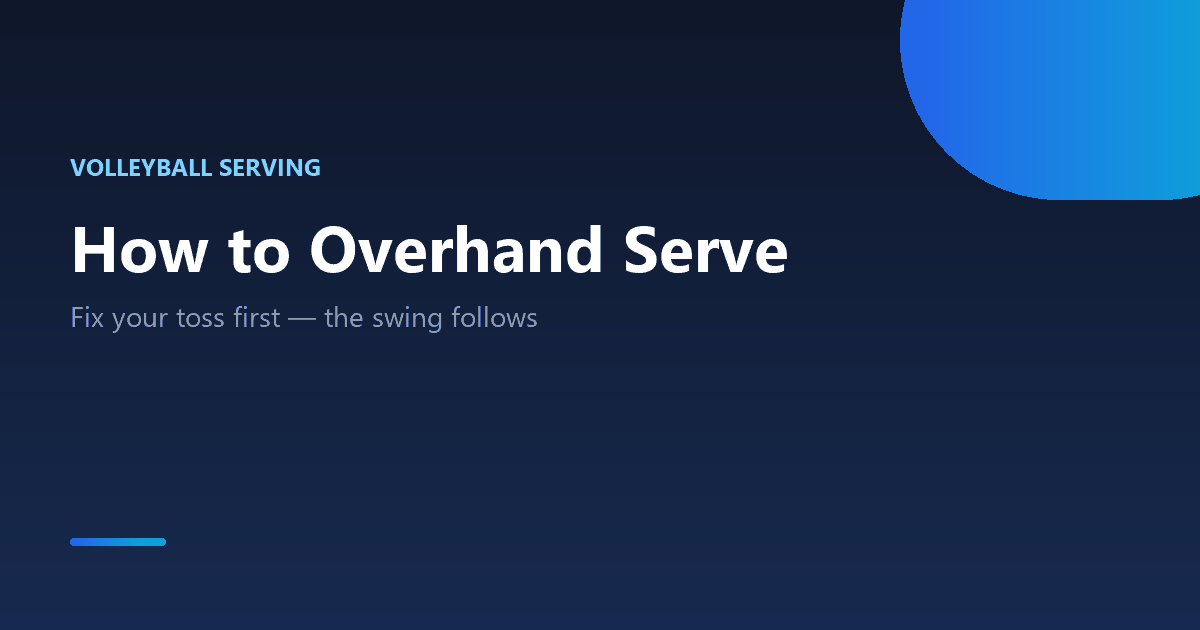
The overhand serve is 90% toss. Stand square behind the end line, toss the ball 12–18 inches above your reach directly in front of your hitting shoulder, draw your arm back like a bow and arrow, and hit the middle of the ball with a stiff, open hand as your weight steps through. If your serve is inconsistent, don’t touch your swing — film your toss. That’s almost always where the problem lives.
Every gym has that player whose overhand serve looks effortless — no windup drama, no leaping, just toss, step, thump, and the ball arrives at the other team wobbling like it’s had a rough day. And every gym has ten players who swing twice as hard and serve half as well. The difference between them is almost never strength. It’s that the first player does the same thing every time, and the thing they repeat starts with the ball leaving their hand.
Having watched an awful lot of serves die in the net over the years, I’ll make the claim plainly: the toss is the serve. The swing is just what happens to the toss. Guides that spend three paragraphs on arm mechanics and one sentence on the toss have it exactly backwards, so this one is built in the order the serve actually works — toss first, then stance, then the arm, then the two kinds of contact, then power, then the fixes.
If you’re still deciding which serve to learn, or you want the rules and placement strategy, that’s covered in our broader guide to serving a volleyball. This page assumes you’ve chosen the overhand serve and want it to work.
- →Toss low: 12–18 inches above your reach. High tosses add timing error, wind error, and nothing else.
- →The toss lands in the same spot every time — in line with your hitting shoulder, slightly in front. Test it by letting tosses drop.
- →Bow and arrow: off hand points at the ball, hitting elbow high beside your ear.
- →Contact decides the serve: stiff hand that stops = float; wrist snap over the top = topspin.
- →Power comes from stepping through the serve, not from the shoulder. Shoulders that do everything eventually hurt.
Table of Contents
Your serve is only as good as your toss
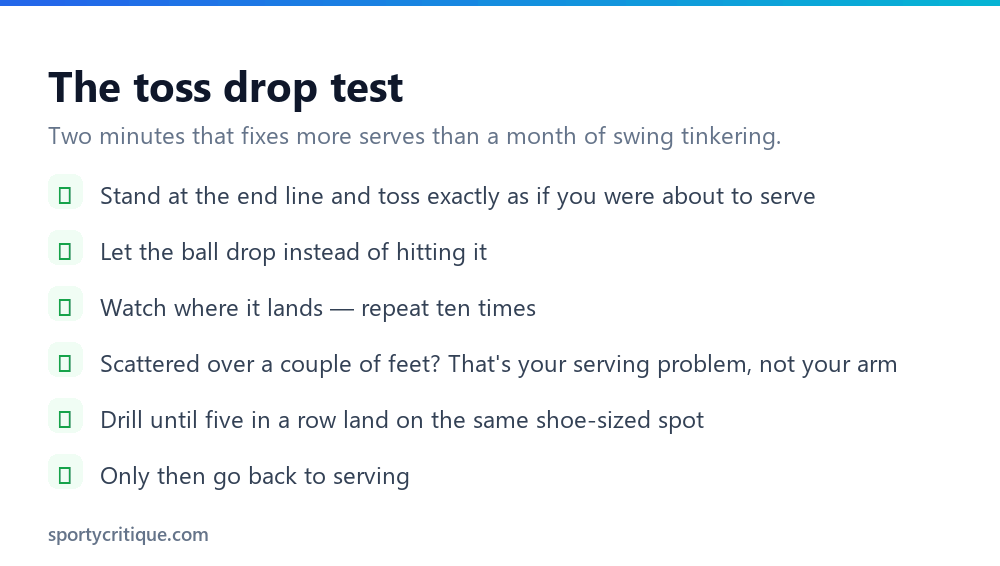
Here’s a test worth two minutes of your life. Stand at the end line, toss like you’re about to serve — and let the ball drop. Do it ten times and watch where it lands. If those ten bounces are scattered across a couple of feet, you’ve found your serving problem, and it has nothing to do with your arm. You’ve been practicing ten different serves and calling it inconsistency.
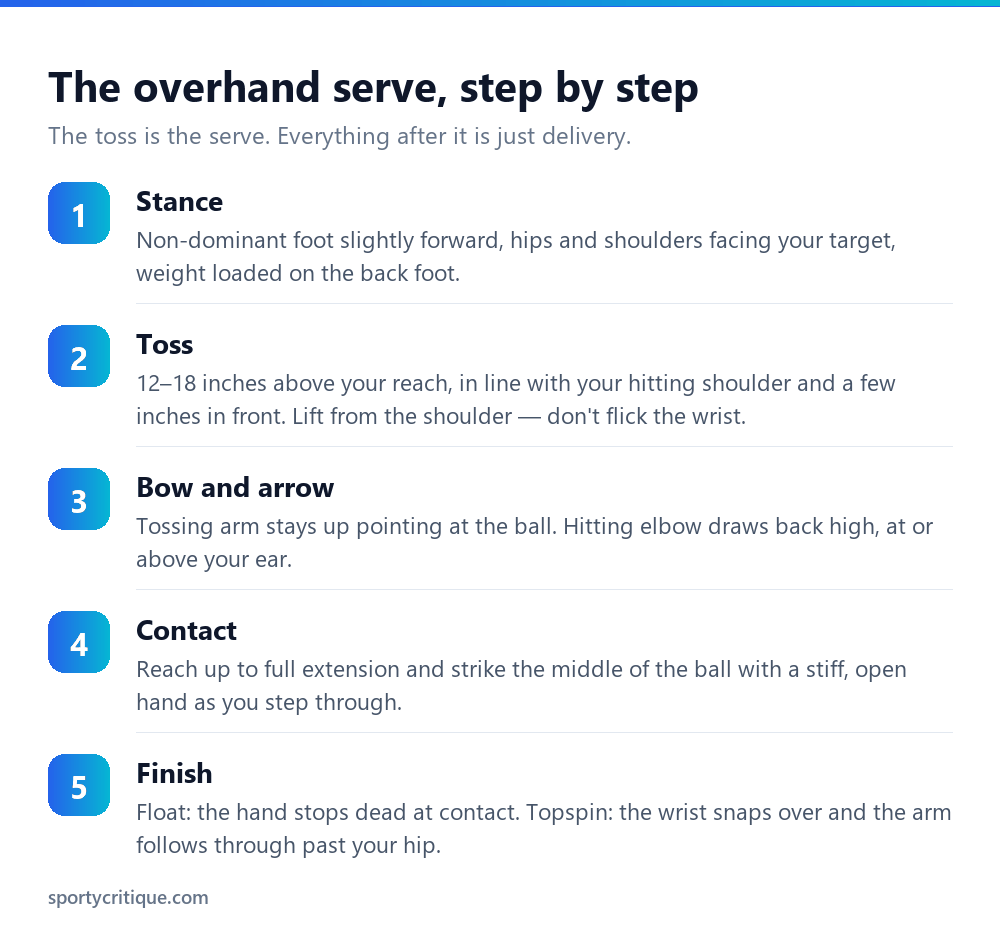
A good serving toss is almost disappointingly small: 12 to 18 inches above your full reach, placed — not thrown — directly in line with your hitting shoulder and a few inches in front of it. Use your non-dominant hand, palm up, and lift from the shoulder like you’re setting a book on a high shelf. The wrist stays quiet; flicky wrists put sideways drift on the toss, and sideways drift is where serves go to die.
Beginners instinctively toss high because it feels like more time to get ready. It’s actually less serve: a high toss falls faster through your contact window, so your timing has to be sharper, and outdoors it gives the wind a full second to relocate the ball. Every inch of unnecessary toss height is a deposit in the error account. The best servers you’ll ever watch have tosses so low and quick the serve looks like one motion.
💡 Pro tip: The drop test is also the fix. Toss-and-let-drop until five in a row land on the same shoe-sized spot, then serve. Do this before every practice for two weeks and your serve will change more than a month of swing tinkering could manage.
Stance and setup: boring on purpose
None of this is exciting, which is the point. The stance’s whole job is to be identical every single time, so that the only variables left in your serve are the ones you chose on purpose.
The bow and arrow
As the toss goes up, your body does two things at once. The tossing arm stays up after releasing, pointing at the ball — it’s your sight, and it keeps your shoulders from opening early. Meanwhile the hitting arm draws back: elbow high, at or above your ear, hand cocked back beside your head. Coaches everywhere call this the bow and arrow because that’s exactly the shape — one arm aims, one arm loads.
Two faults hide here, and they cause most of the ugly serves you’ve ever seen. The first is the dropped elbow — the elbow sags below the shoulder during the draw, the hand pushes forward from chest height, and the serve becomes a shot-put that clears the net only with a slow, loopy arc. If your serve looks like a rainbow, look at your elbow. The second is opening early: the shoulders spin toward the target before contact, the arm drags behind, and the ball sprays wide the same direction every time.
From the loaded position, the swing is compact: elbow leads, hand follows fast, and you reach up to hit at full extension. Contact should happen at the highest point your open hand can meet the ball — higher contact means a flatter serve trajectory, and flat trajectories are hard to pass and hard to send long.
Contact decides everything: float vs. topspin
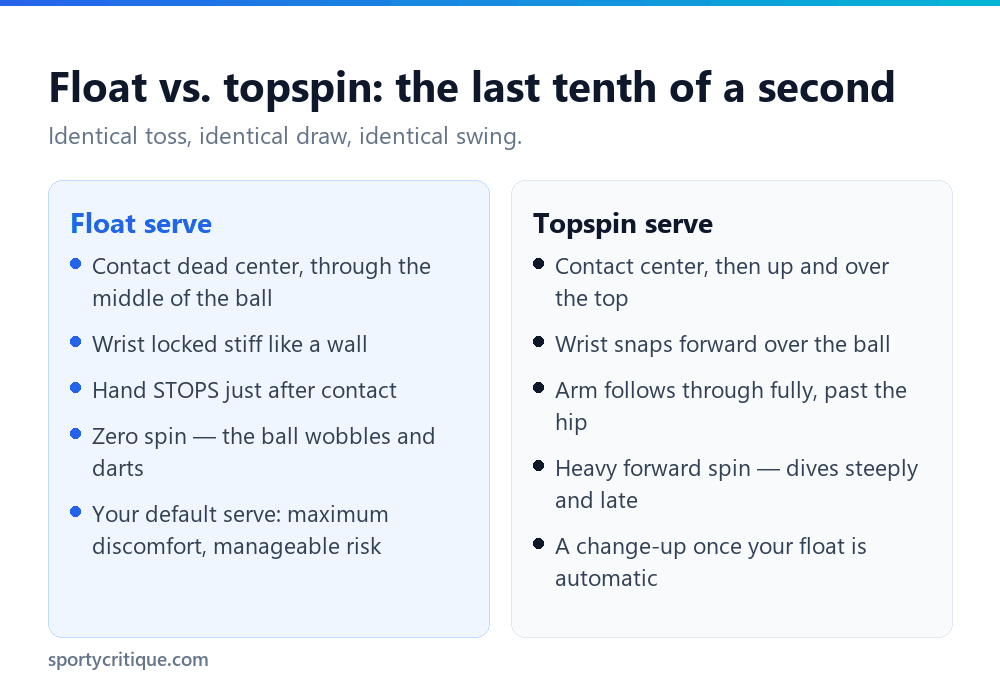
Everything up to the moment of contact is identical for the two overhand serves. The last tenth of a second is the entire difference:
Why does a spinless ball wobble? Because spin is what stabilizes a ball in flight. Take it away and the airflow peels off the seams unevenly, nudging the ball sideways and downward in little unpredictable lurches — the same physics as a baseball knuckleball. The passer can’t read it because there’s nothing to read; the ball itself hasn’t decided where it’s going. That’s why a 60% effort float causes more shanked passes than a 100% effort spin serve: the spin serve is fast but honest.
A float serve isn’t a hit so much as a punch that stops. If your hand wraps over the ball, you’ve politely handed the passer a ball that flies straight.
⚠️ Watch out: Learn the float first, but learn it deliberately. Most self-taught players put accidental spin on every serve because the wrist snap feels natural — then wonder why their serves are easy to pass. The frozen hand is a skill. Practice the stop.
Power comes from the step, not the shoulder
When a serve lacks pace, the instinct is to swing harder, and swinging harder with just the arm is how you get both a worse serve and a sore rotator cuff by autumn. Real serve power is a throwing motion, and throws start from the ground: back foot loads, body steps forward, hips shift, torso follows, and the arm arrives last — fast because everything under it already moved.
The mechanical version: as you toss, your weight is on the back foot. As the ball reaches its peak, step toward the target with your front foot and let your hips carry your weight through contact. You’re not adding a step to your serve; you’re adding your body mass to your arm speed. Players are routinely shocked at how much pace appears from a relaxed arm plus a committed step.
If you (or the player you’re coaching) genuinely can’t get the ball over yet — common for younger kids — don’t groove a shot-put compensation. Shrink the court instead:
Fix your overhand serve by symptom
Do this, not that
- ✓Toss 12–18 inches above your reach, in line with your hitting shoulder
- ✓Point at the ball with your off hand until your swing starts
- ✓Keep your elbow high — at or above your ear in the draw
- ✓Step through contact and let your body supply the pace
- ✓Pick a target during your 8 seconds, before the toss
- ✓Run the toss drop test whenever your serve wobbles
- ✕Launch a high toss to buy time — you’re buying errors
- ✕Drop your elbow and push the ball from chest height
- ✕Snap your wrist on a serve you wanted to float
- ✕Muscle the serve from the shoulder with planted feet
- ✕Toss first and figure out the target mid-swing
- ✕Rebuild your whole swing when the toss was the problem
Frequently asked questions
How far behind the line should I stand?
Start a step or two behind it — enough room to step through the serve without foot-faulting (your foot can’t touch the line until after contact). Standing deeper is legal anywhere along the end line and buys a flatter trajectory more room to drop in; many strong float servers stand 6–10 feet back.
How long does it take to learn a reliable overhand serve?
With deliberate practice — toss drills plus 40–50 serves a session, three sessions a week — most beginners go from ‘sometimes’ to ‘8 of 10 in play’ inside a month. Casual once-a-week serving can take a season to do the same. The difference is almost entirely how seriously you take the toss.
Should I serve with a fist if my hand stings?
No — the sting fades with reps, and a fist trades your whole contact surface for a knuckly gamble. If contact genuinely hurts, you’re likely slapping with fingers instead of striking with the full palm and finger pads. Firm open hand, ball hit with the meat of the palm: more surface, more control, less sting.
What’s the next serve to learn after this one?
The jump float. It’s the same toss discipline and the same frozen-hand contact with a two-step approach and a higher contact point — which is why building the standing float properly first matters. The full jump topspin serve is a spike toss away from all of this and much higher risk; treat it as a someday, not a next step. Speaking of which, the arm swing you’re building here is the same one you’ll use in our spiking guide.
Why do my serves get worse the longer a match goes?
Fatigue eats the legs first, and when the step-through fades, players compensate with shoulder — so serves get flatter, later, and wilder in the fifth set. Two answers: condition the habit by ending practice with serves when you’re already tired, and when you feel it happening in a match, take the full 8 seconds and consciously re-commit to the step.
- →How to serve a volleyball — all five serve types, the rules, and where to aim
- →How to spike a volleyball — the same arm swing, three feet in the air
- →How to play volleyball — rules, rotations, and positions in one guide