Ankle Support for Volleyball: Compression Sleeves & Tape (Not a Brace)

“Ankle support for volleyball” covers two completely different products: soft compression sleeves and tape, or rigid lace-up and hinged braces. This guide is about the soft option, what it actually does, what it doesn’t, and which real products are worth buying.
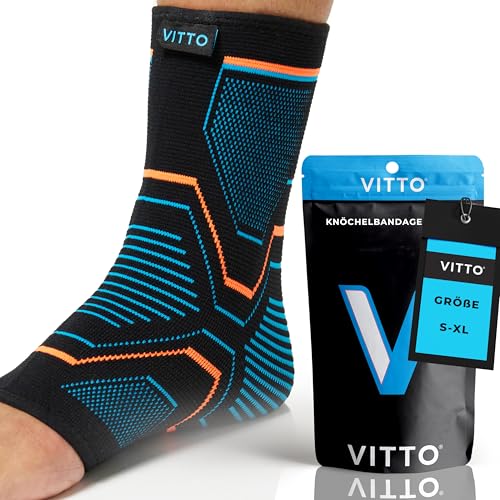
Soft ankle support for volleyball means a compression sleeve or kinesiology tape, not a rigid brace. A sleeve or tape adds mild compression and proprioceptive feedback, the sense of where your foot is in space, which can help with mild swelling, general achiness, or prevention during practice. It does not mechanically block a rolled ankle the way a lace-up or hinged brace does. If you have a history of ankle sprains or an active injury, a rigid brace and a doctor’s opinion matter more than a sleeve.
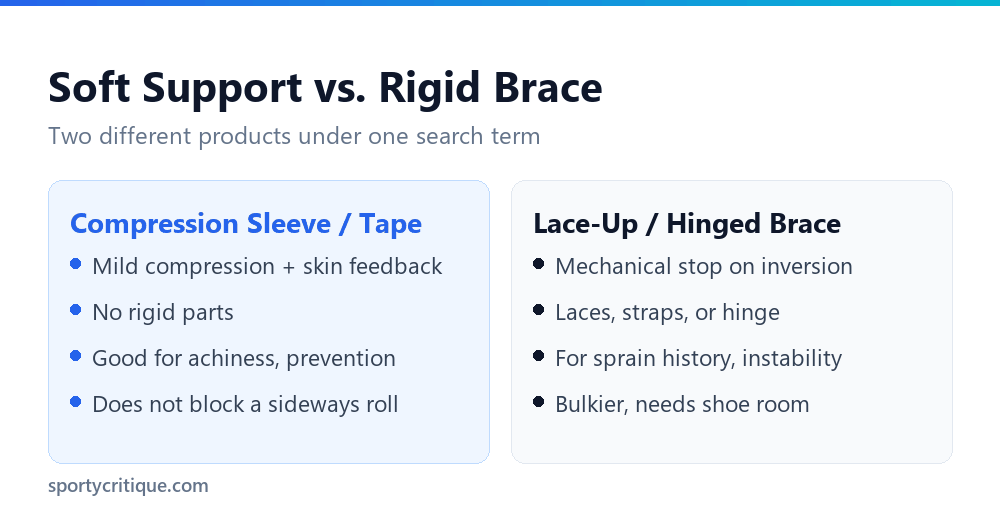
There are two very different products that both get called ankle support for volleyball, and mixing them up leads people to buy the wrong one. One is a rigid or semi-rigid brace, typically a lace-up shell or a hinged plastic stirrup, built to physically limit how far your ankle can roll sideways. The other is soft support: a compression sleeve or kinesiology tape, built from stretchy fabric or adhesive strips with no rigid parts at all. This guide covers only the second category. If you’re dealing with a real history of sprains or an unstable ankle, see our companion guide to rigid lace-up and hinged braces instead, which is a mechanically different product built for a different job.
- →Compression sleeves and kinesiology tape are soft support: no rigid parts, mild compression and feedback only
- →They do not mechanically block a sideways ankle roll the way a lace-up or hinged brace does
- →Good use cases: general achiness, mild swelling, warm-up feel, and prevention during normal practice
- →Poor use case: an actual history of sprains or a currently unstable ankle, where a rigid brace and a doctor’s input matter more
- →Sizing by measured ankle circumference, not shoe size, is what actually determines fit for a sleeve
Table of Contents
Compression sleeve vs. kinesiology tape vs. rigid brace
All three get marketed under the same “ankle support” search term, but they solve different problems. A sleeve is a pull-on fabric tube that applies even, mild compression around the joint. Tape is applied directly to skin in strips and can be positioned to support a specific movement pattern. A rigid brace, covered in our separate guide, adds actual mechanical stops, usually laces plus internal stays or a hinged plastic frame, that physically resist inversion, the inward-rolling motion that causes most volleyball ankle sprains.
What a compression sleeve actually does
A compression sleeve applies steady, even pressure around the ankle joint. That pressure does two things with reasonable evidence behind them: it can modestly reduce swelling after a long practice or tournament day, and it increases what’s called proprioception, your brain’s ongoing sense of where your ankle is positioned without looking at it. Better proprioception is quite useful for a jumping sport like volleyball, since a lot of landing control comes from unconscious joint-position feedback rather than a conscious correction after you’re already off balance.
What a sleeve does not do is stop your ankle from rolling past a dangerous range of motion. There’s no rigid material inside a compression sleeve, just knit fabric under tension. If your foot rolls hard onto its outer edge during a landing, a sleeve will not meaningfully resist that motion. Anyone marketing a plain compression sleeve as sprain prevention for an already-unstable ankle is overstating what the product can do.
What kinesiology tape actually does
Kinesiology tape is a thin, stretchy adhesive strip applied directly to skin in a specific pattern, usually running from the top of the foot up around the ankle in a way that gently resists the exact motion you’re trying to support. Unlike a sleeve, tape doesn’t compress the joint from all sides, it works more through skin tension and the same proprioceptive feedback mechanism: when the tape stretches as your ankle starts to roll, you feel it, which can prompt a faster correction than you’d otherwise make.
⚠️ Watch out: Tape is not a substitute for a rigid brace if you have a genuinely unstable ankle. Its resistance is far lower than a laced or hinged brace’s mechanical stop, and it loses adhesion and effectiveness within a single day of heavy sweating and movement. Use it as practice-day support or light prevention, not as your only protection coming back from a real sprain.
Our picks for soft ankle support
The Dr. Wolf Ankle Compression Sleeve (Medium) (about $18 at last check, only a handful left in stock, so availability moves fast) is a straightforward compression sleeve built for exactly the everyday-wear and-play case: it’s breathable enough for practice under a sock, applies even compression rather than one tight band, and doesn’t add bulk inside a shoe the way a bulkier brace does. It’s a reasonable default pick if you just want general support and mild swelling control without giving up any range of motion.
The Zensah Ankle Support Compression Sleeve (our product data feed did not return a current price or stock status for this listing at last check; confirm both on the Amazon page before buying) is a similar compression sleeve from a brand that specializes in compression sportswear rather than medical bracing, which shows in the fit: it’s cut closer to a running or training sleeve than a bulkier orthopedic one. That makes it comfortable for long practice sessions, though it also means it offers about the same limited mechanical support as any other pure compression sleeve.
For targeted, single-session support, the KT Tape Pro Kinesiology Therapeutic Tape, 20 Precut Strips (about $24 at last check, in stock) is a precut kinesiology tape that skips the trickier job of cutting your own strips from a roll. Precut strips matter more than it sounds for a first-time user, since getting the tension and shape right freehand takes practice, and a bad first attempt with cut-your-own tape can waste half the roll before you get a usable strip.
On a tighter budget, the CYCLXY Ankle Compression Sleeve, 2-Pair (our product data feed did not return a current price or stock status for this listing at last check; confirm both on the Amazon page before buying) sells a pair of compression sleeves rather than a single unit, which is useful if you want one for each ankle or a backup for when the first one is in the wash. It’s a simpler, less specialized construction than the two sleeves above, so treat it as the budget entry point in this category rather than the top pick.
How to size and apply soft support correctly
Size a compression sleeve by measuring your actual ankle circumference at its narrowest point, just above the ankle bone, not by your shoe size. Shoe size and ankle circumference don’t correlate closely enough to guess reliably, and a sleeve that’s too loose won’t compress enough to help, while one that’s too tight can restrict circulation during long matches.
Applying tape correctly matters more than the tape brand you choose. Apply it to clean, dry skin, since sweat and lotion both cause premature peeling. Most kinesiology tape should be applied 30 to 60 minutes before activity to let the adhesive fully bond, and it’s normal for it to lose noticeably some effectiveness after 6 to 8 hours of heavy sweating, which is why it suits single-session, practice-day use better than multi-day wear.
- ✓Wear a compression sleeve for general achiness, mild swelling, or everyday practice support
- ✓Use kinesiology tape for a specific practice session where you want extra feedback on one motion
- ✓Measure your actual ankle circumference before ordering a sleeve size
- ✓Replace tape between sessions rather than trying to reuse a peeling strip
- ✕Rely on a sleeve or tape alone if you have an actual history of ankle sprains
- ✕Expect tape to survive a full tournament day of heavy sweating without reapplication
- ✕Buy a sleeve by shoe size instead of measured ankle circumference
- ✕Treat soft support as a substitute for seeing a doctor after a real ankle injury
💡 Pro tip: If you’re not sure which category you need, ask yourself one question: has this ankle actually been sprained before? If yes, start with our guide to rigid lace-up and hinged braces and talk to a doctor or athletic trainer about your specific case. If no, and you just want general support or prevention, a sleeve or tape from this guide is the appropriate starting point.
When soft support really is not enough
If you feel your ankle repeatedly give way, if it swells noticeably after normal play without a specific injury event, or if you’re returning from a sprain within the last few months, soft support is the wrong tool for the underlying problem, even though it’s often the product people reach for first because it’s cheaper and less bulky. A rigid brace provides mechanical resistance a sleeve simply cannot, and a real, recurring instability issue is worth an actual medical evaluation rather than working around it with tape indefinitely.
A note on wearing soft support inside volleyball shoes
Compression sleeves add minimal bulk, which is one of their real advantages over a rigid brace: most players don’t need to size up their shoes to fit one comfortably. Kinesiology tape adds essentially none. If you find either one is forcing your shoe to feel noticeably tighter, that’s usually a sign the sleeve is the wrong size rather than a normal fit issue, and it’s worth sizing down or up before assuming you need looser shoes.
Bottom line
Reach for a compression sleeve or kinesiology tape when you want general support, mild swelling control, or extra movement feedback during normal play, not when you’re managing an actual unstable or previously sprained ankle. For that situation, a rigid lace-up or hinged brace, and a conversation with a doctor or athletic trainer, is the honest next step rather than reaching for tighter tape.
Can a compression sleeve prevent an ankle sprain in volleyball?
Not reliably. A sleeve can improve proprioceptive feedback, which may help you react faster to an awkward landing, but it has no rigid material to physically block a hard inward roll. For real sprain prevention after an injury history, a rigid brace is the appropriate product, not a sleeve.
Is kinesiology tape or a compression sleeve better for volleyball?
They solve slightly different problems. A sleeve gives even, all-around compression and is reusable across many sessions. Tape gives more targeted support along one direction of movement but only lasts one session before it needs reapplying. Many players use a sleeve for everyday practice and save tape for specific situations.
How long does kinesiology tape last during a volleyball match?
Usually around 6 to 8 hours of heavy activity before it starts to peel from sweat, sometimes less in hot, humid conditions. It’s meant for single-session use, not multi-day wear, and should be reapplied fresh for each practice or match.
Should I see a doctor instead of just buying a sleeve or brace?
If you’ve had a recent or repeated ankle sprain, yes. Over-the-counter soft support and braces are reasonable for general use and mild issues, but they are not a diagnosis or a substitute for a doctor or athletic trainer evaluating an actual injury or ongoing instability.
As an Amazon Associate, we earn from qualifying purchases through links on this page.