What Does an Outside Hitter Do in Volleyball? Role & Key Responsibilities

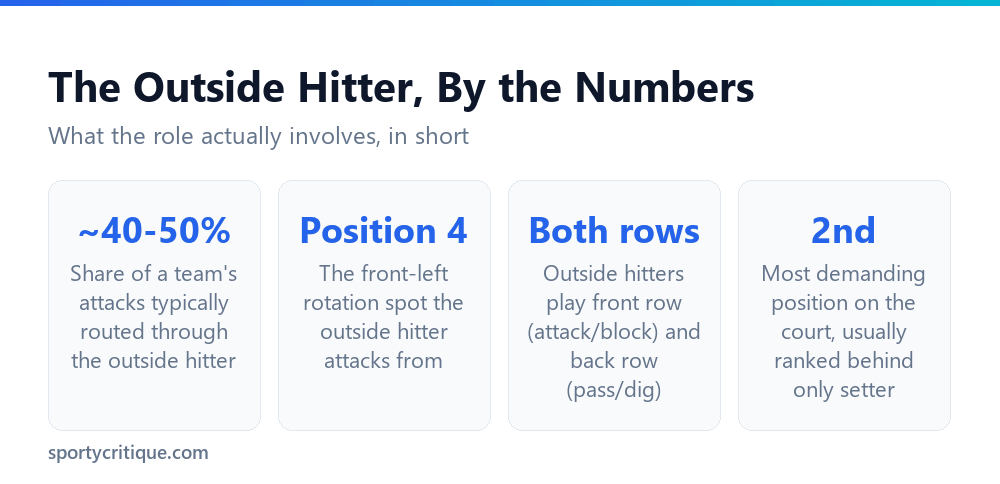
An outside hitter, also called a left-side hitter, is the volleyball position that attacks from the front-left (position 4) and typically receives the largest share of a team’s sets. The role isn’t just offense: outside hitters also pass in serve receive, dig in the back row, block the opponent’s right-side attacker, and help stabilize the offense when a play breaks down. It’s widely considered the second most demanding position on the court after the setter, since it’s involved in nearly every phase of play.
Most positions in volleyball specialize. A libero focuses almost entirely on passing and defense; a middle blocker focuses on blocking and quick-tempo attacks near the net. The outside hitter doesn’t get that specialization. It’s the position where a team asks one player to be reliable at nearly everything, which is exactly why it tends to be filled by some of the more well-rounded, experienced athletes on a roster.
- →Outside hitters attack from the front-left (position 4) and usually receive the most sets on the team
- →They pass in serve receive and dig in the back row, not just attack in the front row
- →Blocking the opponent’s right-side attacker is a core defensive responsibility
- →Outside hitters are the go-to option when a play breaks down, since the setter can get them the ball from almost any pass
- →The role requires jumping ability, quickness, and comfort adjusting to imperfect sets, more than any single specialized skill
Table of Contents
The Attacking Role: Volume and Adaptability
Outside hitters typically receive more sets over the course of a match than any other attacker, often somewhere in the 40 to 50 percent range of a team’s total attacks depending on system and opponent. That volume comes with a trade-off: the sets an outside hitter gets aren’t always the cleanest ones. When a pass is off-target or a play breaks down, the setter frequently defaults to the outside, since it’s a reliable option from almost any pass location on the court.
That means an outside hitter has to be comfortable attacking from a wide range of set locations and tempos, not just a single go-to set run under ideal conditions. A middle blocker’s quick attacks depend on a precise, fast set; an outside hitter’s job includes making something useful happen even when the set isn’t perfect, which is a genuinely different skill than pure attacking power or vertical.
Passing and Defensive Responsibilities
Outside hitters rotate through the back row like every other position, and in that rotation they’re a primary passer in serve receive alongside the libero and any other back-row passers. A team that can’t trust its outside hitters to pass consistently loses a significant chunk of its serve-receive stability, since outside hitters typically cover a meaningful portion of the court during that phase.
In the back row, outside hitters also dig, reading and reacting to opposing attacks the same way any back-row defender does. This is where the position’s dual demand really shows: an outside hitter who’s spent the rally attacking from the front row has to reset and defend from the back row on the very next point, with no specialization break the way a true single-role player gets.
Blocking the Opponent’s Right Side
When in the front row, outside hitters are responsible for blocking the opposing team’s right-side (opposite) attacker, working closely with the middle blocker to read and cover that attack. This requires constant in-game communication, tracking which opposing hitters are running which plays and coordinating block timing with the middle, rather than blocking in isolation.
💡 Pro tip: Watching an outside hitter’s footwork before a block, not just their arms, reveals a lot about their blocking IQ. Good outside blockers are already shifting their feet and reading the set before the opposing hitter even makes contact, rather than reacting purely off the swing.
How the Outside Hitter’s Job Changes Through the Rotation
Volleyball’s rotation rules mean every player, including the outside hitter, cycles through all six court positions over the course of a set, not just their specialty spot. When the outside hitter rotates to the front row, they’re primarily attacking and blocking; when they rotate to the back row, the job shifts almost entirely to passing and digging, with no attacking responsibility at all from behind the ten-foot line except in specific back-row attack situations.
That constant job-shifting is part of what makes the position demanding to learn. A player has to mentally and physically switch modes every time the rotation cycles, from aggressive, attacking front-row play to controlled, read-and-react back-row defense, sometimes within the same rally if a rotation happens to land that way. Positions with a narrower job description don’t ask for that same constant mode-switching.
Fatigue management becomes a real factor across a long match because of this back-and-forth. An outside hitter who’s just finished a physically demanding attacking sequence has to reset quickly into a controlled defensive posture on the very next rally, with no built-in recovery window the way a substituted-out middle blocker sometimes gets. Conditioning specifically for that repeated mode-switch, not just general fitness, is part of what separates outside hitters who hold up over a full match from those who fade in the closing sets.
How the Team’s Offensive System Changes the Role
In a 5-1 system, the most common setup above the youth level, a team runs one setter for the entire match regardless of rotation, and outside hitters attack from the front row on three of six rotations, spending the other three in the back row. In a 6-2 system, common in some youth and high school programs, a second setter comes in from the back row to set whenever the primary setter is in the front row, which changes the attacking math and can put more consistent front-row hitters on the floor at once.
For an outside hitter specifically, a 6-2 system sometimes means facing a different setter’s tendencies depending on rotation, which asks for extra adaptability in timing and communication compared to working with a single, consistent setter all match in a 5-1. Neither system changes the fundamental job description of the position, but it’s worth understanding which system a team runs when trying to make sense of why an outside hitter’s role looks slightly different from one team or level to the next.
Developing Into the Position
Younger or less experienced players moving into outside hitter often come from a background as a generally athletic, multi-skill player rather than a specialist in one area, since the position doesn’t reward narrow specialization the way middle blocker or libero can. Coaches frequently look for a player who’s already comfortable both attacking and passing at a reasonable level before fully committing them to the outside hitter role, rather than developing one skill in isolation and hoping the other catches up later.
Passing tends to be the harder skill to develop for a naturally strong attacker moving into the position, since attacking rewards aggression and power while passing rewards control and quiet footwork, almost opposite instincts. Deliberately splitting practice time between attacking reps and serve-receive reps, rather than letting attacking practice dominate simply because it’s more fun, is a common recommendation from coaches working with developing outside hitters.
⚠️ Watch out: A common developmental mistake is treating outside hitter purely as an attacking position and under-training the passing and defensive side, since attacking gets more attention and highlight-reel visibility. A team relying on an outside hitter who can’t pass under pressure creates an exploitable weakness that opposing servers will target directly.
Watching game film specifically for the outside hitter’s touches outside of attacking, their passes, digs, and blocking footwork, gives a more complete picture of their actual readiness for the position than highlight clips of kills alone. Coaches evaluating a player for the role typically weigh that fuller picture heavily, since a team can usually find a pure attacker more easily than it can find someone reliable across all four core responsibilities at once.
Outside Hitter vs. Other Front-Row Positions
What Makes a Good Outside Hitter
- ✓Attack confidently from imperfect or off-tempo sets
- ✓Pass consistently in serve receive, not just attack well
- ✓Communicate blocking assignments clearly with the middle
- ✓Stay engaged defensively even after a hard attacking sequence
- ✕Relying purely on power while ignoring shot placement and adaptability
- ✕Treating passing as a secondary skill not worth developing
- ✕Blocking in isolation without reading the middle’s positioning
- ✕Checking out defensively after finishing an attacking swing
📊 Note: Because outside hitters play extensively in both the front row (attacking, blocking) and back row (passing, digging), knee protection matters more for this position than for a role that stays mostly near the net. A low-profile pad like the Mizuno LR6 Volleyball Kneepad (check current price on the listing) is a common choice for players who dig frequently and need to move quickly without a bulky pad slowing footwork.
Frequently Asked Questions
Is outside hitter the hardest position in volleyball?
It’s widely considered the second hardest after setter, since it combines high-volume attacking with serious passing and defensive responsibility. Setter is generally ranked hardest because of the decision-making and touch demands involved in running the entire offense.
What’s the difference between an outside hitter and an opposite hitter?
The outside hitter attacks primarily from the front-left (position 4) and typically receives more sets overall, while the opposite (right-side) hitter attacks from the front-right and usually plays less in the back row, since many systems substitute a different player in for the opposite when they rotate back.
Do outside hitters need to be tall?
Height helps for attacking and blocking, but it’s not a strict requirement the way it sometimes is for middle blocker. Vertical jump, arm swing mechanics, and all-around skill across passing and defense matter at least as much as raw height at most levels of play.
Why do outside hitters get so many sets?
Because they’re a reliable target from almost any pass location, not just a clean, well-placed one. When a play breaks down or the pass is imperfect, setters default to the outside far more often than to positions that need a precise set to attack effectively.
What’s the difference between a 5-1 and 6-2 system for an outside hitter?
In a 5-1, one setter runs the whole match, so an outside hitter works with the same setter’s timing and tendencies throughout. In a 6-2, a second setter comes in from the back row depending on rotation, which means an outside hitter may face two different setters’ tendencies across a single match, requiring extra communication and adaptability.
Can a smaller or shorter player succeed as an outside hitter?
Yes, though it usually requires compensating with strong vertical jump, quick approach footwork, and precise shot placement rather than relying on height and reach alone. Passing and defensive skill also matter enough at this position that a smaller, all-around athletic player can be highly effective even without elite height.
Understanding the full scope of the role, not just the attacking highlights, makes it easier to appreciate why coaches value a genuinely well-rounded outside hitter over a one-dimensional power attacker on paper.
As an Amazon Associate, we earn from qualifying purchases through links on this page.