Best Vibration Dampeners for Badminton Rackets


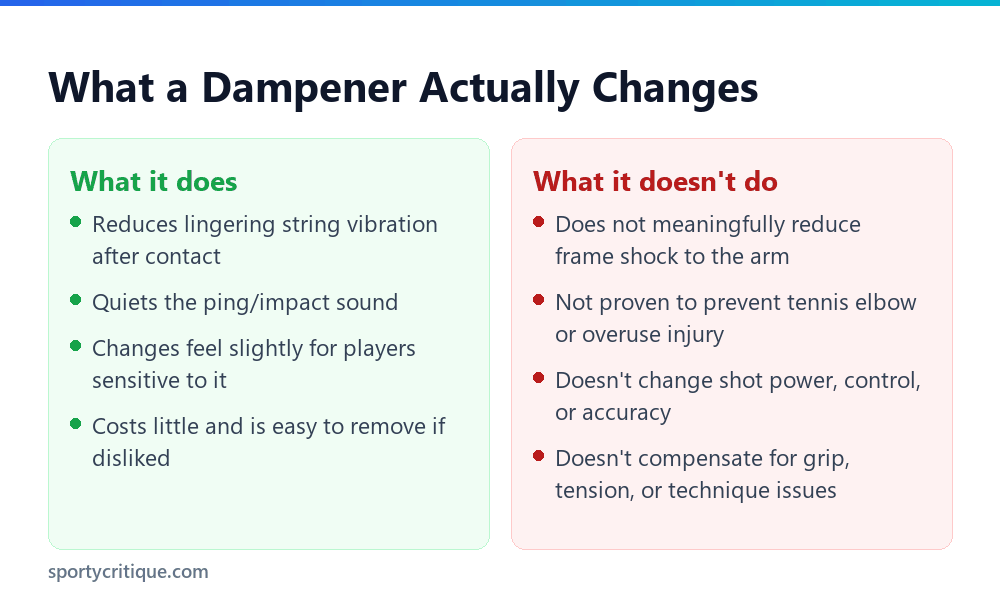
A badminton racket vibration dampener is a small piece of silicone or rubber that clips or threads into the string bed near the throat of the racket. It reduces the lingering string vibration and the ping sound after contact, which some players find more comfortable, but it does not meaningfully reduce the frame shock that travels into the arm, and it has no proven role in preventing injury. It’s a genuine comfort and feel accessory, not protective equipment, despite how some listings market it.
Vibration dampeners are a much bigger deal in tennis than in badminton, and most of the products sold under this name are tennis accessories with “badminton” added to the listing title to widen search reach. That doesn’t make them fake or unusable on a badminton racket; Yonex sells its own dampener specifically for its rackets, and plenty of players use a generic silicone dampener without issue. It just means the category is smaller and less essential for badminton than the marketing around it sometimes implies.
The honest case for one is comfort and preference, not performance or injury prevention. Some players like the quieter, softer feel at contact; others specifically prefer the unmuted feedback and sound, since it helps them judge shuttle contact quality by ear. Neither preference is wrong, and the difference it makes to actual play is genuinely minor either way.
- →A dampener reduces string vibration and impact sound; it does not meaningfully reduce frame shock into the arm
- →There’s no solid evidence it prevents tennis elbow or similar overuse injuries, despite some marketing claims
- →The main real benefit is comfort and personal feel preference, not performance
- →Yonex makes a badminton-branded dampener; most other options are generic multi-sport silicone accessories
- →It’s a low-cost, low-risk accessory to try, just don’t expect it to fix a swing or protect against injury on its own
Table of Contents
What a Vibration Dampener Actually Does
When a shuttle contacts the strings, the strings vibrate briefly and produce both a sound and a lingering hum that a player can feel through the grip. A dampener, wedged or clipped between two of the main strings near the bottom of the string bed, absorbs some of that lingering string vibration and quiets the ping. That’s the mechanism, and it’s a real, measurable effect on string behavior specifically.
What it doesn’t do is meaningfully change the structural shock that travels through the racket frame and into the forearm on contact. That frame vibration is a separate physical phenomenon from string vibration, driven by the racket’s own material and construction, not by anything happening at the string bed. A dampener sitting on the strings has essentially no ability to intercept it.
The Tennis Elbow and Injury-Prevention Claims
Some dampener listings market the product as reducing the risk of tennis elbow or similar overuse injuries. That claim isn’t well supported. Since string vibration and frame shock are separate physical effects, and a dampener only addresses the string side, there’s no strong mechanical reason to expect it to meaningfully change injury risk, and no solid research confirming that it does.
⚠️ Watch out: Treat any “reduces tennis elbow risk” or similar injury-prevention claim on a dampener listing as marketing language rather than an established fact. If elbow or wrist pain is a real, ongoing issue, string tension, grip size, racket weight and balance, and stroke technique are all more likely culprits worth checking before assuming a small string accessory will fix it.
This same pattern shows up across a lot of racket-sport accessories: a genuine, minor effect on feel gets marketed as a solution to a much bigger problem, like injury or performance, because that framing sells better than the honest, smaller claim. It’s worth applying the same skepticism to other accessory marketing beyond dampeners specifically, not just this one product category.
4 Real Dampeners, Compared
📊 Note: None of these four differ in any way that changes performance. The choice between them is entirely about mounting style, appearance, and price, not effectiveness, since the underlying mechanism (a small piece of silicone or rubber contacting the strings) is essentially the same across all of them. A novelty design like the Luckyones option costs more purely for the styling, not for any measurable improvement in how well it dampens string vibration.
How It Attaches and Whether It Fits Your Racket
Most dampeners either clip over two adjacent main strings or thread through a small gap near the throat of the racket, below the lowest cross string. Badminton string beds are strung at much higher tension and with far thinner string than tennis rackets, and the string spacing near the throat can be tighter, so a dampener designed primarily for a tennis string pattern doesn’t always seat as cleanly on a badminton racket.
Yonex’s own dampener is sized with badminton string spacing in mind, which is the practical advantage of choosing a badminton-specific option over a generic tennis dampener, separate from any difference in how well it actually dampens vibration. A dampener that doesn’t seat securely tends to work loose and fall out during play, which is more of a nuisance than a real problem but worth knowing before buying a generic option.
Whether to Bother With One
- ✓Try one if the ping sound or string vibration genuinely bothers you
- ✓Choose a badminton-sized option if fit and secure seating matter to you
- ✓Treat it as a comfort accessory, not injury prevention
- ✓Look elsewhere (grip size, string tension, technique) if elbow or wrist pain is the real concern
- ✕Expecting it to reduce injury risk or protect the arm
- ✕Assuming a more expensive dampener performs meaningfully better than a cheap one
- ✕Buying one specifically to fix a technique-related pain issue
- ✕Worrying if it works loose occasionally; that’s a fit issue, not a defect
Does String Tension Change Whether You Need One?
Badminton rackets are strung far tighter than tennis rackets, commonly in the 20 to 30 pound range for recreational players and higher for advanced players, compared to roughly half that for a typical tennis string bed. Higher tension strings vibrate less and settle faster on their own than a looser string bed does, which means the string-vibration effect a dampener addresses is already smaller on a tightly strung badminton racket than it would be on a loosely strung one.
Practically, that means a player at the higher end of typical badminton stringing tension notices less difference from adding a dampener than a player stringing on the lower end of the range. It’s not a reason to avoid one, just a reason to keep expectations modest: the higher the tension, the smaller the vibration a dampener has left to reduce in the first place.
💡 Pro tip: If string vibration or the impact sound is the actual complaint, checking whether the racket is due for a restring is worth doing before buying a dampener. Old, dead strings that have lost tension over months of play vibrate and sound different than freshly strung ones, and a restring sometimes resolves the exact discomfort a dampener would only partially mask.
A Low-Cost Way to Test the Preference
Because the entire category costs somewhere between roughly $10 and $25 and installs in seconds without tools, there’s little reason to research extensively before trying one. Playing a single session with a dampener installed and one without, back to back, tells a player more about their own preference than any amount of reading about the mechanism.
Removing one is just as quick as installing it, so there’s no real commitment involved beyond the small purchase price. Players who try one and don’t notice or care about the difference haven’t wasted much; players who do notice a preference now have a cheap, simple answer for every racket they own going forward.
It’s worth testing during a normal practice session rather than a match, since the goal is noticing a subtle difference in feel and sound, not evaluating it under competitive pressure where attention is elsewhere. A few dozen clears, smashes, and net shots with and without the dampener installed is usually enough repetition to form a real opinion, well before it’s worth spending more time or money chasing a marginal accessory decision any further.
Why Some Players Skip It Entirely
A meaningful number of players, including many at a high competitive level, don’t use a dampener at all and prefer the unmuted feedback from the strings. That feedback, the specific sound and feel of a clean hit versus a mishit, is genuinely useful information some players rely on to judge shot quality by ear and feel, particularly on fast net exchanges where visual feedback alone isn’t enough.
There’s no competitive disadvantage either way. This comes down to personal preference rather than a performance trade-off, which is part of why the product category stays small and simple: there’s no meaningful incentive to buy an expensive one over a cheap one, and no real cost to skipping the accessory altogether.
Frequently Asked Questions
Do vibration dampeners actually reduce tennis elbow risk in badminton?
There’s no solid evidence supporting that claim. Dampeners address string vibration, not the frame shock more closely associated with overuse injuries. Grip size, string tension, and stroke technique are more relevant factors if elbow or wrist pain is a real concern.
Can I use a tennis vibration dampener on a badminton racket?
Often, yes, though fit can be inconsistent since badminton string beds are strung tighter and with thinner string. A badminton-specific option, like Yonex’s own dampener, tends to seat more securely, but a generic tennis dampener will frequently still work.
Does a more expensive dampener perform better?
Not meaningfully. The mechanism is essentially the same across nearly every dampener on the market: a small piece of silicone or rubber contacting the strings. Price differences mostly reflect branding, styling, and mounting design, not measurably better vibration reduction.
Will a dampener change how my shots feel?
Slightly. It quiets the impact sound and reduces some of the lingering string hum, which some players find more comfortable and others find less informative. It won’t change shot power, control, or accuracy in any meaningful way.
Do professional badminton players use vibration dampeners?
Some do, most don’t, and it’s not something broadcasters or equipment coverage tends to track closely since it makes so little difference to outcomes. Unlike string tension or racket weight, which pros discuss and adjust deliberately, dampener use tends to be a minor personal habit rather than a documented equipment choice.
Does a fresh restring reduce the need for a dampener?
Often, yes, at least partially. Strings that have gone dead from age and repeated impact vibrate and sound different than freshly strung ones, and a restring sometimes resolves the specific string-noise or feel complaint a dampener would otherwise only partially address.
Bottom line: buy one if the idea appeals to you, skip it if it doesn’t, and don’t let either choice become a bigger decision than the small, low-stakes accessory purchase it actually is.
As an Amazon Associate, we earn from qualifying purchases through links on this page.