How to Block in Volleyball: Swing Blocking, Net Penetration, and Footwork Mechanics

SportyCritique is reader-supported. When you purchase through links on our site, we may earn an affiliate commission at no extra cost to you. As an Amazon Associate, we earn from qualifying purchases.
In competitive volleyball, the block is the first line of defense and the most demoralizing offensive shutdown in the sport. Yet most beginner and intermediate front-row players fundamentally misunderstand how blocking works. They treat a block as an attempt to jump straight up and swat at the ball like a flyswatter, or they jump with their hands straight up in the air, creating a flat wall that attackers gleefully bounce balls off out of bounds.
A true block is not an upward jump; it is an act of aggressive net penetration. Your job as a blocker is to take away court space, funnel the ball to your back-row defenders, or “roof” the ball straight down onto the opponent’s side of the 10-foot line. To master how front-row blocking synchronizes with offensive attacks and back-row defense, explore our central Volleyball Guide.
Table of Contents
Swing Blocking vs. Traditional Shuffle Blocking
Modern volleyball uses two primary footwork techniques to move along the net: traditional slide-step (shuffle) blocking and swing blocking. Selecting the right footwork depends on the speed of the opponent’s set and your defensive role.
| Feature | Traditional Shuffle (Slide-Step) Blocking | Modern Swing Blocking |
|---|---|---|
| Footwork Pattern | Lateral shuffle steps along the net tape; torso stays strictly square to the mesh | Directional pivot step → long crossover stride → explosive penultimate brake plant |
| Vertical Lift Advantage | Standard vertical jump (limited to leg drive alone) | Generates 2 to 4 extra inches of vertical jump lift via dynamic arm swing momentum |
| Court Coverage Speed | Slower; best for short movements (3–6 feet) | Extremely fast; covers 10–15 feet from middle to outside pin in under 1.2 seconds |
| Net Penetration Timing | Predictable; hands rise close to chest and press over tape | Deep, wrapping penetration; requires precise arm control to avoid net contact |
| Primary Vulnerability | Can arrive late to fast pin sets, leaving open seams | High risk of lateral drifting into the net mesh or across the centerline if plant foot slips |
| Best Applied To | Recreational play, quick middle slide defense, or tight off-target sets | Club, high school, collegiate, and international competitive play |
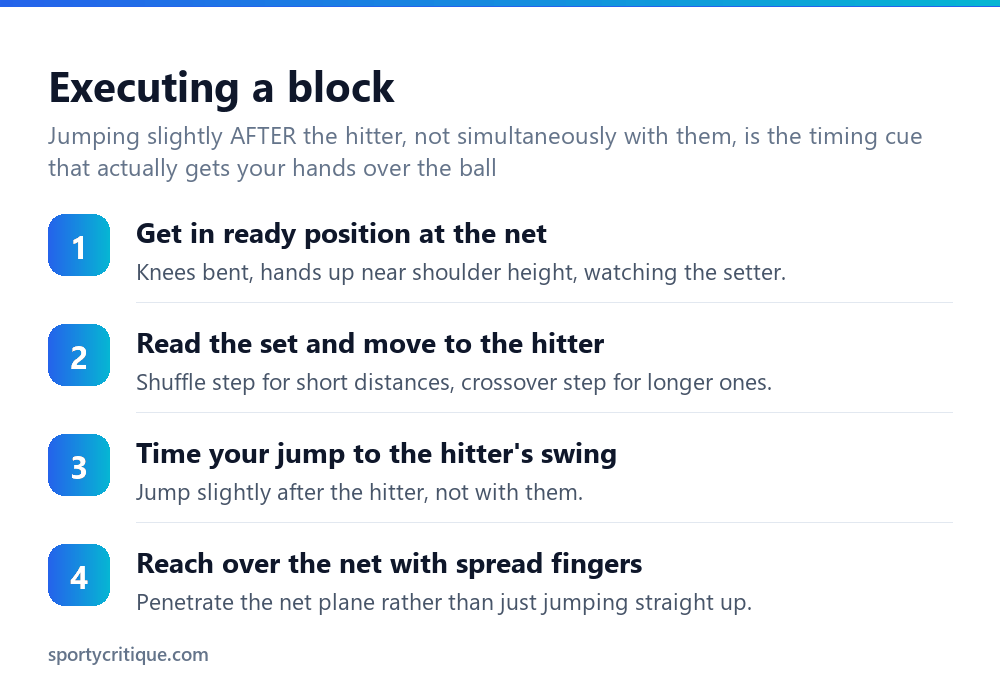
5 Steps to Executing a Dominant Roof Block
Whether you execute a lateral shuffle or a full swing approach, clean contact over the net follows five non-negotiable physical steps:
- Starting Base & Eye Sequence: Stand half an arm’s length (about 12–18 inches) off the net mesh with your knees bent to 100 degrees, hands raised at chest height, palms facing forward. Execute the official blocking eye sequence: Ball → Setter → Ball → Hitter. Watch the setter’s hand release to identify the set direction, then fix your eyes entirely on the approaching hitter’s hitting shoulder.
- The Directional Plant: Drive toward your blocking assignment. On your final step, plant your outside foot firmly, turning your toe 30 degrees inward toward the center of the court. This blocks your lateral momentum and directs 100% of your kinetic energy straight upward.
- Vertical Lift (Zero Drift): Jump straight up. If your body drifts sideways while airborne, you create an unstable landing zone, risk rolling an ankle on your teammate’s foot, and open an easy seam for the attacker to exploit.
- Deep Net Penetration: Do not reach toward the ceiling. As your shoulders clear the net tape, drive your arms forward and down into the opponent’s airspace. Press your hands as close to the ball as possible without contacting the net mesh. Your hands should form a roof over the net, angled downward at a 45-degree pitch into the opponent’s court.
- The Soft Two-Foot Landing: Land balanced on the balls of both feet simultaneously, bending your knees deeply to absorb the impact. Retract your arms clean from the net before your torso descends, avoiding incidental contact with the net tape.
Hand Position: How to Prevent Getting “Tooled”
Getting “tooled” (wiped) occurs when an attacker deliberately hits the ball off the outside of your hands or fingers so it deflects wide out of bounds. Attackers love lazy blockers whose hands flare outward. To prevent getting tooled, implement these three hand rules:
- Spread fingers wide and rigid: Open your fingers as wide as possible like starfish. Stiff, flexed fingers resist the shock of a 60 mph spike without bending backward or suffering sprains.
- Maintain a 6-inch hand gap: Your hands should be separated by roughly 6 inches—narrow enough that a volleyball (which has an 8.2-inch diameter) cannot squeeze through between them, but wide enough to cover maximum defensive area.
- Turn the outside hand inward: If you are blocking on the outside pin (Zone 4 or Zone 2), your outside hand is the primary target for attackers. Turn your outside wrist inward toward the center of the opponent’s court (thumb pointing up, pinky pointing forward). If the attacker attempts to swipe the ball off your hands, the inward angle deflects the ball straight down inside their sideline for a point.
Double Blocking: How the Pin and Middle Close the Seam
Single blocking is rarely effective against elite attackers. The standard defense requires a double block, where the middle blocker moves laterally to join the outside or right-side pin blocker.
In a double block, each player has a clear responsibility:
- The Pin Blocker Sets the Anchor: The pin blocker (left-side or right-side front) sets the position of the block. They line up on the hitter’s hitting shoulder and take away the down-the-line attack. The pin blocker jumps first and sets the wall.
- The Middle Blocker Closes the Seam: The middle blocker’s single priority is to close the space (“the seam”) between their inside arm and the pin blocker’s outside arm. There must be zero space between their adjacent shoulders. If a ball splits between two blockers, it is always the middle blocker’s responsibility for failing to close early.
- Clear Calling & Commitment: The middle blocker must call out the hitter before the whistle: “Watch the slide!” or “I’ve got quick middle!” Once the set is released, commit fully to closing the wall.
Official Rules: Net Touches, Airspace, and Centerline
Blocking involves the most contentious rule interactions in volleyball. Understand the official FIVB and USAV rulebook definitions:
- Reaching Over the Net (FIVB 14.3 / USAV 14.3): A blocker is legally permitted to place their hands and arms beyond the net into the opponent’s space, provided this does not interfere with the opponent’s play. You cannot touch the ball on the opponent’s side until the opponent has executed their attack hit. Intercepting a ball while the opponent’s setter is attempting to set it is an illegal over-the-net fault.
- Net Contact Rule: Under modern FIVB, USAV, and NCAA rules, contact with any part of the net between the antennas during the action of playing the ball is a net violation. Touching the net with your jersey, arms, or chest while jumping, blocking, or landing awards the point to the opponent.
- The Centerline Encroachment: Crossing under the net into the opponent’s court with any part of your body is permitted only if some part of your foot or hand remains on or directly above the centerline, and the action does not interfere with the opponent’s movement. Stepping entirely across the line or contacting an opponent under the net is an immediate fault.
- Back-Row Blocker Fault: A back-row player or Libero cannot participate in a completed block. If a back-row player jumps near the net with hands above the tape and the ball touches them or an adjacent teammate’s block, an illegal back-row block fault is whistled.
- Block Touches Do Not Count Toward the 3 Touches: Under standard indoor rules, a touch off a blocker’s hands does not count as the first team contact. Your team still has three full touches to return the ball (Pass → Set → Attack), and the blocker who touched the ball is legally permitted to make the very next touch.
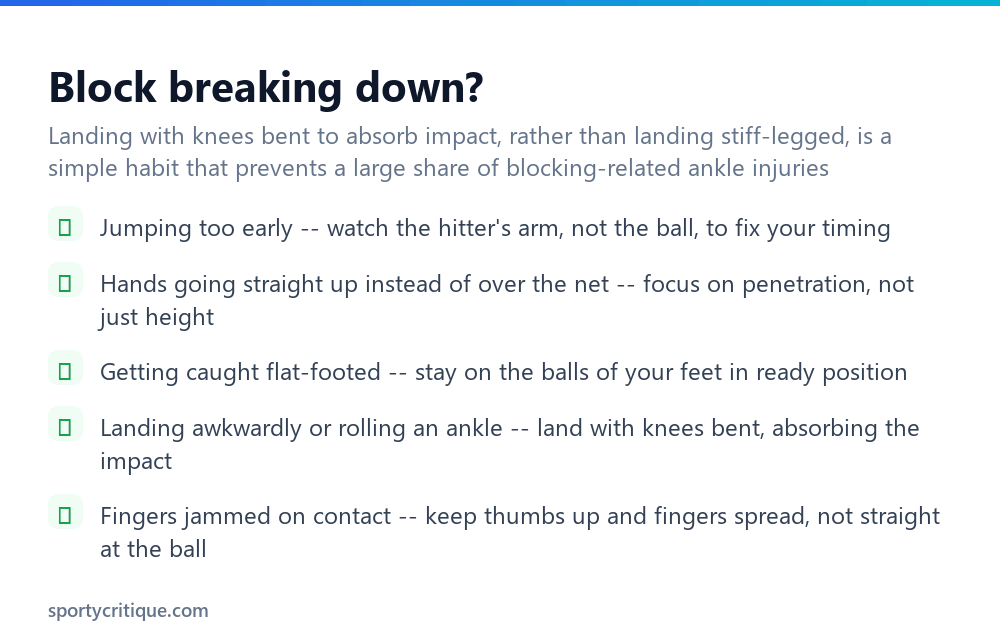
Diagnostic Troubleshooting: 6 Common Blocking Faults & Fixes
If your blocks are missing, getting tooled, or resulting in net violations, use this diagnostic table to correct your form:
| Observable Symptom | Biomechanical Root Cause | Immediate Correction Cue |
|---|---|---|
| Ball repeatedly pushed off hands out of bounds (Getting Tooled) | Hands are flat or flared outward toward sidelines with soft wrists | Angle outside wrist 45° inward toward middle of court; lock wrists and spread fingers rigid |
| Frequent net violations on chest or arms | Jumping forward into the net mesh rather than driving straight up from a planted brake step | Start 18 inches off the net; plant your block foot firmly and push momentum vertically |
| Ball consistently splits between two blockers | Middle blocker is arriving late and failing to close the seam with the pin blocker | Middle must anticipate the set earlier using swing footwork; seal shoulders shoulder-to-shoulder |
| Getting whistled for reaching over the net | Touching the ball before or during the opponent’s attack swing or setting motion | Wait for the attacker to make contact before pressing your hands across the plane |
| Ball ricochets down between chest and net | Failing to penetrate; keeping hands straight up in the air rather than pressing forward over the tape | Shrug shoulders forward and drive wrists 6–12 inches over the tape into the opponent’s space |
| Ankle injuries on landing | Drifting laterally across the centerline into the opponent’s landing zone | Plant your block foot turned inward on your approach to eliminate sideways drift before takeoff |
Essential Training Equipment for Front-Row Blockers
Blocking subjects fingers, ankles, and knees to severe repetitive stress. These four training tools and protective gear items help front-row players practice safely and aggressively:
| Product | Category / Purpose | Key Specifications | Target Benefit | Check Price |
|---|---|---|---|---|
| Tandem Sport Volleyball Blockers | Defensive Blocking Simulator | Two padded foam blocking arms with secure net straps | Allows hitters to practice tooling the block while saving blockers’ fingers from injury | View on Amazon |
| Mizuno Wave Momentum 3 Volleyball Shoes | Max Cushion & Lateral Stability Footwear | Full-length Enerzy foam, high ankle collar, non-marking gum rubber outsole | Absorbs heavy vertical landing shock and prevents ankle rolls during crossover swing steps | View on Amazon |
| Mueller Finger Tape & Splint Wrap | Finger Protection & Joint Support | 100% cotton athletic tape, zinc oxide adhesive, non-elastic rigid support | Buddy-tapes middle and ring fingers together to protect joints against 60+ mph spikes | View on Amazon |
| Active Ankle T2 Rigid Ankle Brace | Ankle Roll Protection | Rigid bilateral plastic shell with padded foam inner lining and single strap | Prevents catastrophic ankle sprains when landing near the centerline or teammate feet | View on Amazon |
Frequently Asked Questions
Does a block count as one of your team’s three touches?
In standard indoor volleyball governed by FIVB, USAV, and NCAA rules, a touch off a blocker’s hands does NOT count as one of the team’s three touches. The team still has three full contacts to pass, set, and attack the ball. Additionally, the player who touched the block may immediately make the next contact (contact 1). Note that in beach volleyball, a block DOES count as the first of your team’s three contacts.
Can you legally reach over the net to block a volleyball?
Yes. Blockers are legally permitted to penetrate their hands and arms across the vertical plane of the net into the opponent’s space, provided they do not touch the ball before or during the opponent’s attack hit, and provided they do not touch the net mesh. You must allow the opponent to initiate their attacking contact before you touch the ball.
Can a back-row player or Libero block in volleyball?
No. Back-row players and Liberos are strictly prohibited from participating in a completed block. A back-row player may not jump near the net with any part of their body higher than the top of the net and touch the ball, or be part of a block with a teammate when the ball is touched. Doing so results in an immediate illegal back-row block violation.
What is a “soft block” in volleyball?
A soft block (often called a “touch” or “up-block”) is executed when a blocker realizes they cannot penetrate deeply over the net to roof the ball straight down. Instead of penetrating forward, the blocker tilts their hands backward toward their own court with fingers relaxed, aiming to deflect the spike high into the air so their back-row teammates can easily pass and transition into an offense.
How can a shorter player block effectively against tall hitters?
Shorter blockers should prioritize penetration and timing over absolute height. Jump a fraction of a second later than the hitter to meet the ball at its descending angle. Focus on taking away one specific angle (such as the line) rather than trying to cover the entire net, allowing your back-row defenders to dig the remaining cross-court space. Shorter players can also excel at soft blocking by angling hands back to redirect power hits upward.
Deepen Your Volleyball Skills:
- Volleyball Cornerstone Guide — Master rules, court dimensions, positions, and gear guides.
- How to Spike a Volleyball — In-depth vertical approach, penultimate brake, and attack timing.
- How to Hit a Volleyball — Passing, setting, attacking, and defensive digging mechanics.
- How to Overhand Serve — Step-by-step float mechanics, toss drills, and seam targeting.
- How to Serve a Volleyball — Breakdown of underhand, float, topspin, and jump serves.
- Volleyball PSI & Inflation Guide — Regulation air pressure standards for indoor and beach play.
- How to Play Volleyball — Complete beginner rules, rotations, and scoring system.
- How Volleyball Scoring Works — Rally scoring rules, side-outs, and tiebreak sets.