Volleyball Rotation Rules Explained: 5-1 vs 6-2, Attack Line

Six players, six positions, and a rule that only applies for a split second at serve contact, then effectively disappears for the rest of the rally. That combination is exactly why rotation confuses more beginners than any other volleyball rule.
Short answer: Teams rotate one position clockwise (1 to 6 to 5 to 4 to 3 to 2 to 1) every time they win back the serve. Alignment rules apply only at the moment of serve contact; after that, players can move anywhere. Front-row players (zones 2, 3, 4) may attack and block above the net; back-row players (1, 5, 6) may not complete an attack above net height in front of the attack line. The 5-1 offense uses one setter running every rotation; the 6-2 uses two setters, giving three front-row attackers in every rotation instead of two. Verified across multiple dedicated coaching sources on 10 September 2026.
📊 Note: This site’s beginner-level “how to play volleyball” guide covers rotation at an introductory level, enough to walk onto a court without being lost. This piece goes further: full rotation-order mechanics, the 5-1 vs. 6-2 system trade-off, and back-row attack-line rule detail the beginner guide deliberately doesn’t cover.
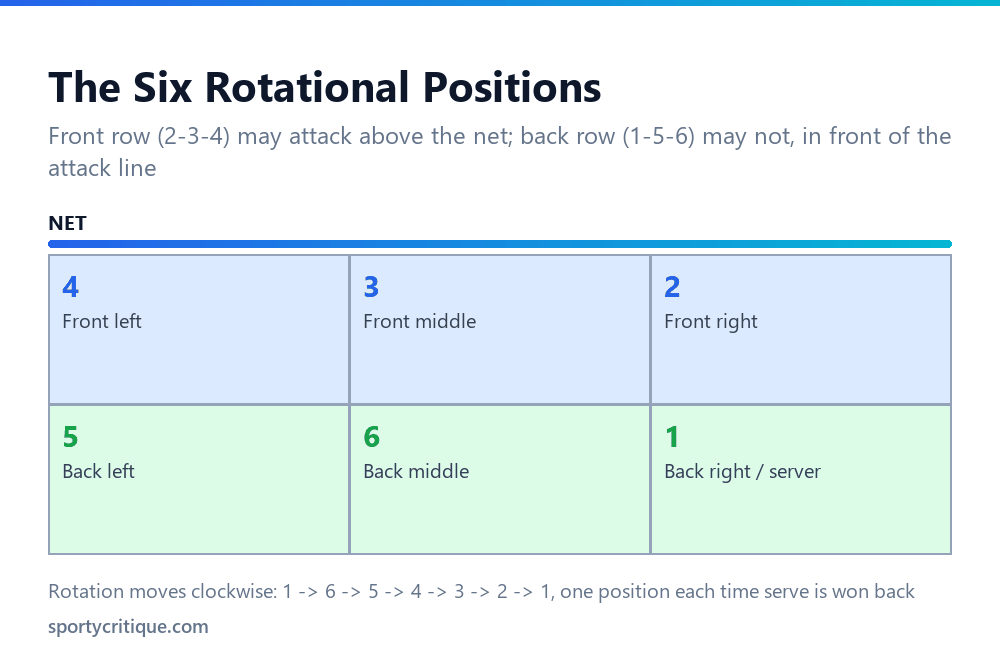
Table of Contents
The Rotation Order, Precisely
Every time a team wins back the serve (a side-out), all six players rotate one position clockwise through the six zones: position 1 moves to 6, 6 moves to 5, 5 moves to 4, 4 moves to 3, 3 moves to 2, and 2 moves to 1, the serving position. This is the only mechanical trigger for rotation, a team does not rotate after winning a point on their own serve, only after winning the serve back from the opponent. Understanding that distinction, rotation on a side-out, not on every point scored, resolves most of the confusion beginners have about when rotation is actually supposed to happen.
Why the Rule Only Applies at the Moment of Serve
This is the detail that trips up more experienced players trying to explain rotation to newcomers: positional alignment rules apply strictly at the moment the server contacts the ball, and only then. The instant that contact happens, players are free to move anywhere on the court, a setter releases to their target position, hitters move into their attacking lanes, and back-row players shift to cover defense, regardless of their nominal rotational position. Watching a team’s actual court positioning mid-rally and trying to reverse-engineer their rotation order from it doesn’t work, because that positioning has nothing to do with the rotation rule once the point is underway.
⚠️ Watch out: A common refereeing and self-officiated dispute involves overlap violations, illegal positioning relative to adjacent players at the moment of serve. Those rules are about position at that single instant, not about where players end up during the rally that follows.
Front Row vs. Back Row: The Attack Line Rule
Zones 2, 3, and 4 make up the front row, positioned closest to the net, and players in those zones may attack the ball above net height and block at the net. Zones 1, 5, and 6 make up the back row, and players in those positions are restricted: they cannot complete an attack above net height while in front of the attack line, a line marked on the court a set distance back from the net. A back-row player can still attack the ball, but only by jumping from behind that line, or by hitting the ball below the height of the net, both real, legal options that simply come with more restriction than a front-row attack carries.
The 5-1 Offense
A 5-1 system uses five hitters and a single dedicated setter who runs the offense from all six rotations, both when they’re in the front row and when they’re in the back row. Because that one setter occupies a front-row zone for three of the six rotations, the team effectively has only two front-row attackers available during those specific rotations, since the setter’s zone isn’t available for an attacking hitter. The trade-off is consistency: one player running the entire offense develops a deep, singular chemistry with all five hitters, at the cost of a reduced attacking option during roughly half the rotations.
The 6-2 Offense
A 6-2 system instead uses two setters, positioned opposite each other in the rotation order so that exactly one of them is always in the back row at any given time. Whichever setter is currently in the back row runs the offense for that rotation, then becomes a full hitter once they rotate into the front row, since a back-row player setting from behind the attack line doesn’t use up a front-row attacking slot the way a front-row setter does. The result is three front-row attackers available in every single rotation, a genuine tactical advantage in attacking options, at the cost of needing two setters skilled enough to run a consistent offense rather than developing chemistry around just one.
How Rotation Interacts With Serve-Receive Patterns
Teams don’t just stand in their literal rotational zone during serve-receive, they arrange players strategically within the legal-position constraints to optimize passing and hide the setter’s position from the opposing server, a tactic sometimes called stacking. Since the alignment rule only governs relative position to adjacent zones at the moment of serve, not exact spacing beyond that, teams have real tactical room to disguise who’s about to set or who’s a weaker passer, within the bounds of staying legally aligned. This is part of why rotation understanding matters beyond just avoiding a violation, it directly shapes real tactical decisions coaches make about court setup.
A Note on Libero Rotation
The libero, a designated back-row defensive specialist, adds a wrinkle to standard rotation mechanics that’s worth flagging even in a deep-dive piece: liberos substitute in and out for back-row players without counting against a team’s standard substitution limit, but they’re still bound by the same back-row attack restrictions as any other back-row player. The full mechanics of libero substitution rules are a large enough topic to deserve their own dedicated treatment rather than a brief mention here, and this site’s own glossary content covers the basic role; this piece focuses specifically on the six-position rotation rule itself.
Reading a Rotation Chart
Coaches and more advanced players often work from a printed or digital rotation chart showing all six rotations for a given lineup at once, rather than tracking the current rotation mentally during a match. Each of the six diagrams shows where every player, by name or number, stands at the moment of that rotation’s serve, making it possible to check serve-receive assignments, confirm which front-row combination is on the court, and spot a potential overlap issue before it happens live. For a team running a 6-2 specifically, a rotation chart is especially useful for tracking which setter is currently responsible for running the offense, since that responsibility changes with every single rotation rather than staying fixed the way it does in a 5-1.
Youth and Lower-Level Adjustments
Some youth and lower-level recreational leagues modify or relax standard rotation rules, most commonly simplifying back-row attack restrictions or reducing enforcement of overlap violations, to keep the game accessible for players still learning basic ball control. A player moving from a modified youth format into standard rules for the first time should expect the full rotation and attack-line restrictions covered in this piece to apply strictly, rather than assuming whatever informal version they learned first carries over unchanged. Checking a specific league’s own rule modifications directly, rather than assuming standard rules apply universally below the adult competitive level, avoids real confusion during a first standard-rules match.
Common Rotation Violations
Beyond the attack-line restriction already covered, the most common rotation-related violation is an overlap fault: a player positioned incorrectly relative to an adjacent teammate at the exact moment of serve, for instance a back-row player standing closer to the net than the front-row player directly in front of them in the same column. These violations are specifically about relative position to immediate neighbors in the rotation order, not about a player’s absolute location on the court, which is why two players can each be standing in a reasonable-looking spot and still commit a violation if their positions relative to each other are wrong.
💡 Pro tip: If self-officiating a recreational game, the simplest way to avoid overlap disputes is having each player consistently line up in the same relative order at serve, rather than reorganizing positioning freely, until the team is comfortable enough with the rule to disguise position deliberately.
Practicing Rotation Until It’s Automatic
Since the rotation rule matters specifically at a brief instant most players aren’t consciously thinking about mid-match, building real comfort with it works best through repeated, deliberate practice rather than trying to consciously track zone numbers during live play. Walking through a full six-rotation cycle slowly during a low-pressure practice session, calling out zone numbers and checking alignment before each simulated serve, builds the pattern recognition needed to stop consciously counting positions during an actual competitive match.
A regulation practice ball matched to official size and weight specifications also matters more for this kind of drilling than it might seem, since a ball that doesn’t match match-day feel and bounce can subtly change timing habits being built during rotation and positioning drills.
Check current price and availability (Mikasa V2000 Official Size Volleyball, Amazon)As an Amazon Associate, we earn from qualifying purchases through links on this page.
- ✓Rotate one position clockwise only after winning the serve back, not every point
- ✓Remember alignment rules apply strictly at the moment of serve contact
- ✓Understand the 5-1 vs. 6-2 trade-off before choosing a system for a team
- ✓Practice full rotation cycles deliberately rather than counting zones live
- ✕Rotate after every point scored regardless of who served
- ✕Judge a team’s rotation order from mid-rally positioning
- ✕Assume 6-2 is strictly better than 5-1 just because of front-row attacker count
- ✕Confuse overlap violations with a player’s absolute court position
The Short Version, Restated
Rotation moves one position clockwise every time serve is won back, and alignment rules apply strictly at the moment of serve contact, not throughout the rally. Front-row players can attack freely above the net; back-row players face real restrictions in front of the attack line. The 5-1 offense trades a reduced front-row attacker count in some rotations for one setter’s deep hitter chemistry; the 6-2 trades that consistency for three front-row attackers in every rotation. Neither system is simply better, they suit different team strengths.
Common Questions
When does a volleyball team rotate?
Only after winning back the serve (a side-out), one position clockwise: 1 to 6 to 5 to 4 to 3 to 2 to 1.
When do volleyball rotation rules actually apply?
Strictly at the moment of serve contact. After that, players may move anywhere on the court for the rest of the rally.
What’s the difference between the 5-1 and 6-2 volleyball offenses?
5-1 uses one setter running every rotation, sometimes leaving only two front-row attackers; 6-2 uses two setters, giving three front-row attackers in every rotation.
Can back-row players attack in volleyball?
Yes, but not above net height in front of the attack line, they must jump from behind it or hit below net height.
What is an overlap violation in volleyball?
A player positioned incorrectly relative to an adjacent teammate at the exact moment of serve, not an absolute court-position error.
The Short Version
- →Teams rotate one position clockwise only after winning back the serve.
- →Alignment rules apply strictly at the moment of serve contact, not during the rally.
- →Front row (2,3,4) can attack freely; back row (1,5,6) faces attack-line restrictions.
- →5-1 offense: one setter, deep hitter chemistry, sometimes only two front-row attackers.
- →6-2 offense: two setters, three front-row attackers every rotation, less setting consistency.
- →Overlap violations are about relative position to neighbors, not absolute court position.