How to Play Volleyball: Rules, Rotation, Scoring, and Positions for Beginners


SportyCritique is reader-supported. When you purchase through links on our site, we may earn an affiliate commission at no extra cost to you. As an Amazon Associate, we earn from qualifying purchases.
Volleyball looks deceivingly simple on television: two teams batting a leather ball back and forth across a net. But step onto a competitive court for the first time, and the sport reveals itself as an intense game of chess played at 70 miles per hour. You must track server hand releases, avoid positional overlap faults down to the inch, transition from defense into offense in under two seconds, and respect strict contact limits where holding a ball for a microsecond too long hands the opposing team an unforced point.
This master beginner’s guide demystifies the sport completely. We break down the official court dimensions, rally rhythms, modern rally scoring, clockwise rotational mechanics, specialized player positions, common illegal faults, and practical survival tactics for your first match. For full technical guides across all individual skills, consult our central Volleyball Guide.
Table of Contents
Court Dimensions, Net Heights, and Equipment
A standard indoor volleyball court is a rectangle measuring 18 meters long by 9 meters wide (59 feet by 29.5 feet). The court is split exactly in half by the center line beneath the net, giving each team a 9m × 9m defensive square.
- The Attack Line (10-Foot Line): Drawn 3 meters (9 feet 10 inches) back from the net line on each side. This line separates the front row from the back row. Back-row defenders cannot jump and attack a ball higher than the net tape if they take off from on or in front of this line.
- Official Net Heights:
- Men’s Regulation: 2.43 meters (7 feet 11 ⅝ inches).
- Women’s Regulation: 2.24 meters (7 feet 4 ⅛ inches).
- Co-ed Competition: Played on the men’s height net.
- The Antennas: Flexible fiberglass rods mounted on the outer edges of the net directly above the sidelines. The ball must travel entirely between the two antennas to be legal. If the ball touches an antenna or travels outside its vertical extension, the ball is immediately whistled out.
- Lines Are In: A ball touching any portion of the boundary boundary line is 100% legal and ruled “in.” Even a 1-millimeter graze of the chalk or tape awards the point to the attacking team.
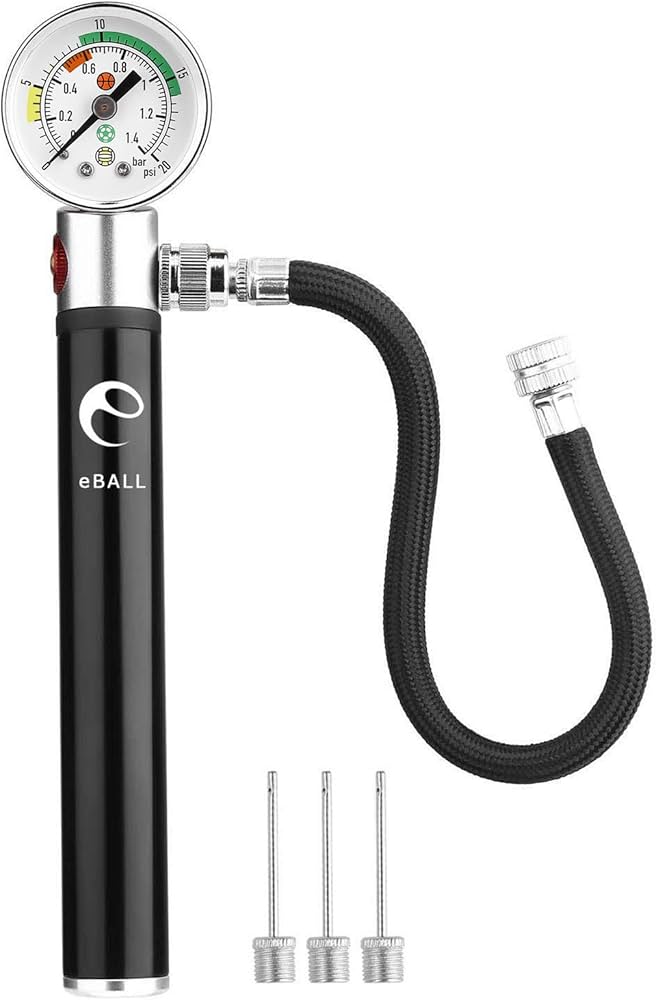
- Ball Inflation: Regulation indoor volleyballs are inflated to 4.3 to 4.6 PSI (0.30–0.325 kg/cm²).
How a Rally Works: The Three-Touch Flow
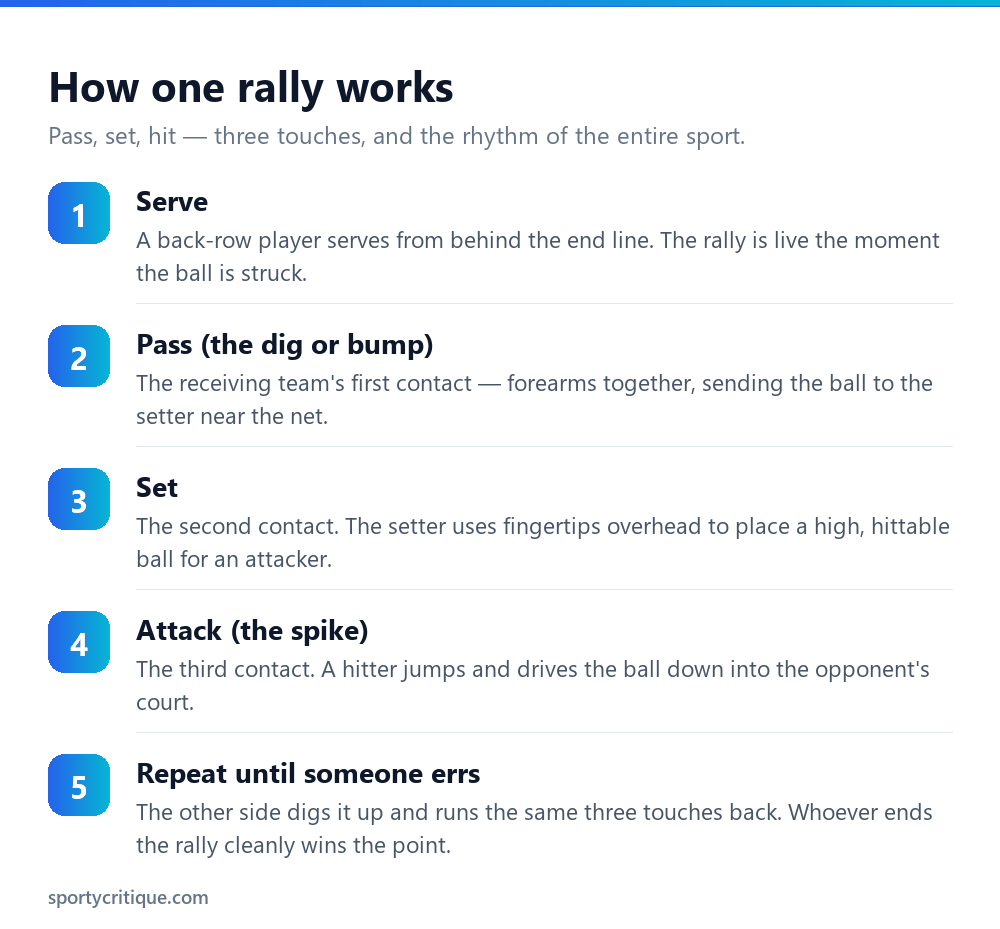
Every rally begins when the server strikes the ball from behind the endline and ends when the ball contacts the floor, flies out of bounds, or a player commits a rule violation. Between those points, your team has a strict maximum of three touches to return the ball over the net:
- Touch 1 — The Forearm Pass (The Bump): Controls the incoming velocity of the opponent’s serve or spike, lofting the ball 12 to 15 feet in the air toward the front-right net area.
- Touch 2 — The Overhead Set: Handled by the setter. Uses finger pads to deliver a clean, parabolic ball to a designated attacker.
- Touch 3 — The Attack (The Hit / Spike): Executed by an outside, middle, or right-side hitter jumping and driving the ball down into the opponent’s court gaps or off blocker fingertips.
Two Fundamental Touch Rules:
- No Consecutive Touches: A single player cannot touch the ball twice in a row. If you pass the ball, you cannot touch it again until a teammate touches it (or an opponent touches it). Exception: A block touch at the net does NOT count as a team touch; the blocker who touched the ball may immediately make the team’s first legal contact.
- Contact Surface: You may contact the ball with any part of your body, including your head, chest, knees, and feet. Kicking the ball to keep it off the floor is completely legal, provided the foot contact is clean and not a resting carry.
Scoring System: Rally Points, Sets, and Win-By-Two
Modern volleyball uses rally scoring: every single rally awards a point to whichever team wins it, regardless of who served. Until 1999, volleyball used legacy “side-out scoring” (where only the serving team could score points), which led to matches lasting three hours. Rally scoring ensures fast-paced, high-stakes competition.
| Match Format | Sets Required to Win | Target Score per Set | Tiebreak Condition |
|---|---|---|---|
| Standard Match (Best of 5) | First team to win 3 sets | Sets 1–4: Played to 25 points (must win by 2) | Play continues indefinitely past 25 until one team leads by 2 (e.g., 27–25, 31–29) |
| Deciding Set (5th Set) | Tiebreak set (tied 2-2) | Set 5: Played to 15 points (must win by 2) | Teams switch court sides at 8 points; play continues past 15 until a 2-point margin is reached |
| Tournament / High School (Best of 3) | First team to win 2 sets | Sets 1–2: Played to 25 points; Set 3 (if needed): 15 points | All sets require a minimum 2-point margin of victory |
For detailed rules on service breaks and timeouts, see our dedicated guide on how scoring works in volleyball.
Rotation: Clockwise Movement and Overlap Rules
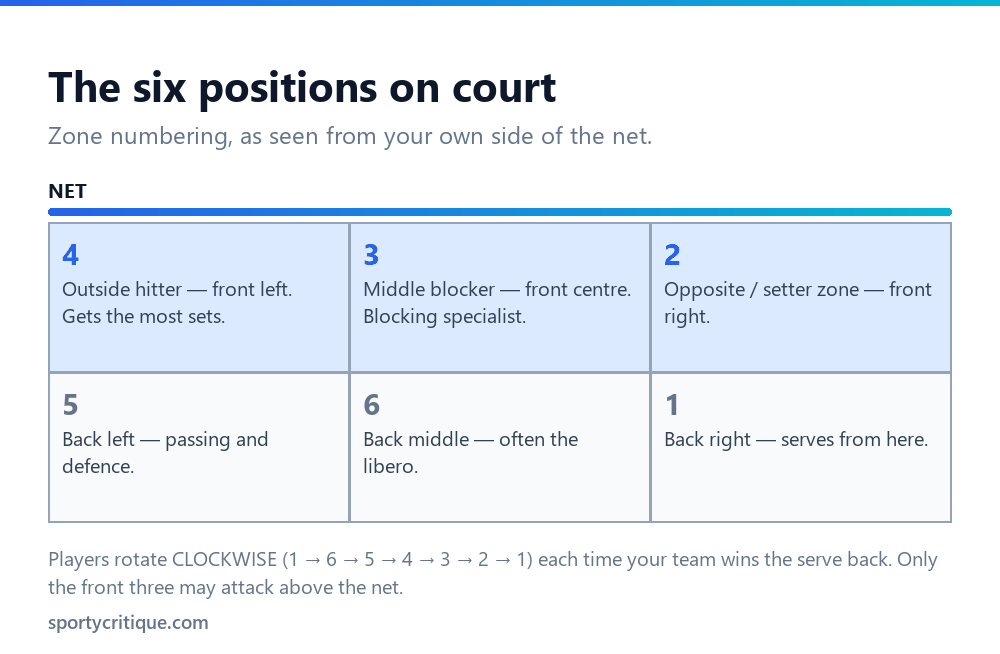
Rotation is the single most intimidating concept for beginner volleyball players. But the core rule is simple: every time your team wins back the serve (a “side-out”), all six players rotate one spot clockwise.
The 6 Court Zones
- Front Row: Zone 4 (Left Front), Zone 3 (Middle Front), Zone 2 (Right Front).
- Back Row: Zone 5 (Left Back), Zone 6 (Middle Back), Zone 1 (Right Back — where the server stands).
When rotating, the player in Zone 2 moves to Zone 1 to serve. Zone 1 moves to Zone 6, Zone 6 moves to Zone 5, Zone 5 moves up to Zone 4, Zone 4 moves to Zone 3, and Zone 3 moves to Zone 2.
The Overlap Rule: When Position Actually Matters
Beginners often think you must stay trapped in your zone for the entire rally. That is false. The rotation order is enforced only at the exact millisecond the server contacts the ball:
- Front-to-Back Overlap: Each front-row player must have at least one foot closer to the net than the corresponding back-row player behind them (Zone 4 ahead of Zone 5, Zone 3 ahead of Zone 6, Zone 2 ahead of Zone 1).
- Lateral (Side-to-Side) Overlap: The middle player in each row must be positioned between their respective lateral teammates (Zone 3 must be between Zone 4 and Zone 2; Zone 6 must be between Zone 5 and Zone 1).
The Instant Switch: The instant the server makes contact with the ball, the overlap rule dissolves! Players are legally free to sprint and “switch” into their specialized court positions (e.g., setters sprint to the net, middle blockers move to the center, outside hitters shift to the left pin).
The 6 Volleyball Positions Explained
Modern volleyball teams do not feature generic players; each athlete fulfills a specialized role with distinct offensive and defensive tasks:
| Position | Court Role | Key Athletic Trait | Primary Touch Responsibility | Special Restrictions |
|---|---|---|---|---|
| Setter (S) | The offensive quarterback; orchestrates set tempos and distribution | Soft hands, rapid footwork, high court IQ | 2nd touch on virtually every offensive rally | Cannot attack or dump ball above net height when in back row |
| Outside Hitter (OH) | Primary all-around attacker; hits from the left antenna | Explosive vertical jump, high-volume endurance, passing consistency | Passes opponent serves; attacks out-of-system high balls in Zone 4 | Must transition rapidly from back-row passing to front-row hitting |
| Middle Blocker (MB) | Front-row defensive anchor; hits quick 1st-tempo balls | Height, long wingspan, lateral swing-blocking speed | Closes the block on both pins; hits quick “1-balls” and slides | Frequently substituted by the Libero in the back row to preserve defense |
| Opposite Hitter (OPP / Right Side) | Power hitter operating from Zone 2; primary blocker against opponent OH | Heavy swing power, strong blocking reach | Attacks from right pin; acts as backup setter if setter digs first ball | Must defend against opponent’s strongest outside spikes |
| Libero (L) | Back-row defensive and serve-receive specialist | Lightning-fast reaction time, low center of gravity, platform control | Primary passer on serve-receive and hard-driven spikes | Wears contrasting jersey; cannot block, serve (in international FIVB), or attack above net |
| Defensive Specialist (DS) | Back-row substitute for offensive hitters who struggle to pass | Consistent platform passing and aggressive floor digging | Enters back row to steady serve-receive and dig hard cross-court balls | Counts against team substitution limits (unlike the Libero) |
The 7 Illegal Faults That Decide Matches
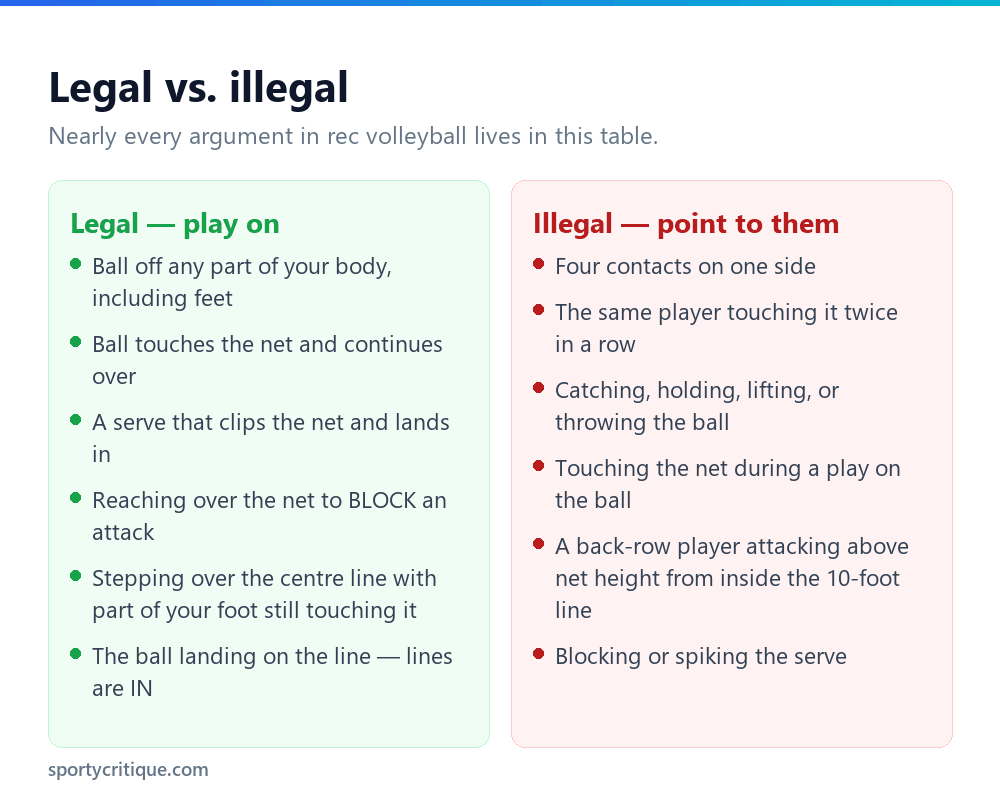
Most points in beginner and intermediate volleyball are not won through spectacular spikes; they are lost through unforced mechanical violations. Memorize these seven faults:
| Violation Name | What Triggers the Whistle | Official Penalty |
|---|---|---|
| Net Contact Fault | Touching any part of the net mesh between the antennas while actively playing the ball | Immediate dead ball; point and side-out awarded to opponent |
| Centerline Encroachment | Crossing entirely over the center line beneath the net into the opponent’s floor space, or interfering with an opponent’s feet | Point to opponent; called strictly to prevent catastrophic landing injuries |
| Illegal Back-Row Attack | A back-row player jumping on or in front of the 10-foot line and contacting a ball completely above net height | Point to opponent; back-row players must jump from behind the attack line |
| Lift / Held Ball (Carry) | Allowing the ball to come to rest in the hands or catching/scooping the ball during an underhand or overhead touch | Illegal contact violation; point awarded to opponent |
| Double Contact | A single player contacting the ball twice in succession, or hands touching the ball unevenly during a set | Point to opponent (relaxed on defensive 1st contact under USAV rules) |
| Foot Fault (Service) | Stepping on or over the baseline before contacting the ball on a serve | Loss of rally; serve awarded to opposing team |
| Four Touches | A team touching the ball four times before sending it over the net (block touches excluded) | Point and side-out awarded to opponent |
Essential Gear for Beginner Volleyball Players
Stepping onto the court with the wrong footwear or an overinflated ball creates bad habits and increases injury risk. These four essentials prepare new players for safe indoor play:
| Equipment | Category / Purpose | Key Specifications | Target Benefit | Check Price |
|---|---|---|---|---|
| Tachikara SV5WSC Sensi-Tec | Indoor Composite Volleyball | Microfiber composite leather cover, butyl bladder, official size & weight | Soft touch eliminates forearm stinging while grooving passing mechanics | View on Amazon |
| Asics Gel-Rocket 11 Volleyball Shoes | Indoor Court Shoes | Non-marking gum rubber sole, forefoot Gel cushioning, Trusstic support | Prevents sliding on dusty gym floors and provides lateral stability for jump landings | View on Amazon |
| Mizuno LR6 Low Profile Knee Pads | Joint Impact Protection | D.F. Cut sleeve with targeted EVA foam knee cap padding | Shields patella and bursae during floor digs and emergency sprawl dives | View on Amazon |
| Tandem Sport Passing Target Sleeves | Passing Aid & Bruise Prevention | Elastic compression sleeve with padded target zone on inner forearms | Provides visual target for platform sweet spot and cushions impact during long sessions | View on Amazon |
Frequently Asked Questions
Can you kick a volleyball legally during a match?
Yes. Under official FIVB, USAV, and NCAA rules, you may contact the ball with any part of your body from head to toe, including feet and shins. Kicking is legal as long as the ball bounces cleanly off the foot without being caught, scooped, or held.
Why does the Libero wear a different color jersey?
The Libero wears a distinctly contrasting jersey so the referees, scorekeepers, and opponents can immediately track their position on the court. Because the Libero has special restrictions (they cannot attack balls above net height, block, or set with fingers in front of the 10-foot line to a hitter), officials need instant visual clarity on where they are.
How many substitutions are allowed per set in volleyball?
Under international FIVB rules, teams are allowed a maximum of 6 substitutions per set. In US collegiate (NCAA) and high school (NFHS) volleyball, teams are permitted up to 12 or 18 substitutions per set, allowing more frequent player rotations between offensive and defensive specialists.
What are the main differences between indoor and beach volleyball?
Indoor volleyball is played 6-on-6 on a hard 18m × 9m court with specialized positions, substitutions, and a 3-touch rally where block touches do not count toward the limit. Beach volleyball is played 2-on-2 on a smaller 16m × 8m sand court with no player substitutions, no specialized positions, and block touches count as the team’s first touch.
What happens if a volleyball hits the ceiling or rafters?
If the ball hits the ceiling on your team’s side of the net and remains on your side, the ball is live and in play, provided your team still has remaining touches. However, if the ball hits the ceiling and travels over the net plane into the opponent’s court, or hits the ceiling on the opponent’s side, it is an immediate out-of-bounds fault.
Deepen Your Volleyball Skills:
- Volleyball Cornerstone Guide — Master rules, court dimensions, positions, and gear guides.
- How to Set a Volleyball — Hand shape, footwork stagger, back set, and offensive set tempos.
- How to Hit a Volleyball — Passing, setting, attacking, and defensive digging mechanics.
- How to Spike a Volleyball — In-depth vertical approach, penultimate brake, and attack timing.
- How to Block in Volleyball — Swing blocking, net penetration, and stopping the tool.
- How to Overhand Serve — Step-by-step float mechanics, toss drills, and seam targeting.
- How to Serve a Volleyball — Breakdown of underhand, float, topspin, and jump serves.
- Volleyball PSI & Inflation Guide — Regulation air pressure standards for indoor and beach play.
- How Volleyball Scoring Works — Rally scoring rules, side-outs, and tiebreak sets.
- Volleyball Rotation Rules Explained — 5-1 vs 6-2 systems, overlap rules, and attack lines.