Best Indoor Volleyball for Practice & Training (Weight, Grip, Leather vs Synthetic)


The best volleyball for practice isn’t the priciest one, it’s the one whose weight, grip, and cover material actually match how hard and how often it’s about to get used. Here’s how those specs work and four real picks across the price range.
The best volleyball for practice is an official-size, official-weight ball (size 5, about 9 to 10 ounces) with a grip your hands can actually read: synthetic composite for the durability of daily team drills, leather once touch and feel start to matter more than cost. For most practice gyms, a mid-tier synthetic composite ball like the Molten FLISTATEC hits the best balance of durability and realistic touch.
Every indoor volleyball on a store shelf claims to be practice-ready. Very few actually match the weight, grip, and durability profile a real practice gym needs, which is a different set of priorities than a single recreational match ball. This guide breaks down what weight and grip actually change about how a ball plays, then walks through four real options across the price range you’ll actually encounter shopping for one.
- →Official size 5 and roughly 9-10oz weight is non-negotiable for realistic practice reps
- →Synthetic composite covers hold up best to the volume and abuse of daily team drills
- →Leather covers offer more touch feedback but need more careful handling and storage
- →A single-dimple or textured surface grips hands more reliably through sweaty, long sessions
- →Buying two tiers of ball, a durable practice ball and a nicer game-day ball, is common at the club level
Table of Contents
Why weight and size matter more than people expect
An official size 5 volleyball weighs between roughly 9.2 and 9.9 ounces and measures about 65 to 67 centimeters in circumference. That’s not an arbitrary spec. A ball outside that range changes how a serve arcs, how a set feels off the fingertips, and how a spike’s timing lines up, which means every rep on an off-weight ball is training a slightly wrong motor pattern. It matters more for practice balls than casual backyard ones precisely because practice reps are supposed to build muscle memory that transfers to real matches.
⚠️ Watch out: A cheap, undersized or underweight ball can feel easier to control in isolated drills, which is exactly the problem: it’s teaching hand and arm mechanics that won’t hold up once a player switches to a regulation ball in an actual game.
Leather vs. synthetic: what the material actually changes
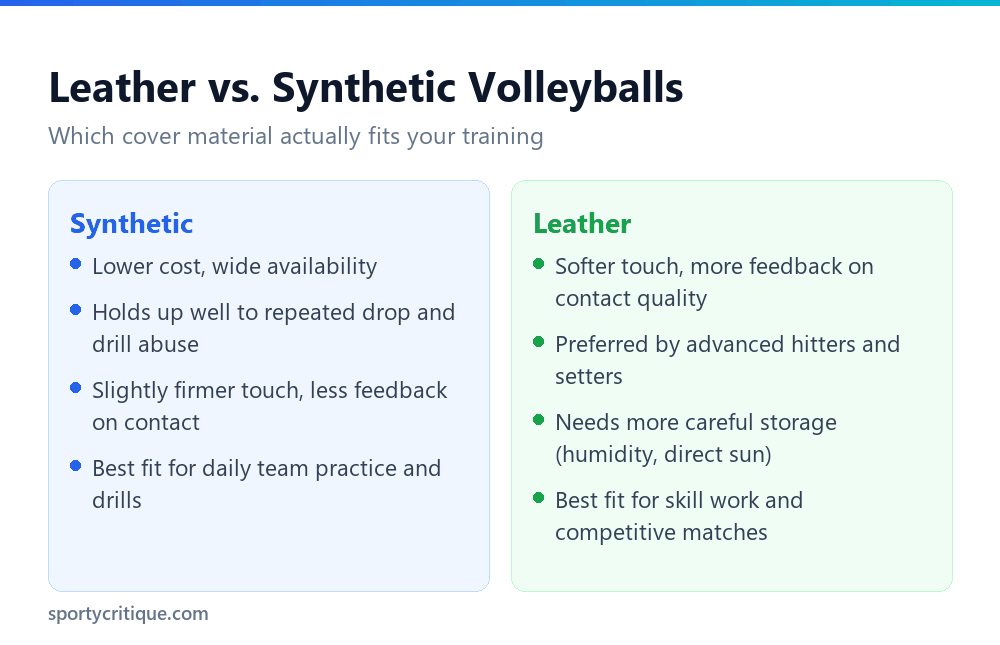
Synthetic composite covers dominate practice gyms for a simple reason: they take a beating. Balls get dropped on hard floors, left in bags, rolled across gravel outside for a pickup game, and a synthetic cover shrugs most of that off without losing shape or feel. Leather covers respond to contact with more feedback, which is exactly why advanced players prefer them for skill work, but that same material is more sensitive to humidity, direct sunlight, and rough handling.
Grip texture is the other half of the equation and gets less attention than it deserves. A dimpled or textured surface holds hands more reliably through a sweaty two-hour practice than a smooth cover does, which matters enormously for setters handling dozens of touches a session. A slick ball that’s fine for the first twenty minutes of practice can start slipping out of hands by the last twenty, and that’s a grip problem, not a skill problem.
Four real picks across the price range
WILSON Soft Play Volleyball
WILSON Soft Play Volleyball sits in the budget / beginner bracket. Sponge-backed synthetic leather cover, official size and weight, soft touch for new players still learning to pass without stinging forearms. As with the rest of this list, treat the price on the listing page as the current number to check rather than anything quoted here, since sporting goods pricing on Amazon moves often and this guide’s product API lookup didn’t return a stable current price for it.
Mikasa V300W Volleyball
Mikasa V300W Volleyball sits in the recreational / training bracket. 18-panel synthetic construction based on the official V200W game ball design, single-dimple surface for reliable grip through repeated practice reps. As with the rest of this list, treat the price on the listing page as the current number to check rather than anything quoted here, since sporting goods pricing on Amazon moves often and this guide’s product API lookup didn’t return a stable current price for it.
Molten FLISTATEC Volleyball
Molten FLISTATEC Volleyball sits in the mid / collegiate-level bracket. The official ball of NCAA men’s volleyball championships, synthetic composite cover with Flistatec panel design for flight stability and easier visual tracking. As with the rest of this list, treat the price on the listing page as the current number to check rather than anything quoted here, since sporting goods pricing on Amazon moves often and this guide’s product API lookup didn’t return a stable current price for it.
Tachikara SV5W Gold Competition Volleyball
Tachikara SV5W Gold Competition Volleyball sits in the premium / leather bracket. Premium full-grain leather cover with dual bladder construction, the tier serious high school and club players step up to once touch and feel start to matter. As with the rest of this list, treat the price on the listing page as the current number to check rather than anything quoted here, since sporting goods pricing on Amazon moves often and this guide’s product API lookup didn’t return a stable current price for it.
Inflation and pressure: the maintenance step most people skip
Every volleyball on this list ships partially deflated or needs regular top-offs, and the pressure printed on the ball (usually 4.3 to 4.6 psi for indoor play) changes how it feels far more than most buyers expect. Overinflated, a ball gets harder and faster off the hands, which can sting forearms on passing drills and makes sets feel less controllable. Underinflated, it goes soft and mushy, which throws off spike timing and makes serves float unpredictably.
A cheap needle gauge takes the guesswork out of this and costs a few dollars. Checking pressure weekly during a heavy practice season, not just when a ball starts looking visibly soft, keeps every ball in a bag playing consistently with the others instead of forcing players to adjust their touch ball to ball, which quietly undermines exactly the muscle memory practice is supposed to build.
How many balls a practice actually needs
One ball per drill station is the practical minimum for any team running multiple simultaneous drills, and most club-level programs keep six to twelve balls in rotation so a flat or damaged ball doesn’t stall practice while someone hunts for a pump. Buying a multi-pack of a durable synthetic ball for this volume use, then adding one or two nicer leather balls separately for setting and hitting technique sessions, is more cost-effective than buying a dozen premium leather balls that will take the same daily abuse as the cheap ones.
📊 Note: Label or mark practice balls separately from any match-day balls if a team owns both. Mixing tiers in the same bag means players unknowingly rotate between different touch and weight profiles mid-practice, which is a small inconsistency but an avoidable one.
Matching the ball to the practice, not just the budget
- ✓Buy a durable synthetic composite ball for daily team drills
- ✓Step up to leather once players are doing focused touch and feel work
- ✓Confirm official size 5 and roughly 9-10oz weight before buying
- ✓Keep a separate, nicer ball reserved for match simulation days
- ✕Buy the cheapest ball available without checking the weight spec
- ✕Use a delicate leather ball for rough outdoor or floor-drill abuse
- ✕Assume every ball labeled ‘official size’ actually meets the full spec
- ✕Ignore grip texture just because the price and weight look right
💡 Pro tip: If your gym runs multiple drill stations at once, buy a durable synthetic ball in bulk for volume reps and reserve one or two nicer leather balls specifically for setting and hitting technique work, where touch actually matters. Most competitive club programs already split their ball budget this way rather than buying one ball type for everything.
Common myths about practice volleyballs
Before you buy
Bottom line
For most practice gyms, a mid-tier synthetic composite ball like the Molten FLISTATEC is the right default: durable enough for daily volume, close enough in touch to a real game ball to build transferable habits. Step down to a soft-play synthetic ball for absolute beginners still learning to pass without stinging their arms, and step up to a leather ball once a player’s skill level actually benefits from the extra touch feedback it provides. Whichever tier fits your budget and your players, checking the actual weight, grip texture, and current listing price beats trusting a product title alone, because those three details are what determine whether reps on that ball actually transfer to a match.
What’s the best volleyball for practice on a tight budget?
A synthetic composite ball in the Mikasa V300W or similar tier gives the closest touch to a real game ball without the cost or fragility of leather, and it holds up well to daily drill volume.
Do I need a leather volleyball to get better at setting?
No. Leather offers more touch feedback, which advanced players value, but a good synthetic composite ball is more than accurate enough to build solid setting technique, especially early on.
How do I know if a volleyball is official size and weight?
Check the listing for size 5 and a weight around 9.2 to 9.9 ounces (roughly 260 to 280 grams). Reputable brands list both specs directly; if neither is stated, treat that as a red flag.
How often should a practice volleyball be replaced?
A durable synthetic ball used daily by a team typically lasts one to two seasons before the cover starts losing grip or the shape starts going soft. Leather balls vary more depending on storage and handling, but need replacing sooner under heavy daily abuse.
Is it worth buying multiple volleyballs for different drills?
For any team or club running more than one drill station, yes. A bulk set of durable synthetic balls for volume reps plus one or two nicer balls reserved for touch-focused work is standard practice at the club level.
What inflation pressure should a practice volleyball be?
Most indoor volleyballs are designed for roughly 4.3 to 4.6 psi, usually printed near the valve. A cheap needle gauge is worth owning if a team shares balls across a full season, since both over and underinflated balls noticeably change how they feel off the hands.
As an Amazon Associate, we earn from qualifying purchases through links on this page.