How to Hit a Volleyball: Passing, Setting, Attacking, and Digging

“Hitting” usually means the attack — open hand, full extension, wrist snapping over the top of the ball. But volleyball has four ways to contact a ball, and which one you use depends entirely on how high the ball is: forearms below your waist (pass and dig), fingertips above your forehead (set), open hand above your head (attack). The universal rule underneath all four: get your feet there first and play the ball in front of your body.
“How do I hit a volleyball?” is a bigger question than it sounds, because in volleyball you hit the ball four different ways with four different parts of your body, and using the wrong one is the reason most rallies end early.
If you specifically want the jumping, swinging, drive-it-into-the-floor version, that’s the spike, and we have a full guide to spiking covering the approach and arm swing in detail. This page is the broader one: every contact in the sport, when to use each, and the mechanical fundamentals they all share. It’s the guide I wish someone had given me before I spent a season trying to spike balls I should have been passing.
- →Four contacts: pass (forearms), set (fingertips), attack (open hand), dig (emergency forearms).
- →Ball height picks the contact for you — below the waist is forearms, above the forehead is fingertips or an open hand.
- →Move your feet first. Reaching for a ball is what turns a routine contact into a shank.
- →Passing is aiming: angle a flat, locked platform at your target instead of swinging at the ball.
- →The pass is the contact that decides matches, and it’s the one nobody practises.
Table of Contents
Four contacts, one decision
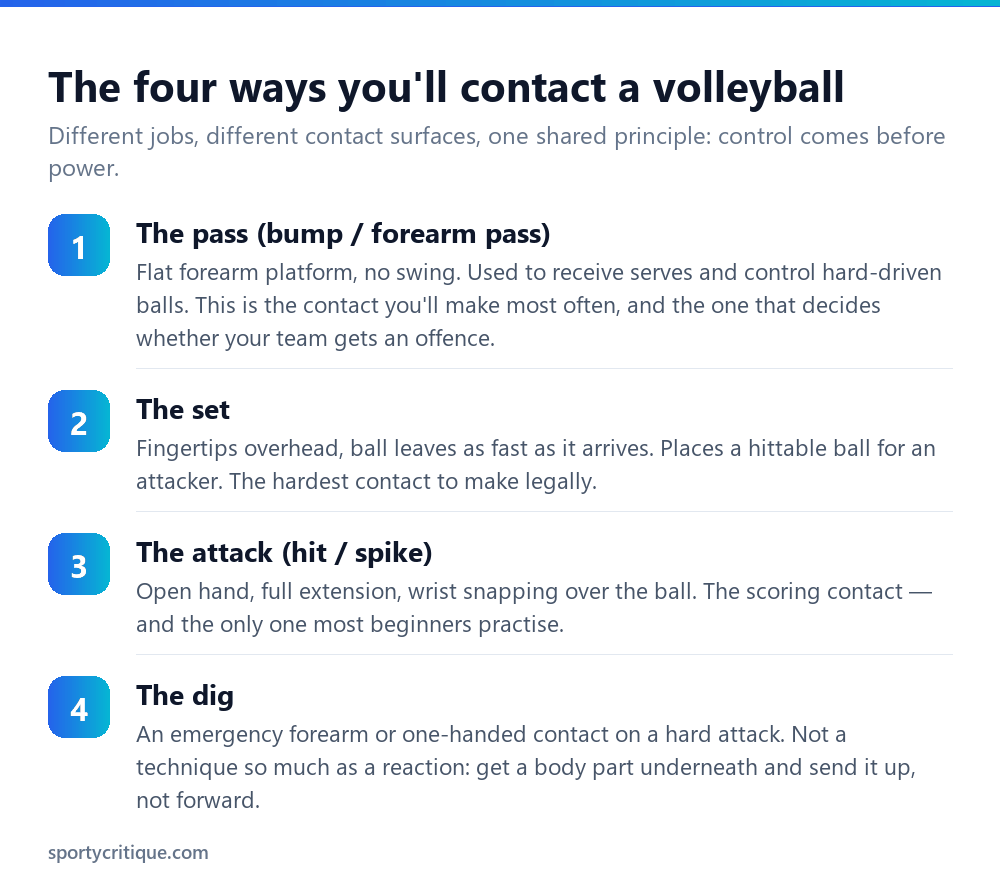
The choice between them is made almost entirely by the ball’s height and speed when it reaches you, and it happens too fast to deliberate. Below your waist, or coming hard and flat: forearms. Above your forehead and controllable: fingertips. Above your head with room to swing: open hand. Coming at your face at speed: forearms, and quickly.
Beginners get this wrong in one specific direction — they try to attack balls they should be passing. A ball arriving chest-high at pace is not a hitting opportunity, it’s a control problem, and swinging at it produces a ball that flies into the ceiling or over the back line. Recognising which contact a ball calls for is genuinely half the skill.
The pass: the contact that decides matches
Here’s a claim worth taking seriously: the forearm pass is the most important skill in volleyball, and it gets the least practice time of any of the four. Everyone wants to spike. Nobody wants to stand in a line receiving serves. But a team that can’t pass never gets to spike at all, because the setter never receives a ball worth setting.

The mechanics that matter most, in order:
Passing is aiming, not hitting. Almost every bad pass in recreational volleyball is a player swinging their arms at a ball that only needed a flat surface pointed at the setter.
⚠️ Watch out: Never interlock your fingers or clasp your hands into a ball. It bends the wrists, tilts the platform, and hurts. Thumbs parallel, one hand cupped in the other, is the version that survives a hard serve.
The set: the hardest legal contact
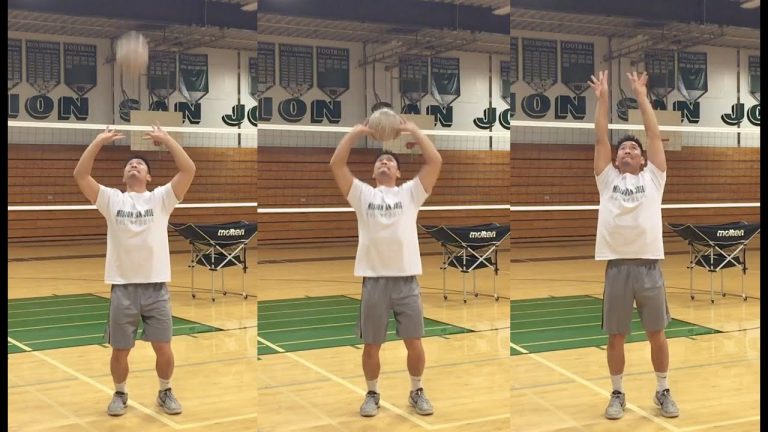
Setting looks gentle and is technically the most demanding contact in the sport, because the rules give you almost no margin. The ball has to leave your hands as fast as it arrives — any hint of catching, holding, or rotating it is a lift or a double, and gets whistled.
The hand shape is the whole skill. Hold your hands above your forehead, fingers spread, thumbs and index fingers forming a rough triangle you could look through. Contact the ball with the pads of your fingers — all ten of them, never the palms — and extend your arms and legs together as you release. The power comes from your legs and a full extension, not from flicking your wrists.
Two fixes that solve most beginner setting problems: get under the ball so it’s directly above your forehead rather than in front of your face, and square your hips to your target before the ball arrives, since you’ll set roughly where your body is pointing regardless of what your hands intend.
💡 Pro tip: Learn the feel by setting a ball straight up to yourself, repeatedly, ten feet in the air. If it spins, you’re pushing with one hand more than the other. A clean set comes off both hands evenly and barely rotates.
The attack: hitting the ball down
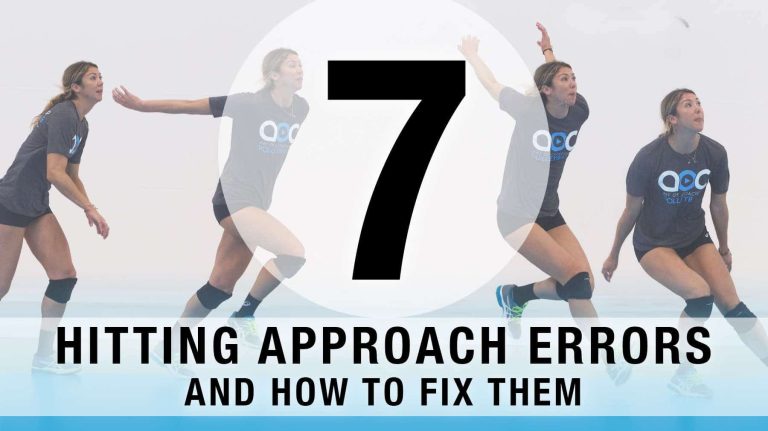
This is the contact people mean when they say “hit,” and it’s covered thoroughly — approach footwork, jump mechanics, shot selection — in our spiking guide. The contact fundamentals in brief:
Contact the ball with a full open hand, palm and fingers wrapping its shape, at the highest point you can reach and slightly in front of your hitting shoulder. Strike the upper back of the ball and snap your wrist over the top. That snap generates topspin, and topspin is what lets you swing hard without the ball sailing long — it makes the ball dive into the court.
The mistake that costs beginners the most points here isn’t a weak swing. It’s swinging at all when a swing isn’t available. If the set is tight to the net, or low, or behind you, a full swing produces a net violation or a ball into the tape. The mature answer is a roll shot or a tip — same approach, controlled contact, ball lands in a gap. It looks humble and it scores constantly.
The dig: a reaction, not a technique
Digging is what you do when someone else’s attack is arriving fast and low. It uses the same forearm platform as passing, but the circumstances are different enough that it’s worth treating separately: you have no time to build anything, and the goal is far more modest.
The one thing to understand about digging: your job is to send the ball up, not forward. A dug ball that goes high and stays on your side of the net is a great dig — it buys your team time to run an attack. A dig that shoots forward over the net is a free ball handed to the opposition. Angle your platform toward the ceiling, not toward their court.
Beyond that, digging is mostly positioning and posture. Start low, weight forward on the balls of your feet, arms already out in front of you rather than hanging at your sides. You cannot get low after the ball arrives, so the players who dig well are the ones who were already down before the hitter swung. One-handed digs, dive saves, and the pancake all exist, but they’re what happens after good positioning fails, not a substitute for it.
What every contact has in common

Whichever contact you’re making, the same handful of principles decide whether it works:
A practice session that isn’t just spiking
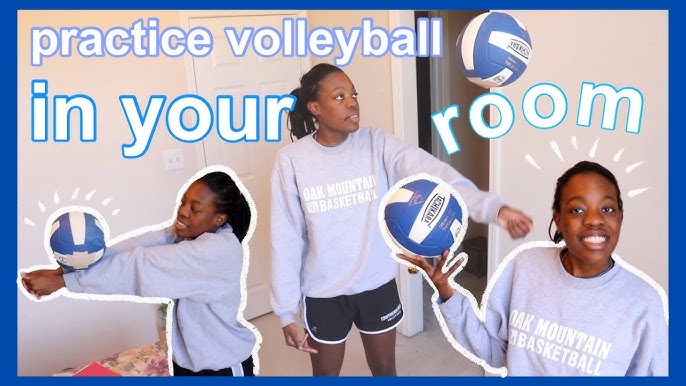
If you have an hour and a wall, this is a better use of it than hitting balls at a net:
Frequently asked questions
What’s the difference between hitting, spiking, and attacking?
In practice they’re the same thing. ‘Attack’ is the formal rulebook term for any ball you send toward the opponent’s court, ‘hit’ is the everyday word, and ‘spike’ specifically implies a hard downward finish. When a coach says ‘go hit,’ they mean go attack.
Why does the ball keep flying off my arms sideways?
Your platform is tilted, and almost always because you reached for the ball instead of moving your feet to it. When you extend one arm further than the other, the flat surface becomes a wedge. Get your body behind the ball so both forearms meet it evenly.
Does it hurt to pass a volleyball?
It stings at first while your forearms toughen up, but persistent pain means you’re contacting the wrong spot. The ball should meet the flat, fleshy part of your forearms a few inches above the wrists — not the bony wrists themselves, and never the hands. If you’re bruising, check your contact point before you blame the ball.
Can you hit the ball with a closed fist?
Legal, but rarely a good idea. A fist gives you a tiny, hard, unpredictable contact surface with no control and no spin. The exceptions are emergency digs and beach volleyball, where an open-hand tip is illegal and players use knuckles or a ‘cobra’ instead.
How long until I can spike properly?
With regular play, most beginners hit a ball over the net from a jump within a few weeks and take a season to do it consistently and with placement. The rate-limiting step is usually not the swing — it’s timing the approach to the set, which is why our spiking guide leads with timing rather than arm mechanics.
Which skill should I practise first?
Passing, without much competition for the answer. It’s the contact you’ll make most often, it’s the one that determines whether your team can run an offence, and it’s the skill that separates rec players who improve from those who plateau. Everyone practises hitting; the people who practise passing are the ones you want on your team.
- →How to spike a volleyball — approach, timing, and the arm swing in full
- →How to serve a volleyball — every serve type and where to aim
- →The overhand serve, step by step — toss and contact mechanics
- →How to play volleyball — rules, rotation, and positions
- →How scoring works — where points actually come from