Shuffleboard Scoring: How to Keep Score in Both Versions


In table shuffleboard, only ONE player scores per round — whoever has the weight furthest down the table — and they count each of their weights that sits beyond the opponent’s best. Zones are worth 1, 2, and 3, with a hanger over the edge worth 4. Games go to 15 (singles) or 21 (doubles). In deck shuffleboard, BOTH players score every disc fully inside a zone (10, 8, 8, 7, 7), the kitchen subtracts 10, and games run to 50, 75, or 100.
🎯 Shuffleboard Hub: Explore all 18 table reviews, wax speed guides, and scoring tutorials in our Complete Shuffleboard Resource Hub.
Shuffleboard scoring is where casual games go wrong, and it’s almost always the same mistake: assuming that every piece in a scoring zone counts for whoever owns it. In the table version, that’s not how it works at all — and groups can play for years scoring incorrectly, which changes the entire strategy of the game.
Because two different games are called shuffleboard, this guide covers both. They score on genuinely different principles, so find your version below.
- →Table shuffleboard: only the player with the furthest weight scores in a round.
- →Deck shuffleboard: both players score, and a disc touching a line scores nothing.
- →A hanger — a weight overhanging the far edge — is worth 4, the table game’s maximum.
- →Table games go to 15 or 21; deck games to 50, 75, or 100.
- →Score at the END of a round, after all eight pieces are played — never as you go.
- →House rules vary a lot. Agree the target and the edge cases before the first shot.
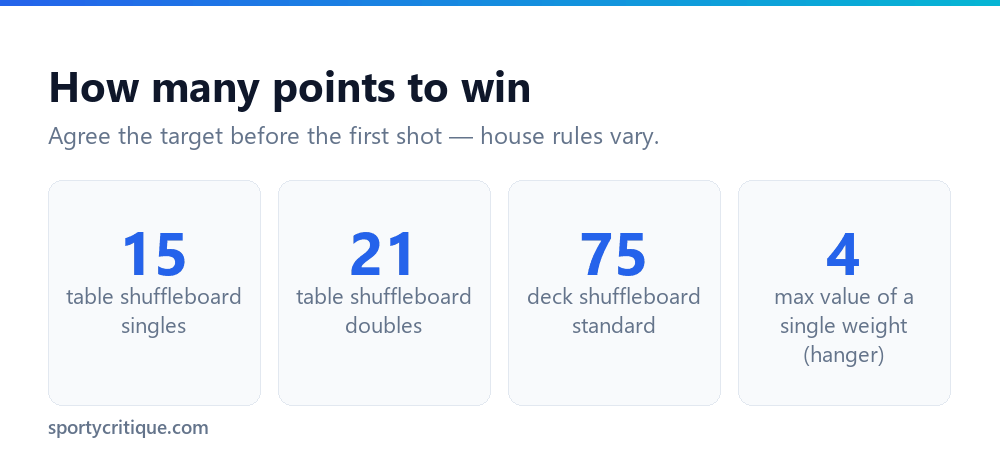
Table of Contents
The rule that decides everything: who scores?

This is the fork in the road, and getting it wrong means scoring an entire game incorrectly.
Table shuffleboard uses leader-only scoring. When all eight weights are played, you find the single weight furthest down the table. Its owner is the only player who can score anything that round. They then count every one of their own weights sitting beyond the opponent’s furthest weight. Everything else — including their own weights that don’t clear the opponent’s best — scores nothing.
Deck shuffleboard uses inclusive scoring. Every disc lying fully inside a scoring zone counts for whoever owns it, so both sides normally score in the same frame. There’s no leader rule at all.
The consequence is a completely different game. Leader-only scoring makes table shuffleboard aggressive — knocking your opponent’s lead weight off can erase their entire round in one shot, so removal is often worth more than placement. Inclusive scoring plus a penalty zone makes deck shuffleboard cautious, since you’re accumulating steadily and a wild shot actively costs you. Our strategy guide follows this thread further.
Table shuffleboard scoring in detail
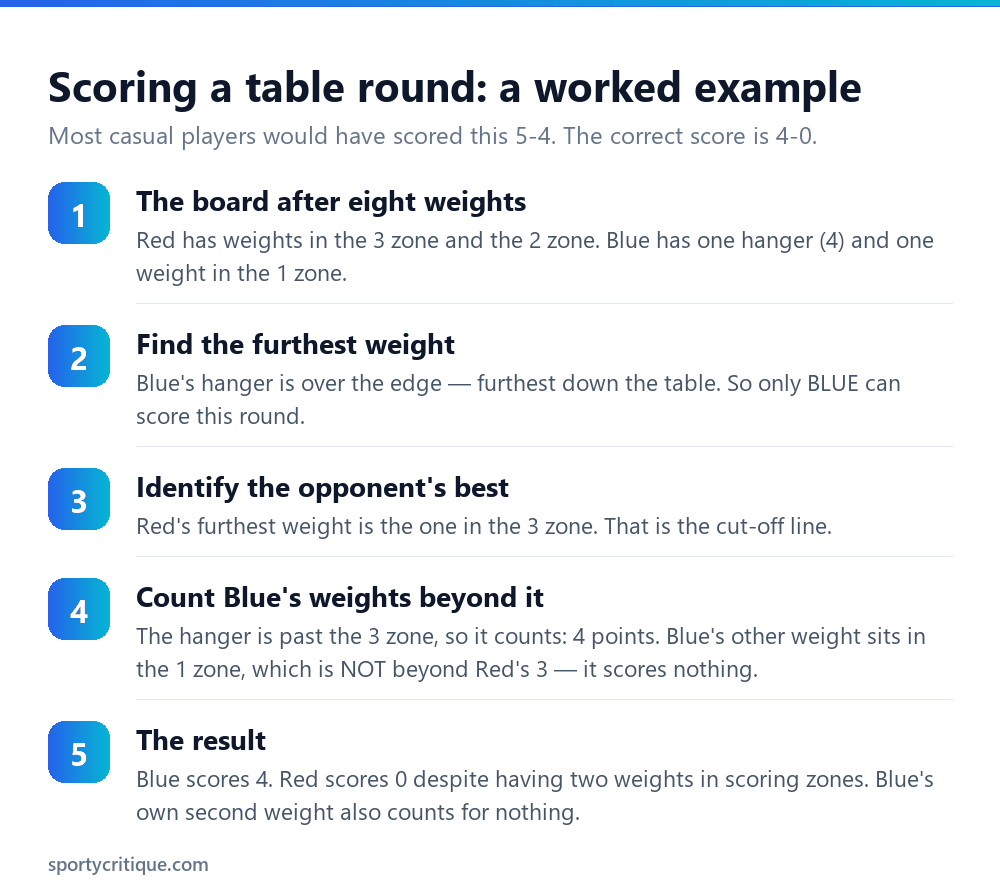
Work through that example once and the rule sticks. The board looks like Red should get something — they have two weights sitting in scoring zones. They get nothing, because Blue’s hanger is further down the table, and Blue’s second weight also gets nothing because it doesn’t clear Red’s best weight. A scoreline that most groups would call 5–4 is correctly 4–0.
This is also why the hammer — the last shot of a round — matters so much. The final weight can convert a losing round into a winning one, either by sliding past the opponent’s best or by knocking it clean off. Rounds swing completely on that one shot.
⚠️ Watch out: Score only after all eight weights are played. Weights get knocked, nudged, and displaced constantly during a round, and a board that looks settled at weight six often looks nothing like that at weight eight. Scoring as you go is the second most common way casual games go wrong.
Deck shuffleboard scoring in detail
Add each player’s scoring discs, subtract ten for any disc in the kitchen, and record the frame. A player can finish a frame on a negative number, and running totals genuinely go backwards — which is unusual among target sports and is exactly what makes the kitchen such a strong deterrent.
Frames alternate ends, and the player who scored lower in the previous frame shoots first in the next. That’s a deliberate catch-up mechanism: shooting last is an advantage, so it goes to whoever is behind. It keeps games closer than they would otherwise be, and it’s often overlooked in casual play.
📊 Note: The line-touching rule is the single biggest difference in the details, and it runs opposite between the two games. Table: a weight on a line scores the lower value. Deck: a disc on a line scores nothing. If you play both, expect to get this wrong at least once.
Scoring the variant games
Standard rules aren’t the only way to score a table. The common variants change the scoring model itself, not just the target — which is why they play so differently.
Horse Collar deserves a warning, because its scoring is genuinely punishing in a way people don’t expect. Since every weight must clear the foul line or the whole round is forfeited, a single mistimed shot can wipe out a round’s work. Groups often start it thinking it’s a gentler game because the shots are simpler, and discover halfway through that a 40-point lead evaporated in two rounds.
Scoring doubles
Doubles changes the geometry more than the arithmetic. In table shuffleboard, partners stand at opposite ends of the table, each shooting two weights per round toward their partner’s end. The scoring rule is unchanged — leader-only, counted from the far end — but the team total is what accumulates, and the target rises to 21.
The practical consequence is that you spend half of every round unable to do anything except watch and call advice down 22 feet of table. Partners who play well together develop a habit of setting up rather than scoring: leaving a blocking weight in a useful spot so the partner at the other end has something to work with next round. It’s a genuinely different game from singles, and teams that treat it as two people taking turns tend to lose to teams that treat it as one continuous plan.
Edge cases that cause arguments
Most shuffleboard disputes are not about the main rules — they’re about situations the main rules don’t obviously cover. These are the ones worth settling in advance.
A weight hanging over the end but also touching the side rail. Standard practice is that it still counts as a hanger if it’s over the end edge; the side contact is irrelevant. Some houses disagree, so ask.
A weight knocked off by a dead weight. If a shot that failed to cross the foul line still travels far enough to disturb weights, the standard remedy is to remove the dead weight and, where possible, restore the displaced ones to their original positions. In practice this depends on everyone agreeing where they were, which is why it’s better to remove dead weights promptly.
Weights that fall after the round ends. A hanger that drops seconds after everyone agreed the round was over is generally scored as it lay when play concluded. Vibration from someone leaning on the table is not a scoring event, though it will be argued about.
Outdoors: wind and slope moving a settled disc. On deck courts, a disc nudged by wind after coming to rest is normally scored where it stopped, not where it drifted to. If a court has enough slope that discs creep, that’s worth agreeing before you start rather than relitigating each frame.
Keeping score in practice
Most bar tables have an abacus-style bead scorer mounted on the wall or built into the frame — two rows of beads, one per player, slid along as points accumulate. It’s a good system precisely because it’s visible to everyone, which prevents the slow-motion arguments that come from someone tracking the score in their head.
If you’re keeping score on paper, record it by round rather than as a running total. Two columns, one row per round. It takes no longer and it makes disputes resolvable — you can point at round four rather than argue about a single number. It also lets you see the shape of a game afterwards, which is more interesting than it sounds once you start noticing that you always lose ground in the rounds where you don’t have the hammer.
💡 Pro tip: Before playing anywhere new, ask two questions: what are we playing to, and does a line-toucher count? Those two cover the vast majority of mid-game disputes. Bar house rules in particular vary far more than people expect — plenty of places play to 11 or 21 in singles rather than 15.
Frequently asked questions
How many points do you need to win at shuffleboard?
Table shuffleboard is traditionally 15 for singles and 21 for doubles, though house rules commonly use 11 or 21 for both. Deck shuffleboard runs to 50, 75, or 100, with 75 as the usual standard. There’s no universal answer, which is exactly why you should agree it before the first shot rather than discovering the disagreement at 14–13.
Can both players score in the same round?
In deck shuffleboard, yes — routinely. In table shuffleboard, no. Only the player whose weight sits furthest down the table can score, and their opponent gets nothing regardless of how many weights they have in scoring zones. This is the most misunderstood rule in the game.
What is a hanger worth in shuffleboard?
Four points — the maximum for a single weight in table shuffleboard. A hanger is a weight that comes to rest overhanging the far edge of the table without falling off. Some house rules ignore hangers entirely and cap scoring at 3, so it’s worth confirming in an unfamiliar bar.
Does a weight touching a line score?
It depends which game, and the rules are opposites. In table shuffleboard, a weight touching a line between zones scores the lower of the two values. In deck shuffleboard, a disc touching any line scores nothing at all — it must sit entirely inside a zone. This catches out anyone who plays both.
When do you score — during or after the round?
After. All eight pieces are played, then you score. Weights and discs get knocked around constantly, so a board that looks settled halfway through can be transformed by the final shot. Scoring as you go produces both errors and arguments.
Do you have to win by two points?
Not in standard rules for either version — reaching the target total wins, even by a single point. Some leagues and bars add a win-by-two rule, and some cap the game at a fixed number of rounds instead. Another one for the pre-game conversation.
- →How to play shuffleboard — both games, explained
- →Table shuffleboard rules — the bar game in full
- →Outdoor deck shuffleboard — court, cue, and the kitchen
- →Strategy and how to win — using the scoring rules to your advantage