How to Win at Shuffleboard: Shot Selection and Strategy


Winning at shuffleboard is mostly shot selection, not throwing accuracy. Because only the player with the furthest weight scores in table shuffleboard, knocking your opponent’s lead weight off can erase their entire round — often worth far more than placing another weight of your own. Block when you’re ahead, knock off when you’re behind, use the hammer deliberately, and calibrate to the table’s speed before you compete. Most casual players lose because they shoot the same way regardless of the situation.
There are two ways to get better at shuffleboard. One is to improve your touch, which takes months. The other is to make better decisions with the touch you already have, which takes an afternoon of understanding — and produces a bigger immediate improvement.
This guide is about the second one. It assumes you know the rules; if the scoring still feels murky, our scoring guide covers it, and everything below depends on getting that right.
- →Only the leader scores, so removing their best weight can erase a whole round.
- →Ahead in the round: block and protect. Behind: knock off and take risks.
- →The hammer — shooting last — is a real advantage. Plan around having it.
- →Calibrate to the table’s speed before you start competing on it.
- →Aim down the rails: protected from knock-offs, and where hangers happen.
- →Play the scoreboard, not just the board in front of you.
Table of Contents
Competitive Shot Selection, Board Control & Hammer Tactics Matrix
| Match Situation & Score | Optimal Tactical Shot | Delivery Velocity & Placement | Approach Angle | Risk / Failure Consequence |
|---|---|---|---|---|
| Holding Hammer (Trailing / Tied) | Deep Hanger / Rail Hugger | Delicate touch hanging over 3-pt edge | Straight down outer concave rail | Over-sliding into gutter (scratch) |
| Defending Without Hammer | Center Line Guard Blocker | Medium speed stopping between foul line & 1-pt | Dead center over midline | Leaving open outside lane for opponent carom |
| Opponent Weight in 3-Pt Area | Direct Knock-Off (Takeout) | High velocity punch stroke | Direct center-to-center strike | Shooting puck off board into gutter |
| Opponent Guard Blocking Deep Puck | Side Rail Bank Shot (Carom) | Controlled medium-firm weight | 25° angle off side cushion around guard | Missing carom and leaving open scoring pocket |
| Tight Endgame Defense (Final Frame) | Defensive Freeze / Deep Body Contact | Delicate touch resting directly against guard | Tucked flush behind existing friendly puck | Inadvertently nudging friendly weight into alley |
Why shot selection matters more than accuracy
The scoring rule is what makes shuffleboard a strategy game, and it’s worth restating because everything else follows from it: at the end of a round, only the player with the weight furthest down the table scores anything at all.
That creates a wildly asymmetric payoff structure. If your opponent has a weight sitting deep in the 3 zone and you have two weights in the 1 and 2 zones, you’re currently scoring nothing. You have two ways to change that: place a weight beyond theirs, or remove theirs. Removing it doesn’t just gain you the lead — it converts their guaranteed points into zero and simultaneously makes your two existing weights live.
One shot, three effects. There is no equivalent in most target games, and it’s why experienced players spend so many shots aiming at other weights rather than at open space. Beginners almost always default to placing, which leaves strong opponent weights sitting untouched all round.
Knocking one weight off can erase their round, take the lead, and make three of your own weights count. No placement shot does that.
The four shots
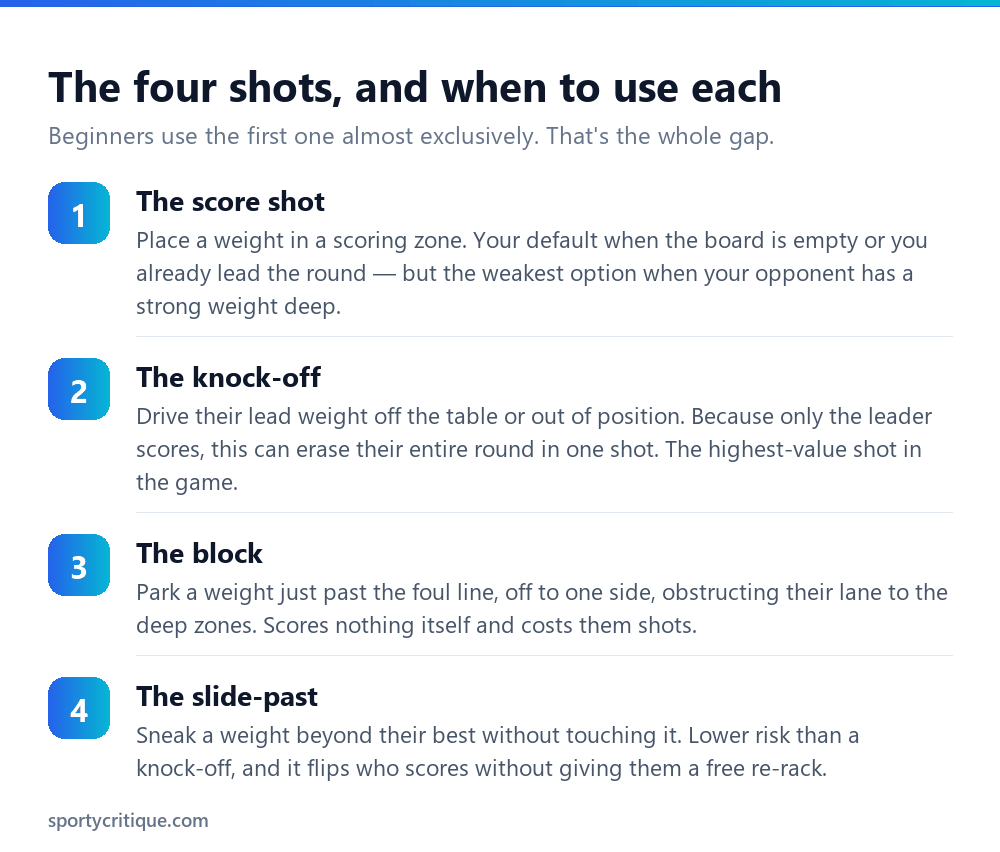
The slide-past deserves more attention than it gets. It’s the shot that beats a strong opponent weight without touching it — you simply place yours slightly further down. It’s lower risk than a knock-off (a missed knock-off often leaves their weight untouched and yours wasted) and it achieves the same reversal of who scores.
The reason to prefer it when available: a knock-off that connects badly can push their weight further down the table rather than off it, handing them a better position than they had. A clean slide-past has no such failure mode — worst case, you’re short.
Blocking is the most underrated shot in casual play. A weight parked just past the foul line, off to one side, does nothing for your score and makes their preferred lane much harder to use. Against a player who only knows how to shoot straight down the middle, a well-placed block effectively removes one of their options for the rest of the round.
Playing the situation
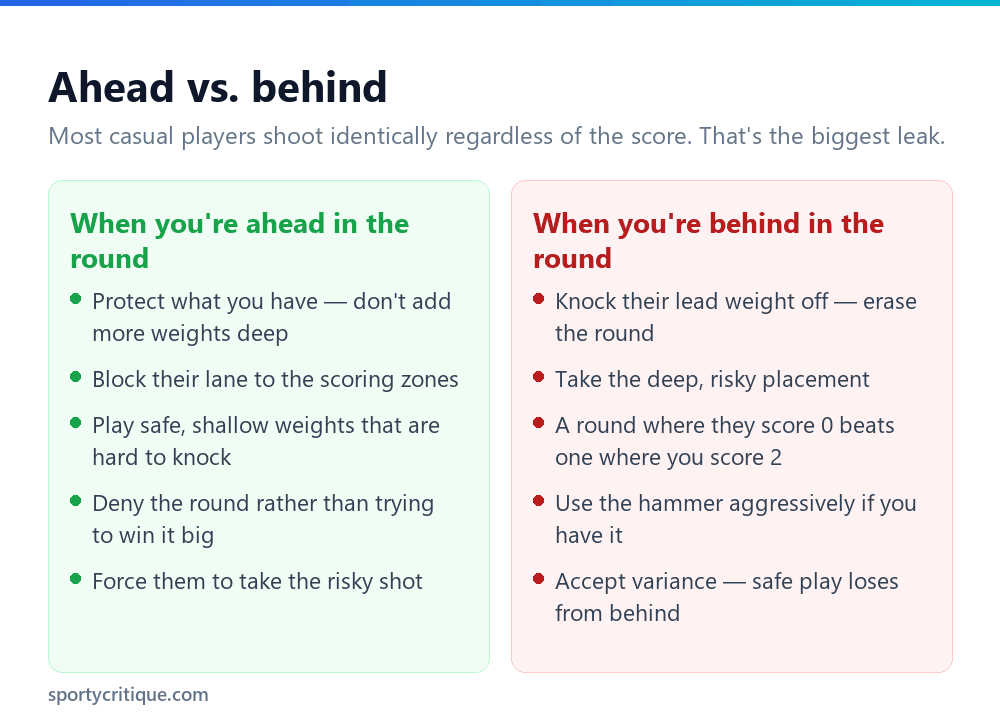
The single biggest leak in casual shuffleboard is shooting identically regardless of the situation. Two different situations demand opposite approaches.
When you’re leading the round — your weight is currently furthest — your job is to protect that, not extend it. Adding more deep weights just gives your opponent bigger targets. Play shallow, play blocks, and make their route to beating your lead weight as awkward as possible. A round won 2–0 counts the same as one won 2–0 dramatically.
When you’re behind in the round, safe play is losing play. You need to change the board, which means the knock-off or the deep placement, and it means accepting that some of those shots will fail. A round where you erase their score is worth more than a round where you creep to second place, because second place scores nothing.
And play the scoreboard. A player needing 2 points to win should be shooting completely differently from one needing 12. Trailing badly late in a game means taking risks that would be foolish at 5–5; leading comfortably means denying rounds rather than chasing big scores. Most casual players never adjust, which is how comfortable leads evaporate.
The hammer
Shooting last in a round — the hammer — is a genuine, quantifiable advantage, because you make your final decision with complete information about the board.
With the hammer, you can respond to whatever they’ve built: knock off their best weight, slide past it, or simply add a safe scoring weight if the round is already yours. Without it, your last shot is played knowing they get to answer it, so you should be building positions they must respond to rather than positions that merely score.
The practical habit is to know before each round whether you’ll have it, and plan accordingly. Without the hammer, place early weights that are genuinely annoying — blockers, and weights sitting in awkward spots — so that they spend shots clearing rather than scoring. Every shot they spend on your mess is a shot not spent building their own.
📊 Note: In casual play, who shoots last is often decided loosely or forgotten entirely. If you’re playing anyone seriously, agree the order at the start — it’s a real advantage and it should alternate, not fall to whoever happens to be standing closer.
Calibration: the free advantage
Every shuffleboard table plays differently, and the difference is large. Wax type and freshness, humidity, surface wear, and how level the table sits all change how far a given push sends a weight. The regulars at your local bar have an enormous advantage over you that has nothing to do with skill — they know their table.
So spend your first round learning rather than competing. Four shots will tell you whether the table is fast or slow, whether it drifts to one side, and how much force the deep zones need. Losing a round to gather that information is a good trade, and it’s the closest thing to a free win available in the game.
Drift is worth checking specifically. Many tables — especially older or poorly levelled ones — send weights consistently toward one rail. Once you spot it, aim off to compensate rather than fighting it. Players who never notice will spend the whole evening quietly blaming their own technique. If it’s your own table, our cleaning and levelling guide fixes the cause rather than the symptom.
💡 Pro tip: On an unfamiliar table, deliberately overshoot your very first weight off the end. It sounds wasteful and it instantly tells you the upper bound of the table’s speed — far more useful information than four cautious shots that all fall short.
Reading your opponent
Once your own decisions are sound, the next gain comes from watching theirs. Casual shuffleboard players are extremely predictable, and most of them are unaware of it.
Most have one shot. Watch two rounds and you’ll usually find your opponent throws almost everything at the same speed toward the same part of the table. Once you know their default landing zone, you can pre-empt it — park a block in that lane, or leave a weight sitting exactly where their habitual shot will collide with it.
Most panic when behind. The common pattern is that a trailing player starts throwing harder, which on a low-friction surface means weights sailing off the end. If you’re leading late, the highest-value thing you can do is nothing dramatic — place safe weights, force them to keep attacking, and let the overthrows accumulate.
Almost nobody blocks. Which means a blocking weight in the lane is not just an obstacle but an unfamiliar problem. Players who’ve never had to shoot around anything tend to either hit the block or overcorrect wildly, and both outcomes are good for you.
The reciprocal point is that you’re just as readable. If you’ve thrown four consecutive deep placements, expect a decent opponent to be waiting. Varying your shot — even occasionally taking a suboptimal one — keeps them honest, which is worth more over a full game than squeezing maximum value from every individual round.
Winning habits
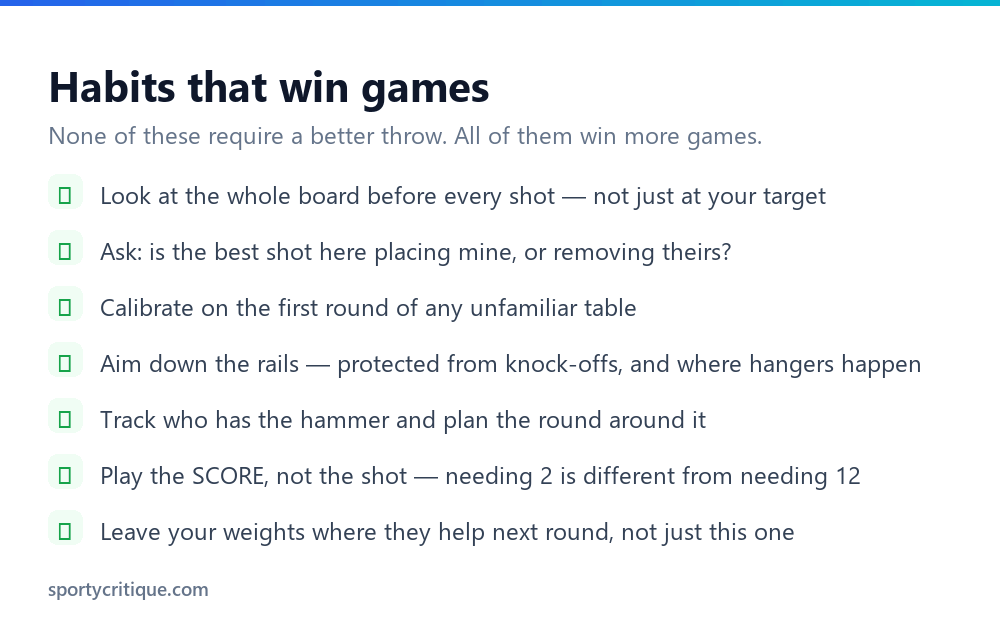
The unifying idea behind all of these is that shuffleboard rewards looking more than it rewards throwing. Before each shot, take two seconds to read the whole board: where their weights sit, where yours sit, who’s currently leading the round, whether you have the hammer, and what the scoreboard demands.
Almost every casual player skips that and simply aims at wherever looks empty. Adding the pause is worth more than months of technique work, and it costs nothing.
Strategy on the outdoor court
Most of the above applies to table shuffleboard. Deck shuffleboard shares the tactical instincts but inverts two things worth flagging.
First, both players score in deck shuffleboard, so the knock-off doesn’t erase an entire round the way it does on a table. It’s still valuable — particularly knocking an opponent’s disc backward into the −10 kitchen, which removes their points and adds a penalty — but it’s one shot’s worth of value rather than a round’s.
Second, the kitchen penalises overhitting, so deck shuffleboard rewards restraint in a way the table game doesn’t. On a table, a shot that’s slightly too hard simply falls off the end and scores nothing. On a court, it costs you ten points. That single difference makes the outdoor game fundamentally more conservative, and players who move between the two need to consciously adjust.
Frequently asked questions
What’s the best strategy in shuffleboard?
Play the situation rather than shooting the same way every time. When you’re leading a round, block and protect; when you’re behind, knock their lead weight off. Because only the leader scores in table shuffleboard, removal is frequently worth more than placement — and that’s the single insight that most improves a casual player.
Should I knock off my opponent’s weights?
Often, yes — it’s legal and it’s the highest-value shot in the game. Removing their lead weight erases their entire round, takes the lead, and can make several of your own weights count. The exception is when a slide-past is available, since a mistimed knock-off can push their weight further down the table instead of off it.
How do I get better at shuffleboard quickly?
Improve decisions before technique. Look at the whole board before each shot, ask whether placing or removing is worth more, and calibrate to the table before competing. These cost nothing and produce a bigger immediate gain than months of work on your throw.
What is the hammer in shuffleboard?
The last shot of a round. It’s a real advantage because you decide with full knowledge of the board — you can knock off, slide past, or place safely as the situation demands. Agree the shooting order at the start of a game, since in casual play it often gets forgotten.
Why do I keep losing to the same person at my local bar?
Very possibly because they know the table and you don’t. Wax, wear, and levelling vary enormously between tables, and a regular knows exactly how much force each zone needs. Spend your first round calibrating rather than competing, and check whether the table drifts to one side.
Does strategy work the same in outdoor shuffleboard?
The instincts transfer but two things invert. Both players score in deck shuffleboard, so a knock-off doesn’t erase a whole round. And the −10 kitchen punishes overhitting, which makes the court game far more conservative than the table game. Our outdoor guide covers the differences.
- →Table shuffleboard rules — the bar game in full
- →Shuffleboard scoring — why only one player scores
- →Outdoor deck shuffleboard — the court game and the kitchen
- →Cleaning your table — fixing drift and slow surfaces
- →How to play shuffleboard — both versions compared