
Best Shuffleboard Pucks: Plastic, Metal, and Composite Compared


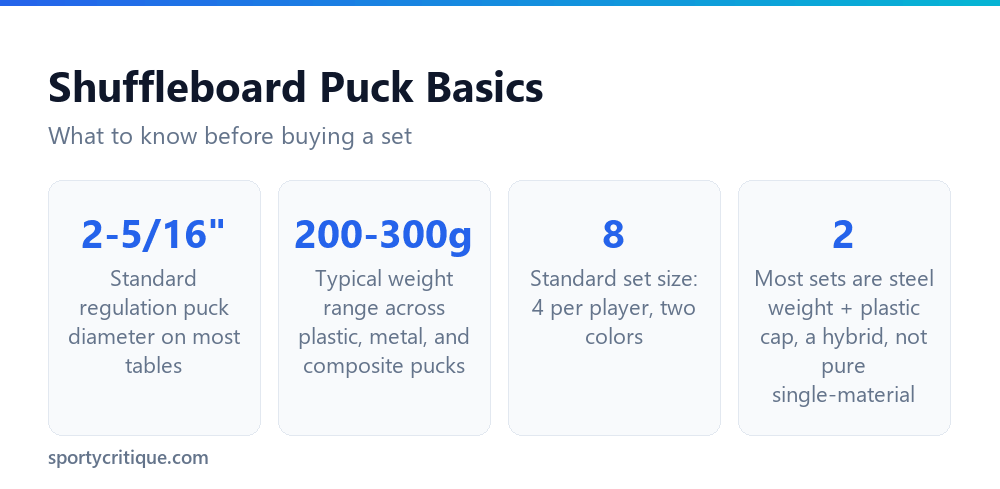
Most shuffleboard pucks sold today are a hybrid construction: a steel or metal weight core with a colored plastic top cap, not purely plastic or purely metal. The real differences between sets come down to overall weight (roughly 200 to 300 grams), size accuracy (2-5/16″ is standard regulation), and build consistency between the pucks in a set, more than a simple plastic-versus-metal split. Four real sets, from $49.99 to $249.99, are compared below.
“Plastic vs. metal vs. composite” is how shuffleboard puck marketing frames the choice, but it oversimplifies what’s actually inside most sets sold today. The overwhelming majority use a metal (usually steel) weight as the core, with a plastic cap on top that gives the puck its color and, on some models, a swappable design. A puck marketed as “plastic” is describing the visible cap, not claiming the whole object is plastic through and through; an all-plastic puck with no metal weight at all would be too light to play correctly on a regulation table.
What genuinely varies between sets is total weight, how consistent that weight is puck to puck within the same set, and how precisely the diameter matches regulation size. Those practical differences matter more to actual play than whichever material gets emphasized in a product’s marketing copy.
- →Most sets combine a metal weight core with a plastic top cap; pure single-material pucks are less common than marketing suggests
- →Standard regulation diameter is 2-5/16 inches; confirm this before buying for a regulation table
- →Weight typically runs 200 to 300 grams; heavier pucks glide more smoothly but need more force
- →Consistency between the 8 pucks in a set matters as much as the weight number itself
- →A booklet or documented weight spec from the manufacturer is a good sign of a quality-controlled set
Table of Contents
Why Weight Matters More Than Material Label
Heavier pucks, toward the 280 to 300 gram end of the typical range, glide more smoothly and are less sensitive to small surface imperfections or uneven wax distribution, but they require more force to move and can feel less controllable for a beginner still building touch. Lighter pucks, closer to 200 to 250 grams, are easier to handle and require less force, but they can move less predictably on an inconsistent surface, since there’s less mass to smooth out minor irregularities.
Neither end of that range is objectively correct. Casual and family play generally does fine with a mid-weight set, while players regularly practicing precision shots, particularly combination and bump shots, tend to prefer the more predictable glide of a heavier set once they’ve built the strength and touch to control it.
4 Real Puck Sets, Compared
Consistency Within a Set Matters as Much as Weight
A set where all 8 pucks weigh close to identically is more valuable for consistent, fair play than a set with the exact same average weight but more variance puck to puck. A puck that’s noticeably heavier or lighter than its teammates behaves unpredictably compared to the rest, which is frustrating in a way that’s hard to diagnose without actually weighing each puck individually.
💡 Pro tip: A manufacturer that documents the exact weight spec, ideally with a booklet or listing that states the target weight per puck, is generally more reliable on consistency than one that just lists a size and color with no weight documentation at all. It’s not a guarantee, but it’s a reasonable signal of quality control during manufacturing.
Getting the Size Right
Standard regulation shuffleboard pucks measure 2-5/16 inches in diameter, and this size is consistent across most full-size tables regardless of brand. A mismatched puck size, too large or too small for the table’s gutters and scoring zones, plays inconsistently and can even affect scoring accuracy near the edges of zones.
⚠️ Watch out: Some smaller or novelty tables use a different, non-regulation puck size. Confirm the puck diameter your specific table was built for before ordering a replacement set, rather than assuming every shuffleboard table uses the same 2-5/16″ standard.
What Actually Matters When Buying
- ✓Confirm the exact diameter matches your table’s regulation size
- ✓Look for documented weight specs, not just size and color
- ✓Choose weight range based on player skill level and preference, not brand reputation alone
- ✓Buy a full matched set rather than mixing pucks from different sets
- ✕Assuming “plastic” or “metal” labeling tells you the full construction
- ✕Ignoring puck-to-puck weight consistency within a set
- ✕Buying the heaviest available set assuming heavier always performs better
- ✕Mixing pucks from two different sets and expecting consistent play
How Pucks Interact With Wax Speed
A puck’s weight and surface finish interact directly with whatever speed-rated wax is on the table, and the two shouldn’t be considered separately when tuning how a table plays. A heavy puck on a fast wax can overshoot the kitchen zone more easily than the same wax with a lighter puck, while a light puck on a slow wax can struggle to reach the higher-value zones at all.
Players fine-tuning table speed for their skill level or preference generally have two levers available: wax speed grade and puck weight. Changing wax is the more common adjustment since it’s cheaper and faster to redo, but puck weight is worth considering as a second lever if wax changes alone aren’t producing the desired feel, particularly for players who’ve already settled on a wax they like for other reasons.
📊 Note: The bottom surface of a puck also affects glide, separate from weight. A puck with a smooth, worn bottom surface glides differently than a new one straight from the package, which is worth factoring in when comparing a used set’s actual playing feel against a brand-new set’s advertised specs.
Cleaning and Maintaining Pucks
Pucks accumulate wax and dust buildup on their bottom surface over time, which changes how they glide even if the weight itself hasn’t changed. Wiping the bottom surface with a dry or slightly damp cloth periodically removes that buildup and restores more consistent glide without needing to replace the set.
Plastic caps can crack or chip with heavy use over years, particularly from repeated hard contact against other pucks or the table’s rails. On a set with screw-on, replaceable caps, a cracked cap is a cheap, simple fix rather than a reason to replace the whole set; on a fixed-cap design, a cracked cap usually means retiring that individual puck rather than the full set.
💡 Pro tip: Inspect all 8 pucks periodically for chips, cracks, or visibly uneven wear rather than assuming a set stays uniform indefinitely. Catching a damaged puck early and replacing just that one, where the design allows it, keeps the set playing consistently longer than waiting until multiple pucks show visible damage.
Swappable Caps and Color Customization
Some sets, including the Zieglerworld option above, use screw-on caps specifically so owners can swap colors without buying an entirely new puck set. That’s a real practical advantage for anyone who wants to match team colors for an event or simply prefers changing up the table’s look occasionally, and it doesn’t come at a meaningful cost to durability compared to a fixed-cap design.
This customization is purely cosmetic, though; it doesn’t change weight, glide, or any actual playing characteristic. It’s worth factoring into a purchase decision only if color flexibility genuinely matters to the buyer, not as a meaningful performance consideration.
Do You Need More Than One Set?
A single 8-puck set covers standard two-player shuffleboard, but some owners keep a second set on hand, either a different weight for practicing at a different speed feel, or simply a backup in case a puck gets damaged mid-game. This isn’t necessary for casual or occasional play, but it’s a reasonable consideration for a table that sees frequent use or hosts regular guests who may prefer a different weight than the household’s default set.
For a table used primarily by one or two regular players, a single well-chosen set covers essentially all needs. Multiple sets make more sense for a shared or public table, a bar, rec center, or frequently hosted game night, where player preference and skill level vary more from session to session.
Replacing Individual Pucks vs. Buying a Full New Set
When only one or two pucks in an otherwise good set show damage, buying a full replacement set isn’t always necessary or cost-effective. Some manufacturers sell individual replacement caps or single pucks matched to their existing product lines, which costs a fraction of a full 8-puck set and keeps the rest of the original set in play.
That option depends entirely on whether the original manufacturer offers matched individual replacements, which isn’t universal across brands. Checking before assuming a full replacement is required saves real money on an otherwise still-functional set, particularly for a higher-tier set where the full replacement cost is substantial.
⚠️ Watch out: Buying a generic replacement puck from a different manufacturer to patch a damaged set risks introducing the exact weight and size inconsistency described earlier. If matched individual replacements aren’t available from the original manufacturer, a full new set is usually the more reliable choice over mixing brands.
Frequently Asked Questions
Are metal shuffleboard pucks better than plastic ones?
The framing is somewhat misleading, since most sets already combine a metal weight core with a plastic cap. What actually varies between sets is total weight, consistency, and build quality, not a simple metal-versus-plastic split.
What’s the standard shuffleboard puck size?
2-5/16 inches in diameter is standard on most full-size regulation tables. Some smaller or novelty tables use different sizing, so confirm your table’s spec before ordering a replacement set.
How much do shuffleboard pucks weigh?
Typically somewhere between 200 and 300 grams, with heavier pucks gliding more smoothly and lighter pucks requiring less force but playing somewhat less predictably on an inconsistent surface.
Can I mix pucks from two different sets?
It’s not recommended for serious or competitive play, since weight and size can vary meaningfully between manufacturers even at the same nominal spec. For casual play it usually works fine, but a matched set gives more consistent results.
How often should shuffleboard pucks be replaced?
There’s no fixed schedule; it depends entirely on frequency of use and how well the caps hold up to contact over time. A well-maintained set with periodic cleaning can last many years before any individual pucks need replacing.
Do heavier pucks make a table play faster?
Not directly; wax speed grade has a bigger effect on overall table speed than puck weight alone. Puck weight changes glide smoothness and how forgiving the puck is of surface imperfections more than it changes raw speed.
Picking the right set comes down to matching weight and quality to how the table actually gets used, not chasing a specific material label. Any of the four sets above is a reasonable, honest choice within its own price tier and intended level of play.
As an Amazon Associate, we earn from qualifying purchases through links on this page.