How to Play Shuffleboard: Both Games, Explained Properly

There are two completely different games called shuffleboard. Table shuffleboard is played on a long waxed wooden table where you slide metal weights by hand — that’s the bar game, first to 15. Deck shuffleboard is played on a 39-foot painted court where you push discs with a long cue — that’s the cruise ship and park game, usually to 50 or 75. Both share one core idea: get your pieces further down than your opponent’s, and only one side scores per round.
🎯 Shuffleboard Hub: Explore all 18 table reviews, wax speed guides, and scoring tutorials in our Complete Shuffleboard Resource Hub.
Nearly every guide to shuffleboard has the same problem: it picks one of the two games and never mentions the other exists. You search “how to play shuffleboard,” land on a page about waxing a wooden table, and think “that’s not the game I played on a cruise ship with a stick.” Or the reverse.
The confusion isn’t your fault, and it’s not really the writers’ fault either — most shuffleboard content is published by companies that sell one kind of equipment. So this page starts by sorting out which game you actually mean, then teaches you both.
- →Two sports share the name: table shuffleboard (bar, hand-slid weights) and deck shuffleboard (court, cue-pushed discs).
- →In both games, only ONE player or team scores in each round — the one furthest down.
- →In table shuffleboard, a weight hanging over the far edge is a ‘hanger’ and scores 4, the maximum.
- →Knocking your opponent’s pieces out of play is completely legal and is half the strategy.
- →Shooting last in a round (the hammer) is a real advantage — play the round with that in mind.
- →Table games go to 15 or 21; deck games go to 50, 75, or 100.
Table of Contents
First: which game are you playing?
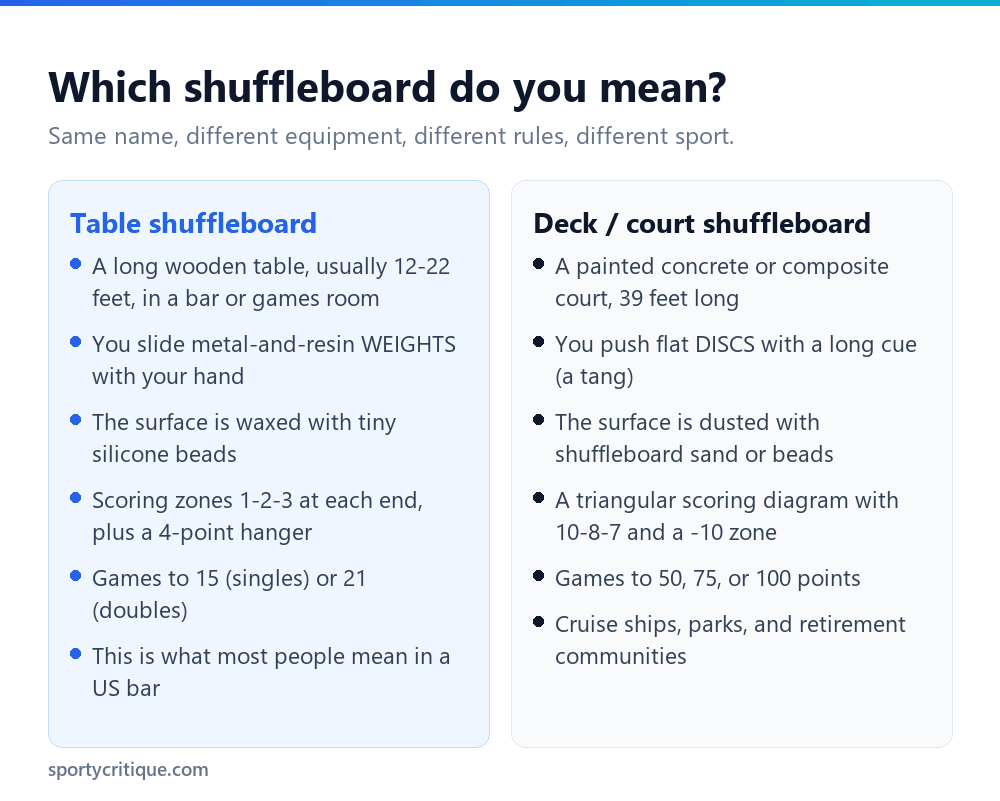
The quickest test is the equipment. If you slid a heavy metal puck with your fingers along a polished wooden table, that’s table shuffleboard. If you pushed a flat plastic disc with a long-handled cue across a painted surface on the ground, that’s deck shuffleboard — also called court, floor, or outdoor shuffleboard.
They’re historically related — both descend from a 15th-century English game called shove-groat, where players slid coins across a table — but they diverged centuries ago and are now genuinely separate sports with their own governing bodies, tournaments, and terminology. Learning one doesn’t teach you the other, though the strategic instincts transfer surprisingly well.
There’s also a third thing people mean: the shuffleboard game in iMessage, part of the GamePigeon app pack. Rules are loosely based on the table version, physics included.
Table shuffleboard: the bar game
This is the version in American bars, and the one most people encounter first. A regulation table is 22 feet long, though bar and home tables run anywhere from 9 to 22 feet. The surface is hard maple, finished to a gloss, and dusted with silicone beads — called wax, sand, powder, or cheese depending on where you are — which is what lets a heavy puck glide most of the length of a table.
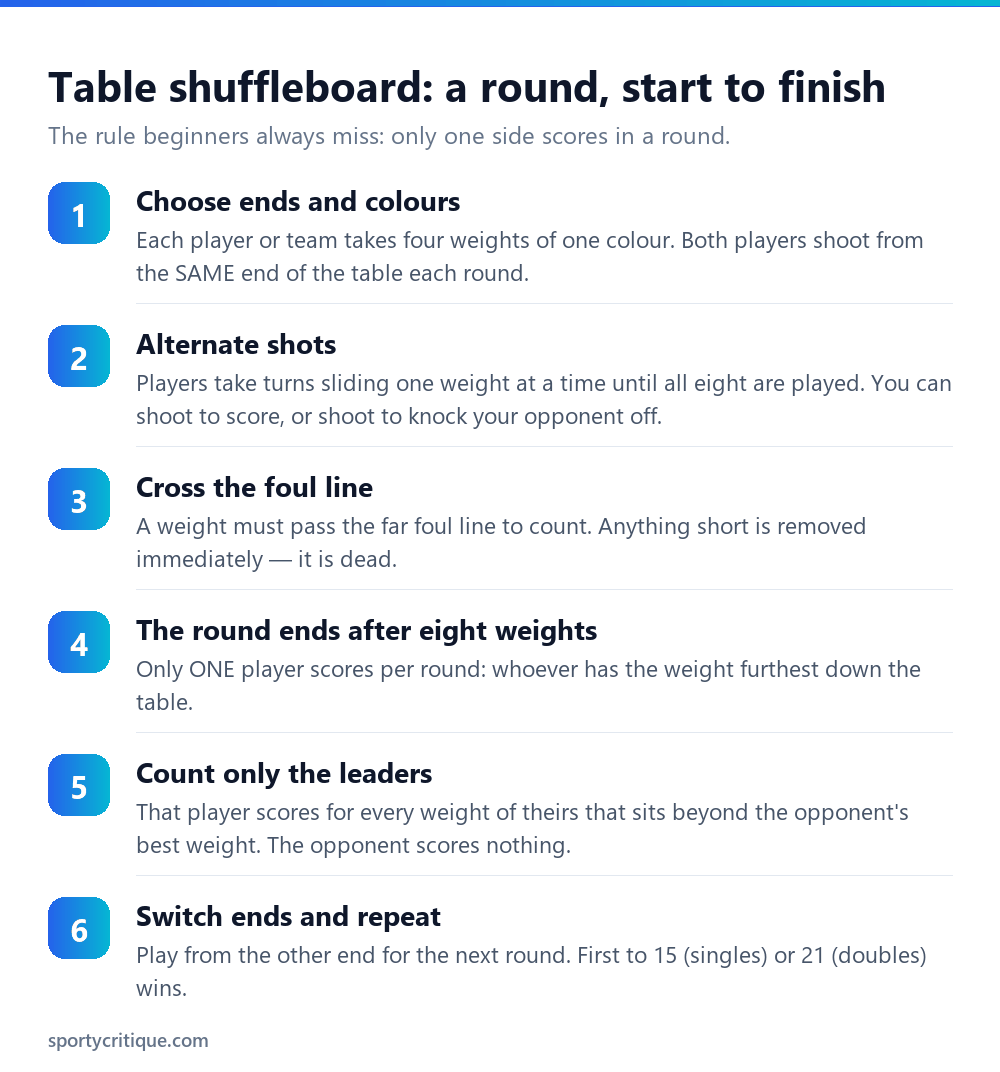
The single rule that beginners get wrong: only one side scores per round. People assume every weight in a scoring zone counts for whoever owns it. It doesn’t. At the end of a round, find the weight furthest down the table — that player is the only one who can score. They then count every one of their weights that sits beyond the opponent’s furthest weight. Everything else is worth nothing.
This is what makes the game tactical rather than a slide-and-hope exercise. If your opponent has a weight sitting in the 3 zone, you don’t need to out-place it precisely — you can knock it off the table entirely, or slide past it, and their whole round collapses to zero. Full detail is in our shuffleboard scoring guide.
💡 Pro tip: The most common beginner error is throwing too hard. A shuffleboard weight needs far less force than instinct suggests — most first-timers send every puck straight off the end. Start by aiming to barely reach the first scoring zone, then build up. You’ll learn the table’s speed in about ten shots, and every table is different.
Deck shuffleboard: the court game
Deck shuffleboard is played on a court 39 feet long by 6 feet wide, with a scoring triangle at each end. You stand at one end and use a cue — properly called a tang — to push flat discs about six inches across toward the far triangle. Two players use four discs each, alternating shots.
The scoring diagram is where it differs most from the table game. The triangle is divided into zones worth 10, 8, 8, 7, and 7 points, and directly behind it sits a zone marked −10 — universally called the kitchen. Land in the kitchen and you lose ten points. That single feature changes the whole character of the game: a shot that’s slightly too hard doesn’t just fail, it actively costs you, so deck shuffleboard rewards caution in a way the table game doesn’t.
Unlike table shuffleboard, both players’ scoring discs count in deck shuffleboard — every disc fully inside a scoring zone scores for its owner, and discs touching a line score nothing. Games typically run to 50, 75, or 100 points depending on how long you want to be out there. Our outdoor shuffleboard guide covers the court, the cue technique, and the tactics in depth.
📊 Note: If you want to build your own, the two projects are completely different undertakings: a DIY shuffleboard table is a precision woodworking job where flatness is everything, while a backyard shuffleboard court is a concrete-and-paint project. Neither is beyond a competent DIYer, but don’t confuse the two.
Why there are two games in the first place
The split makes more sense once you know where the game came from. Shuffleboard descends from a 15th-century English pastime variously called shove-groat or slide-groat, in which players slid coins or metal discs down a long table toward marked scoring areas. It was popular enough in taverns to be legislated against — authorities of the period repeatedly tried to suppress it, on the familiar grounds that working men were gambling on it instead of practising archery.
That tavern game crossed the Atlantic and stayed indoors, on tables, becoming what American bars still play today. But the same basic idea also migrated outdoors, onto the decks of passenger ships, where a longer surface and a cue made more sense than a table for people playing in the open air. That’s the version that became deck shuffleboard, spread through cruise lines and resorts, and eventually onto painted courts in parks and retirement communities across the US.
So the two games aren’t a modern naming accident. They’re two branches of the same tree, separated by a couple of hundred years and about thirty feet of playing surface — which is exactly why they share terminology and instincts while sharing almost no actual rules.
Terms people use without explaining them

Two of those deserve more than a line. The hammer — shooting last in a round — is a genuine strategic advantage, because you get the final say on the board. If the round is close, the player with the hammer can knock off, block, or place with full knowledge of what’s already there. Good players plan the whole round around whether they have it.
Wax is the confusing one, because it isn’t wax. Table shuffleboard powder is tiny silicone or plastic beads that act like ball bearings under the puck. It comes in speeds, usually numbered, with higher numbers being faster. A bar table that feels sluggish usually just needs cleaning and fresh powder — see our guide to cleaning a shuffleboard table, since old powder combined with spilled drinks is what ruins most bar tables.
Basic strategy for both games
The tactics differ in detail, but three principles hold across both versions:
Our shuffleboard strategy guide goes deeper on shot selection, when to knock off versus when to place, and how to use the hammer.
Other games you can play on a shuffleboard table
Standard rules are only the starting point. Table shuffleboard has a set of well-established variants, and they’re worth knowing because they solve specific problems — too many players, mismatched skill levels, or a group that finds the standard game slow.
- Standard scoring, but knocking opponents off is the explicit goal
- Aggressive, fast, and forgiving of poor touch
- The best version for beginners — less finesse required
- All four weights shot from one end, then scored
- Weights must pass the foul line or the whole round is lost
- Play to 51; a bad round can wipe out your progress
- Points only count in specific zones agreed beforehand
- Rewards precision over aggression
- Good for evening out a skill gap
- You must touch an existing weight with each shot
- Pure finesse — no big swings, no knock-offs
- The best practice game for learning table speed
If you’re introducing someone to the game, start with Knock Off rather than standard rules. It gives beginners something to do with a badly weighted shot — aim at your opponent — instead of watching pucks sail off the end for twenty minutes. Tap and Draw is the opposite: the most useful game for actually improving, and the one that will teach you a table’s speed faster than anything else.
Getting a table or a court
If you’re thinking about buying, the size decision matters more than the brand. Regulation is 22 feet, but that requires roughly 26 feet of room to play comfortably — you need standing space at both ends. Most homes end up with a 9-, 12-, or 14-foot table, and those play perfectly well; shorter tables just make the game less about touch and more about accuracy, since there’s less runway for a weight to slow down.
The specification that actually matters isn’t length, it’s playfield thickness. Thicker hardwood (1.5 to 3 inches) stays flat over time; thin playfields warp, and a warped shuffleboard table is unplayable in a way that no amount of wax fixes. A climate adjuster — the set of tensioning bolts under the board — is worth having for the same reason. Our shuffleboard table roundup covers current options.
⚠️ Watch out: A shuffleboard table is not a piece of furniture you can move casually. A 14-foot table can weigh several hundred pounds, arrives in sections, and needs levelling once installed — a table that isn’t level will send every weight drifting to one side, and players will blame their technique for months.
Frequently asked questions
How many points do you need to win at shuffleboard?
Table shuffleboard is usually first to 15 in singles and 21 in doubles, though bar house rules vary and 11 or 21 are both common. Deck shuffleboard runs much longer — 50, 75, or 100 points depending on the format. Agree the target before you start, because ‘first to 15’ and ‘first to 75’ are very different evenings.
Can you knock your opponent’s puck off the table?
Yes, and you should. It’s fully legal in both versions and it’s central to good play, because only the leading player scores in table shuffleboard — removing their best weight can wipe out their entire round. Beginners often treat knock-offs as unsporting; experienced players treat them as the point.
What is a hanger in shuffleboard?
A weight that comes to rest overhanging the far edge of the table without falling off. It’s worth 4 points, the highest single value, and it’s the shot every player chases. Getting one requires a weight to travel the full length and stop within a fraction of an inch of falling — which is why it feels so good.
Why won’t my pucks slide properly?
Almost always the surface, not the puck. Table shuffleboard needs a clean, dry, waxed playfield — and ‘clean’ is the part people skip. Old powder mixed with dust and spilled drinks turns gritty and grabs the weights. Wipe the board down, apply fresh powder of the right speed, and it will feel like a different table. Our cleaning guide covers the full process.
Is shuffleboard the same as curling?
No, though the strategic ideas overlap a lot — both involve sliding objects toward a target, both score only for the closest pieces, and both use blocking and knock-outs. But curling is played on ice with 40-pound granite stones and sweeping, and it’s an Olympic sport with a very different physical demand. If you like shuffleboard tactics, you’ll probably enjoy watching curling.
Do you have to alternate shots?
Yes, in standard rules for both versions — players take turns sliding one piece at a time. Some casual bar formats let a player shoot all four weights consecutively, but that removes most of the tactical interplay, since you can’t respond to what your opponent just did. Alternating is what makes it a game rather than a target exercise.
- →Table shuffleboard rules in full — the bar game, in detail
- →Outdoor / deck shuffleboard — the court game, cue technique and tactics
- →How scoring works — zones, hangers, and why only one side scores
- →Strategy and how to win — knock-offs, blocks, and the hammer
- →Cleaning and waxing a table — the fix for a slow board
- →Best shuffleboard tables — sizes, thickness, and what matters