How to Play Golf: A Beginner’s Guide to Rules, Scoring, and Etiquette

Golf is simple to describe: hit your ball into each of the 18 holes in as few shots as possible, and the lowest total wins. Every swing counts as a stroke, you play the ball where it lies, and losing a ball or hitting out of bounds costs a penalty stroke. You score against par — match it for par, one under is a birdie, one over is a bogey. You may carry up to 14 clubs, higher-numbered ones hitting shorter, higher shots. You do not need to learn the full rulebook to start — a handful of rules gets you round a course.
⛳ Golf Hub: Explore all 29 club reviews, swing tutorials, and short game guides in our Complete Golf Resource Hub.
Golf has a reputation for being complicated and intimidating, and that reputation does more to keep beginners away than the game itself ever would. The truth is that the core of golf — hit the ball, find it, hit it again until it’s in the hole — is genuinely simple, and you can play a real round knowing only a handful of rules.
This guide covers what you actually need: how scoring works, the rules that matter, what the clubs do, and the etiquette that makes golf feel intimidating until someone explains it. The swing itself — the part everyone worries about — is a separate skill covered in our guide to the golf swing.
- →The goal: get the ball into 18 holes in the fewest total strokes.
- →Score against par — birdie is one under, bogey is one over.
- →Play the ball as it lies; a swing counts even if you whiff.
- →Lost ball or out of bounds = a one-stroke penalty.
- →14 clubs max; higher numbers hit shorter, higher shots.
- →You don’t need the rulebook — a handful of rules is enough to start.
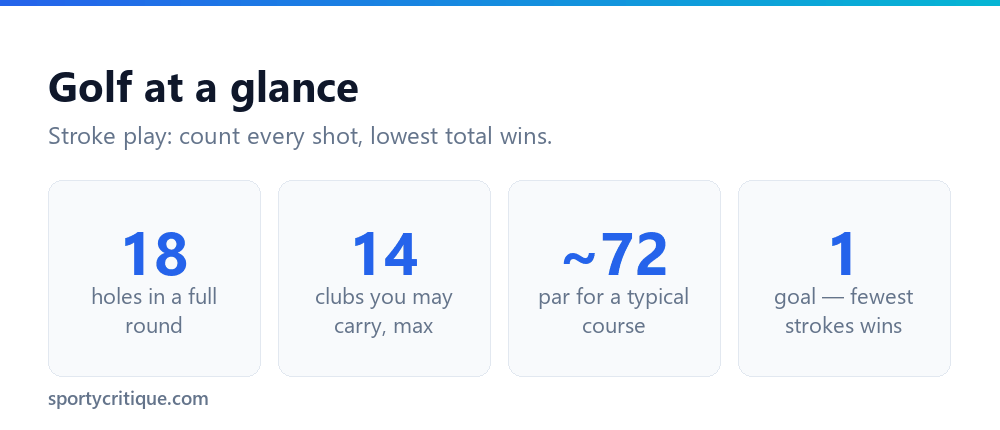
Table of Contents
How a round works
A full round is 18 holes, and every hole follows the same shape. You start on the tee, where you get to place the ball on a little peg (the tee) and take your first shot. From wherever it lands — the mown fairway if you’re lucky, the longer rough if you’re not — you play it as it lies and hit again, working your way toward the green, the area of very short grass around the hole.
Once on the green, you switch to your putter and roll the ball along the ground until it drops into the hole, which is marked by a flag. Then you add up how many shots that hole took, and move to the next tee. Do that 18 times, total your shots, and that’s your score for the round.
Each hole has a par — the number of shots a very good golfer would expect to take, usually 3, 4, or 5 depending on length. Add up the pars for all 18 holes and you get the course par, typically around 72. Your score is measured against that, which is why golf is unusual: you’re really playing against the course, hole by hole, rather than trading shots with your opponent directly.
Golf’s genius is that a beginner and an expert can play the same hole and both have a good time — because you’re each playing against par, not each other.
Scoring: par, birdie, bogey
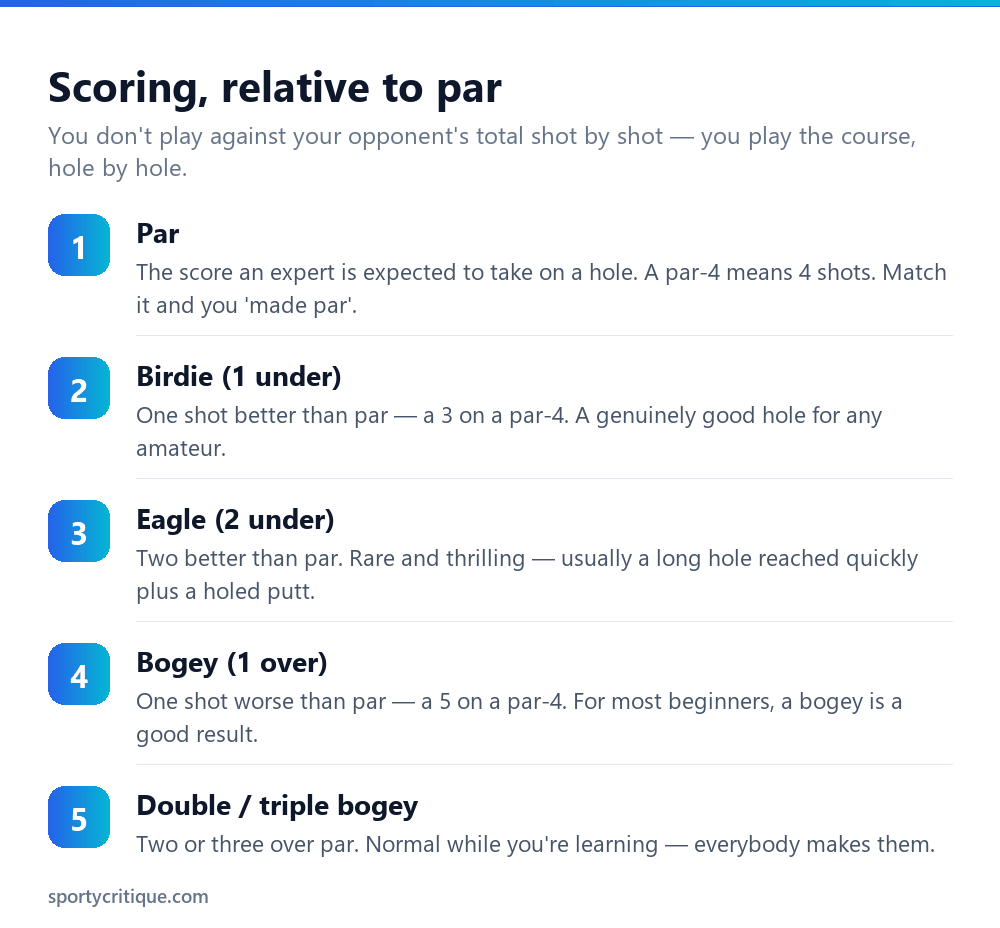
The vocabulary sounds like a secret code and is actually simple: every term just describes how a hole compares to its par.
Par means you took exactly the expected number of shots. Birdie is one shot better, eagle is two better. Going the other way, bogey is one worse, double bogey two worse, and so on. So on a par-4 hole: a 3 is a birdie, a 4 is par, a 5 is a bogey, a 6 is a double bogey.
For a beginner, this framing is genuinely encouraging. You’re not expected to make par — making bogeys is completely normal and even good while you learn, and a round full of bogeys with the odd par is a fine day out. The most common scoring method, used in almost all casual and professional golf, is stroke play: simply count every shot over the round and the lowest total wins.
📊 Note: There’s a second common format, match play, where you win or lose each hole individually rather than counting total strokes — whoever wins the most holes wins the match. It’s great fun and takes the pressure off a single disastrous hole, since a blow-up only costs you that one hole rather than your whole scorecard.
The rules you actually need
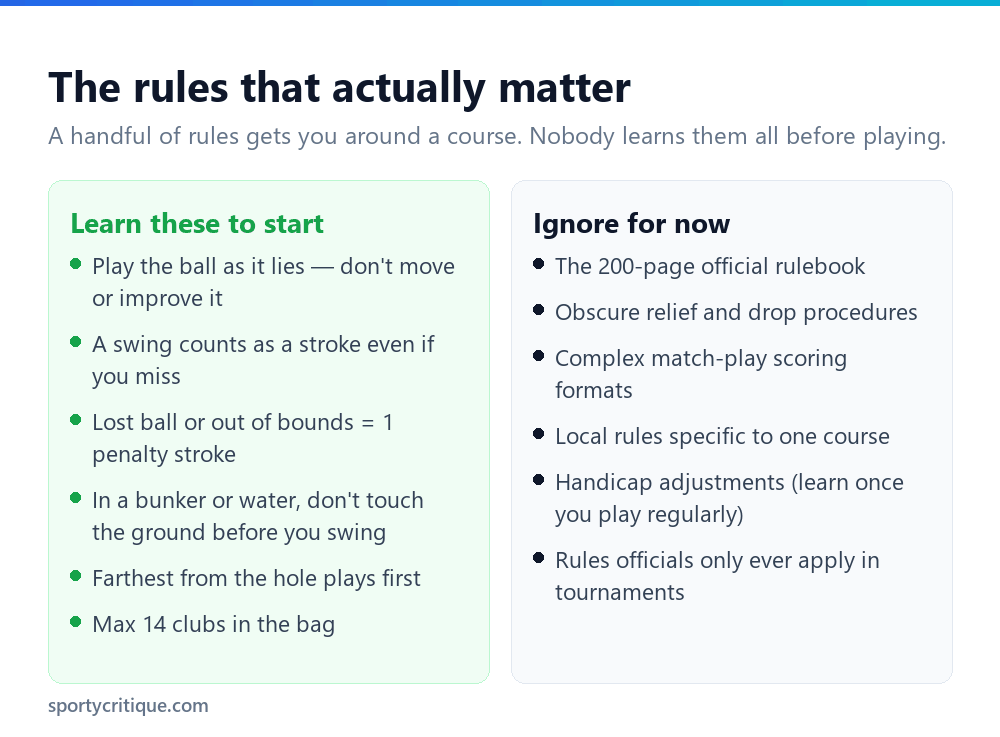
Golf’s official rulebook runs to hundreds of pages, and beginners understandably assume they need to absorb it before setting foot on a course. They don’t. A small set of rules covers almost everything you’ll encounter.
Play the ball as it lies. Wherever your ball comes to rest, that’s where you play your next shot from — you don’t move it, nudge it to a better spot, or improve the ground around it. This is the single most fundamental rule in golf, and it’s the source of both its challenge and its fairness.
Every swing is a stroke. If you swing at the ball meaning to hit it and miss completely — a whiff, or ‘air shot’ — that still counts as a stroke. It’s a rite of passage; everyone does it, and you count it and move on.
Lost balls and out of bounds cost a penalty. If you can’t find your ball, or it finishes outside the course boundary (marked by white stakes), you add a penalty stroke and play another ball. The exact procedure has nuances, but the practical version for a beginner is: take a penalty shot, drop a ball near where it went, and carry on rather than holding everyone up searching.
In hazards, don’t ground your club. In a sand bunker or a water hazard, you’re not allowed to let your club touch the ground (or water) before your swing — doing so is a penalty. And the player farthest from the hole plays first, which keeps the group organised and safe. That’s genuinely most of what you need.
The clubs, and which you actually need
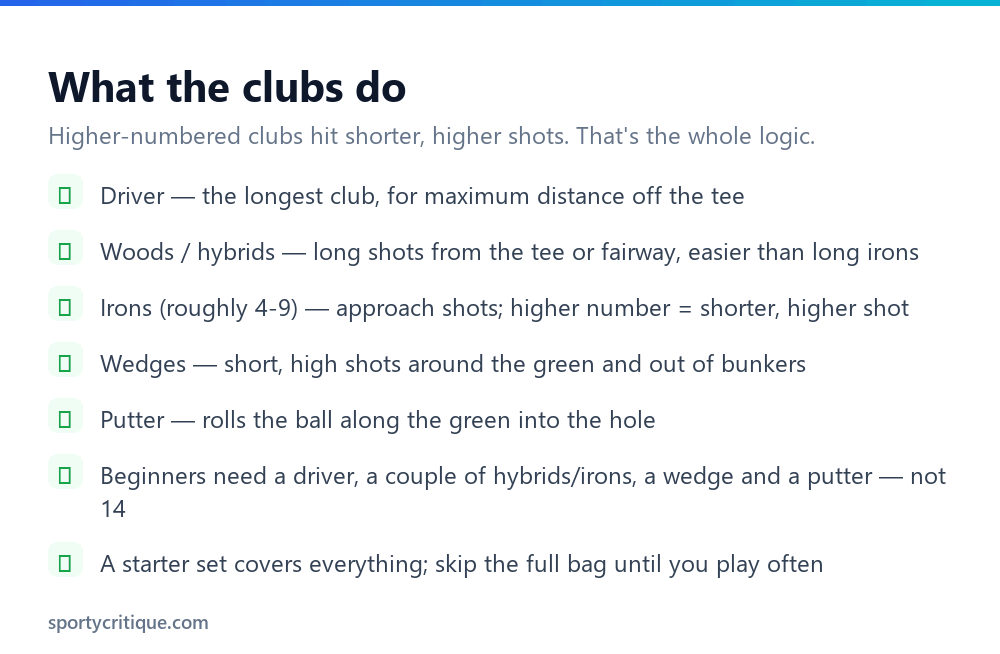
You may carry up to 14 clubs, and the variety confuses beginners more than almost anything else. The underlying logic, though, is simple: different clubs hit the ball different distances and heights, and higher-numbered clubs hit shorter, higher shots.
The driver is the biggest club, built for maximum distance off the tee. Woods and hybrids are for long shots from the tee or fairway and are far more forgiving than the long irons they’ve largely replaced. Irons, numbered roughly 4 to 9, handle approach shots into the green — a 9-iron hits a short, high shot, a 5-iron a longer, lower one. Wedges are for short, high shots close to the green and escaping bunkers. And the putter rolls the ball along the green into the hole.
Here’s the reassuring part: you don’t need all 14 to start. A beginner is well served by a driver, a couple of hybrids or mid-irons, a wedge, and a putter — and a starter set bundles a sensible selection for exactly this reason. Buying a full 14-club bag before you know whether you enjoy the game is a classic beginner overspend.
Etiquette: the unwritten rules
If golf’s written rules are simpler than they seem, its etiquette is what actually makes newcomers anxious — the sense that everyone knows an invisible code you don’t. Here’s the code, and it’s mostly common courtesy.
💡 Pro tip: The etiquette that matters most to everyone else on the course is pace. Nobody minds a beginner who plays badly; everyone minds a group that plays slowly. Keep moving, pick up and pocket your ball if a hole is going disastrously, and you’ll be welcome anywhere — a high score bothers no one, a five-minute search on every hole bothers everyone.
Getting started without embarrassment
The gap between ‘I’d like to try golf’ and ‘I’m confident on a course’ is where most would-be golfers give up, so here’s the low-stress path.
Start at the driving range, not the course. A range lets you hit a bucket of balls, learn the basic grip and swing, and get comfortable making contact — all with nobody waiting behind you and no score to keep. A lesson or two from a pro at this stage is the best money a beginner can spend, because it prevents bad habits that take years to unlearn.
Then play a shorter, easier course first. A par-3 course (every hole is short) or a quiet 9-hole course is far less intimidating than a championship 18, and it lets you practise the actual flow of play — tee, find it, hit it, putt, next hole — without the full commitment. Go out early or late when it’s quiet, ideally with a patient friend who already plays.
And borrow or buy cheap clubs to begin. You don’t need good clubs to learn, and you certainly don’t need new ones. A cheap or second-hand starter set is perfect until you know you’re hooked, at which point our guide to beginner clubs covers upgrading sensibly. Once you’re playing regularly, our guide to calculating a handicap explains how to track your progress and play fairly against others of any level.
Where to play: the options
“A golf course” isn’t one thing, and knowing the options saves beginners from starting somewhere far too demanding.
One thing to be clear about: mini-golf (crazy golf) isn’t a stepping stone to real golf — it’s a different game entirely, played with a putter on obstacle courses, and it teaches you almost nothing transferable. Fun, but not practice. If you want to ease in cheaply, a driving range and then a par-3 course are the genuine on-ramp, and increasingly a golf simulator is a weather-proof way to learn and play whenever you like.
Frequently asked questions
How do you keep score in golf?
Count every shot you take on each hole, including any penalty strokes, and add them up over 18 holes — the lowest total wins, which is called stroke play. Each hole’s score is also described relative to par: matching par is ‘par’, one under is a ‘birdie’, one over is a ‘bogey’. You don’t need to make par to enjoy golf; bogeys are completely normal while you learn.
Do I need to know all the rules to play golf?
No. Golf’s official rulebook is enormous, but you only need a handful to play: play the ball as it lies, count every swing as a stroke, take a penalty for lost or out-of-bounds balls, don’t ground your club in a bunker, and let the player farthest from the hole go first. Everything else you can learn gradually as it comes up.
How many clubs can you carry?
A maximum of 14, in any combination you like. But beginners don’t need anywhere near that many — a driver, a couple of hybrids or irons, a wedge, and a putter will get you around any course. A starter set bundles a sensible selection, and adding clubs makes sense only once you play regularly and know your game.
How long does a round of golf take?
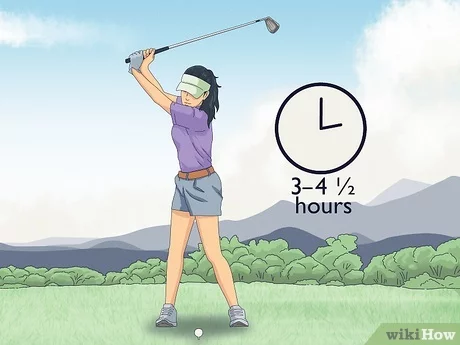
A full 18-hole round typically takes around four hours for a group, and about half that for 9 holes. Pace of play is the etiquette that matters most, so being ready to hit and keeping up with the group ahead is important — a slow group affects everyone behind them. Beginners can help by picking up on a bad hole rather than holing out every time.
What’s the difference between par, birdie and bogey?
They all describe your score on a hole relative to its par — the number of shots a very good golfer is expected to take. Par is matching that number, a birdie is one shot better, an eagle two better; a bogey is one worse and a double bogey two worse. On a par-4, a 3 is a birdie, a 4 is par, and a 5 is a bogey.
Is golf hard to learn?
The concept is easy; the skill takes time, and that’s true for everyone. Making consistent contact with the ball is the hard part and comes with practice, ideally starting at a driving range with a lesson or two. But you can play and enjoy a real round long before you’re any good — golf is unusual in that beginners and experts can play the same course together, because everyone plays against par rather than each other.
- →How to hold a golf club — the grip, where every shot starts
- →How to swing a golf club — the fundamental motion
- →How to hit a golf ball — making solid contact
- →How to calculate a golf handicap — tracking progress and playing fairly
- →Best golf clubs for beginners — what to actually buy