How Long Does It Take to Golf 18 Holes? Real Time Ranges

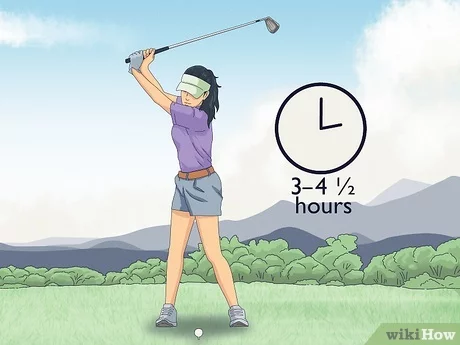
How long does it take to golf 18 holes? There’s no single honest answer, only a range that shifts with group size, course type, and how busy the tee sheet is. Here’s what actually moves that number, with real time ranges for each factor.

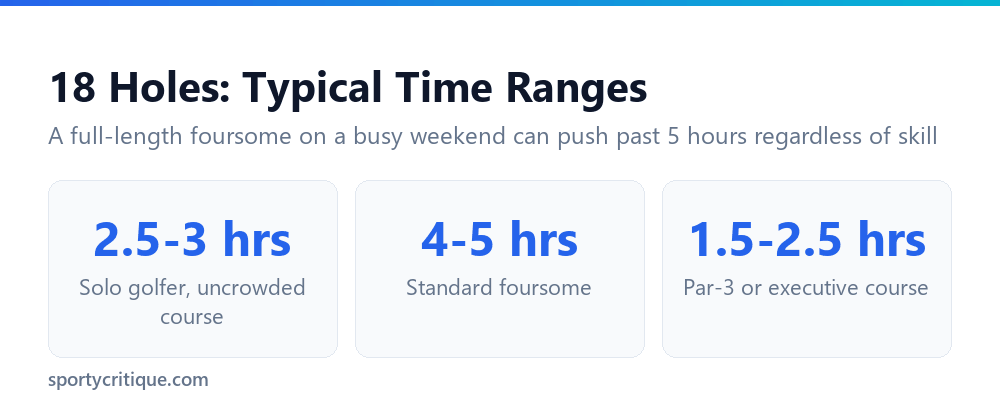
18 holes typically takes 4 to 5 hours for a standard foursome, 3 to 3.5 hours for a twosome, and 2.5 to 3 hours for a solo golfer on an uncrowded course. A par-3 or executive course cuts that to 1.5 to 2.5 hours regardless of group size. Riding carts instead of walking saves roughly 30 to 60 minutes; a crowded weekend tee sheet can add well over an hour to any of these ranges no matter how fast your group plays.
How long does it take to golf 18 holes is a harder question than it looks, because the honest answer is a range, not a number, and the range is wide: as short as 2 hours for a fast solo round and past 6 hours for a full foursome stuck behind slow play on a packed weekend morning. What actually moves that number is group size, whether you’re walking or riding, the course itself, and how busy the tee sheet is that day.
- →Group size matters more than skill level: a foursome takes roughly 1.5-2 hours longer than a solo round on the same course
- →PGA and USGA pace-of-play guidelines target 13-14.5 minutes per hole for a foursome, which works out to about 4 hours for 18 holes
- →Riding in a cart instead of walking typically saves 30-60 minutes over a full round
- →A par-3 or executive course runs 1.5-2.5 hours regardless of group size, since holes are shorter and approach shots are simpler
- →Course crowding on a busy weekend can add over an hour to any group’s pace, independent of how quickly your own group plays
Table of Contents
Time by group size
Each additional player adds real time, not just a few extra shots. More players in a group means more balls to find, more turns reading and taking putts on the green, and more waiting for each person to be ready to hit. The PGA’s own pace-of-play guidance targets roughly 14.5 minutes per hole for a foursome and 13.5 minutes for a threesome, which lines up closely with the USGA’s commonly cited 4-hour target for a foursome playing 18 holes at a reasonable pace.
Walking versus riding
Riding in a cart saves time mainly by cutting the distance and time spent between shots, particularly on longer holes or courses with hilly terrain between the green and the next tee. The commonly cited savings is 30 minutes to a full hour over an 18-hole round compared to walking, though the exact gap depends on the course’s layout and how far apart consecutive holes are routed. A well-conditioned walking group on a compact, walkable course can close much of that gap; a group walking a sprawling resort-style layout with long green-to-tee walks will feel the difference far more.
- ✓Ride if the course has long walks between greens and tees, or if daylight is limited
- ✓Walk a compact, well-routed course if you want the exercise and have time to spare
- ✓Ask the pro shop about typical walking time for that specific course before assuming
- ✓Book an earlier tee time if you’re walking and want to avoid backing up behind slower carts ahead
- ✕Assuming walking always adds exactly an hour; layout affects this more than raw distance suggests
- ✕Riding purely out of habit on a course built for walking, where carts add little time savings
- ✕Ignoring cart-path-only rules after rain, which can slow a cart round down closer to walking pace
Course type changes everything
A full-length 18-hole championship course and a par-3 or executive course aren’t really comparable in time. Par-3 courses, where every hole is a short iron shot rather than a full drive, run 1.5 to 2.5 hours for 18 holes because there’s simply less distance to cover and fewer full-swing shots per hole. Executive courses, a mix of mostly par 3s with a handful of short par 4s, land somewhere between a par-3 course and a full championship layout, typically in the 2.5 to 3.5 hour range.
📊 Note: If you’re short on time but want a full 18-hole round rather than 9, checking whether a nearby course offers a par-3 or executive layout is often the fastest legitimate way to fit it in, rather than trying to rush through a full-length course.
Weekday versus weekend
The same course, same group, and same skill level can run noticeably different times depending on the day. Weekday mornings at most public courses see lighter bookings and fewer walk-ups, which lets groups play closer to their natural pace with less backup at each tee. Weekend mornings, especially the first several hours after a course opens, are when tee sheets run tightest, and that’s when the gap between a course’s stated “average round time” and what a group actually experiences tends to widen the most.
Daylight and season
Daylight doesn’t change how long a round takes to play, but it does cap how late you can start one. A 4 to 5 hour foursome round needs a tee time early enough to finish before sunset, which matters more in fall and winter when daylight windows shrink. Many courses post a “last tee time for 18 holes” that accounts for this, separate from their last tee time overall, since a later slot might only leave enough daylight for 9.
What actually slows a round down
Course crowding is the biggest wildcard, and it has almost nothing to do with how well or fast your own group plays. Tee times spaced too close together, a slow group several pairings ahead backing up the whole field, or a weekend morning at a popular public course can all add well over an hour regardless of your group’s own pace. Ready golf, meaning hitting when you’re ready rather than strictly by honors order, and picking up a ball once a hole is clearly out of reach for your score, are the two habits that make the biggest dent in a slow round without changing anything about the course itself.
⚠️ Watch out: Searching for lost balls is one of the single biggest, most avoidable time sinks in a round. Most local rules and etiquette guides suggest capping the search at around 3 to 5 minutes before taking a drop and moving on, both for your own pace and out of consideration for the group behind you.
Twilight and off-peak rounds
Booking a twilight tee time or an early weekday morning slot doesn’t change how long 18 holes physically takes to play, but it changes how much waiting you’ll do getting there. An empty course lets a group play close to its natural pace with minimal backup between holes, which is often the real reason twilight rounds feel noticeably faster than the exact same course on a crowded Saturday.
💡 Pro tip: Calling the pro shop and asking directly how long a round is running that day is more reliable than any general estimate, including the ranges in this guide. Courses track their own pace in real time and can tell you whether the field is backed up before you even tee off, which is information no article can give you in advance.
Beginners and mixed-skill groups
A group of beginners doesn’t automatically play slower because of higher shot counts alone; extra shots off the tee or out of a bunker add relatively little time compared to indecision and unfamiliarity with pace expectations. A newer player who plays ready golf, picks up once a hole is out of reach for their score, and doesn’t insist on holing out every short putt often keeps pace close to an experienced group. Where beginner groups actually lose time is searching extensively for every ball hit off line and over-reading greens they haven’t learned to judge yet, both of which are habits rather than an unavoidable consequence of skill level.
Mixed-skill groups, pairing a beginner with more experienced players, generally move faster than an all-beginner group because the more experienced players model pace and can offer quick advice that shortcuts decision time, like club selection or reading a line on the green, without slowing down to explain everything in depth mid-round.
Tournament and scramble formats run longer
A standard stroke-play round where everyone plays their own ball is the baseline for every time range in this guide. Formats that change how shots are taken add real time on top of that baseline. A scramble, where the whole group plays from the best shot each time, sounds faster in theory since only one shot gets hit per turn, but in practice groups often take longer discussing which shot to play from and lining up around that one ball, which can offset the apparent time savings. Tournament rounds with strict rules enforcement, required yardage measurements, or backup at every tee due to a full field regularly run an hour or more past a casual round on the same course.
9 holes as a time-saving option
If a full round doesn’t fit your schedule at all, 9 holes is roughly half the time of 18 on the same course, so a foursome that would take 4 to 5 hours for a full round typically finishes 9 holes in 2 to 2.5 hours. Many public courses sell 9-hole rates specifically for this, and starting on the back nine when the front is busy, where the course allows it, can shave additional waiting time off a short round.
Frequently asked questions
How long does 18 holes take for a solo golfer?
Roughly 2.5 to 3 hours on an uncrowded course, since there’s no waiting on other members of a group and no time lost to turn-taking on shots or putts. A crowded course can still slow a solo golfer down by backing up behind groups ahead, even with no group of their own to coordinate.
Why do golf courses sometimes make you wait even if your group is fast?
Pace on a course is set by the slowest group ahead of you, not your own group’s speed. If a group two or three pairings up is playing slowly, every group behind them backs up regardless of how efficiently they themselves play.
Does weather affect how long 18 holes takes?
Yes. Wet conditions often trigger cart-path-only rules, which slows a riding round closer to walking pace, and rain delays or lightning holds can add significant time on top of normal play. Wind can also slow pace indirectly by making club selection and shot execution take longer.
How much faster is a twosome than a foursome?
A twosome typically finishes in 3 to 3.5 hours versus 4 to 5 hours for a foursome, a difference of roughly an hour to 90 minutes on the same course under similar conditions, mostly from less waiting between shots and fewer players per green.
Can I ask to play through a slower group ahead?
Yes, and most golf etiquette guides encourage it once a gap of a hole or more opens up ahead of the slower group. Wave your group through at a tee or a par 3 where it’s safe, rather than quietly stewing behind them for the rest of the round.