Best Golf Clubs for Beginners: What to Buy If You’re Not Buying a Set


Looking for the best golf clubs for beginners to buy individually rather than as a packaged set? This page is about understanding what each club actually does, in what order to buy them, and whether buying piece by piece even makes sense for you yet.
⛳ Golf Hub: Explore all 29 club reviews, swing tutorials, and short game guides in our Complete Golf Resource Hub.
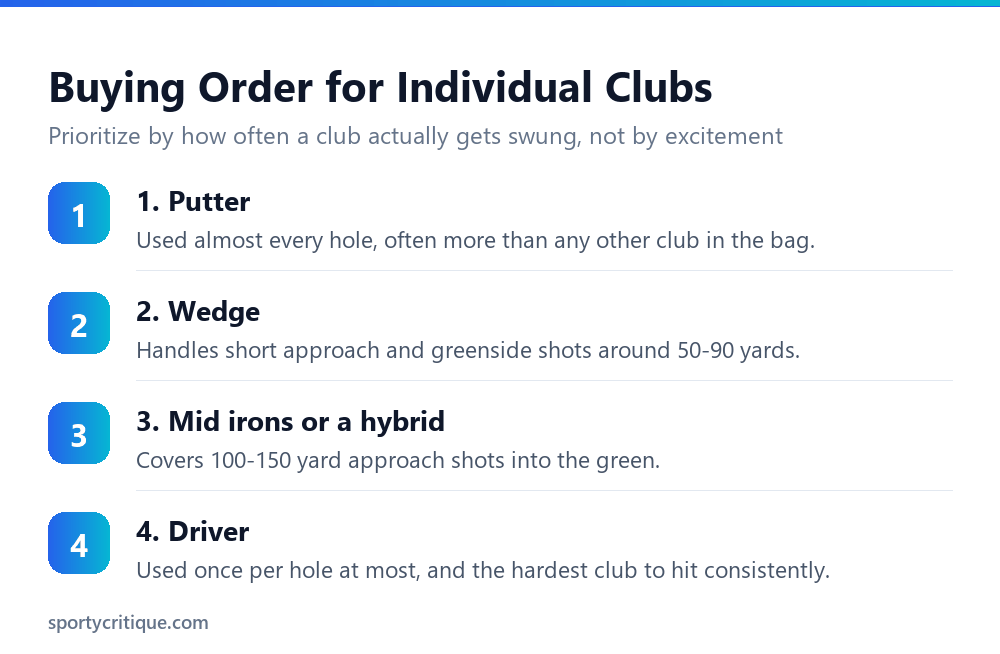
If you’re buying clubs one at a time instead of as a package, prioritize a putter and a short iron or wedge first, since those get used on nearly every hole, then a mid-iron or hybrid, and buy the driver last. That’s the reverse of how boxed sets present clubs, but it matches how often each club actually gets swung during a real round. If you’d rather skip this decision entirely, our companion guide covers complete boxed sets that bundle everything at once.
Most “best golf clubs for beginners” pages are really about complete package sets, boxed bundles of a driver, irons, wedge, and putter sold together. We cover that angle separately. This page is about the opposite situation: you want to understand what each individual club actually does, so you can buy or mix pieces yourself rather than take whatever a manufacturer bundled together.
Buying individually is not automatically the better path. It takes more research, costs more per club in most cases, and requires enough golf experience to know roughly what you want. But if you’ve already hit a rented or borrowed set and noticed you like a particular putter feel, or you only need to replace one or two clubs rather than start from zero, buying piece by piece is the more sensible route, and this page is written for that reader.
- →A beginner realistically needs 5 to 7 clubs to start: driver, a couple of irons or a hybrid, a wedge, and a putter
- →Buy in order of how often a club gets used, not how exciting it is: putter and short irons first, driver last
- →Individually-sold beginner clubs are less consistently in stock on Amazon than complete sets, so verify current price and availability before committing to this route
- →Mixing brands is completely normal and often how experienced golfers build their bag over time
- →If you want the simpler, cheaper-per-club route, a complete boxed set solves the same problem in one purchase
Table of Contents
The clubs a beginner needs, and why
If you’re buying a driver individually

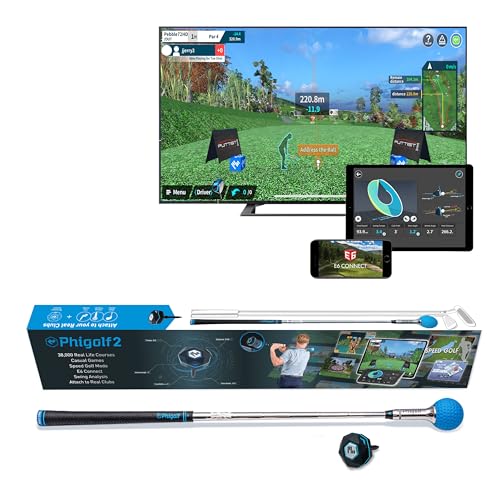
The Wilson Staff Launch Pad Men’s Golf Driver was priced at $305.82 at the time of writing, sold individually rather than as part of a set, in men’s right-hand graphite with a choice of loft. Wilson built the Launch Pad line specifically around a draw bias, meaning the head design is weighted to help correct a slice, which is the miss most new golfers fight with a driver. Buying a driver on its own like this only makes sense once you already have irons and a putter covered; it’s the club you can most safely put off.
If you’re buying irons individually

The Wilson Staff Launch Pad 2 Men’s Golf Irons (5-PW, GW) was priced at $801.48 for the 6-club 5-iron through gap-wedge set at the time of writing. That’s notably more than a full complete package costs for an entire bag, which is the real tradeoff of buying individually from a name brand rather than a beginner-specific package line: you’re paying for Wilson’s mainline construction and technology rather than a budget-tier build, and it shows up directly in price. If $800 for six irons is more than you want to spend as a beginner, this is exactly the situation where a complete boxed set makes more financial sense than piecing individual clubs together.
⚠️ Watch out: Individually-sold wedges and putters were harder to verify as reliably in-stock on Amazon than complete sets or drivers at the time of writing. Models worth researching directly on Amazon include the Cleveland CBX Full-Face wedge and the Odyssey White Hot OG putter, both well-reviewed and commonly recommended for beginners, but we could not confirm live pricing or stock for specific listings of either at the time of writing, so check the current listing yourself before treating a price as final.
What buying individually actually costs versus a boxed set
A middle path: start with a set, upgrade one club at a time
The approach we’d actually recommend for most true beginners is a hybrid of both pages on this site. Buy a complete boxed set to start, since it’s the cheaper and simpler way to get playing. Once you’ve had a season with it and know which single club is holding you back, whether that’s a putter that never feels right or a driver you consistently slice, replace just that one club individually rather than rebuying an entire bag. This gets you the low upfront cost of a package set and the eventual fit of individually-chosen clubs, without paying individual-club prices for every piece from day one.
💡 Pro tip: If you do buy individually, prioritize trying before buying wherever possible, a demo day, a friend’s spare club, or a shop that allows returns. Feel is genuinely personal for a putter especially, more than any spec sheet can tell you.
- ✓Buy the putter and a wedge first; they get used every round
- ✓Check current price and stock before committing since individual listings change more often than package sets
- ✓Mix brands freely; there’s no rule requiring a matched set
- ✓Consider a boxed set instead if the individual total is creeping past $600-$700
- ✕Buy a driver first just because it’s the most exciting club to hit
- ✕Assume every individually-listed club is in stock; several common models were not at the time of writing
- ✕Overspend on a full iron set before you know if you’ll play regularly
- ✕Ignore shaft flex; a stiff shaft bought for the wrong swing speed will fight you on every shot
Shaft flex, the spec that matters more than brand
When buying clubs individually, shaft flex is the one spec worth understanding before anything else, more than head design or brand reputation. Flex options usually run from senior (A) through regular (R) to stiff (S) and extra stiff (X), and they’re built around swing speed rather than skill level directly, though the two correlate for most beginners. A slower swing speed needs a more flexible shaft to help launch the ball; a stiff shaft bought for a slow swing tends to produce weak, low shots that feel like they never get airborne.
Most adult male beginners fall into regular flex, and most adult female beginners fall into ladies or senior flex, but this is a generalization, not a rule. If a shop or demo day can measure your actual swing speed, that number is worth more than any assumption based on gender or age. Buying a mismatched flex is a common way an individually chosen club ends up feeling worse than a mass-market complete set, where the manufacturer already picked a flex tuned to the average beginner swing.
Length and lie angle for individual irons
Standard-length irons assume an average height and posture, and a beginner who’s noticeably taller or shorter than average will feel it immediately at address. Lie angle, the angle between the shaft and the ground when the club sits flat, affects whether the clubface points where you’re aiming or drifts left or right of it. Getting fitted for lie angle is normally a premium-club service, but even without a formal fitting, checking a manufacturer’s standard length against your own height using their published sizing chart avoids the most obvious mismatches before you buy.
📊 Note: A simple at-home check: stand normally and let your arms hang, then measure from the ground to your wrist crease. Manufacturers publish a rough wrist-to-floor to shaft-length chart, and if your measurement falls well outside the standard-length range, it’s worth looking for a tall or petite option specifically rather than assuming standard will work fine.
How to know which path is right for you
If you’ve never swung a golf club before, skip this page’s approach for now and start with a complete boxed set. There is no way to know what feel you prefer before you’ve hit anything, so individual-club shopping at that stage is mostly guessing with extra steps. Come back to this page once you have a season or two of rounds behind you and a specific club you want to replace or upgrade, at which point buying individually starts to make real sense instead of adding cost without adding fit.
Used and secondhand individual clubs
Buying individually opens up the secondhand market in a way a complete set usually doesn’t, since it’s uncommon to find a full matching used set at a good price. A used putter or wedge from a reputable golf retailer’s trade-in program is often the best value in this entire page, since those clubs see less wear than woods and irons and their performance barely changes with age. A used driver is a riskier buy, since driver technology has moved quickly in recent years and a five-year-old head gives up real distance and forgiveness compared to a current model, even at a steep discount.
What clubs does a true beginner actually need to start?
A driver, a wedge, one or two mid irons or a hybrid, and a putter covers most situations a new golfer faces. You can add more irons and a fairway wood later as you play more.
Is it cheaper to buy clubs individually or as a set?
A complete boxed set is almost always cheaper for a full bag. Individual name-brand clubs, like the Wilson Launch Pad pieces above, cost more per club because you’re paying for mainline construction rather than a beginner-specific budget build.
Which club should a beginner buy first if buying individually?
The putter, followed by a wedge or short iron. Both get used far more often per round than a driver, which is the club most beginners are tempted to prioritize first.
Can I mix brands across my clubs?
Yes. There’s no rule or performance penalty for a bag with a Wilson driver, a Cleveland wedge, and an Odyssey putter. Many experienced golfers build their bags exactly that way over time.
As an Amazon Associate, we earn from qualifying purchases through links on this page.