Best Rangefinders for Golf

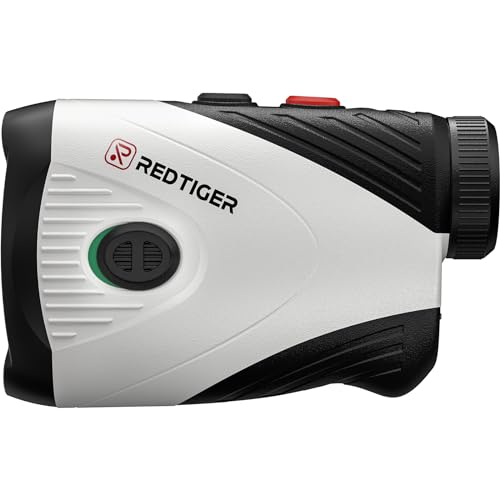
“Best rangefinders for golf” turns up dozens of lists with a dozen names each, most of them reviewing specs off a press release rather than checking whether the product is even still sold at the price quoted. This guide sticks to four real, currently listed rangefinders, verified against live Amazon product data, split across the two technologies that actually matter: laser and GPS. The right one depends on what you’re trying to measure, not on which name is loudest.
⛳ Golf Hub: Explore all 29 club reviews, swing tutorials, and short game guides in our Complete Golf Resource Hub.
The best rangefinders for golf split into two real categories, laser and GPS, and the right pick depends on what you actually want measured. For precise, aim-at-the-flag distance, the Bushnell Tour V6 Shift ($349.97) and the Precision Pro NX9 Slope ($199.98) are both genuine laser units with slope compensation you can switch off for tournament-legal rounds. If you’d rather glance at a screen for distances to the green, hazards, and doglegs without aiming at anything, the Garmin Approach G12 ($134.99) is a real GPS clip-on with no laser at all. On a tighter budget, the TecTecTec VPRO500 with Slope ($89.99) is a laser unit that covers the fundamentals without the premium-brand price.
Every rangefinder mentioned here is a real, currently listed product, checked against Amazon’s product data for name, price, and stock status before writing this. Prices move, so treat the figures here as a snapshot rather than a guarantee of what you’ll see when you click through.
Table of Contents
Laser vs. GPS: the actual technology difference
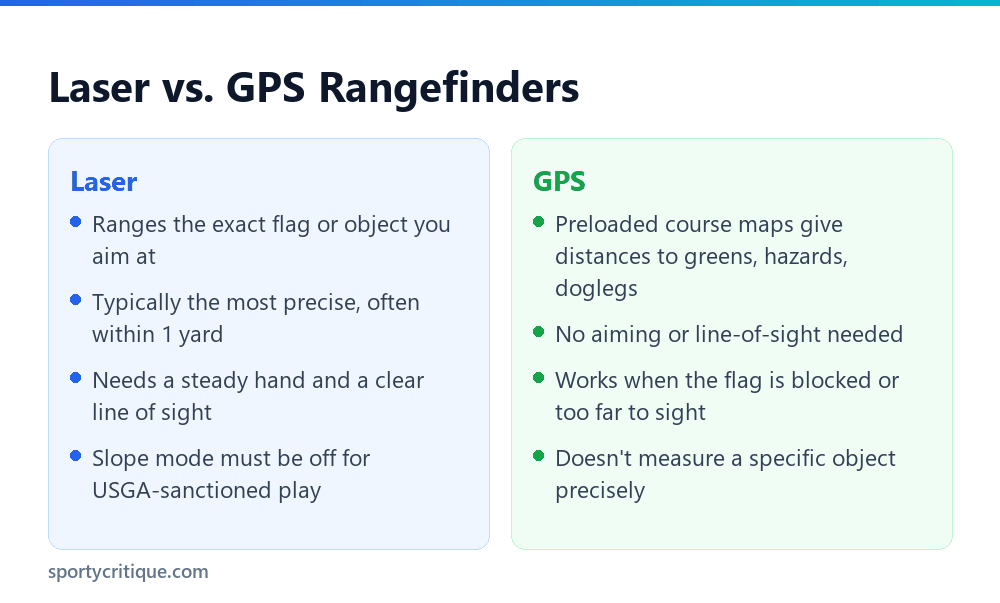
A laser rangefinder works by aiming, literally pointing the device at a flag, tree, or bunker edge and pressing a button, at which point it bounces a laser off that object and calculates distance from the return time. Accuracy depends on your ability to hold the unit steady and get a clean read on the object, which is why magnification (commonly 6x across the models in this guide) and a flag-lock feature that vibrates or flashes when it’s confident it found the pin, rather than the background behind it, both matter more than most buyers realize going in.
A GPS rangefinder or watch works completely differently: it doesn’t aim at anything. It uses a preloaded course map and your device’s GPS position to tell you the distance to the center, front, and back of the green, plus hazards and layup points, the moment you’re on the hole. There’s nothing to aim and nothing that can miss the flag by locking onto a tree behind it, but it also can’t give you an exact yardage to something that isn’t already mapped, like a specific spot your ball happens to land.
Slope mode and why it matters for legal play
⚠️ Watch out: Slope-adjusted distance is illegal in USGA- and R&A-sanctioned competition, including most club tournaments and any round you’re posting for handicap purposes under those rules. Every laser rangefinder in this guide includes a way to switch slope off, which is what makes it “tournament legal,” but that legality depends on you actually turning it off, not on the device having the feature.
Slope mode adjusts the number it shows you for elevation change, uphill shots play longer than the flat number, downhill shots play shorter, which is genuinely useful information for casual rounds and practice. The rule against it in sanctioned play isn’t about the technology being unreliable; it’s that the rules of golf treat club selection for elevation as part of the skill being tested, the same reason distance-measuring devices themselves were only broadly permitted by local rule in the first place. Buy a rangefinder with slope if you want the extra data for practice rounds, but confirm the specific model’s slope-off switch before you rely on it for a competition round.
The picks, and what actually separates them
Bushnell Tour V6 Shift ($349.97): the accuracy-first laser
Bushnell has been the rangefinder brand most tour caddies and serious amateurs default to for years, and the Tour V6 Shift is its current flagship laser. It carries a magnetic cart mount, a slope switch you can toggle on or off, and Bushnell’s flag-lock vibration feedback so you can feel when it’s confident it’s reading the pin rather than the trees behind the green. At $349.97, it’s the most expensive rangefinder in this guide, and the price mostly buys glass quality and lock-on consistency in difficult backgrounds rather than a longer maximum range than the cheaper options here.
Precision Pro NX9 Slope ($199.98): the mid-tier laser
Precision Pro built its reputation on undercutting Bushnell’s price while keeping the same core feature set: 6x magnification, adaptive slope you can switch off, flag-lock vibration, and a roughly 1-yard accuracy claim. The NX9 specifically ships with a 3-year warranty and a stated lost-rangefinder replacement program, which matters in practice since a laser unit that gets left on a cart or dropped in rough is a common way to lose one mid-round.
Garmin Approach G12 ($134.99): the GPS alternative
This is the one non-laser pick here, a small clip-on GPS unit rather than a handheld you aim. It comes preloaded with more than 40,000 courses and gives distances to the front, center, and back of the green plus hazard yardages without you doing anything but glancing at it. It won’t tell you the exact distance to an object that isn’t already on the course map, and it doesn’t need slope mode or a legality switch at all, since it’s not measuring elevation the way a laser’s slope feature does. If your main complaint about laser units is fumbling to aim one under time pressure, this solves that problem entirely rather than making the laser experience marginally faster.
TecTecTec VPRO500 with Slope ($89.99): the budget laser
TecTecTec makes rangefinders specifically to compete on price against the premium brands, and the VPRO500 with slope covers the same fundamentals, laser measurement, a slope switch, a pin-sensing mode, at roughly a quarter of the Bushnell’s price. The trade-off shows up in build quality and consistency in harder conditions (low light, backgrounds with lots of clutter behind the flag) rather than in the core feature list, which is a reasonable trade for a golfer who plays occasionally and doesn’t want to spend $200-plus on a device they’ll use a dozen times a season.

Magnification and why 6x shows up everywhere
Three of the four laser-capable specs referenced across these listings land on 6x magnification, which isn’t a coincidence, it’s close to the practical sweet spot for handheld stability at golf distances. Higher magnification amplifies hand shake along with the image, which actually makes it harder to hold a lock on a small flag at 150-plus yards without a mount or a very steady hand. Unless you specifically know you want a higher-power optic for reasons beyond golf, treat 6x as the standard to compare everything else against rather than assuming more magnification is simply better.
Does using a rangefinder actually slow down play?
It’s a fair worry, since fumbling with any device on a tee box while a group waits behind you is a real pace-of-play problem, but the practical answer is that a rangefinder used well is faster than the alternative, not slower. Pacing off yardage markers or guessing based on a sprinkler head takes longer than a two-second laser read once you’re used to the device, and a GPS unit is faster still since it requires no aiming at all. The slowdown most golfers actually experience comes from using an unfamiliar rangefinder for the first time mid-round rather than practicing with it beforehand, so spend a few minutes with a new unit on a practice green or driving range before trusting it during an actual round with people waiting on you.
Local rules at some clubs also restrict distance-measuring devices entirely, separate from the slope-mode question, so check your specific course or event’s posted rules rather than assuming a rangefinder is automatically allowed everywhere just because the USGA permits it under a local rule. Most public and resort courses allow them without restriction, but private clubs and some tournaments set their own policy.
Battery type and a small but real annoyance
📊 Note: Most laser rangefinders, including every laser model in this guide, run on a CR2 battery, not a common AA or AAA. CR2 batteries aren’t stocked at every gas station or drugstore the way AA batteries are, so keeping a spare in your bag is worth doing before you’re standing on a tee box with a dead unit and no way to buy a replacement nearby.
- ✓Confirm slope mode has an off switch if you plan to use the device in sanctioned competition
- ✓Buy a laser if you want the exact distance to a specific object you can see
- ✓Consider GPS if fumbling to aim and lock a laser under time pressure is your actual complaint
- ✓Keep a spare CR2 battery in your bag once you own a laser rangefinder
- ✕Assume higher magnification than 6x is automatically an upgrade for golf-distance use
- ✕Leave slope mode on and post a competitive score without checking your club or local rules
- ✕Buy the most expensive option assuming it measures farther than a cheaper laser; check the spec
- ✕Expect a GPS unit to give you an exact distance to something that isn’t already on the course map
Bottom line
If you want the most precise number for a specific target and don’t mind aiming a device, buy a laser, the Bushnell Tour V6 Shift if budget allows, the Precision Pro NX9 Slope if you want most of the same feature set for less. If you’d rather glance at a screen for course-wide distances without aiming anything, the Garmin Approach G12 GPS unit is the real alternative, not a lesser laser. And if you’re not ready to spend $150-plus on a device you’ll use occasionally, the TecTecTec VPRO500 with Slope covers the fundamentals honestly at a fraction of the price.
As an Amazon Associate, we earn from qualifying purchases through links on this page.
Is a laser or GPS rangefinder better for golf?
Neither is universally better; they solve different problems. A laser gives the most precise distance to a specific object you aim at. A GPS unit gives distances to the green and hazards without aiming, which is faster but less exact for a specific target.
Is slope mode legal to use in golf tournaments?
No. Slope-adjusted distance is against the rules in USGA- and R&A-sanctioned play, including most club tournaments and any round posted for handicap purposes. Every laser model in this guide includes a switch to turn slope off for legal play.
What magnification should a golf rangefinder have?
6x is the common standard across laser rangefinders and a reasonable target to compare against. Higher magnification amplifies hand shake at typical golf distances, which can make it harder, not easier, to hold a steady lock on the flag.
What battery do golf laser rangefinders use?
Most run on a CR2 battery rather than a standard AA or AAA. Since CR2 isn’t sold everywhere, keeping a spare in your golf bag avoids getting stuck with a dead unit mid-round.
Do I need a rangefinder if I already use a golf GPS watch?
Not necessarily. A GPS watch and a GPS rangefinder solve the same core problem, distance without aiming, so owning both is mostly redundant unless you specifically want a laser’s precision to a single object as a separate tool alongside your watch.