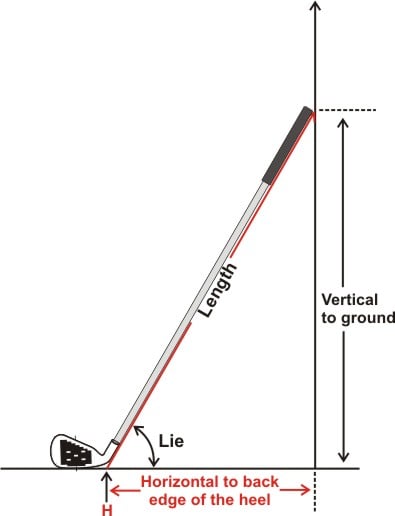
How to Swing a Golf Club: Sequence, Tempo, and the Transition


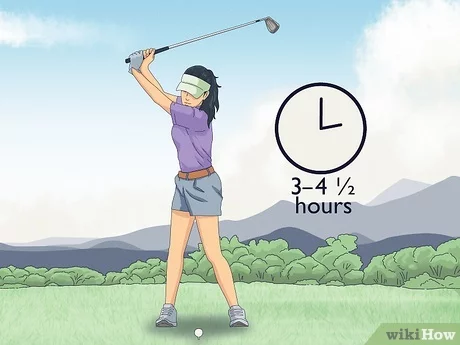
A golf swing is a rotation, not a hit. Set up in an athletic posture, take the club back by turning your shoulders (not lifting with your arms) until your back faces the target, then — the key move — start the downswing from the ground up, with your hips turning toward the target before your arms come down. Power comes from your body unwinding, not from swinging your arms hard, so smooth tempo beats force every time. Finish balanced, weight on your front foot. Almost every beginner fault comes down to two things: using the arms instead of the body, and swinging too hard.
The golf swing looks simple and feels impossible, and the reason is that human instinct fights it at every turn. Your instinct says swing hard with your arms and lift the ball into the air. The correct swing does neither — it’s a rotation of your whole body that happens to have a club on the end of it, and it produces power precisely when you stop trying to force it.
This guide walks through the swing in sequence and, more usefully, explains the handful of ideas that separate a swing that works from one that doesn’t. It assumes your grip is sorted first, because the swing can’t fix a bad grip — and it pairs with our guide to hitting the ball cleanly, which is a slightly different problem.
- →The swing is a body rotation, not an arm-hit — that’s the whole mindset.
- →Take the club back by turning your shoulders, not lifting your hands.
- →Start the downswing from the ground up: hips first, then arms.
- →Power comes from your body unwinding, so smooth tempo beats swinging hard.
- →Hit down on the ball — the club’s loft lifts it, you don’t.
- →Finish balanced. If you can hold the finish, the swing was sound.
Table of Contents
Set up first
A good swing is impossible from a bad setup, and beginners routinely skip straight to swinging. Get the stance right and half your swing problems never arise.
Stand with your feet about shoulder-width apart, knees slightly flexed, and bend forward from the hips — not by rounding your back — so your arms hang down freely beneath your shoulders. Your weight should be balanced on the balls of your feet, athletic and ready to move, like a shortstop or a tennis player waiting to react. The club reaches the ball naturally from here; you shouldn’t have to stretch for it or crowd it.
This athletic posture matters because the swing is a rotation around your spine, and a slumped or too-upright setup makes that rotation awkward or impossible. Ball position varies by club — roughly centre for short irons, creeping forward toward the lead foot for longer clubs — but for learning, centred is a fine default.
The swing sequence
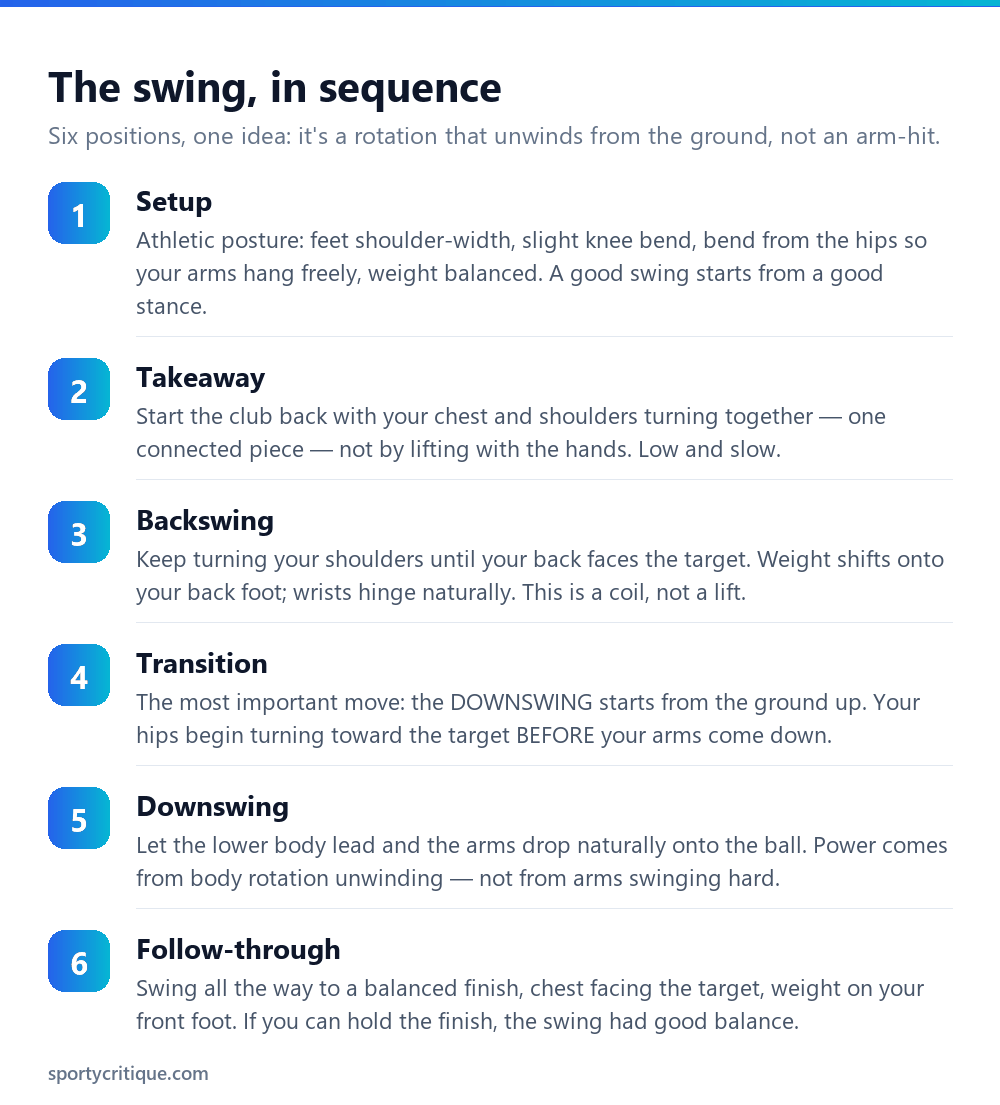
With a good setup, the swing flows through a sequence. Understanding the order matters more than any single position, because the sequence is what produces effortless power.
The takeaway starts the club back with your chest, shoulders, and arms moving together as one connected piece — low and slow, not a quick lift with the hands. The backswing continues that turn until your shoulders have rotated far enough that your back faces the target, your weight has shifted onto your back foot, and your wrists have hinged naturally. Think of it as coiling a spring, not raising the club.
The transition is the single most important and most misunderstood moment in golf, so it gets its own section below. The downswing then unwinds everything the backswing coiled, with the lower body leading and the arms simply dropping the club onto the ball. And the follow-through carries the swing all the way to a balanced finish — chest facing the target, nearly all your weight on your front foot, and enough balance to hold the pose. That balanced finish isn’t decoration; it’s proof the swing had the right sequence and tempo.
The backswing coils a spring. The downswing lets it unwind from the ground up. Beginners skip the coil and just hit — which is why they’ve got power and no distance.
The one move that matters most: the transition
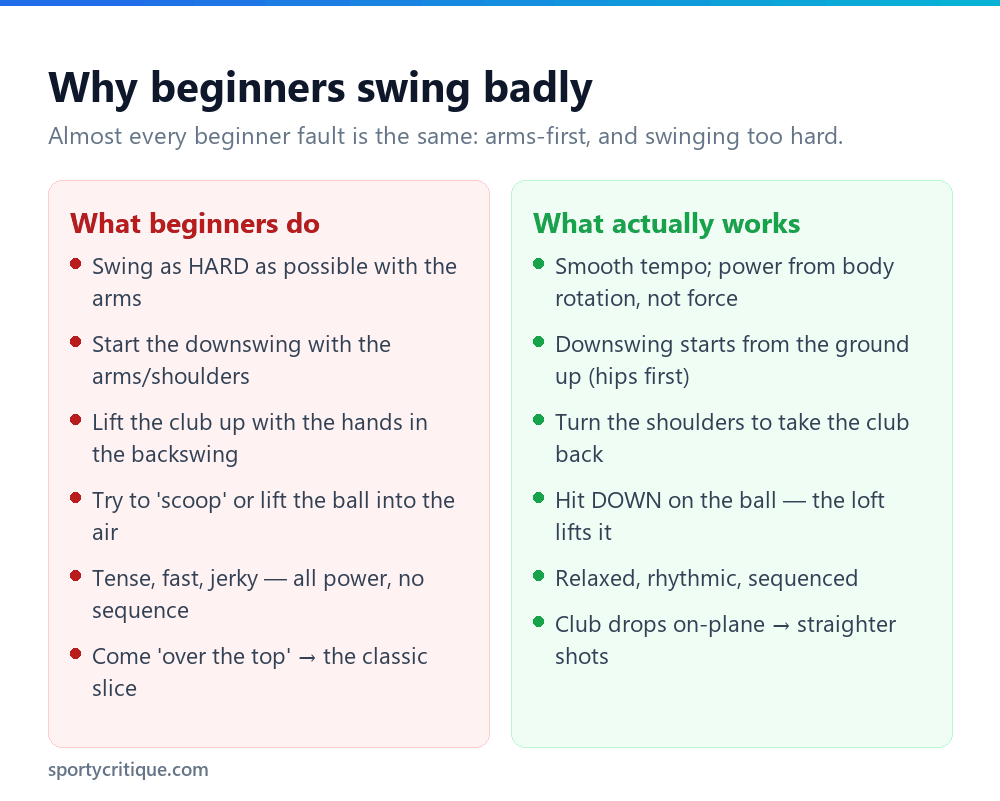
If there’s a single secret to the golf swing, it’s this: the downswing starts from the ground up. As you reach the top of your backswing, the first thing that moves back toward the ball should be your lower body — your hips beginning to turn toward the target — before your arms and the club come down.
This feels backwards, which is exactly why beginners get it wrong. Instinct screams to throw the arms and club at the ball from the top, using the strong muscles of the arms and shoulders. That move — called ‘casting’ or ‘coming over the top’ — throws the club onto a steep, out-to-in path that produces the weak, sliced shot almost every beginner knows too well. The ball starts left and curves hard right, and no amount of extra arm effort fixes it.
When the lower body leads instead, it drops the arms and club into the slot — onto a shallower, inside path that delivers the clubface squarely to the ball from behind. The result is a straighter, more powerful shot that felt like less effort, because the big muscles of your core and legs did the work your arms were failing to do. Learning to start the downswing with your hips is the single biggest improvement most amateurs can make.
⚠️ Watch out: You can’t think your way through the transition in real time — it happens too fast. You build it with drills (below) that groove the lower-body-first feeling until it’s automatic. Trying to consciously time it mid-swing just adds tension and makes it worse.
Tempo: swing slower to hit it further
The most counterintuitive truth in golf is that swinging harder usually makes the ball go shorter, and swinging smoother makes it go further. Beginners find this almost impossible to believe until they experience it.
The reason is sequence. A smooth swing lets the body unwind in the right order, delivering the clubhead at maximum speed exactly at the ball. A frantic, all-out swing throws that sequence into chaos — the arms fire early, the body stops rotating, tempo collapses, and the clubhead is actually slowing down or off-line by the time it reaches the ball. All that visible effort produces a slow, crooked strike. This is why professional swings look so relaxed and unhurried: they’re not swinging hard, they’re swinging in sequence, and the speed appears where it counts.
A simple tempo thought helps: a slow, deliberate backswing, a tiny pause at the top, then an accelerating downswing — think ‘one-and-two’, with the emphasis and speed only on the ‘two’. Aim to swing at maybe 80% of your maximum effort. You’ll almost always hit it further and straighter than at 100%, and once you feel that, it changes how you play.
Drills that actually build it
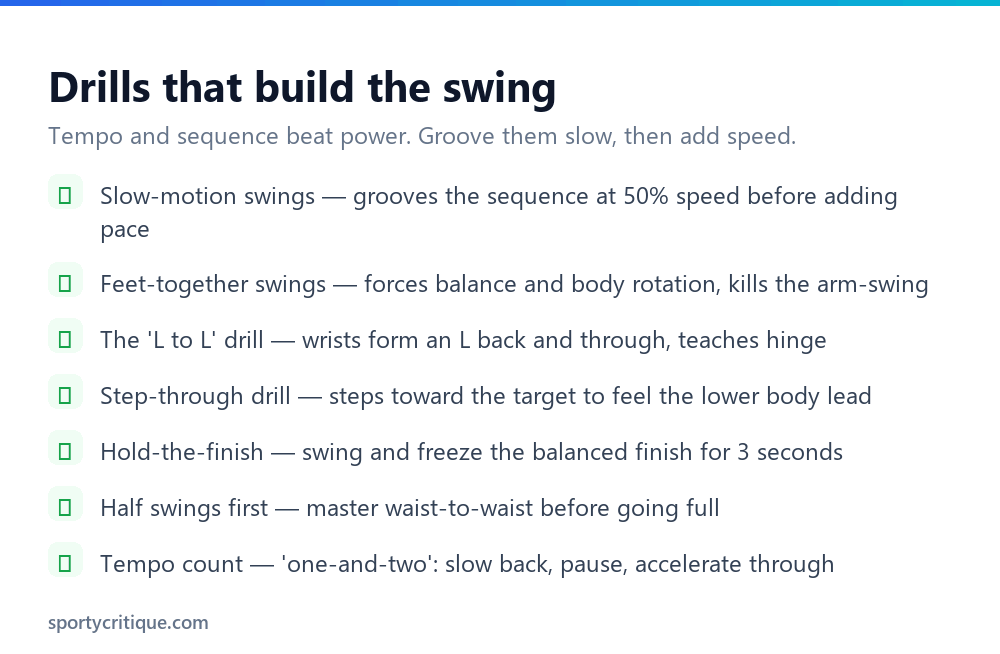
You can’t fix a swing by reading about positions — you build it through repetition that grooves the right feelings. A few drills are worth more than a hundred range balls hit thoughtlessly.
Slow-motion swings are the foundation. Swing at half speed, exaggerating the sequence — full shoulder turn back, lower body leading the downswing, balanced finish. At slow speed your body can actually learn the movement, which it can’t when you’re swinging flat out. Feet-together swings are the fastest cure for the arm-swing: with your feet close together, swinging with your arms alone makes you fall over, so your body is forced to rotate and stay balanced. Hit gentle shots this way and the feeling of a body-driven swing clicks.
The step-through drill builds the transition directly: start the downswing by stepping your lead foot toward the target, which physically forces the lower body to lead. And the humble hold-the-finish drill — swing, then freeze your balanced finish for three full seconds — is a brilliant diagnostic, because you simply can’t hold a balanced finish after a bad, over-swung effort. If you can’t hold it, the swing was off; if you can, it was probably good.
💡 Pro tip: Build the swing in halves before you go full. Master a controlled waist-to-waist half swing — club parallel to the ground back, parallel through — making clean contact every time, before extending to a full swing. Beginners who skip straight to the full swing groove faults; those who build up from half swings develop a repeatable motion far faster. And a few lessons from a pro at this stage is the best investment in golf.
Does the swing change by club?
A common beginner worry is that every club needs its own swing. Reassuringly, it doesn’t — the swing is fundamentally the same motion throughout the bag, with only small, natural adjustments.
The core sequence never changes: rotate back, transition from the ground up, unwind through the ball, finish balanced. What changes is mostly automatic. With a driver, the ball sits forward in your stance on a tee and you catch it slightly on the upswing to launch it high and far; the longer shaft makes the swing feel wider and more sweeping. With irons, the ball sits more central and you hit down and through it (more on that in a moment). With a wedge around the green, you make a shorter, softer version of the same swing. The engine is identical; you’re just changing the gear.
The one genuinely counterintuitive point, and the bridge to actually striking the ball well: with irons you hit down on the ball to make it go up. Beginners instinctively try to scoop or lift the ball into the air, which causes thin and fat shots. In reality the club’s built-in loft launches the ball — your job is to strike down and through, catching the ball first and the turf just after. That contact problem is common enough and important enough that we’ve given it its own guide on hitting a golf ball cleanly.
Frequently asked questions
What is the correct golf swing sequence?
Setup, takeaway, backswing, transition, downswing, follow-through. The key ideas within it: take the club back by turning your shoulders (not lifting your arms), coil until your back faces the target, then start the downswing from the ground up with your hips leading before your arms come down, and finish balanced. The sequence — especially the lower body leading the downswing — matters more than any single position.
Why do I slice the ball when I swing?
Usually because you start the downswing with your arms and shoulders, throwing the club ‘over the top’ onto a steep out-to-in path that opens the face relative to the swing direction. Starting the downswing with your lower body instead drops the club onto a shallower inside path and squares the strike. A grip that’s too weak compounds it — our grip guide covers that side. It’s a sequence problem, not a lack of effort.
Should I swing hard for more distance?
No — and this is the hardest thing for beginners to accept. Swinging harder usually disrupts your sequence and tempo, so the clubhead is slower or off-line at impact and the ball goes shorter and crookeder. A smooth swing at around 80% effort lets the body unwind in order and delivers real clubhead speed exactly at the ball. Smoother genuinely goes further.
How do I start the downswing?
From the ground up. As you reach the top of the backswing, begin the downswing by turning your hips toward the target before your arms and club come down — the lower body leads and the arms follow. This feels backwards and is the single biggest improvement most amateurs can make. Build it with the step-through and feet-together drills rather than trying to time it consciously mid-swing.
What’s the most important part of the golf swing?
The transition — the change of direction from backswing to downswing — because that’s where the sequence is set. Start it with your lower body and everything downstream tends to fall into place; start it with your arms and you get the classic over-the-top slice no matter how good the rest looks. After that, tempo. Both are about sequence rather than positions.
How long does it take to learn a golf swing?
You can build a functional, repeatable swing in a few weeks of focused practice, especially with a lesson or two to avoid grooving faults. But the golf swing is a skill you refine for as long as you play — even professionals work on it constantly. The good news is you can enjoy playing long before your swing is polished, so don’t wait for perfection to get on the course.
- →How to hold a golf club — the grip the swing is built on
- →How to hit a golf ball — making clean contact
- →How to play golf — rules, scoring, and getting started