How to Juggle a Soccer Ball: The Progression That Works

| Juggling Skill Level | Primary Contact Surface | Ankle Position & Tension | Ball Apex Height | Benchmark Target & Progression |
|---|---|---|---|---|
| Beginner (Foundation) | Top shoelace / instep (flat sweet spot) | Locked ankle, toes pointed slightly upward | Waist high (Bounce-kick-catch routine) | 10 consecutive controlled single juggles |
| Intermediate (Alternating Rhythm) | Alternating right/left shoelaces & mid-thighs | Soft, relaxed ankle cushioning ball descent | Knee to chest height with slight backspin | 50 consecutive juggles without ball hitting ground |
| Advanced (Multi-Surface Control) | Inside of foot, outside laces, chest, head | Active dynamic ankle adjustment | Below eye level (Tight high-frequency tempo) | 100+ juggles incorporating direction changes |
| Freestyle Mastery (Low Juggling) | Toes and ball of foot (Toe taps / stalls) | Extremely supple ankle with rapid twitch reaction | Shin to knee height (Under 24 inches) | Around-the-world (ATW) crossovers & foot stalls |
Start with a bounce, not continuous juggling. Drop the ball, let it bounce once, kick it back to your hands, and catch it. Repeat until that’s reliable, then take two touches with a bounce between, then remove the bounce. Keep your toes pulled up so your laces form a flat platform, lock your ankle, and use small touches to about waist height. Nearly everyone who fails at juggling failed because they tried to juggle continuously on day one.
⚽ Soccer Hub: Explore all 30 cleat reviews, striking tutorials, and recruiting guides in our Complete Soccer Resource Hub.
Juggling is the most useful solo skill in soccer and the one most people give up on within ten minutes, because the standard advice is effectively “keep the ball up” — which is the outcome, not a method.
The method is a progression, and its key feature is that you’re allowed to use the bounce and your hands for far longer than pride suggests. Skip that and you’ll spend an afternoon chasing the ball around a garden and conclude you have no coordination. You almost certainly do; you just started at step four.
- →Use the bounce. It’s a training tool, not a failure — it buys you time to reset.
- →Toes UP, ankle locked. Pointed toes send the ball forward and away from you.
- →Small touches, waist height. Height is the enemy of control.
- →Watch the ball all the way onto your foot — don’t track where it’s going.
- →Weak foot from early on. It’s uncomfortable and it’s where the real gain is.
- →Juggling builds first touch, which is the skill that makes everything else possible in a match.
Table of Contents
Why juggling is worth the time
It’s fair to point out that you will never juggle in a match. Nobody keeps the ball up eleven times in a game situation, and players who can juggle 200 times aren’t automatically good footballers.
What juggling does build is first touch — the ability to control a moving ball cleanly and put it where you want. That is arguably the single most valuable skill in soccer, because it buys you the half-second in which every other decision becomes possible. A player with a good first touch has time; a player without one is permanently rushed, and being rushed is what makes people pass badly, lose possession, and look slower than they are.
Juggling trains it because it forces thousands of repetitions of the same core action — judging a falling ball, presenting the right surface, and applying exactly the right amount of force. It also does something coaching can’t: it makes you comfortable with the ball in the air, which is where most beginners panic.
You’ll never juggle in a match. But the thing juggling builds — a reliable first touch — decides almost every moment of one.
The progression
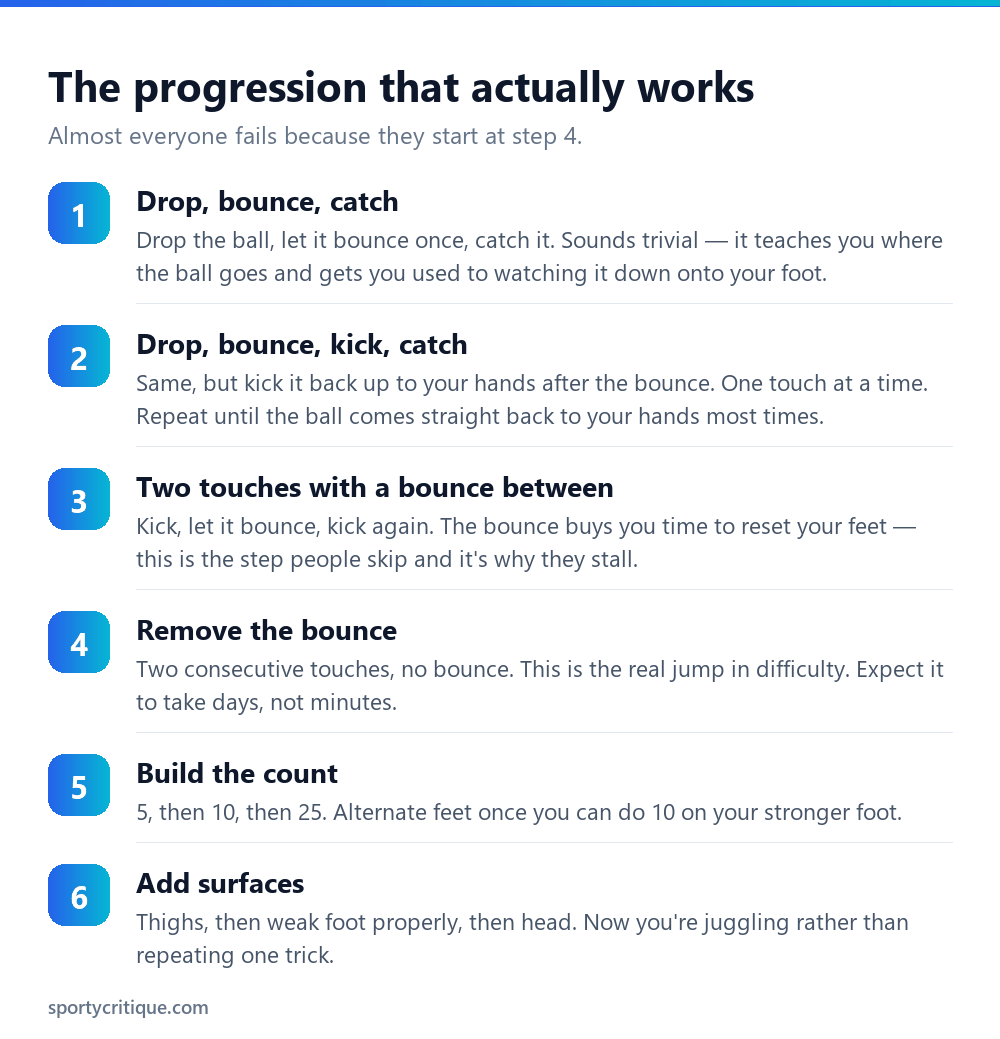
Work through these in order and do not move up until the current step is comfortable most of the time. The temptation to skip ahead is the entire reason people fail at this.
The bounce is the key tool. Letting the ball bounce between touches gives you a predictable trajectory and roughly a second to get your foot into position. Almost all the difficulty in juggling is not the kick itself — it’s arriving under a falling ball with your foot already set. The bounce gives you time to learn that skill separately, before you have to do it fast.
Removing the bounce is the genuine difficulty spike, and it’s where you should expect to plateau for a few days. That’s normal. The gap between “two touches with a bounce” and “two touches without” is bigger than any other step in the progression, and getting through it is mostly repetition rather than insight.
💡 Pro tip: Slightly deflate your ball while learning. A softer ball bounces less and sits on the foot longer, which makes control much easier. Reinflate it as you improve — and expect to lose some consistency when you do, since it’s genuinely a different ball to control.
The technique
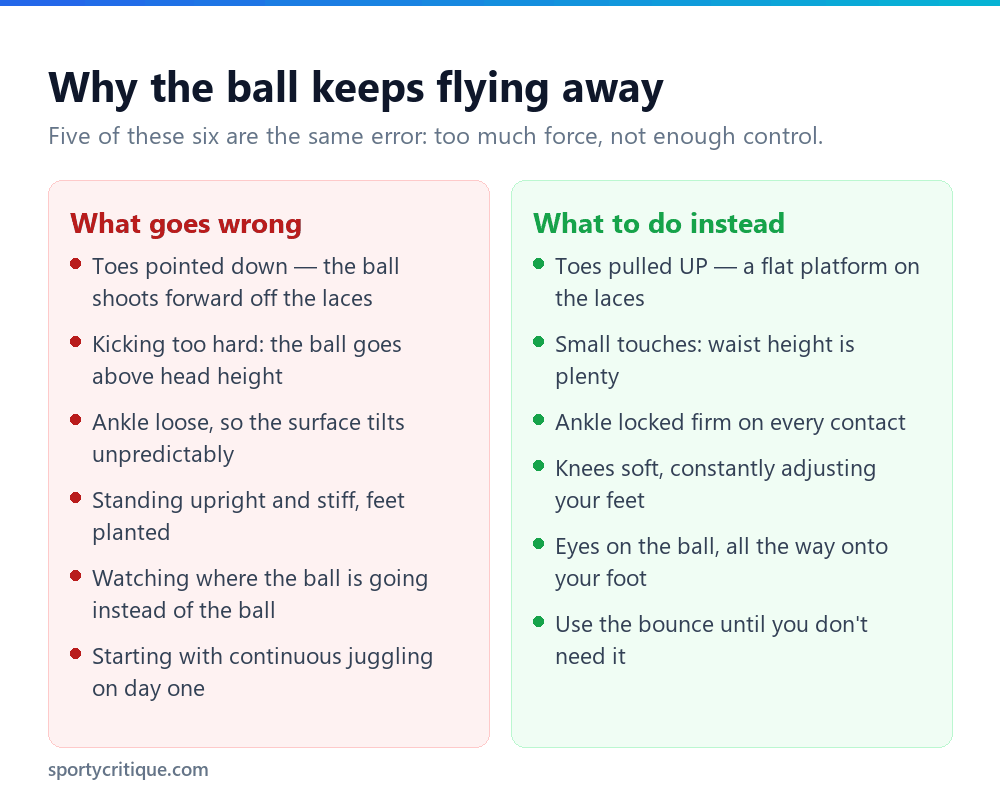
Toes up. This is the detail that fixes most beginners instantly. If your toes point down — the position you’d use to strike a shot — your laces form a sloped ramp and the ball shoots forward away from you. Pull your toes up toward your shin so the top of your foot becomes a flat platform, and the ball goes straight up instead.
Lock the ankle. Same principle as every other kick in soccer, covered in our guide to kicking a ball. A loose ankle means the striking surface tilts differently on each contact, so the ball goes somewhere new every time and you can’t build a rhythm.
Small touches. Beginners kick far too hard, sending the ball above head height where it accelerates on the way down and becomes much harder to control. Waist height is plenty. The gentler the touch, the more time you have and the less distance the ball can drift.
Stay soft and mobile. Juggling looks static and isn’t — you should be making constant small adjustments with your feet, knees slightly bent, weight on the balls of your feet. Planting yourself and reaching for the ball is what sends people lunging sideways after two touches.
Watch the ball onto your foot. The instinct is to look where you want the ball to go. Resist it. Track the ball all the way down to contact — the same discipline that applies to a first touch in a match.
Milestones and how long they take
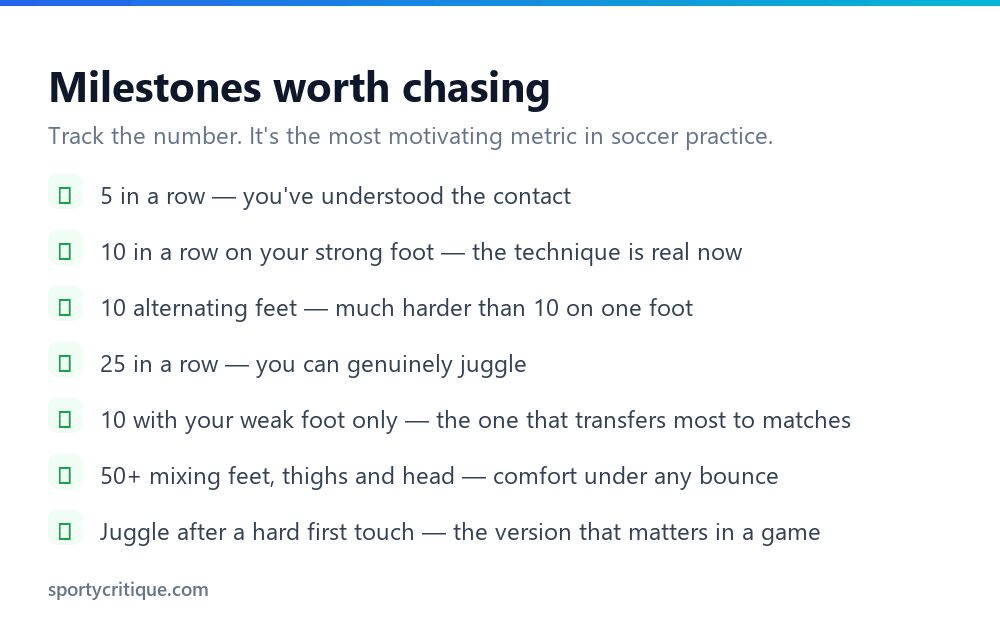
Counting is what makes juggling practice stick, because progress is unusually visible — you go from 3 to 6 to 11 and can see it happening, which is rare in skill work.
Rough expectations for someone starting from zero, practising fifteen minutes most days: a handful in a row within the first week, ten on your strong foot within two to three weeks, and twenty-five within a couple of months. Alternating feet reliably takes longer than any single-foot count, because it doubles the demand on your weaker side.
The milestone worth prioritising over raw numbers is ten with your weak foot only. It’s frustrating and it transfers more directly to matches than anything else on the list, because in a game the ball arrives on whichever side it arrives on. A player who can only control the ball with one foot is a player defenders can predict.
📊 Note: Don’t chase huge numbers. Someone who can juggle 500 times has mostly proven they can juggle 500 times — past about 50 the returns to your actual football drop off sharply. Add surfaces, add your weak foot, and add difficulty instead of adding repetitions.
Adding thighs and head
Once you’re comfortable on both feet, extending to other surfaces makes the skill genuinely useful, because in a match the ball arrives at all heights.
Thighs are the easiest addition and the most useful. Use the flat middle of the thigh, keep it roughly horizontal at contact, and pop the ball straight up. The thigh is a large, forgiving surface, and it’s what you’ll actually use in a game to bring down a dropping ball.
Heading in juggling means using the flat of your forehead, not the top of your head, with your neck firm and eyes open. Small, controlled contacts. It’s worth practising in moderation for control, though there’s no benefit in doing hundreds of repetitive headers — several football associations now restrict deliberate heading in youth training, and the sensible approach for anyone is to keep the volume low and the contacts gentle.
A good rounded target is a sequence like foot – thigh – foot – head – foot, kept going. That mixed pattern is far more representative of match control than a hundred touches on the same foot.
A practice session that works
Fifteen minutes done properly beats an hour of chasing the ball around in frustration. Structure it like this:
Practise on a flat surface with space around you, and ideally near a wall or fence so a mis-hit ball doesn’t turn into a two-minute walk. That sounds trivial and it isn’t — the single biggest reason people stop practising is that retrieving the ball takes longer than the practice itself.
Beyond basic juggling
Once fifty is comfortable across both feet, thighs, and head, the skill splits into two directions and they’re worth distinguishing.
Freestyle tricks — around the world, the crossover, catching the ball in the neck — are their own discipline. They’re impressive, genuinely difficult, and largely irrelevant to match performance. That’s not a criticism; freestyle is a legitimate sport in its own right. Just don’t mistake time spent on it for football training.
Match-relevant control is the more useful direction, and it means making your juggling messier on purpose. Throw the ball hard against a wall and control the awkward rebound. Kick it high and take it out of the air on the half-volley. Juggle while walking, then while jogging. Have someone throw balls at you at different heights and angles.
That’s the transfer point. Clean juggling from a controlled drop is a technique exercise; controlling a ball that arrives fast, spinning, and at the wrong height is what actually happens in a game. Once basic juggling is solid, deliberately make the ball harder to deal with — that’s where the practice starts paying off on Saturday.
Frequently asked questions
Why can’t I juggle a soccer ball at all?
Almost certainly because you’re starting with continuous juggling instead of using the bounce, and because your toes are pointing down rather than pulled up. Go back to drop-bounce-kick-catch and rebuild from there. It’s not coordination — it’s that the standard advice skips the four steps that make it learnable.
How long does it take to learn to juggle?
With fifteen minutes most days, most people manage a few in a row within a week and ten within two to three weeks. Twenty-five takes a couple of months. Progress is jumpy rather than smooth — you’ll stall for days and then suddenly improve, which is normal for any motor skill.
Does juggling actually make you better at soccer?
Indirectly but genuinely. It builds first touch, comfort with the ball in the air, and weak-foot competence — all of which decide how much time you have in a match. What it doesn’t build is decision-making, passing under pressure, or positioning, so it should be part of your practice rather than all of it.
Should I use a smaller or lighter ball to learn?
A slightly under-inflated normal ball is the best learning aid — it bounces less and sits on the foot longer. Smaller balls (futsal or size 3) make the skill harder, not easier, though they’re excellent for sharpening control once you can already juggle.
Is it better to juggle with shoes or barefoot?
Trainers or boots for normal practice, since that’s what you play in. Barefoot on grass is a good occasional variation because it forces very gentle contacts and improves feel, but it’s not where you should start — and never barefoot on hard ground.
How do I stop the ball spinning away from me?
Spin means you’re striking the ball off-centre. Aim for the underside of the ball, directly beneath its middle, with a flat foot and toes up. The same contact-point logic that governs shooting applies here — our kicking guide explains why off-centre contact creates spin.
- →How to kick a soccer ball — contact points, power, and curl
- →How to play soccer — rules, positions, and offside
- →How to get good at soccer — a structured improvement plan