How to Breathe While Running: Rhythm, Belly Breathing, and Stitches

Breathe through your mouth — or mouth and nose together — because your nose can’t supply enough air once you’re working. Breathe with your diaphragm so your belly expands rather than your shoulders rising. Use a rhythm tied to your footsteps: 3:3 for easy running, 2:2 for steady and tempo, 2:1 for hard efforts. And if you’re gasping on an easy run, the problem almost certainly isn’t your breathing technique — you’re running too fast.
Breathing is the thing beginners blame when running feels awful, and it’s usually the messenger rather than the cause. You can’t out-breathe a pace your aerobic system can’t sustain, so the first question is always whether you’re running too hard.
That said, there are three genuine breathing skills worth having: breathing deeply rather than shallowly, tying your breath to your stride, and knowing what to do about a side stitch. All three are learnable in a couple of runs.
- →Mouth breathing is correct for running — your nose can’t move enough air.
- →Breathe into your belly, not your chest. Shoulders rising means shallow breathing.
- →Match your breath to your footfalls: 3:3 easy, 2:2 steady, 2:1 hard.
- →An odd-numbered pattern alternates the foot that lands on your exhale, which reduces stitches.
- →A side stitch is a diaphragm cramp — slow down, press the spot, exhale hard.
- →Breathlessness on an easy run is a pacing problem, not a technique problem.
Table of Contents
Mouth or nose?
Mouth, mostly. Nasal breathing filters, warms, and humidifies air, which is genuinely useful at rest and in cold weather — but the nasal passage simply can’t move enough air to meet the oxygen demand of running. Trying to breathe only through your nose while running at any real effort means running at a pace your nose can supply, which is far slower than your legs could manage.
The practical answer for most runners is both: inhale through nose and mouth together, exhale through the mouth. You get some of the filtering benefit without limiting airflow. In cold weather, drawing at least some air through the nose is worth the effort, since cold dry air straight into the lungs is what triggers coughing and tightness afterwards.
You may encounter people advocating strict nasal breathing for training. It has a genuine niche — it forces you to keep easy runs genuinely easy, which is a real problem for most runners as our endurance guide explains. But as a general rule for all running it’s an unnecessary constraint, and it becomes impossible at higher intensities anyway.
Belly breathing: the actual technique
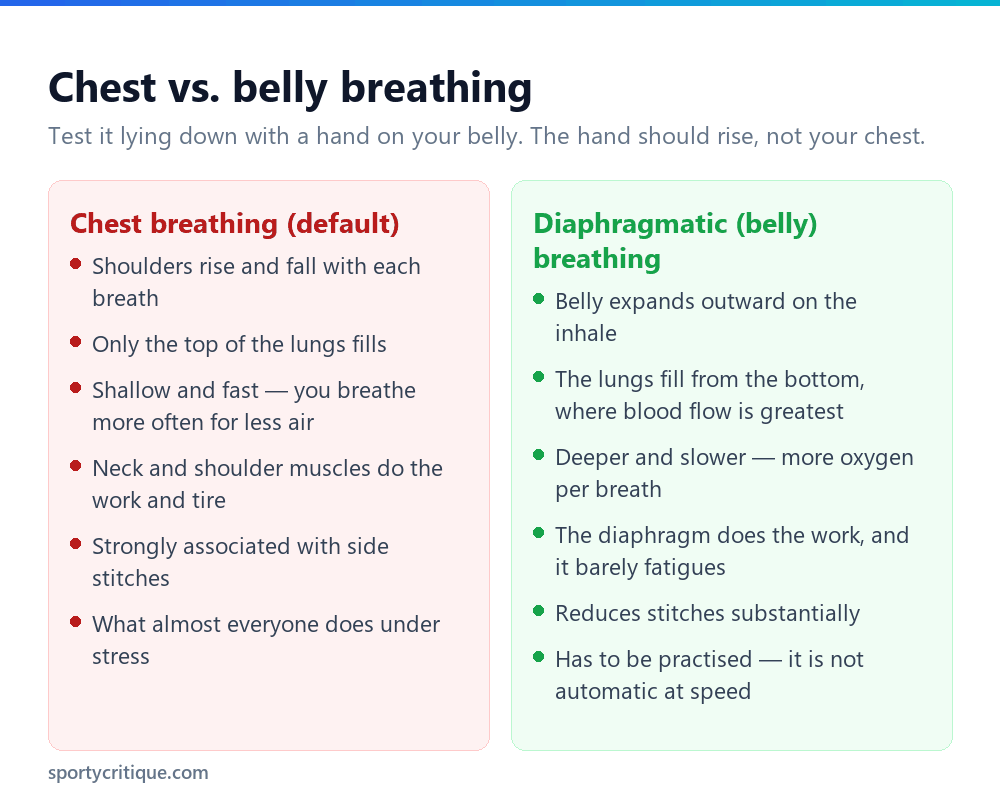
Most people breathe shallowly into the top of their chest, which is fine sitting at a desk and inefficient when running. The lungs’ lower regions receive substantially more blood flow, so filling only the top means much of the air you’re pulling in never meets enough blood to be useful. You breathe more often and get less from it.
Diaphragmatic breathing fixes this. The diaphragm is a large muscle beneath your lungs; when it contracts and flattens downward, it draws air deep into the lungs and pushes your abdominal contents down and out — which is why the belly visibly expands. It’s a more powerful and far more fatigue-resistant muscle than the neck and shoulder muscles that drive chest breathing.
💡 Pro tip: Good posture makes belly breathing far easier. Running hunched forward compresses the abdomen and physically restricts the diaphragm. Run tall, shoulders relaxed and down, chest open — a slouch is often the real reason someone can’t breathe deeply.
Rhythmic breathing and the stitch connection
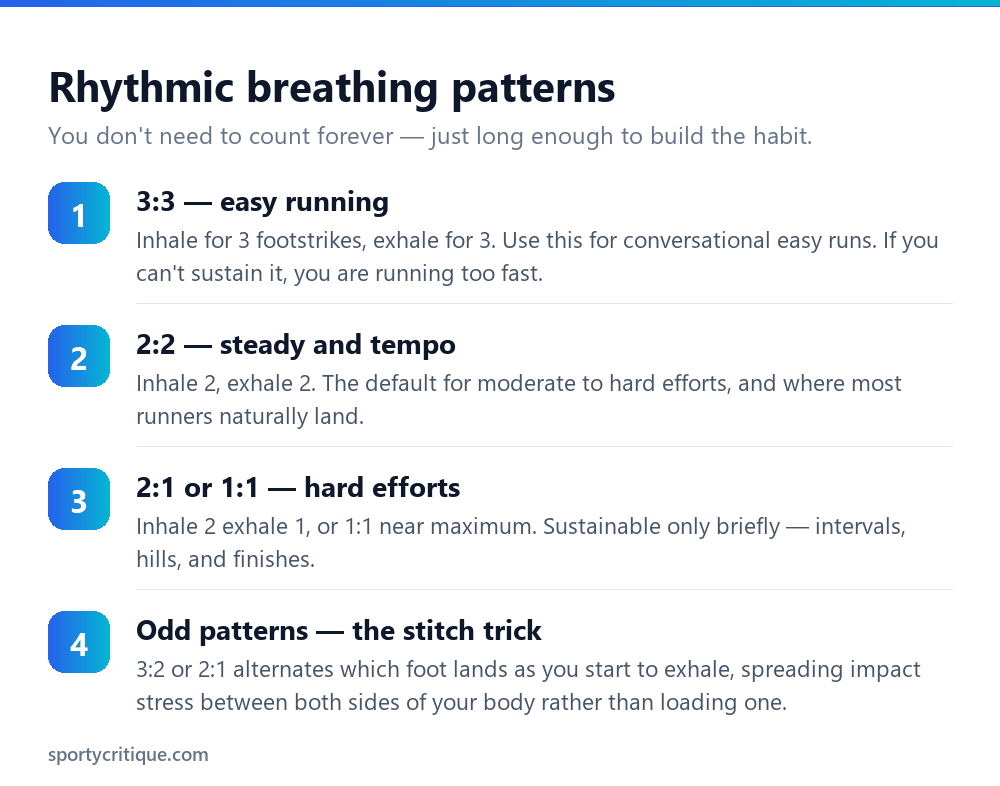
Tying your breathing to your footfalls does two things. It regulates your effort — a pattern you can’t sustain is direct evidence you’re running too fast — and it gives your mind something steady to hold onto, which matters more than it sounds when a run gets hard.
There’s a second, subtler argument for odd-numbered patterns like 3:2. The greatest impact stress on your body occurs at the moment of footstrike during exhalation, when your diaphragm and its supporting muscles are relaxed and your core is least stable. With an even pattern like 2:2, you always begin your exhale on the same foot, so that stress lands on the same side of your body for the entire run. An odd pattern alternates it.
How much this matters is debated, and it isn’t the sole cause of side stitches. But it costs nothing to try, and runners who consistently get a stitch on the same side often find switching patterns helps noticeably. Use 3:2 for easy running and 2:1 for harder efforts if you want to test it.
⚠️ Watch out: Don’t count your breathing forever. The point is to install a rhythm, not to spend every run doing arithmetic. Use it for a few weeks, or during the sections of a run where your form starts drifting, then let it become automatic.
Side stitches: what they are and how to kill one
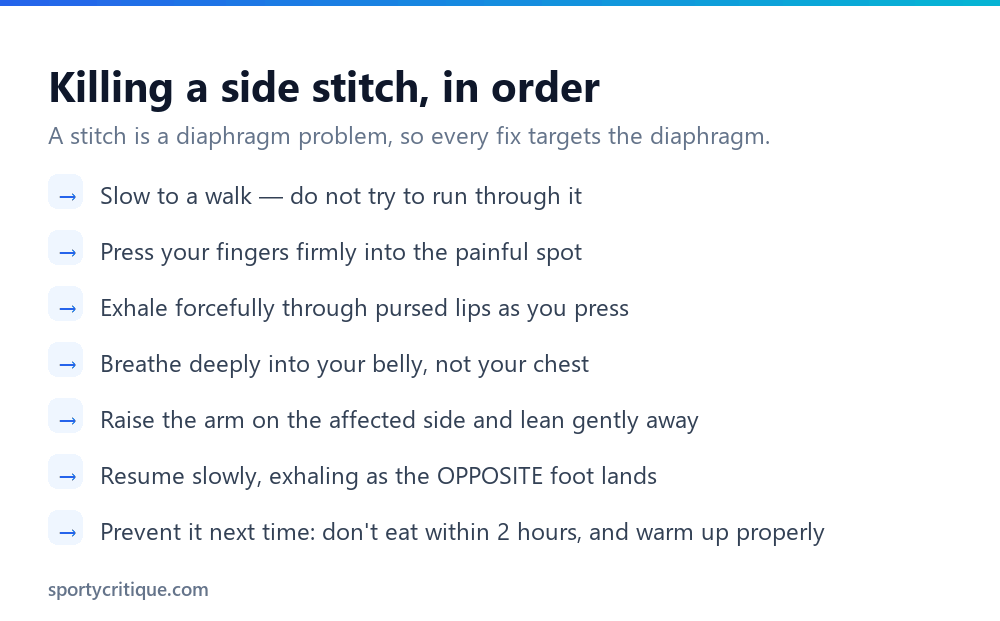
A side stitch — properly an exercise-related transient abdominal pain — is that sharp cramp under the ribs, usually on the right. The most supported explanation is irritation of the membrane lining the abdominal cavity, aggravated by the diaphragm working hard while the abdominal contents jostle beneath it. A full stomach makes it markedly worse, which is why eating too close to a run is such a reliable trigger.
The fix follows from the cause. Slow down — running through it rarely works and usually intensifies it. Press your fingers firmly into the painful area and exhale hard through pursed lips, which forces the diaphragm to contract fully and releases the cramp. Deepen your breathing into the belly rather than panting from the chest.
Prevention is more effective than treatment: don’t eat a substantial meal within about two hours of running, go easy on large volumes of fluid immediately beforehand, warm up properly rather than starting hard from cold, and work on belly breathing. Stitches also become dramatically less frequent as you get fitter, which is why experienced runners rarely get them and beginners get them constantly.
Breathing on hills and during intervals
Hills are where breathing rhythm collapses first, and where holding one is most useful. The instinct on a climb is to keep your flat-ground pace, which spikes your effort and leaves you gasping halfway up. The better approach is to hold your effort constant and let the pace drop — shorten your stride, raise your cadence, and shift your breathing pattern down a gear from 3:3 to 2:2, or 2:2 to 2:1.
Coming over the crest, most runners keep breathing hard and coast. Do the opposite: consciously deepen your breathing on the descent to clear the accumulated carbon dioxide and recover before the next climb. On a hilly route this single habit makes the difference between finishing steady and finishing wrecked.
During intervals, expect to be at 2:1 or 1:1 during the hard portion — that’s normal and not a technique failure. The part that matters is the recovery: get back to deep belly breathing as quickly as you can rather than continuing to pant shallowly. How fast your breathing settles between reps is one of the better informal measures of fitness, and it improves noticeably over a training block.
Cold air, pollen, and pollution
Conditions affect breathing more than most runners account for, and blaming yourself for a bad run that was really a bad environment is common.
Cold air is dry, and dry air drawn rapidly into the airways is the classic trigger for post-run coughing and chest tightness. Draw more of your air through the nose to warm and humidify it, and consider a buff or scarf over your mouth in properly cold weather — it traps warmth and moisture, and it makes a bigger difference than it looks.
Pollen affects a lot of runners who don’t consider themselves hay fever sufferers. Counts are typically highest in the early morning and evening, so a midday run in season can be dramatically easier. Air pollution follows a similar logic — running beside a busy road at rush hour means breathing traffic exhaust deeply for half an hour. Moving a few streets away to a park or quieter route is usually enough.
When breathlessness isn’t a breathing problem
Worth stating plainly: if you’re gasping during what’s supposed to be an easy run, no breathing technique will fix it. You’re running too fast for your current aerobic fitness, and the breathlessness is a symptom of that, not an independent fault.
The test is the same one in our beginner’s guide: can you speak a full sentence out loud? If not, slow down, however slow that ends up being. Beginners routinely discover their genuine easy pace is barely faster than walking, and that’s normal and temporary.
There are a few cases where persistent breathing difficulty deserves proper attention rather than more training. Exercise-induced bronchoconstriction — airway narrowing triggered by exercise — is common and very treatable, and it often shows up as coughing, wheezing, or chest tightness a few minutes into running or shortly after finishing. It’s frequently mistaken for poor fitness for years.
⚠️ Watch out: See a doctor if you experience wheezing, a persistent cough after running, chest tightness or pain, disproportionate breathlessness at low effort, or dizziness. These are not things to train through, and exercise-induced asthma in particular is straightforward to manage once identified.
Frequently asked questions
Should I breathe through my nose or mouth when running?
Mouth, or both together. Your nasal passages can’t deliver the air volume running requires — restricting yourself to nasal breathing means capping your pace at whatever your nose can supply. Inhaling through both and exhaling through the mouth is the practical default, with more nasal involvement in cold weather to warm the air.
Why do I get out of breath so quickly when running?
Almost always pace. Beginners run considerably faster than their aerobic system can sustain, which tips them into anaerobic effort within a minute or two — and that feels exactly like being unable to breathe. Slow down until you can talk in full sentences. If breathlessness persists even at very slow paces, it’s worth seeing a doctor about exercise-induced asthma.
What is the best breathing pattern for running?
3:3 for easy running, 2:2 for steady and tempo efforts, 2:1 or 1:1 for hard intervals. Some runners prefer odd patterns like 3:2 because they alternate which foot lands as you begin exhaling, spreading impact stress across both sides rather than repeatedly loading one. Try both and use whichever feels more sustainable.
How do I stop getting a stitch every run?
Stop eating within about two hours of running, warm up gradually instead of starting hard, and practise belly breathing. If it’s always the same side, try an odd-numbered breathing pattern. Stitches also fade substantially with fitness — if you’re new to running, they will likely resolve on their own within a couple of months.
Is it normal to breathe heavily on easy runs?
Breathing noticeably, yes. Gasping, no. The line is the talk test: on a genuinely easy run you should sustain a full spoken sentence. Most runners run their easy runs too hard, which is the central point of our endurance guide — it undermines the whole purpose of an easy run.
Do breathing exercises off the run help?
Diaphragmatic breathing practice does, because the technique is genuinely hard to learn mid-run — five minutes lying down is the fastest way to install it. Dedicated inspiratory muscle training devices exist and show some benefit in studies, but they’re well down the list of things that will improve your running compared with simply running more at an easy pace.
- →How to start running — the beginner plan and why pace matters most
- →Improve running endurance — the 80/20 rule and long runs
- →How to get faster at running — speed work once you have a base