
How to Improve Running Endurance and Stamina


Endurance is built by running more total volume, mostly at an easy pace — not by running hard more often. Follow the 80/20 rule: roughly 80% of your weekly running should be conversational, with one genuinely hard session. Add a weekly long run and increase total mileage by no more than about 10% a week. Expect real gains in 6–8 weeks. The most common reason endurance stalls is running every run at a moderate-hard ‘grey zone’ effort that’s too hard to recover from and too easy to adapt to.
“Endurance” and “stamina” get used interchangeably, and for practical purposes they’re the same question: how do I run for longer without falling apart? The answer is well established, boring, and almost universally ignored by amateur runners — because it involves running slower than feels productive.
If you’re not yet running 20–30 minutes continuously, start with our beginner’s guide to running and come back. Everything here assumes you have that base.
- →Volume builds endurance, and volume is only sustainable at easy pace.
- →80% of your running easy, ~10% hard, is the most robust finding in endurance training.
- →The weekly long run is the single most valuable session for endurance.
- →Increase total weekly mileage by no more than about 10%.
- →Running everything at ‘medium’ — the grey zone — is why most runners plateau.
- →Endurance adaptations take 6–8 weeks to show. Judging a plan in two weeks tells you nothing.
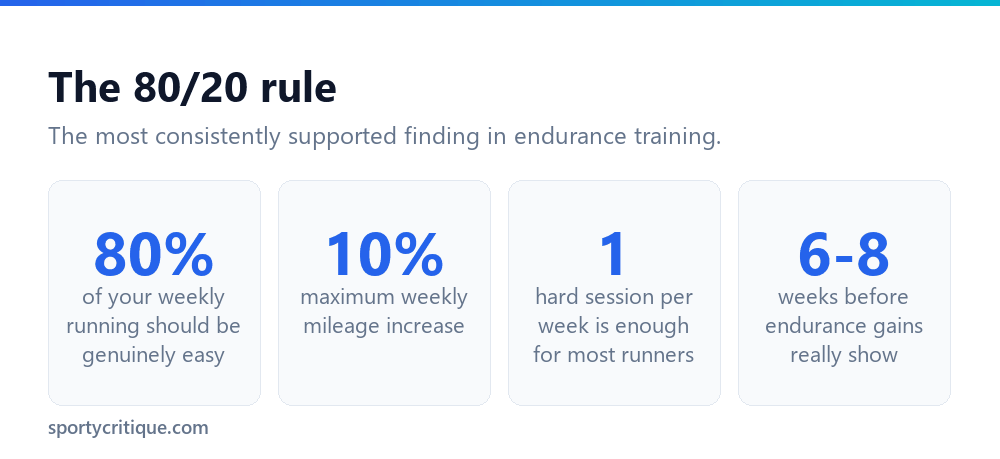
Table of Contents
Why easy running builds endurance
This is the part that feels wrong, so it’s worth explaining the mechanism rather than just asserting it.
Endurance is largely a question of how well your body delivers and uses oxygen. The adaptations that matter are structural: more capillaries feeding the working muscles, more mitochondria inside the muscle cells to process oxygen, a stronger heart moving more blood per beat, and better fat metabolism so you spare your limited glycogen stores.
Crucially, those adaptations are driven primarily by time spent running, not by intensity. Easy running stimulates them nearly as well as hard running does — and because it’s easy, you can do far more of it and recover fast enough to run again tomorrow. Hard running produces a similar signal at vastly higher cost, so you can only do a little before you need days to recover.
Easy running is not the lazy version of training. It’s the version you can do enough of to actually change your body.
So the logic is simple: total volume drives endurance, and volume is only achievable at easy pace. Run everything hard and you’ll cap your weekly mileage at whatever you can survive, which is far below what you’d need to improve.
The grey zone: where progress goes to die
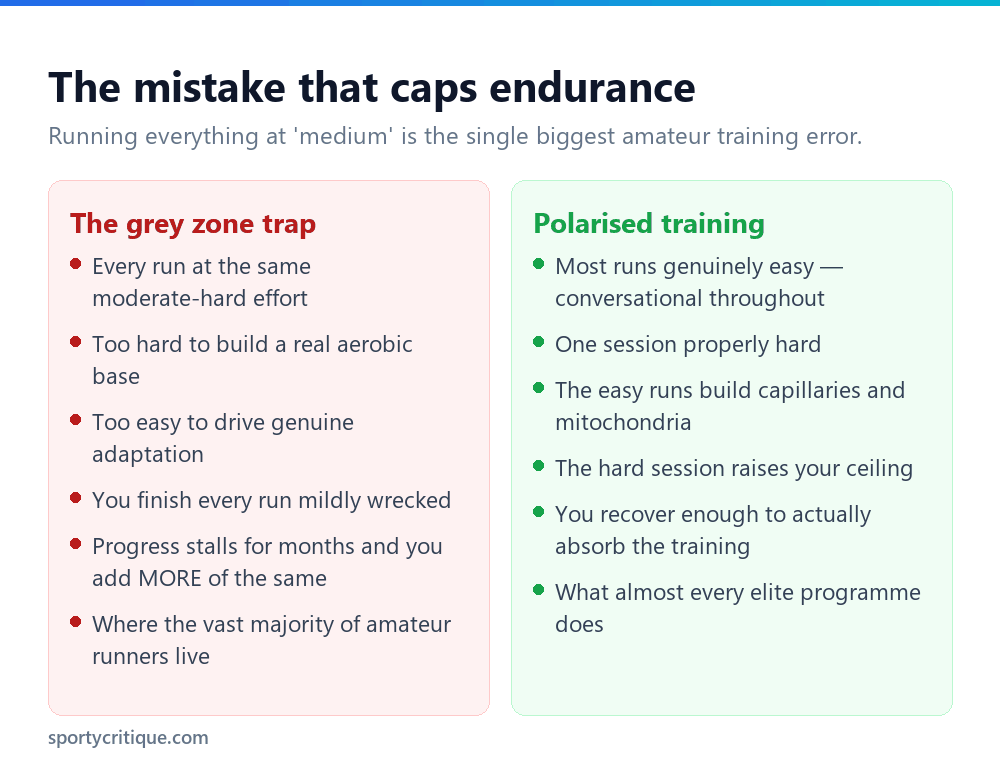
Most amateur runners run at one speed: moderately hard. It’s the pace that feels like a proper workout — breathing heavily, working, but not sprinting. It’s also close to useless for building endurance, and it’s the reason so many runners plateau for years.
The problem is that it falls between two stools. It’s hard enough to accumulate real fatigue, so you can’t run much of it and you never fully recover. But it’s not hard enough to drive the high-intensity adaptations that a genuinely hard session produces. You get the cost of hard training and the benefit of neither.
The fix is polarisation: push your easy runs genuinely easy, and push your hard session genuinely hard. It feels strange at first because both ends feel wrong — the easy runs feel too slow to count, and the hard session is harder than you’re used to. That discomfort is the sign it’s working.
⚠️ Watch out: The most common failure when adopting 80/20 is that the “easy” runs aren’t easy. Use the talk test on every single easy run: full sentences, out loud, no gasping. If you’re borderline, slow down. Most runners who think they’re doing 80/20 are actually doing about 50/50 and wondering why nothing changed.
The long run
If you only change one thing, add a weekly long run. It’s the highest-value endurance session there is, and its benefits are partly structural and partly things nothing else trains: teaching your body to burn fat efficiently, building tendon and bone resilience to sustained loading, and rehearsing the mental experience of continuing when you’d rather stop.
Rules for it are few. Run it slower than your normal easy pace — the duration is the stimulus, not the speed. Start at whatever you can currently manage comfortably, often around 60 minutes, and add five to ten minutes per week. Every third or fourth week, cut it back significantly to let your body absorb the work.
The long run should account for roughly 25–30% of your weekly mileage. If it’s creeping much beyond a third of your total, your other runs are too short rather than your long run being too long — the answer is to add volume during the week, not to shorten the long one.
The 10% rule and why runners break it
Increase your total weekly mileage by no more than about 10% at a time. It’s a rough guideline rather than a physical law, but it encodes something real: your cardiovascular system adapts in weeks while your bones and tendons adapt over months, so fitness consistently runs ahead of structure.
This is why injuries so often arrive when training is going well. You feel strong, the runs feel easy, so you add distance — and your tissues, which are still catching up with where you were three weeks ago, object. Almost every overuse injury in running is a story about progressing faster than connective tissue can follow.
Build in a cutback week roughly every fourth week, dropping volume by around 20–30%. Runners hate these because they feel like lost ground. They aren’t: adaptation happens during recovery, and the cutback is when the previous three weeks actually turn into fitness.
📊 Note: Coming back after time off, don’t resume at the volume you stopped at. Cardiovascular fitness fades in a couple of weeks, but tissue tolerance fades faster than most people assume. Start around 60–70% of your previous volume and build back — you’ll return to where you were within a few weeks, far quicker than starting over after an injury.
The one hard session
Easy volume builds the engine; one weekly hard session raises the ceiling. Two options cover almost everything a distance runner needs:
- 20 minutes at a pace you could hold for about an hour
- Hard but controlled — you could speak a few words, not a sentence
- Raises the effort level you can sustain before fatigue accumulates
- 5-6 x 3 minutes hard, with 2-3 minutes easy jogging between
- The hard portions should be genuinely uncomfortable
- Improves your maximum oxygen uptake and running economy
- 8-10 x 45 seconds uphill hard, jog down to recover
- Builds leg strength with far less impact than flat speed work
- A good first hard session — the hill limits how badly you can overdo it
- Start easy, finish the last third at tempo effort
- Teaches you to run strong when already tired
- Lower injury risk than intervals, good in a build phase
One of these per week. Not two. The temptation once you feel fitter is to add a second hard session, and that’s usually the point at which the easy runs stop being easy, the whole week drifts into the grey zone, and progress stops. If you want to be faster rather than just go further, our guide to getting faster goes deeper into structured speed work.
Fuel, breathing, and the things that feel like endurance limits
Plenty of runners think their endurance ceiling is cardiovascular when it’s actually something simpler.
Fuelling. Under about 75 minutes, you don’t need to eat during a run — you have enough stored glycogen. Beyond roughly 90 minutes, you increasingly do, and the wall people describe at the two-hour mark is largely glycogen depletion. If your long runs are heading past 90 minutes, start taking on carbohydrate during them, and practise it in training rather than discovering on race day that your stomach objects.
Breathing. Feeling out of breath is usually a pacing symptom rather than a breathing problem — but rhythm and side stitches are real and fixable, covered in our guide to breathing while running.
Sleep. The least glamorous variable and one of the most powerful. Adaptation to training happens overwhelmingly during sleep, and a runner sleeping six hours a night while training hard is asking their body to build something without materials. If your endurance has stalled despite sensible training, look here before adding sessions.
How to know it’s working
Endurance improves invisibly for weeks, which is why people abandon good plans. It helps to know what the early signs actually look like, because none of them is “my runs got faster.”
The first thing to change is usually your heart rate at a given pace. If you run the same easy route at the same effort, and your pace creeps up while the effort stays identical, that’s the aerobic engine growing. This is the clearest early signal, and it’s why running the same route regularly is useful even though it’s dull.
The second is recovery between runs. Endurance shows up as feeling ready to run again sooner — the day after a long run stops feeling like a write-off. Many runners notice this before they notice anything about speed.
The third is what happens at the end of long runs. Early on, the last fifteen minutes are a grind. As endurance builds, the run stops degrading — you finish moving much as you started. That’s fat metabolism and fatigue resistance improving, and it’s the adaptation that matters most for going further.
💡 Pro tip: Keep a one-line log: distance, time, and how it felt out of ten. Nothing more. Over two months the pattern is unmistakable, and it will show you progress on the weeks when your own memory insists there wasn’t any.
Frequently asked questions
How long does it take to build running endurance?
Noticeable change in 6–8 weeks of consistent training; substantial change over months. Cardiovascular adaptations come first, structural ones later. The most common mistake is judging a training approach after two weeks — that’s not long enough for any of the relevant adaptations to have occurred.
What’s the difference between endurance and stamina?
In everyday use, nothing meaningful — both describe running longer without fading, and both improve through the same training. If you want to be precise, endurance usually refers to sustaining aerobic effort over time, while stamina is sometimes used for the ability to sustain a harder effort. The training answer is identical: mostly easy volume, one hard session, patience.
Should I run every day to build endurance?
Not necessarily, and not at first. Four quality runs a week with proper recovery beats seven rushed ones. Daily running works for experienced runners with years of tissue adaptation behind them and genuinely easy easy-days. If you’re adding days, add them as short easy runs, not as more hard sessions.
Why do I hit a wall at the same distance every time?
Usually one of three things: you’re running your easy runs too fast, so you arrive at the long run already fatigued; you’re not fuelling if the run exceeds about 90 minutes; or you’ve simply not extended the long run gradually enough. Work through them in that order — pacing is the culprit far more often than fuelling.
Does strength training help running endurance?
Yes, more than most runners expect. Heavy, low-rep strength work improves running economy, meaning you use less oxygen at any given pace — which is functionally the same as more endurance. Two short sessions a week of squats, deadlifts, and single-leg work is plenty, and it also reduces injury risk.
Is it better to run further or more often?
More often, up to a point. Three 40-minute runs build more endurance than one two-hour run, because frequency delivers repeated adaptive signals and spreads the tissue load. Once you’re running four or five times a week, then extend the long run. Frequency first, duration second.
- →How to start running — the beginner run-walk plan
- →How to get faster at running — speed work on top of an endurance base
- →How to breathe while running — rhythm and side stitches