How to Kick a Soccer Ball: Power, Accuracy, and Curl

| Kick Style & Purpose | Plant Foot Placement | Striking Surface & Ankle State | Torso & Chest Lean Angle | Follow-Through Vector |
|---|---|---|---|---|
| Driven Instep Power Shot (Laces) | 5 to 7 inches beside ball, pointing at target | First metatarsal / laces; ankle rigidly locked down | Chest leaned firmly over the ball (Prevents skying) | Drive straight through ball, landing on kicking foot |
| Inside Foot Push Pass / Finesse | 6 inches parallel to ball, pointing at recipient | Inside arch (navicular bone); ankle locked at 90 deg | Upright, balanced athletic posture | Smooth forward sweep along ground plane |
| Curled Bending Shot / Cross (Whipped) | 6 to 8 inches outside ball with 30-degree approach | Big toe knuckle / instep edge; wrapping contact | Torso tilted slightly away from ball for arc | Diagonal follow-through across opposite shoulder |
| Lofted Driven Pass / Goal Kick | 8 inches behind and slightly lateral to ball | Lower bone of laces struck beneath ball equator | Slight backward torso lean to generate launch angle | High upward follow-through with open hip angle |
| Knuckleball Free Kick (Zero Spin) | 4 to 6 inches beside ball, firm heel plant | Center laces directly into ball valve; zero sweep | Chest square over ball; rigid core contraction | Abrupt abbreviated follow-through; sudden braking |
Plant your non-kicking foot beside the ball, pointing where you want it to go. Lock your ankle — a loose ankle destroys both power and accuracy. Then choose your contact: the inside of the foot for accurate passing, the laces for driven shots, below centre to lift the ball, and the outside half of the ball to curl it. The variable almost nobody explains is where on the ball you strike — that’s what decides whether it flies flat, lifts, or bends.
⚽ Soccer Hub: Explore all 30 cleat reviews, striking tutorials, and recruiting guides in our Complete Soccer Resource Hub.
Most guides to kicking a soccer ball describe the same body mechanics: plant foot here, ankle locked, follow through. All correct, all necessary, and all of it stops short of the thing that actually determines what the ball does.
Because two players can have identical technique and produce completely different results depending on where on the ball their foot lands. A centimetre lower and the ball lifts. A centimetre to the side and it bends. That contact point is the master variable, and once you understand it, every kick in the game becomes a variation on the same idea rather than six unrelated skills to memorise.
- →Lock your ankle. It’s the difference between a shot and a scuff, on every kick type.
- →Plant foot beside the ball, toes pointing at your target — it aims the whole kick.
- →Where you contact the BALL decides lift and spin; where you contact your FOOT decides accuracy vs power.
- →Inside of the foot for passing, laces for driving. Beginners overuse the laces.
- →Shots go over the bar because you leaned back and struck underneath the ball.
- →Power comes from a locked ankle and a fast lower leg, not from swinging harder.
Table of Contents
The foundation: plant foot and ankle
Two things apply to every kick in soccer, so get them right before worrying about kick types.
The plant foot aims the kick. Place it roughly 10–15cm beside the ball — not behind it, not on top of it — with the toes pointing where you want the ball to go. Your body naturally follows your standing foot, so a plant foot pointing off-target sends the ball off-target no matter what your kicking leg does. It also controls height: plant level with the ball and the strike stays low; plant well behind it and your body opens upward, lifting the ball.
The locked ankle transfers the force. This is the single most common technical failure in amateur soccer. A relaxed ankle absorbs the impact — the foot gives way at contact, energy disappears into the joint, and the ball leaves slowly and unpredictably. Lock the ankle rigid, toes pointed down for a laces strike or turned out for an inside-foot pass, and hold it through contact. The foot becomes a solid striking surface rather than a hinge.
A loose ankle is why a strong player’s shot can be feeble. It isn’t leg strength — the energy never reaches the ball.
💡 Pro tip: Test your ankle lock without a ball: point your toes hard and have someone press up against the sole of your foot. If your foot gives, that’s what happens at contact. It’s a strength and habit issue, and it improves within a couple of sessions of deliberate attention.
Contact point: the variable nobody explains

This is the concept that turns kicking from a list of techniques into a single principle. The ball is a sphere, and where your foot meets that sphere determines the direction of the force you apply relative to its centre of mass.
Strike through the centre and all your force goes into forward motion — maximum speed, no rotation. Strike below centre and you apply force under the middle, which lifts the ball and imparts backspin. Strike the side and the force passes off-axis, setting the ball spinning sideways — and a spinning ball curves through the air because the spin creates a pressure difference across it, the same Magnus effect that makes a table tennis loop dip.
This explains things that otherwise look like separate mysteries. Why does a hard shot sometimes fly over? You struck under the centre. Why does a free kick bend around the wall? Side contact. Why does a knuckleball wobble? Because it has almost no spin — struck dead centre with a firm foot and little follow-through — and an unspinning ball is pushed around by turbulent airflow instead of being stabilised by rotation.
📊 Note: The practical takeaway: before you kick, decide what you want the ball to do, then pick your contact point. Most beginners strike wherever their foot happens to land and are surprised by the result each time.
The pass and the drive
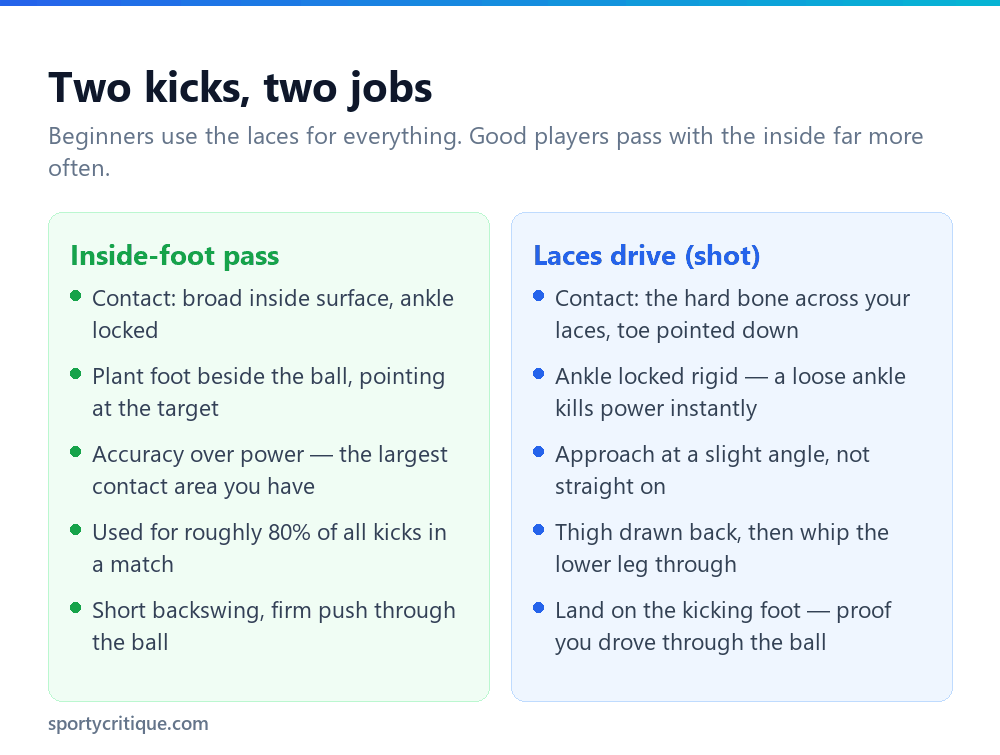
The inside-foot pass is the most-used kick in the sport and the one beginners neglect because it doesn’t feel impressive. It uses the broad flat surface on the inside of your foot, which is the largest and most controllable contact area available to you — a bigger surface means more margin for error, which is exactly what accuracy is.
Turn your kicking foot outward, lock the ankle, keep the backswing short, and push firmly through the middle of the ball. The most common error is under-hitting: a soft pass gives defenders time to intercept and forces your teammate to work harder to control it. Firm passes are safer passes.
The laces drive is the power shot. Approach at a slight angle rather than straight on, plant beside the ball, point your toes down and lock the ankle, then draw your thigh back and whip the lower leg through. The power comes from that whip — hip drives the thigh, thigh drives the shin, shin accelerates the foot — not from muscling the whole leg through in one piece.
Keep your head and chest over the ball. Leaning back opens the body upward and is the most reliable way to send a shot into the stands. If you finish a shot having hopped or landed on your kicking foot, that’s a good sign: it means you drove your weight forward through the ball rather than pulling away from it.
Curling, chipping, and the knuckleball
- Strike the outside half of the ball with the inside of your foot
- Wrap your foot around it and follow through across your body
- The ball bends away from your standing leg
- The classic free-kick and far-post finish
- Stab down sharply beneath the ball with a firm ankle
- Almost no follow-through — that’s what creates the steep lift
- Heavy backspin makes it stop quickly on landing
- For lifting the ball over an advancing keeper
- Strike the exact centre with the hard part of your laces
- Firm, short follow-through — cut the leg off after contact
- Almost zero spin means the ball moves unpredictably in flight
- Difficult, spectacular, and unreliable — learn it last
- Contact with the outer edge of the boot
- Curls opposite to an inside-foot pass
- Very hard to read, so useful in tight areas
- Short range — it sacrifices power for deception
Learn these in that order. The curled shot has the broadest application and is the most reliable of the four. The chip is situational but wins goals. The knuckleball is genuinely difficult, works only at high speed over distance, and is the one people try first — which is why so many free kicks end up in row Z.
Fixing the shot that goes over the bar

This is the most common complaint in amateur soccer, and it’s almost always a body-position problem rather than a power problem.
The dominant cause is leaning back. It happens because hitting a ball hard feels like it should involve a big backswing and an upright, chest-open posture — and that posture tilts your whole striking arc upward. Your foot arrives under the ball’s centre, and the ball goes up. The correction is simple to say and awkward to feel: get your head and chest over the ball at contact, almost as though you’re leaning into it.
The second cause is plant foot position. If your standing foot lands behind the ball rather than beside it, your body is forced backward, producing the same upward arc. Watch your plant foot for a session and you’ll likely find it drifting back on your hardest attempts, because rushing the shot is what causes it.
⚠️ Watch out: Trying to hit it harder makes all of this worse. Maximum-effort swings wreck body position and ankle stability, which is exactly why a controlled 80% strike usually goes faster and straighter than a 100% lunge. Power is a technique outcome, not an effort outcome.
Practising alone
Kicking is one of the most practisable skills in sport, because a wall does everything a partner does and never gets bored.
For ball control and touch, which is what makes all of this usable in a real match, our juggling guide is the most efficient solo drill there is. And if you want the wider improvement plan, getting good at soccer puts the skills in order.
Frequently asked questions
How do I kick a soccer ball harder?
Lock your ankle, strike through the centre of the ball with your laces, and generate speed by whipping the lower leg rather than swinging the whole leg. Get your head over the ball and follow through forward. Most players who feel weak aren’t lacking strength — they’re losing energy through a loose ankle and off-centre contact.
Why does the ball hurt my foot when I kick it?
You’re striking with your toes or the soft top of the foot rather than the hard bone across your laces, and your ankle is probably unlocked. Point your toes down firmly and make contact with the laces area. Kicking a heavy, over-inflated, or waterlogged ball also hurts far more, which is worth checking before assuming it’s technique.
How do you curve a soccer ball?
Strike the outside half of the ball with the inside of your foot and follow through across your body. The off-centre contact makes the ball spin sideways, and the spinning ball curves through the air. More spin means more curve but less speed — every degree of bend costs you pace, which is the trade-off free-kick takers are constantly balancing.
Should I kick with my toes?
No. The toe-poke has one legitimate use — a surprise shot in a crowded box where there’s no room for a backswing — and is otherwise inaccurate, low-powered, and a good way to hurt yourself. Use the laces for power and the inside of the foot for accuracy.
How do I stop slicing the ball?
Slicing usually means your foot is cutting across the ball rather than driving through it, often because your plant foot is too far from the ball or your approach angle is too steep. Straighten the approach slightly, plant closer, and concentrate on following through toward the target rather than across your body.
How long does it take to kick properly?
The basic technique can be corrected in a few focused sessions — ankle lock and plant foot are quick wins. Consistency under match pressure takes months, because in a game you rarely get a stationary ball and time to set up. That’s why wall work matters: it makes the technique automatic enough to survive being rushed.
- →How to play soccer — rules, positions, and offside
- →How to juggle a soccer ball — the fastest way to build touch
- →How to get good at soccer — a structured improvement plan