How to Get Good at Soccer: The Right Order to Learn Things


There’s no shortcut, but there is a correct order, and most people get it backwards. Fix your first touch first, then passing with both feet, then fitness, then decision-making. Finishing and skill moves come last, because they’re the smallest part of a match. The fastest realistic route is 20–30 minutes of solo practice against a wall most days, plus playing as often as you can — and the biggest free gain available to any amateur is learning to look around before the ball reaches you.
Let’s deal with “quickly” honestly. You can improve noticeably in a few months, and you can become genuinely useful in a team within a season. You cannot become a great player in six weeks, and any guide promising that is selling something.
What you can do is stop wasting effort. Most amateur players spend their practice time on the least valuable skills and their match time repeating the same habits, which is why so many people play for years without getting better. The order below is about spending your time where the return is highest.
- →First touch first. It’s the skill involved in every moment you have the ball.
- →Train your weak foot from the start — it roughly doubles your options in every situation.
- →Scanning before you receive is the biggest free improvement available. It costs nothing.
- →20–30 minutes of solo wall work most days beats one long session a week.
- →Fitness is a skill multiplier: technique you can’t access when tired isn’t technique.
- →Skill moves and long shots are the last thing to work on, not the first.
Table of Contents
The priority order
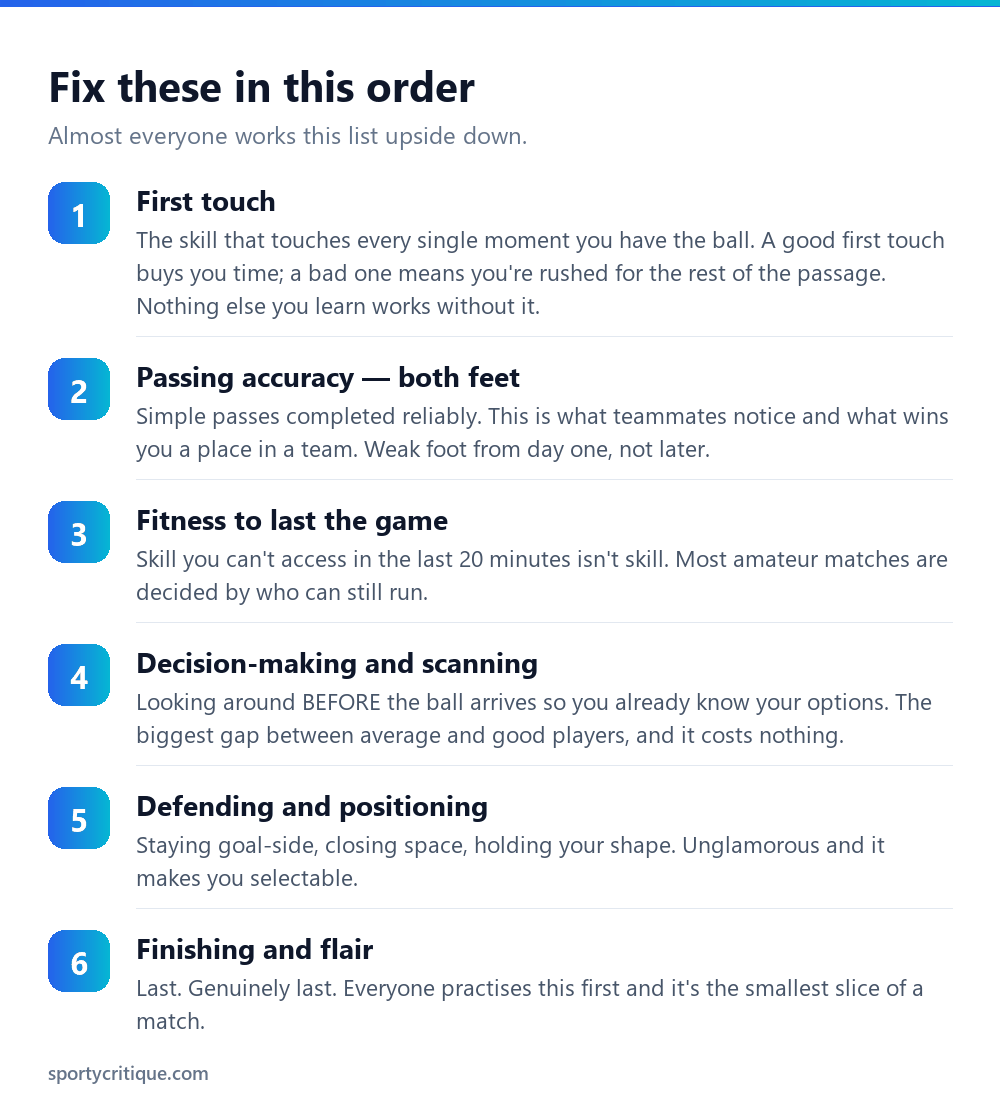
The logic behind this order is simply how often each skill occurs. In ninety minutes, an amateur outfield player might have the ball for two or three minutes total, spread across perhaps forty touches. Almost every one of those forty starts with a first touch and most end with a pass. Very few involve a shot, and essentially none involve a stepover that comes off.
So first touch and passing are where the volume is, and volume is where improvement pays. A player who controls the ball cleanly and passes simply and accurately is immediately useful to a team, even with no pace, no tricks, and no shot. A player with a great shot and a poor first touch loses the ball before the shot ever arises.
You’ll take maybe forty touches in a match. Nearly all of them start with a first touch and end with a pass. Practise accordingly.
First touch: the whole game
A good first touch isn’t just stopping the ball dead — it’s directing it into space, away from the nearest defender, and into a position from which your next action is easy. That distinction is what separates a player who always looks composed from one who always looks harried.
The mechanics: get your body behind the ball, choose the surface that faces where you want to go, and cushion rather than block. Withdraw the contact surface slightly as the ball arrives, absorbing the pace rather than letting it rebound. And crucially, know where you’re going before the ball reaches you, which brings us to scanning.
The fastest way to build it is wall work — pass firmly against a wall, control the rebound into space, pass again. Ten minutes a day, both feet. It’s repetitive and unglamorous and it will improve your matches more than anything else on this page. Juggling is the useful supplement, because it builds control of balls arriving in the air.
Scanning: the free improvement
If there’s one thing on this page that produces a visible jump within weeks and requires no physical ability whatsoever, it’s this.
Most amateur players watch the ball. They receive it, then look up, then decide what to do — by which point a defender has arrived and the easy option has closed. Good players do it in the opposite order: they look around repeatedly before the ball comes, building a mental picture of who’s free, who’s marking them, and where the space is. When the ball arrives, the decision is already made.
The habit is trainable and simple to describe: every few seconds when the ball is elsewhere, turn your head and take a snapshot. Before you call for a pass, check over both shoulders. It feels artificial for a fortnight and then becomes automatic, and it makes you look substantially faster than you are — because speed of decision reads as speed.
💡 Pro tip: Watch a professional midfielder for one full match and count how often they turn their head. It’s constant — several times before every single reception. This is the most visible difference between levels and it’s almost never taught to amateurs.
Practising alone

A wall is the most underrated coach in football. It returns the ball instantly, never tires, and gives you hundreds of repetitions in the time a training session gives you dozens.
Structure twenty minutes like this: five minutes of one-touch wall passing with your strong foot, five with your weak foot, five minutes of control-then-pass (two touches, the first into space), and five minutes on whatever you’re worst at. Then finish by hitting a target for accuracy at moderate pace — our kicking guide covers the striking technique.
The weak foot deserves its own note. Being genuinely two-footed is the single biggest structural upgrade available to an amateur, because a one-footed player is predictable — defenders show you onto your weak side and you’re finished. Most people avoid weak-foot work because it feels incompetent. That feeling is the point: it’s the only part of your practice where you’re actually a beginner, which is exactly why it improves fastest.
⚠️ Watch out: Don’t spend your solo time on skill moves. Stepovers and drag-backs are fun to practise and rarely useful for beginners, because they’re only effective if your first touch and passing are already good enough that a defender has to commit to you. Learn to be reliable first; learn to be unpredictable later.
Fitness: the skill multiplier
Amateur matches are frequently decided in the last twenty minutes, by whichever side still has legs. Technique that disappears at minute 70 is technique you don’t really have.
Soccer fitness is repeated-sprint fitness rather than steady endurance — you jog, walk, then sprint hard, then repeat, several hundred times. Long slow runs build a useful aerobic base, but interval work matches the demand better: 30 seconds hard, 60 seconds easy, repeated ten to fifteen times, twice a week. Add some basic strength work for your legs and core, which reduces injuries as much as it improves performance.
There’s also a direct link between fatigue and decision quality. Tired players stop scanning, stop moving after passing, and default to whatever’s easiest — usually hoofing the ball away. So fitness doesn’t just extend your physical output; it protects everything else on this list.
Learning from matches
Playing regularly is essential and it isn’t automatically improvement — plenty of people play weekly for a decade and finish exactly where they started, because they repeat the same habits without noticing them.
Two habits turn matches into practice. First, pick one thing per game. Not five. This week you scan before every reception; next week you move immediately after every pass. A single conscious focus survives the chaos of a match, and a list of five doesn’t.
Second, review honestly afterwards. Two questions on the walk home: what did I do well, and what one thing cost my team the most? Most players either don’t reflect at all or spiral into blaming themselves for everything, and neither produces change. Specific and singular is what works.
Watching football helps too, if you watch it properly. Instead of following the ball, pick one player in your position and watch only them for fifteen minutes — including all the time they don’t have the ball. Where do they stand? When do they move? How often do they check their shoulder? It’s the cheapest coaching available and almost nobody does it.
What people practise vs. what decides matches

The mismatch in that table isn’t a criticism of anyone’s discipline — it’s a natural consequence of what looks like football when you watch it. Highlights are goals and skill moves, so those feel like the sport. The parts that actually decide amateur matches are invisible on television: a clean control under pressure, a five-yard pass that keeps possession, a defender in the right position so nothing happens at all.
There’s also a feedback problem. Practising stepovers gives immediate, visible feedback — the move either works or it doesn’t, and it feels like progress. Practising scanning gives no visible feedback for weeks, and then quietly changes every game you play. Skills with slow feedback get neglected regardless of how valuable they are, which is why knowing this in advance matters.
The practical fix is to allocate deliberately rather than by instinct. If you have thirty minutes, give twenty to the right-hand column and ten to whatever you enjoy. Enjoying practice matters — a plan you abandon is worth nothing — but it shouldn’t be the whole plan.
A realistic timeline
Notice that nothing in the first six months is exciting. That’s the honest answer to “how do I get good quickly”: do the dull things consistently, in the right order, and you’ll pass the people doing exciting things inconsistently.
Frequently asked questions
How can I get better at soccer fast?
Wall work for first touch and passing, 20 minutes most days, with a third of it on your weak foot — plus scanning before every reception in matches. Those two habits produce the quickest visible change. What won’t help is spending that time on skill moves and long-range shooting, which is where most people put it.
Am I too old to start playing soccer?
No. Adult beginners improve quickly because they understand instruction and can practise deliberately, which children can’t. You may not reach a high competitive level starting at 30, but becoming a genuinely decent recreational player is entirely achievable at any age. Small-sided football is the easiest place to start.
What’s the most important skill in soccer?
First touch, for outfield players. It occurs in nearly every possession, it determines how much time you have, and it’s the skill whose absence makes everything else impossible. Passing is a close second. Neither is glamorous, which is precisely why they’re where the advantage is.
How often should I practise?
Short and frequent beats long and rare — 20–30 minutes most days will outperform a three-hour weekend session, because motor skills consolidate through repeated exposure. Combine that with playing at least once a week so the skills get tested under pressure.
Should I focus on my weak foot?
Yes, more than feels comfortable — about a third of your practice time. A one-footed player is predictable and defenders exploit it constantly by showing you onto your weak side. It’s the least enjoyable part of practice and reliably the highest-return.
Do I need a coach to improve?
Not to reach a solid recreational standard — wall work, matches, and deliberate self-review will take you a long way. A coach becomes valuable when you’ve plateaued and can’t identify why, since the hardest problems to fix are the ones you can’t see yourself. Filming yourself in a match is a cheap substitute.
- →How to juggle a soccer ball — build first touch and air control
- →How to kick a soccer ball — passing, driving, and curling
- →How to play soccer — rules, positions, and offside