How to Hit a Golf Ball: Clean Contact and Fixing Fat, Thin, and Topped Shots

| Shot Trajectory & Shape | Clubface Angle at Impact | Swing Path Direction | Ball Position in Stance | Attack Angle (AOA) |
|---|---|---|---|---|
| Straight Shot (Target Line) | Square (0 degrees to target line) | Neutral / In-to-In (0 degrees) | Center to 1 ball forward of center (Irons) | -2 to -4 degrees downward strike |
| Controlled Baby Draw | 1 to 2 degrees closed to swing path (Open to target) | 2 to 4 degrees In-to-Out | Inside left heel (Driver) / 1 ball forward (Irons) | +2 to +4 degrees (Driver upward strike) |
| Controlled Power Fade | 1 to 2 degrees open to swing path (Closed to target) | 2 to 4 degrees Out-to-In | Opposite left armpit / logo of shirt | -1 to -3 degrees (Clean descending strike) |
| Over-the-Top Slice (Fault) | 4+ degrees open to target and path | 6+ degrees steep Out-to-In | Too far forward off front toe | Steep descending chop (-6+ degrees) |
| Stinger / Low Knockdown | De-lofted (Forward shaft lean) | Direct down target line | Middle to back of stance (Right of center) | -4 to -6 degrees sharp downward compression |
To hit a golf ball cleanly, hit down on it — with an iron, the club strikes the ball first and the turf just after, and the club’s built-in loft launches the ball into the air. Trying to scoop or lift the ball is the number-one beginner mistake, and it causes topped and thin shots. The keys: play the ball roughly centre in your stance, get your weight forward onto your front foot through impact so the low point of the swing is ahead of the ball, and stay down in your posture instead of standing up. Fat, thin, and topped shots are all one problem — the swing’s low point in the wrong place.
⛳ Golf Hub: Explore all 29 club reviews, swing tutorials, and short game guides in our Complete Golf Resource Hub.
“Why can’t I just hit the ball?” is the most common cry of the beginning golfer, and it’s a different question from how to swing. You can have a reasonable-looking swing and still top the ball along the ground, chunk it two feet, or catch it thin, because clean contact is its own specific skill — and a genuinely counterintuitive one.
This guide is about ball-striking: making the club meet the ball the way it’s designed to. It pairs with our golf swing guide (the motion) and assumes your grip is sound. Get contact right and golf suddenly feels possible.
- →Hit DOWN on the ball — the club’s loft lifts it, not your effort to scoop.
- →Strike the ball first, then brush the turf just after it.
- →Get your weight forward through impact so the low point is ahead of the ball.
- →Play the ball roughly centre in your stance to start; adjust from there.
- →Fat, thin, and topped shots are all low-point problems, not three separate faults.
- →Stay down in your posture — standing up through impact tops the ball.
Table of Contents
The big idea: down is up
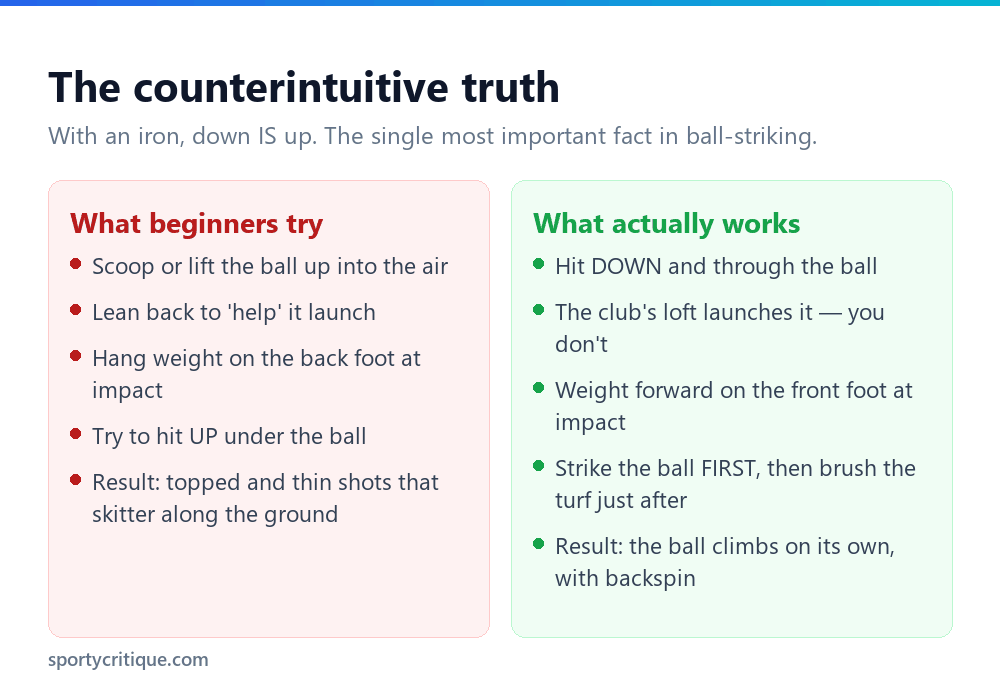
Every instinct you have about launching a ball into the air is wrong for golf, and until you unlearn it, clean contact stays random. So let’s be blunt about the single most important fact in ball-striking: with an iron, you hit down on the ball to make it go up.
It seems absurd. The ball is on the ground and you want it in the sky, so surely you swing up under it? No — that’s exactly the scooping instinct that ruins beginners. The club has loft built into its face precisely so that when it strikes down and through the ball, the angled face launches the ball upward with backspin. Your job is simply to deliver a descending blow; the club’s design does the lifting. The ball is struck first, and the club continues down into the turf after the ball, taking a shallow divot on the target side of where the ball was.
You don’t lift a golf ball. You hit down and through it, and the loft on the clubface throws it into the air. Fighting that instinct is most of the battle.
When you try to help the ball up instead — leaning back, hanging on your back foot, flicking your wrists to scoop — you move the bottom of your swing arc backward, behind the ball. Now you either hit the ground first (a fat shot) or, compensating, catch the ball on the way up with the club’s leading edge (a thin or topped shot). Trusting the loft and hitting down is what breaks the cycle.
Fat, thin, topped: one problem in three disguises
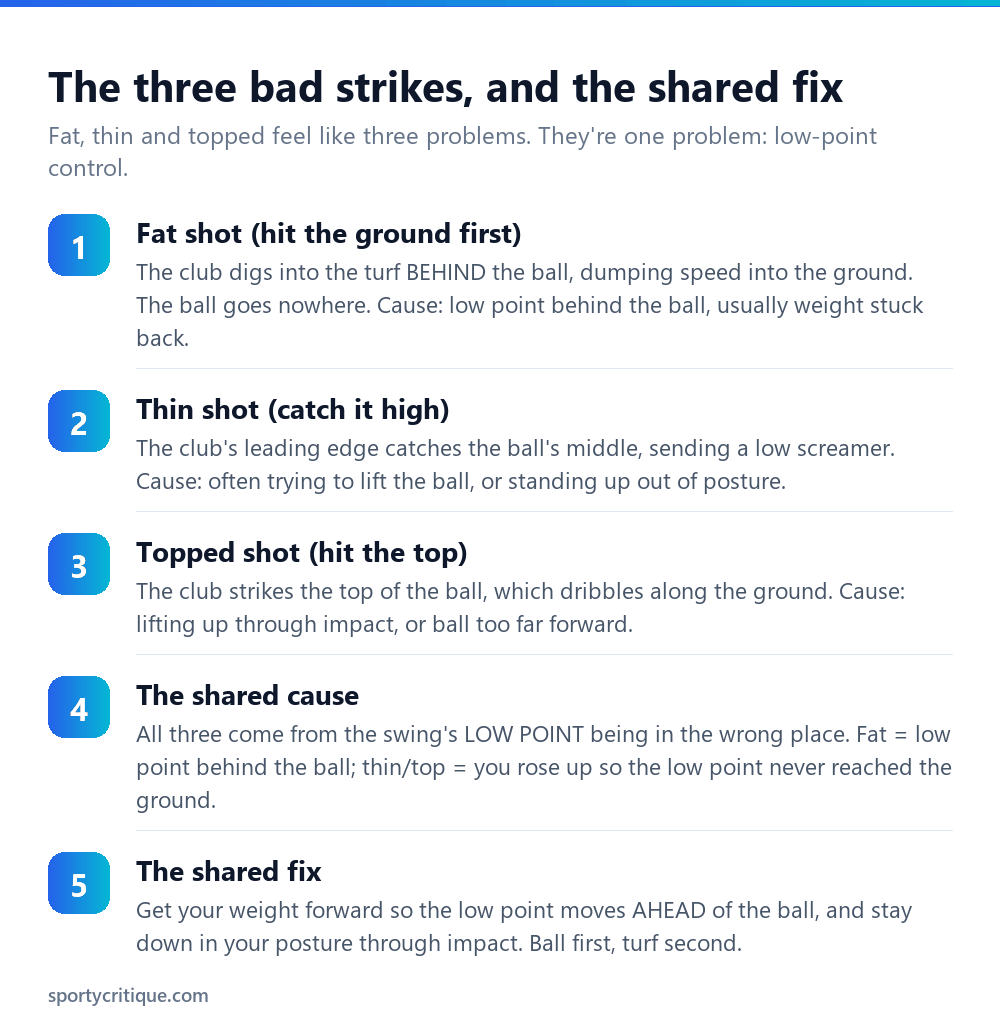
Beginners treat their bad shots as separate mysteries — “sometimes I hit it fat, sometimes I top it” — but they share a single root cause: the low point of the swing (the bottom of the arc) is in the wrong place relative to the ball.
A fat shot (also called a chunk or a duff) is when the club hits the ground behind the ball first, dumping most of its energy into the turf so the ball travels a pathetic distance. The low point arrived too early — usually because your weight stayed back on your trail foot, moving the whole arc backward. A thin shot is the opposite miss: the club’s leading edge catches the ball around its middle, sending a low, hard, stinging shot that races along the ground. A topped shot is the extreme version — the club strikes the top of the ball, which just dribbles forward. Thin and topped shots usually come from trying to lift the ball, or from standing up out of your posture through impact so the club rises away from the ground.
Because they share a cause, they share a fix. Get your weight forward. Moving onto your front foot through the downswing shifts the low point of your swing ahead of the ball, which is exactly where it needs to be to strike ball-first-then-turf. And stay down — maintain your spine angle and knee flex through impact rather than rising up to watch the shot. Those two things cure the large majority of contact problems, and they’re the same two things whether your current miss is fat or thin.
Setup: giving yourself a chance
A lot of contact is decided before you swing, by two setup details beginners rarely think about.
Ball position. For most iron shots, start with the ball roughly in the centre of your stance, or just ahead of centre. Too far forward and you’ll tend to catch it thin or on the upswing; too far back and you’ll hit it fat and low. Centre is a reliable default that puts the ball near where a well-sequenced swing bottoms out. As clubs get longer, the ball moves progressively forward toward your lead foot, but for learning clean contact with a mid-iron, centred keeps things simple.
Posture you can keep. Set up bent from the hips with your knees flexed and your back straight, arms hanging freely — and the crucial part is that you have to maintain that posture through the swing. Beginners collapse or stand up out of their posture mid-swing, which moves the club away from the ball and causes thin and topped shots. Staying in your setup posture until well after impact is one of the least glamorous and most effective contact keys there is.
Drills that build clean contact
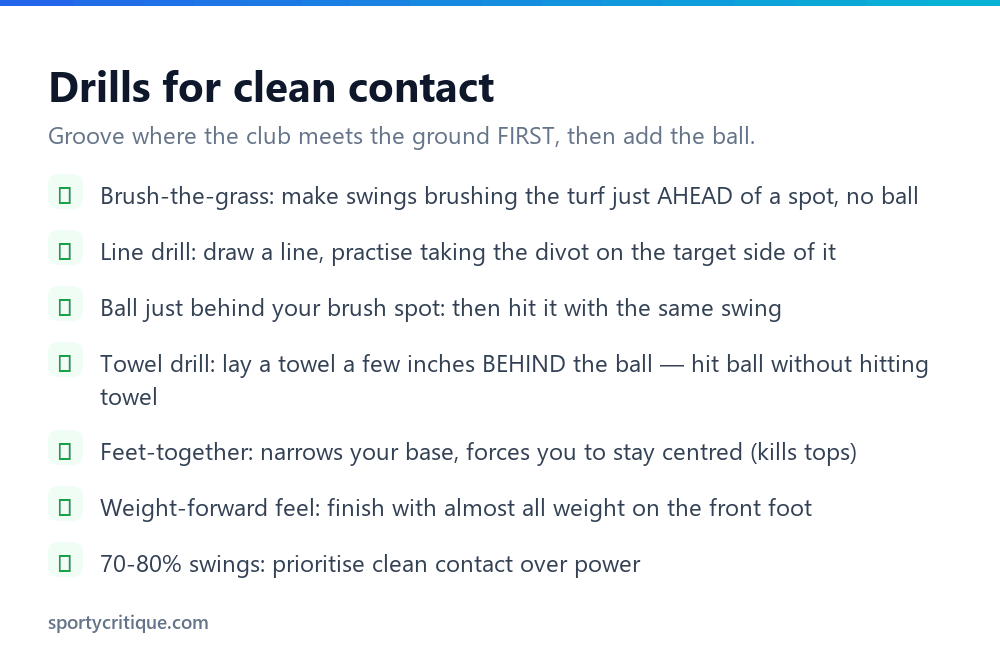
Clean contact is trained by grooving where the club meets the ground — the ball almost gets in the way of that. These drills isolate it.
Brush the grass. Without a ball, make swings that just brush the turf, and pay attention to where the club brushes. The goal is for the lowest point — where the club touches the grass — to be a few inches ahead of where a ball would sit, on the target side. Once you can brush the same spot ahead of the ball position consistently, you’ve built the exact motion clean contact requires. Then place a ball just behind that brush spot and make the identical swing — the ball simply gets collected on the way to the ground you were already brushing.
The towel drill targets fat shots directly: lay a small towel on the ground a few inches behind the ball. If you hit fat — ground before ball — you’ll strike the towel first, giving instant feedback. Swinging to miss the towel and catch the ball forces your low point forward. And the feet-together drill from our swing guide doubles as a contact fixer, because a narrow base forces you to stay centred and balanced, which kills the sway and stand-up that cause tops.
💡 Pro tip: Make your practice swings count double: on every practice swing before a real shot, brush the grass and check where the club bottomed out. If it’s brushing behind where the ball will be, you already know that shot is going to be fat — adjust before you hit it rather than after. Most amateurs take practice swings that touch nothing, which teaches nothing.
Driver is the exception
One important caveat, because it’s a common source of confusion: everything above is about irons, where you hit down on the ball. The driver is different.
With a driver, the ball sits on a tee, well forward in your stance near your lead foot, and you actually want to catch it slightly on the upswing — the club’s low point is behind the teed ball, and you strike it as the club is starting to rise. That’s why a driver has so little loft on its face compared to an iron: you’re launching the ball off the tee with an ascending strike rather than a descending one. So the mental cue flips: hit down on irons off the turf, sweep up on the driver off a tee. Getting these two mixed up — trying to hit down on a driver or sweep an iron off the ground — causes a lot of beginner confusion, so it’s worth keeping them clearly separate in your head.
⚠️ Watch out: Don’t tee your irons high and try to sweep them like a driver — on the course you’ll be hitting irons off the turf, so practise them off the turf (or off a very low tee at the range). Grooving a sweeping iron swing at the range and then trying to use it off tight grass is a recipe for topped shots.
Frequently asked questions
Why do I keep topping the golf ball?
Usually because you’re trying to lift or scoop the ball into the air, or standing up out of your posture through impact — both raise the club so it catches the top of the ball. The fix is to trust the club’s loft, hit down and through with your weight moving onto your front foot, and stay bent in your setup posture until after impact. Topping is a low-point problem, not bad luck.
How do I stop hitting fat shots?
Fat shots — hitting the ground before the ball — come from the low point of your swing being behind the ball, usually because your weight hangs back on your trail foot. Get your weight moving forward onto your lead foot through the downswing so the club bottoms out ahead of the ball, striking ball first then turf. The towel drill (a towel behind the ball) gives instant feedback.
Am I supposed to hit down or up on the ball?
With irons off the ground, you hit down — the club strikes the ball first and the turf just after, and the loft launches the ball up. With a driver off a tee, it’s the opposite: the ball is forward in your stance and you catch it slightly on the upswing. Mixing these up causes a lot of confusion, so keep them separate: down on irons, sweep up on the driver.
Why does the ball go up if I hit down on it?
Because of the loft built into the clubface. When you strike down and through the ball, the angled face compresses the ball against the ground and launches it upward with backspin — the club does the lifting. This is why trying to help the ball up yourself is counterproductive: the club is already designed to do it, and scooping only moves your low point to the wrong place.
Where should I position the ball in my stance?
For most iron shots, start with the ball around the centre of your stance or just ahead of it — a reliable default for clean contact. Too far forward tends to cause thin shots; too far back causes fat, low ones. Longer clubs move the ball progressively forward toward your lead foot, and the driver sits well forward on a tee, but centred is the right starting point for learning to strike a mid-iron.
What’s the difference between hitting and swinging a golf club?
They’re related but distinct skills. The swing is the motion — setup, backswing, transition, downswing, finish — while ‘hitting’ is about clean contact, delivering the club to the ball correctly so you don’t top, chunk, or thin it. You can have a decent swing and still strike the ball poorly, which is why contact deserves its own focus. Our swing guide covers the motion; this guide covers the strike.
- →How to swing a golf club — the motion behind the strike
- →How to hold a golf club — the grip it all starts from
- →How to play golf — rules, scoring, and getting started