How to Hold a Golf Club: Grip, Styles, and the Fix for Your Slice


Hold the club in your fingers, not your palm. Lead hand goes on first (left hand for a right-hander), running diagonally across the fingers, closed so you see about two knuckles and the ‘V’ between thumb and forefinger points at your trail shoulder. The trail hand fits snugly below it. Link them with an overlap, interlock, or ten-finger grip — whichever is comfortable, it matters less than you think. Keep the pressure light. And if you slice or hook the ball, the fix is usually grip strength — how far your hands are rotated on the club — not the linking style.
The grip is the least glamorous fundamental in golf and arguably the most important, because it’s your only physical connection to the club. Everything the clubhead does at impact traces back to how your hands sit on the grip — which means a bad grip quietly sabotages an otherwise decent swing, and a good one fixes faults you’d otherwise chase for years.
Beginners tend to obsess over the wrong part of it (overlap versus interlock) and neglect the parts that actually matter (where the grip sits in the hands, and how far the hands are rotated). This guide sorts out which is which. It’s a fundamental for the golf swing and the whole game — if you’re brand new, start with how to play golf for the wider picture.
- →The grip is your only link to the club — it shapes everything at impact.
- →Hold it in the fingers, not the palm. This is the most common beginner error.
- →Lead hand shows about two knuckles; the ‘V’ points to your trail shoulder.
- →Overlap, interlock, or ten-finger — pick by comfort; it matters least.
- →Grip pressure should be light, around 4-5 out of 10, not a death grip.
- →Slicing or hooking? Adjust grip strength (hand rotation), not the linking style.
Table of Contents
Fingers, not palm
If you fix one thing about your grip, make it this: the club sits in your fingers, not across your palm. It’s the error almost every self-taught beginner makes, because gripping it in the palm feels natural and secure — like holding a hammer.
But a palm grip locks your wrists, and the golf swing depends on the wrists being able to hinge and release freely. Held in the fingers, the club can move the way the swing needs it to; held in the palm, it can’t, and you lose both distance and control without understanding why. Lay the grip diagonally across the fingers of your lead hand — running from the base of the pinky area up toward the middle joint of the index finger — and close your hand over the top. That single change fixes more beginner grips than anything else.
Gripping the club in the palm feels secure and is wrong. It locks the wrists the swing needs to hinge. In the fingers is the whole secret.
Building the grip

With that principle in mind, here’s the full sequence. For a right-handed golfer the lead hand is the left; left-handers simply mirror everything.
Lead hand on first. Place it so the grip runs through the fingers as described, then close it. Look down: you want to see roughly two knuckles of that hand, and the ‘V’ formed by your thumb and forefinger should point up toward your trail shoulder (the right shoulder for a right-hander). Your thumb sits just right of straight down the top of the grip.
Trail hand below it. The right hand goes on underneath, also in the fingers, with its palm roughly facing the target. It nestles against the lead hand so the two feel like a single unit rather than two hands doing separate jobs — the lifelines of the right hand fitting over the left thumb. Its ‘V’ also points toward the trail shoulder, mirroring the lead hand.
Pressure light. Grip firmly enough that the club won’t twist or fly out, but no more — think 4 or 5 on a scale of 10. Squeezing the life out of the grip is the second most common fault after the palm grip: it tenses your forearms, kills your wrist hinge, and reduces both power and feel. A light grip feels almost too loose at first and is correct.
The three grip styles (and why they matter least)
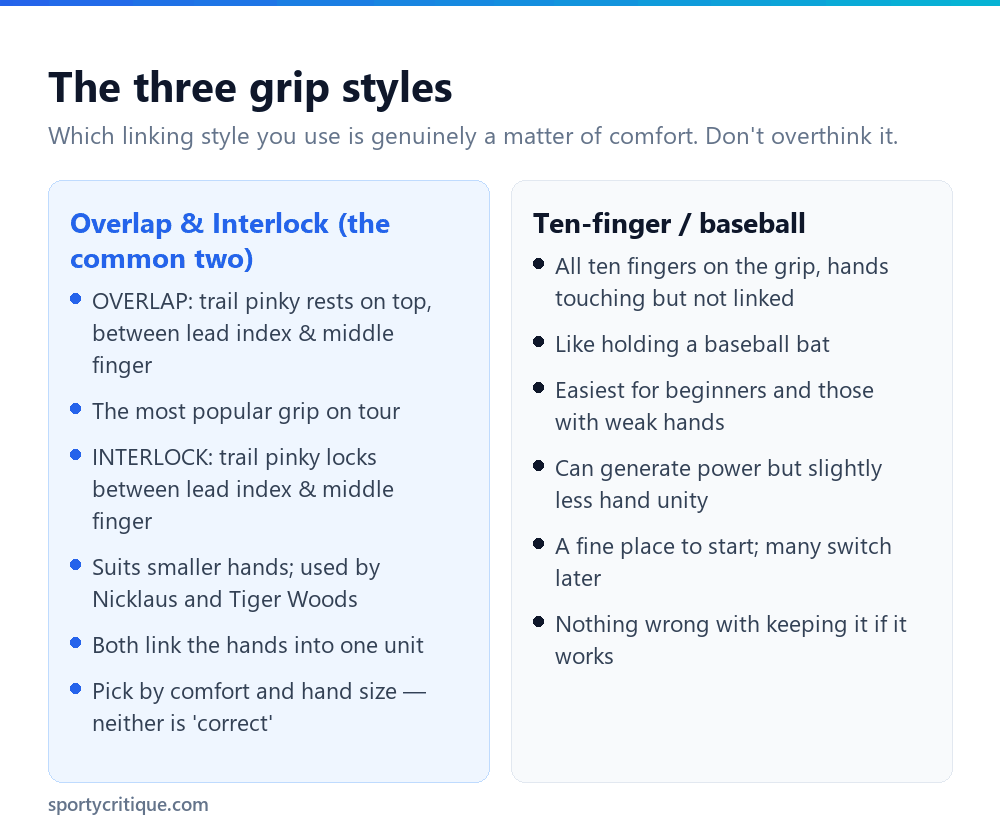
Now the part everyone asks about first and should ask about last: how the two hands link together. There are three standard ways, and the honest truth is that the difference between them is small and mostly personal.
The overlap (Vardon) grip rests the little finger of the trail hand on top of the gap between the index and middle fingers of the lead hand. It’s the most common grip among tour professionals and works well for average-to-large hands.
The interlock grip instead locks that trail-hand pinky between the lead hand’s index and middle fingers. It joins the hands more tightly and suits players with smaller hands — and if it’s good enough for Jack Nicklaus and Tiger Woods, it’s good enough for anyone.
The ten-finger (or baseball) grip puts all ten fingers on the club with the hands touching but not linked, exactly like holding a baseball bat. It’s the easiest for beginners, juniors, and anyone with weaker hands or arthritis, and while it offers marginally less hand unity, plenty of golfers play well with it for life. There’s no rule you must ‘graduate’ from it.
📊 Note: Try all three for a few shots each and keep whichever feels most secure and comfortable through the swing. That’s the entire decision. Time spent agonising over overlap versus interlock is time far better spent on the two things that actually shape your shots: finger placement, and grip strength.
Grip strength: the real fix for your bad shots
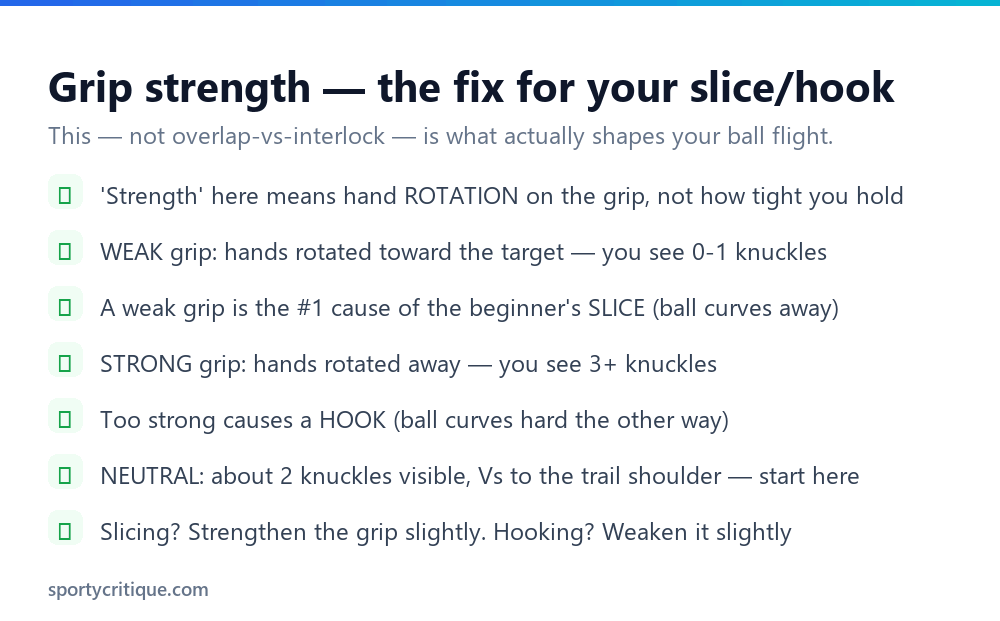
Here’s the part that will genuinely lower your scores, and it’s badly named. In golf, a ‘strong’ or ‘weak’ grip has nothing to do with how tightly you hold the club — it refers to how far your hands are rotated around the grip. And it’s the single biggest influence on the direction your ball curves.
A weak grip has the hands rotated toward the target, so you see only zero or one knuckle of the lead hand. It tends to leave the clubface open at impact, which sends the ball curving away to the right for a right-hander — the dreaded slice that plagues almost every beginner. A strong grip has the hands rotated away from the target, showing three or more knuckles; it closes the face and can produce a hook that curves hard the other way. A neutral grip sits between them — about two knuckles visible, both ‘V’s to the trail shoulder — and it’s where you should start.
The practical power of this is that you can fix a persistent bad shot by adjusting your grip strength rather than overhauling your whole swing. Slicing everything? Rotate both hands slightly away from the target (a stronger grip) until you see more knuckles, and watch the slice straighten out. Hooking hard left? Rotate them slightly toward the target (weaker) to open the face a touch. This one adjustment cures more amateur ball-flight problems than any swing change, and it costs nothing to try.
⚠️ Watch out: Change grip strength in small increments, and give each change a bucket of balls to settle — a new grip feels strange for a few dozen shots before it feels normal. Don’t judge it on the first three swings, and don’t overcorrect: the goal is a gentle, straight curve, not swapping a slice for an equally wild hook.
Grooving it so it lasts
A good grip feels wrong at first, precisely because your old bad grip feels comfortable and familiar. That mismatch is why so many golfers correct their grip on the range and revert on the course — the correct version simply hadn’t become automatic yet.
The fix is boring and effective: form your grip correctly every single time you pick up a club, even for a practice swing in the garden, until the right hold is the one that feels natural. Check it in a mirror or on video occasionally, because grips drift over time without you noticing. And build it deliberately from scratch rather than just grabbing the club — lead hand, check the knuckles, trail hand, link, pressure — until that little routine is second nature. Once the grip is solid and automatic, the rest of the swing has a foundation to build on, which is exactly why our swing guide assumes you’ve got this part sorted first.
💡 Pro tip: A cheap training aid worth its money: a grip trainer, a moulded rubber sleeve that slips onto a club and forces your hands into the correct position. A few minutes a day holding one teaches your hands the right feel faster than thinking about it ever will — and it’s far cheaper than a lesson, though a single lesson to check your grip in person is money well spent too.
Frequently asked questions
What’s the correct way to hold a golf club?
In your fingers, not your palm. Place the lead hand (left, for a right-hander) so the grip runs diagonally across the fingers, close it so you see about two knuckles with the ‘V’ pointing to your trail shoulder, then fit the trail hand snugly below it. Link the hands with whichever style feels comfortable, and keep the pressure light. Finger placement and hand rotation matter far more than the linking style.
Is overlap or interlock grip better?
Neither is objectively better — it’s down to comfort and hand size. The overlap (trail pinky resting on top) is the most common on tour and suits larger hands; the interlock (trail pinky locked between two lead fingers) suits smaller hands and is used by Nicklaus and Tiger Woods. Try both, and keep whichever feels more secure through the swing. It’s the least important part of your grip.
Why do I slice the golf ball?
Most often because your grip is too ‘weak’ — your hands are rotated too far toward the target, which leaves the clubface open at impact and curves the ball away to the right. The fix is usually a grip adjustment, not a swing overhaul: rotate both hands slightly away from the target so you can see two or three knuckles of your lead hand, and the slice typically straightens out.
What does a ‘strong’ golf grip mean?
Confusingly, it has nothing to do with grip pressure. A ‘strong’ grip means your hands are rotated away from the target on the club, so you see three or more knuckles of the lead hand; a ‘weak’ grip is rotated toward the target, showing fewer. Strong grips tend to close the clubface (and can cause a hook); weak grips open it (and cause a slice). Neutral — about two knuckles — is the starting point.
How tight should I hold a golf club?
Lightly — around 4 or 5 out of 10. Firm enough that the club won’t twist or slip, but no tighter. A ‘death grip’ is one of the most common beginner faults: it tenses the forearms, prevents the wrists from hinging, and costs you both power and feel. A correct grip pressure feels almost too loose at first, which is normal.
Does the grip really matter that much?
Yes — it’s your only physical connection to the club, so it influences everything the clubface does at impact. A faulty grip undermines an otherwise good swing and produces slices, hooks, and inconsistency that people wrongly blame on their swing. Getting the grip right is the cheapest, fastest improvement available to most amateurs, and it’s the foundation everything else is built on.
- →How to swing a golf club — the motion the grip enables
- →How to hit a golf ball — making solid contact
- →How to play golf — rules, scoring, and getting started