Golf Glossary: Handicap, Bogey, and Other Terms

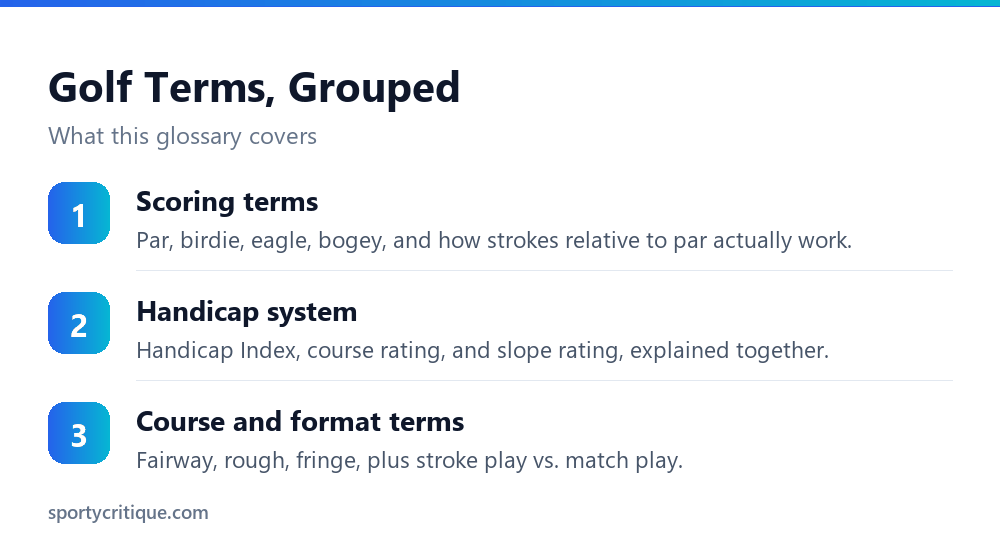
Par is the expected number of strokes for a hole; a birdie is one under par, an eagle two under, a bogey one over, and a double bogey two over. A Handicap Index is a number representing a golfer’s potential playing ability, letting players of different skill levels compete fairly, calculated from recent scores adjusted for a specific course’s rating and slope. This glossary covers those terms along with the other common scoring, handicap, and course vocabulary a beginner runs into constantly without ever getting a plain explanation.
Golf’s vocabulary gets thrown around constantly in instruction, broadcast commentary, and casual conversation with other players, almost always assuming a level of familiarity a genuine beginner doesn’t have yet. This is the reference to check when a term comes up without explanation, rather than nodding along or guessing at meaning from context.
- →Par is the expected stroke count for a hole; birdie, eagle, bogey, and double bogey measure strokes relative to par
- →A Handicap Index represents potential playing ability, calculated from recent scores and adjusted for course difficulty
- →Course Rating measures difficulty for a scratch (zero handicap) golfer; Slope Rating measures relative difficulty for higher-handicap golfers
- →Stroke play counts total strokes across a round; match play is decided hole by hole
- →A mulligan is an unofficial do-over among friends, never legal in official or tournament play
Table of Contents
Scoring Terms
A bogey means something different depending on who’s scoring it. For a professional or a low-handicap player, a bogey is a genuinely poor result. For a newer golfer, bogeying every hole on a par-72 course produces a round of 90, which is a real milestone many beginners work toward for months. The term is the same; what it signals about performance depends entirely on the player’s own skill level and goals.
💡 Pro tip: The “breakfast ball” is a common informal variation on the mulligan specifically, an unofficial do-over taken off the first tee to shake off first-shot nerves before the round really counts. Like any mulligan, it has no standing in official rules; it’s purely a casual, friendly convention.
The Handicap System
A Handicap Index reflects a golfer’s potential playing ability, not their average score, calculated from the best 8 of a player’s last 20 score differentials under the World Handicap System. That calculation adjusts for the specific courses those rounds were played on, which is where Course Rating and Slope Rating come into the picture.
Course Rating represents the expected score for a scratch golfer, a player with a Handicap Index of 0.0, playing that specific course under normal conditions. Slope Rating measures how much harder that same course plays for a bogey golfer compared to a scratch golfer, on a scale roughly from 100 (easier) to 155 (extremely difficult). A bigger gap between how a scratch golfer and a bogey golfer would be expected to score produces a higher Slope Rating.
📊 Note: Handicap Index and Course Handicap aren’t the same number. Handicap Index is a portable measure of potential ability that travels with a player across any course; Course Handicap is that Index translated into an actual number of strokes for the specific course and tee being played that day, using the course’s own rating and slope.
⚠️ Watch out: A common beginner confusion is assuming a lower Handicap Index means a golfer always scores close to that number every round. It represents potential ability based on recent good rounds, not a guaranteed or average score, which is why even a skilled golfer with a low handicap can post a round well above it on a difficult day.
Course and Format Terms
Stroke play and match play produce genuinely different strategic decisions, not just different scorekeeping. In stroke play, every single stroke across all 18 holes counts toward the final total, which rewards consistent, conservative play. In match play, a disastrous score on one hole only costs that one hole, not the whole match, which can reward a more aggressive approach on individual holes since a blowup hole doesn’t compound the way it does in stroke play.
“All Square” and Match Play Scoring
In match play, a match is “all square” when both sides have won the same number of holes, the match-play equivalent of a tie at that point in the round. Match status gets described relative to holes won and holes remaining, phrases like “2 up with 3 to play,” rather than total strokes, which is the vocabulary that trips up someone used to only following stroke play scoring.
Shot and Situation Terms
A gimme deserves special mention since it’s purely a social convention, not a rule most golfers realize is entirely absent from official stroke-play scoring. In a truly by-the-book round, every putt has to actually go in the hole to count, no matter how short or seemingly automatic it looks. Casual rounds conceding gimmes speed up play and reduce friction between playing partners, which is exactly why the convention persists even though it isn’t technically legal scoring.
“Links” gets used loosely in casual conversation to mean any golf course, but it technically refers to a specific style of course built on coastal, sandy land, historically in Scotland and Ireland, generally open and exposed to wind with few or no trees. A tree-lined inland course, however nice, isn’t technically a links course in the strict original sense of the word.
Club and Equipment Terms
These equipment terms come up constantly in buying guides and fitting conversations, and confusing loft with lie angle specifically is a common beginner mix-up, since both are angles measured on the same club but describe entirely different things. Loft affects trajectory and distance; lie angle affects whether shots tend to pull left or push right at impact.
Putting the Terms to Use: Tracking Your Own Round
Understanding these terms matters most once a beginner starts actually tracking scores relative to par, rather than just counting total strokes without context. Knowing whether a given hole was a bogey, a double bogey, or a par gives real feedback on which parts of a round are going well and which need work, in a way a raw total score alone doesn’t.
💡 Pro tip: A simple wristband stroke counter, something like this Golf Shot Counter Wristband (3-Pack) ($11.63), helps a beginner keep an accurate running count without relying purely on memory, which matters more than it sounds like it would over a full 18-hole round where it’s easy to lose track after a distracting shot or a long wait on the tee.
Common Beginner Vocabulary Mistakes
- ✓Learn scoring terms relative to par, not as fixed “good” or “bad” labels
- ✓Understand Handicap Index reflects potential, not a guaranteed average score
- ✓Distinguish Handicap Index from Course Handicap when the terms come up
- ✓Ask what format (stroke or match play) is being played before assuming standard scoring rules
- ✕Assuming a mulligan has any standing in official rounds or tournaments
- ✕Confusing Course Rating (scratch golfer difficulty) with Slope Rating (relative difficulty for bogey golfers)
- ✕Treating a bogey as automatically bad regardless of the player’s skill level
- ✕Applying stroke-play strategy logic to a match-play round without adjusting
Frequently Asked Questions
What’s a good score for a beginner golfer?
There’s no universal number, but shooting bogey golf, one over par on every hole for a total around 90 on a par-72 course, is a commonly cited milestone many beginners work toward over their first year or two of consistent play.
Is a lower handicap always better?
Yes, a lower Handicap Index represents stronger potential playing ability, with a scratch golfer (0.0) representing an elite amateur level. Most recreational golfers carry handicaps well above that, and there’s no shame in a higher number relative to how often someone plays.
What’s the difference between Course Rating and Slope Rating?
Course Rating measures the expected score for a scratch (zero handicap) golfer on that specific course. Slope Rating measures how much harder the same course plays for a bogey golfer relative to a scratch golfer, which is a different, relative measure of difficulty.
Can I use a mulligan in a real tournament?
No. Mulligans have no standing in official rules or sanctioned tournament play; they’re strictly a casual, friendly convention used in relaxed rounds among friends.
What’s the difference between loft and lie angle?
Loft is the angle of the clubface, which primarily affects trajectory and distance. Lie angle is the angle between the shaft and the ground at address, which primarily affects whether shots tend to pull left or push right. They’re both angles on the same club but control different things.
Are gimmes allowed in real golf?
Not in official stroke-play scoring; every putt technically has to go in the hole to count. Gimmes are a widely used casual convention in relaxed and match-play rounds to speed up play, not a formal rule.
Picking up this vocabulary happens naturally with enough time on the course, but there’s no reason to wait for it to sink in through repeated confusion when a straightforward reference like this one answers the question the moment an unfamiliar term comes up.
As an Amazon Associate, we earn from qualifying purchases through links on this page.