How to Increase Lung Capacity for Swimming (What Actually Works)

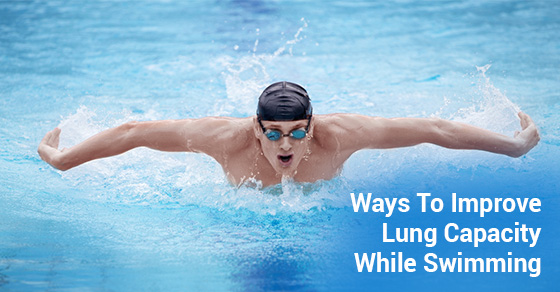
You mostly can’t increase your actual lung capacity — total lung volume is set by your height and build, and no drill meaningfully grows it. What you can train, and what actually stops you feeling out of breath, is CO2 tolerance, breathing efficiency, and diaphragm strength. Do it with controlled-exhale drills, gradual stroke-count breathing, dryland nasal breathing, and endurance swimming. And avoid repeated breath-holds or hyperventilation — that path leads to shallow water blackout, which is silent and fatal.
“How do I increase my lung capacity” is one of the most common questions in swimming, and the honest answer starts with a correction: you’re chasing the wrong number. Your lung capacity is largely fixed, and the swimmers who never seem to run out of air aren’t the ones with the biggest lungs. They’re the ones who’ve trained everything around their lungs.
That’s good news, because those things — how efficiently you breathe, how long before you feel desperate for air, how strong your breathing muscles are — respond quickly to training. This guide covers what actually works, and one thing that’s genuinely dangerous.
- →Your total lung capacity is mostly fixed by genetics and body size — drills won’t grow it.
- →CO2 tolerance is the real trainable factor: it decides when you feel air-hungry.
- →The panic feeling is carbon dioxide buildup, not lack of oxygen.
- →Controlled exhaling, stroke-count drills, and diaphragm work build breath control.
- →Endurance swimming lowers breathlessness more than any breathing gimmick.
- →Never train breath-holds by hyperventilating or swimming alone — it can be fatal.
Table of Contents
The lung capacity myth
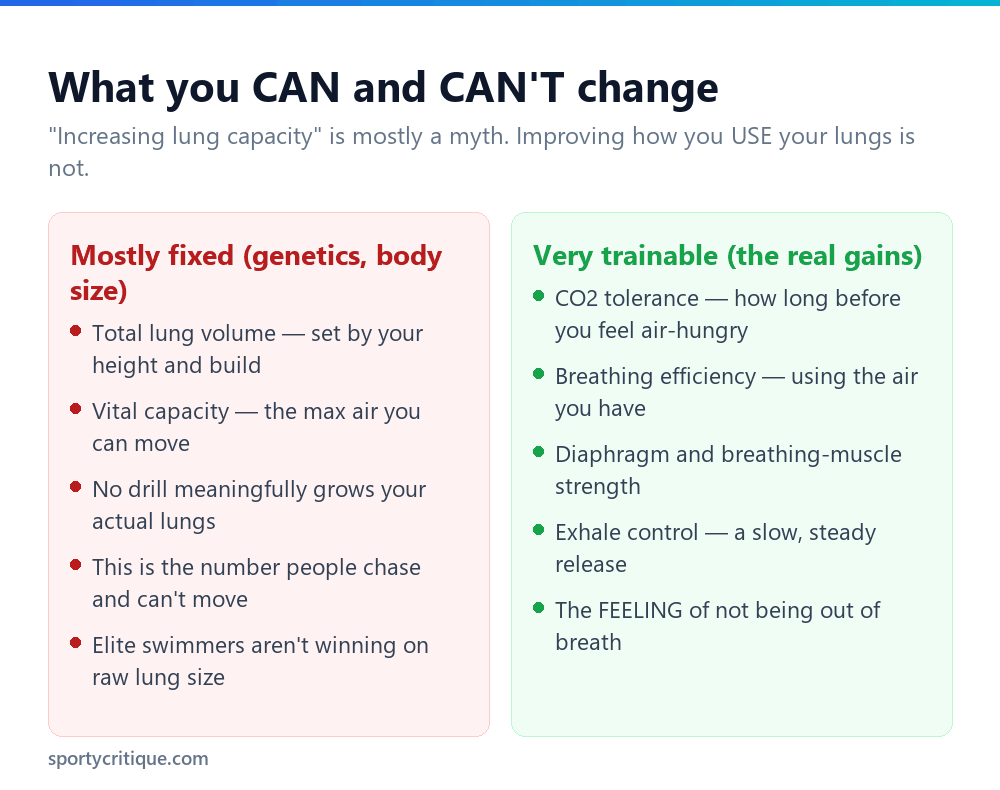
Total lung capacity — the maximum volume of air your lungs can hold — is determined largely by your height, build, sex, and age. A tall person has bigger lungs than a short one, and there’s very little you can do to change your own number. The idea that you can “expand” your lungs through training is one of swimming’s most persistent myths.
What confuses people is that trained swimmers genuinely do feel like they have more air. But when you measure it, their lung volume usually isn’t dramatically larger than an untrained person of the same size. What’s changed is everything else: they extract more oxygen from each breath, they tolerate higher carbon dioxide before feeling the urge to breathe, and their breathing muscles are stronger, so a full breath costs them less effort.
Elite swimmers don’t win on lung size. They win on tolerating CO2, using each breath efficiently, and staying relaxed — all of which you can train, none of which shows up on a lung-volume test.
So the useful reframe: stop trying to make your lungs bigger, and start training how well you use them. Every genuinely effective “lung capacity” drill is actually a breath-control or CO2-tolerance drill wearing the wrong name.
CO2 tolerance: the real target
Here’s the piece that ties everything together, and it’s the same principle behind our guide to breathing while swimming: the urgent, air-hungry feeling that makes you cut a length short is not caused by running out of oxygen. It’s caused by rising carbon dioxide in your blood.
Your body monitors CO2 far more sensitively than oxygen. As CO2 builds, it triggers an increasingly desperate urge to breathe — long before your oxygen has actually run low. This is why you can feel like you’re suffocating after twenty seconds underwater while still having plenty of oxygen in reserve.
CO2 tolerance is how well you cope with that rising signal, and unlike lung volume, it’s highly trainable. Train it and the same swim feels dramatically easier — you stop feeling panicked, your breathing calms, and you swim further before the urge to gasp arrives. That’s what people are really after when they ask about lung capacity.
📊 Note: The most important habit for CO2 tolerance is one you do while swimming normally: exhale continuously underwater. Holding your breath spikes CO2 fast; a steady exhale keeps it manageable. If you haven’t fixed your basic breathing yet, start with the breathing guide before any of the drills below.
Drills that actually work
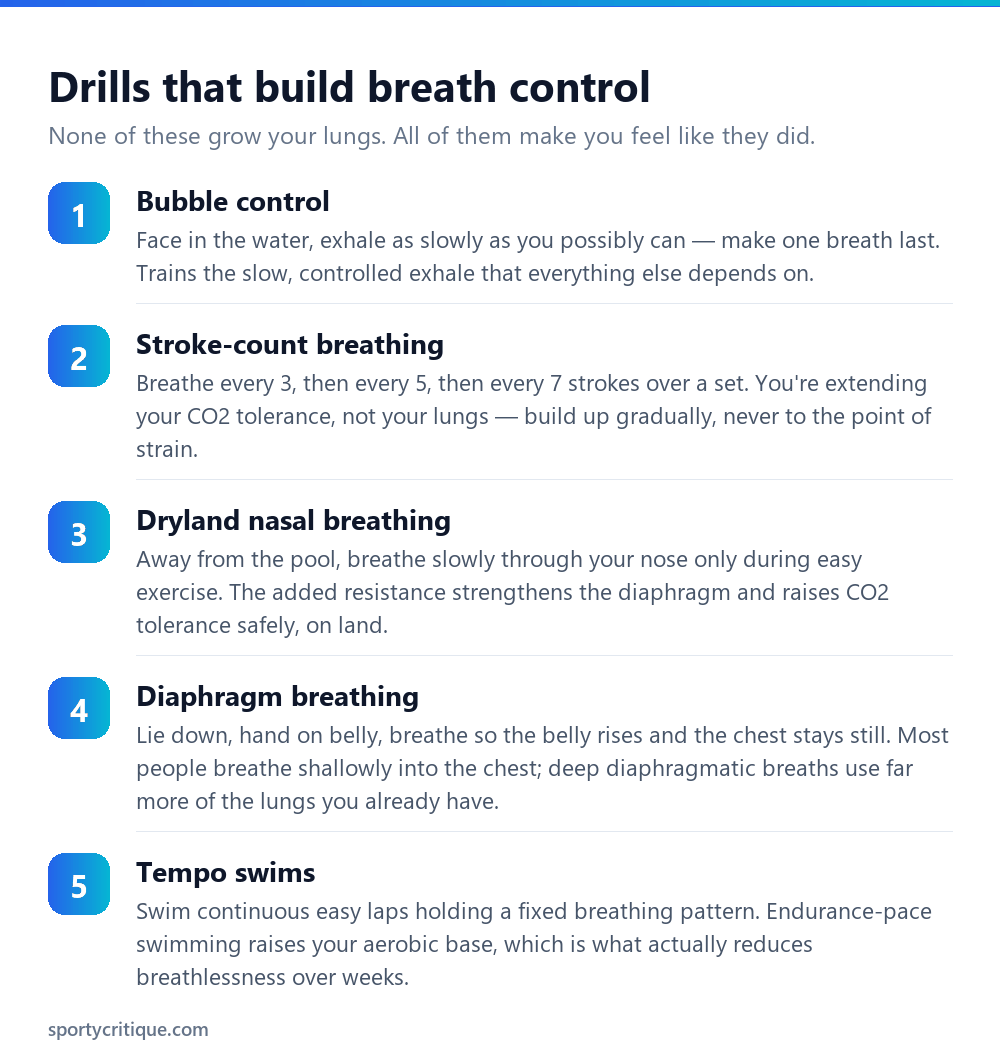
These build the trainable factors — control, tolerance, muscle strength, aerobic base — rather than the untrainable one.
The controlled exhale is the foundation. Being able to release a breath slowly and steadily, rather than dumping it all at once, is what lets you manage CO2 and stay relaxed. The bubble-control drill — face in the water, making a single exhale last as long as possible — trains this directly, and it transfers to every length you swim.
Stroke-count breathing is the safe way to extend your tolerance. Over a set, breathe every three strokes, then every five, then every seven — going a little longer between breaths each round. You’re teaching your body to stay calm as CO2 rises. Build this up gradually and back off the moment it feels like a strain rather than a stretch; this is training, not a competition to suffer.
Dryland breathing is genuinely underused. Slow nasal breathing during easy exercise on land adds airflow resistance, which strengthens the diaphragm and raises CO2 tolerance — with none of the drowning risk that in-water breath-holding carries. It’s the safest way to train the breathing system, and you can do it anywhere.
Diaphragm breathing fixes a hidden inefficiency. Most people breathe shallowly into the upper chest, using only part of their lung volume. Practising slow belly breathing — where the abdomen rises and the chest stays still — teaches you to use the lungs you already have more fully, which feels exactly like having gained capacity.
A word of real warning: breath-hold training
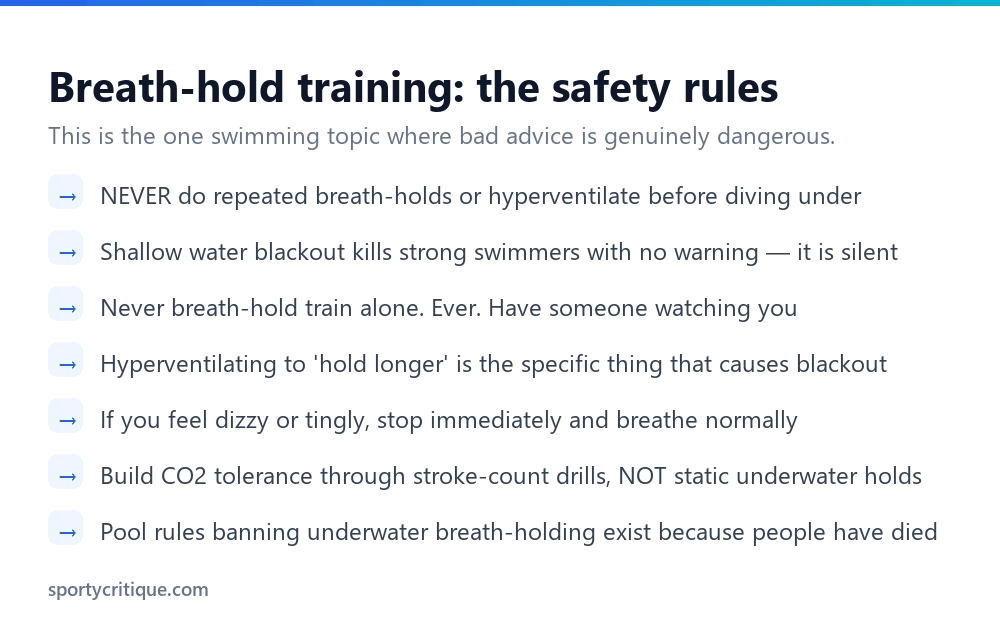
This is the one swimming topic where following the wrong advice can kill you, so it needs plain language rather than a gentle caution.
You’ll find advice online to train “lung capacity” with extended underwater breath-holds, often preceded by several deep, fast breaths to “hold longer.” That fast breathing is hyperventilation, and it’s lethal. It doesn’t add oxygen — it flushes out CO2. And since CO2 is what triggers the urge to breathe, hyperventilating removes your early warning. You then swim underwater feeling fine, right up until your oxygen runs out and you black out with no warning at all. This is shallow water blackout, and it drowns strong, fit, experienced swimmers every year.
⚠️ Watch out: Do not hyperventilate before going underwater. Do not do repeated breath-hold sets. Do not breath-hold train alone — blackout is silent, so a swimmer beside you won’t notice you’re in trouble. Public pools ban underwater breath-holding for exactly this reason: people have died doing it. Build CO2 tolerance with the stroke-count and dryland drills above, which raise tolerance without ever pushing you toward blackout.
The frustrating irony is that the safe drills work better anyway. Genuine CO2 tolerance is built gradually through consistent, controlled exposure — not through occasional dangerous maximal holds. There is no version of the risky approach that’s worth it.
The unglamorous truth: fitness matters most
Beyond the specific breathing work, the single biggest reducer of breathlessness in the water is simply aerobic fitness, built by swimming more.
A fitter cardiovascular system delivers oxygen more efficiently and clears CO2 faster, so at any given effort you feel less out of breath. This is why a swimmer three months into regular training feels transformed compared to their first week — not because their lungs grew, but because their whole aerobic system improved. Consistent, moderate-distance swimming a few times a week does more for your “lung capacity” than any drill in isolation.
Two supporting factors are worth naming. Relaxation: a tense swimmer burns oxygen faster and breathes less efficiently, so learning to swim calmly directly reduces air hunger. And technique: a swimmer with poor body position works far harder to move the same distance, which means more oxygen demand and more breathlessness. Improving your stroke efficiency reduces how much air you need in the first place, which is a better solution than needing more.
💡 Pro tip: If you want a single weekly structure: two or three swims, most of them easy continuous laps for aerobic base, with one set of stroke-count breathing drills mixed in. Add five minutes of dryland nasal or diaphragm breathing on non-swim days. That combination trains every real factor and none of the fake one.
Do lung-training gadgets work?
Walk into a swim shop or search online and you’ll find breathing trainers — handheld devices you inhale and exhale through against adjustable resistance, sold as tools to “increase lung capacity.” It’s worth knowing which claims hold up.
These devices train inspiratory muscle strength — they make the muscles that drive breathing work harder, the same way a dumbbell loads a bicep. The research on inspiratory muscle training is reasonably positive: it can strengthen the diaphragm, reduce the perceived effort of breathing, and modestly improve endurance performance in some athletes. What it does not do is enlarge your lungs, despite the marketing implying otherwise.
So the honest verdict: a resistance breathing trainer is a legitimate but minor tool. It strengthens breathing muscles — which you can also do for free with dryland nasal breathing and diaphragm work — and it will not transform your swimming. If you enjoy structured gadgets and will actually use one consistently, it won’t hurt. But nobody needs one, and buying it instead of simply swimming more would be a poor trade.
Frequently asked questions
Can you actually increase your lung capacity?
Barely. Total lung volume is set mostly by your height, build, age and sex, and no amount of training meaningfully expands it. What improves — and what people actually mean — is how efficiently you use your lungs, how much CO2 you tolerate before feeling breathless, and how strong your breathing muscles are. Those change a lot; your raw capacity doesn’t.
Why do I run out of breath so quickly when I swim?
Usually a combination of holding your breath underwater (which spikes CO2 and triggers the panic feeling), poor body position making you work too hard, and tension. Fix the exhale first — breathe out steadily underwater so you’re never holding air — then work on relaxation and technique. It’s rarely a lung problem and almost never solved by trying to grow your lungs.
Do breathing exercises on land help swimming?
Yes, and they’re underused. Slow nasal breathing and diaphragm training on dry land strengthen the breathing muscles and raise CO2 tolerance, with none of the drowning risk of in-water breath-holding. They’re one of the safest and most effective ways to improve how you breathe when you swim.
Is holding my breath underwater good training?
Static breath-holding, especially after hyperventilating, is dangerous — it causes shallow water blackout, which kills strong swimmers with no warning. Never do it alone or after fast deep breaths. Build breath control instead through stroke-count breathing (going a few strokes longer between breaths) and dryland drills, which raise CO2 tolerance safely.
How long before I stop feeling out of breath?
The controlled-exhale habit can help within a single session. Meaningful improvement in breathlessness comes over a few weeks of consistent swimming, as your aerobic fitness and CO2 tolerance rise together. If you’re new, expect a noticeable change around the one-to-two-month mark of regular practice — the same timeline as building any aerobic base.
Does swimming increase lung capacity more than other sports?
Swimming does place unusual demands on breathing — you can only breathe at set moments, and against water pressure on the chest — which strengthens the breathing muscles and CO2 tolerance well. But even competitive swimmers don’t end up with dramatically larger lungs than other athletes of similar size. The adaptation is in efficiency and tolerance, not raw volume, in every sport.
- →How to breathe while swimming — the exhale-underwater foundation
- →Heart-rate monitoring while swimming — training by effort in the water