How to Breathe While Swimming: The Exhale-Underwater Secret

The secret to breathing while swimming is exhaling underwater. Beginners hold their breath while their face is down, then try to breathe out AND in during the split second their mouth clears the water — which is impossible, so they panic. Instead, breathe out steadily the whole time your face is in the water, so that when you turn to breathe you only have to inhale. And rotate your body to the side rather than lifting your head. Get those two things and the rest is rhythm.
Almost everyone who says they “can’t swim” can actually swim — they just can’t breathe while doing it, so they run out of air in half a length and stop. It feels like a fitness problem. It’s a technique problem, and it comes down to one habit.
This guide is about freestyle (front crawl), the stroke that causes the most breathing trouble because your face spends the most time in the water. Fix breathing here and every other stroke feels easy.
- →Exhale continuously underwater — never hold your breath. This is the whole fix.
- →At the surface you should only ever INHALE, because you already breathed out.
- →Rotate your body to breathe; don’t lift your head. Lifting sinks your legs.
- →Keep one goggle in the water — you need far less clearance than you think.
- →Learn to breathe every 2 strokes first. Bilateral breathing comes later.
- →Panic is a breath-holding symptom, not a courage problem.
Table of Contents
The one thing: exhale underwater
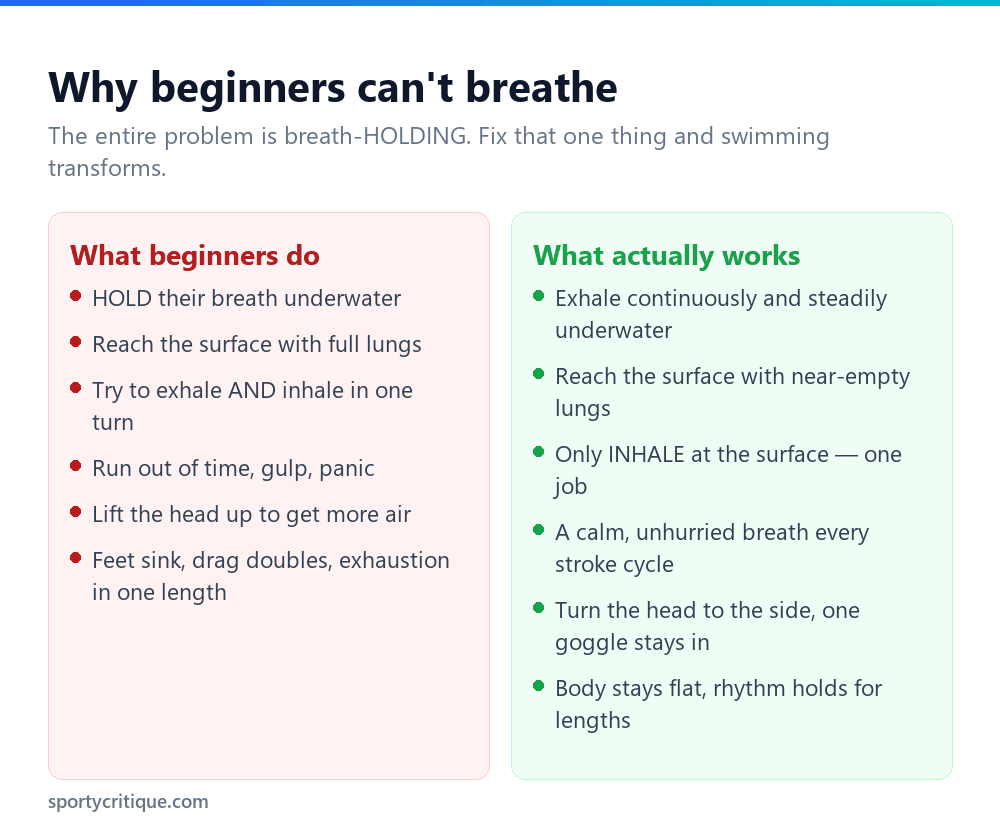
Here is the entire problem, and it’s worth understanding rather than just being told.
On land, breathing is passive — you inhale and exhale in the same spot, with all the time you need. Swimming breaks that. Your mouth is only clear of the water for a fraction of a second, and in that instant you cannot both empty and refill your lungs. There simply isn’t time.
So beginners do the natural thing: they hold their breath underwater to “save” it, and plan to breathe out and in when they turn. But holding a full breath does two bad things. It builds up carbon dioxide, which is what actually triggers the panicky, air-hungry feeling — not lack of oxygen, but the urge to get rid of CO2. And it means the breathing turn now has two jobs and time for one.
The feeling of desperately needing air isn’t lack of oxygen. It’s built-up carbon dioxide from holding your breath — and it vanishes the moment you start exhaling.
The fix is to exhale continuously the whole time your face is in the water. A steady stream of bubbles from your nose and mouth. Then, when you rotate to breathe, your lungs are nearly empty and you have one simple job: inhale. No rush, no gulp, no panic. This single change is the difference between swimming one length and swimming twenty.
How to take the breath
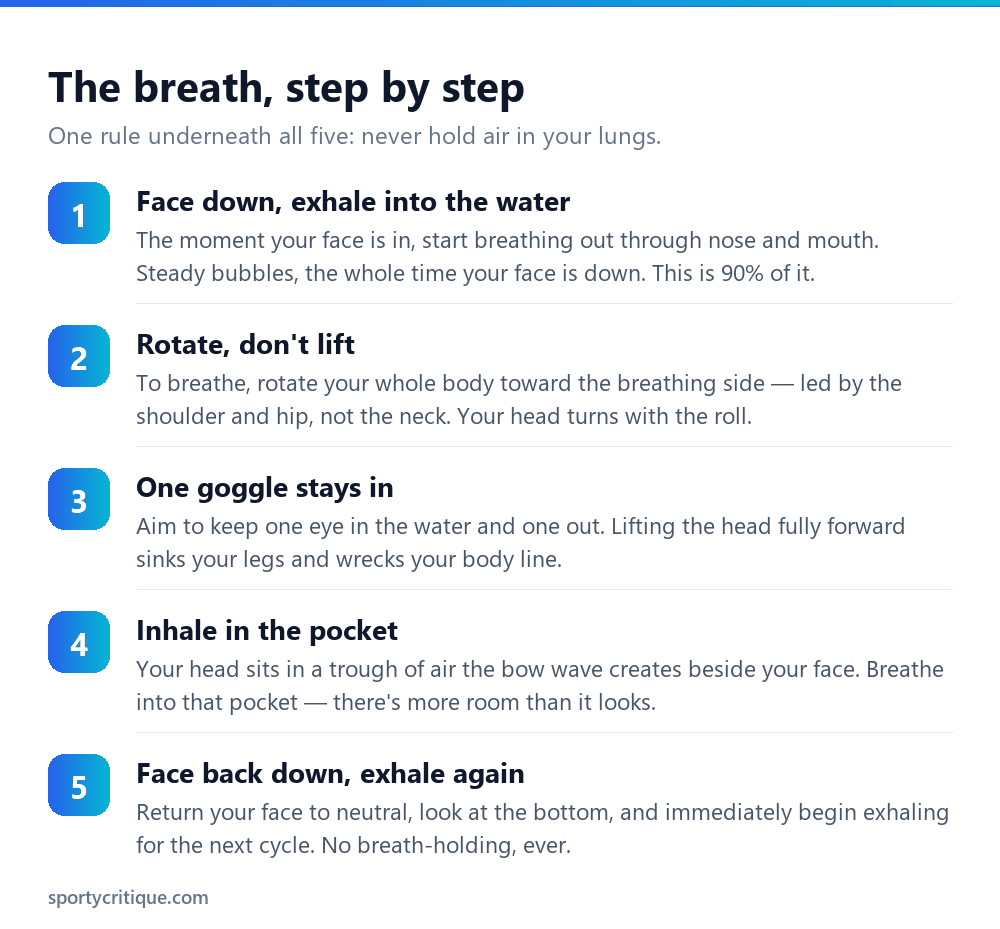
With exhaling sorted, the mechanics of the breath itself are about rotation, not the neck.
Freestyle is swum on your side, rolling from one side to the other with each stroke. To breathe, you simply let that roll bring your mouth to the surface — you rotate your whole body toward the breathing side, led by your shoulder and hip, and your head turns naturally with it. Your neck barely moves. If you find yourself craning your head up and forward to breathe, that’s the error that sinks beginners’ legs.
Keep one goggle in the water. You need far less clearance than instinct says. Your forward motion creates a bow wave, and beside your head that wave leaves a small trough of air — a pocket lower than the surrounding water. You breathe into that pocket, which is why elite swimmers barely seem to turn at all. Lifting your head to get “above” the water is both unnecessary and counterproductive.
⚠️ Watch out: The instant you lift your head forward instead of rotating, your hips and legs drop. Now you’re swimming uphill, drag multiplies, and you get tired in one length — which feels like poor fitness but is pure body position. Keep your eyes down and let rotation do the work.
How often to breathe: the bilateral myth

Open a swimming guide and you’ll be told to breathe bilaterally — every three strokes, alternating sides. It’s good advice aimed at the wrong person.
Breathing every three strokes means you go longer between breaths and take in less air overall. For an experienced swimmer building a symmetrical stroke, that’s a worthwhile trade. For a beginner who is already short of air, it makes the core problem — not enough breathing — worse. Being told to breathe less often while you’re gasping is exactly the wrong instruction.
Learn to breathe every two strokes, to your comfortable side, first. A breath every stroke cycle gives you the air you need and lets you build a rhythm. Once that’s automatic and relaxed, then add bilateral breathing as a tool — it builds a balanced stroke, corrects the one-sided pull that single-side breathers develop, and lets you see both sides in open water. But it’s a stage-two skill, not an entry requirement.
💡 Pro tip: A useful compromise once you’re comfortable: breathe every two strokes to your good side for most of a length, and practise bilateral in short bursts. You keep the air you need while slowly training the weaker side. Forcing full bilateral from day one is why many beginners conclude they’ll never manage freestyle.
Drills that fix breathing
You can’t think your way to good breathing mid-length — it has to become automatic. These drills, in order, build it:
📊 Note: If you can already breathe on land but panic in the water, spend a whole session on just the first two drills. It feels like it isn’t ‘swimming’, but the exhale habit is the foundation everything else sits on, and rushing past it is why people plateau for years.
Timing: when in the stroke to breathe
Once exhaling and rotation feel natural, the last piece is when in the arm cycle the breath happens — and getting it slightly wrong is why some swimmers still feel rushed even after fixing the exhale.
In freestyle, you breathe as your hand on the breathing side finishes its pull and exits the water near your hip. That arm’s exit is what rotates you onto your side and opens the breathing pocket. Turn your head with that rotation, take the breath, and your face is back down by the time your recovering arm re-enters the water in front of you. The breath lives in the back half of the stroke, not the front.
The common timing error is breathing too late — waiting until the recovering arm is already coming over, which forces you to hold the head turned too long and rush the return. If you feel like you’re always a fraction behind, try initiating the head turn a touch earlier, right as the pulling hand passes your ribs. It should feel almost lazy, never snatched.
A quiet truth here: good breathing timing makes you faster, not just more comfortable. A well-timed breath is part of the body roll that powers the whole stroke, so it adds propulsion rather than interrupting it. A rushed, head-lifting breath does the opposite — it stalls the stroke and costs you a beat every cycle. This is why our lung capacity guide spends as much time on relaxation as on fitness.
Breathing in other strokes
The one principle that carries across all four: exhale when your face is in the water. Even in backstroke, where your face is never submerged, holding your breath makes you tense and inefficient. A breathing rhythm is what keeps you relaxed, and relaxation is most of what separates a comfortable swimmer from a thrashing one.
Frequently asked questions
Why do I get out of breath so fast when swimming?
Almost always because you’re holding your breath underwater instead of exhaling. Holding a full breath builds up carbon dioxide, which triggers the frantic air-hungry feeling, and it leaves you no time to actually inhale when you turn. Breathe out steadily the whole time your face is down and the breathlessness usually disappears within a session or two — it’s rarely a fitness problem.
Should I breathe through my nose or mouth when swimming?
Inhale through your mouth at the surface (it’s faster and takes in more air), and exhale through both nose and mouth underwater. Exhaling partly through the nose also stops water going up it, which is a common source of discomfort. The one rule that matters: exhale continuously underwater, however you do it.
Is bilateral breathing necessary?
No, especially not for beginners. Breathing every three strokes means less air, which makes the core beginner problem worse. Learn to breathe every two strokes to your comfortable side first. Bilateral breathing is a valuable tool for building a symmetrical stroke and swimming straight in open water, but it’s a stage-two skill, not a requirement to swim freestyle.
Why do my legs sink when I breathe?
Because you’re lifting your head forward to breathe instead of rotating to the side. When your head comes up, your hips and legs drop to compensate — it’s a seesaw. Keep your eyes looking down at the bottom, rotate your whole body to bring your mouth to the surface, and aim to keep one goggle in the water. Your legs will stay up.
How do I stop water going up my nose?
Exhale gently through your nose whenever your face is in the water — the outgoing air keeps water out. Beginners who hold their breath have no outward airflow, so water flows in. This is another reason continuous exhaling fixes so many problems at once. A nose clip is a fine training aid while you build the habit.
How long does it take to learn to breathe while swimming?
The exhale-underwater habit can click in a single focused session for many people. Making it automatic across a full swim takes a few weeks of regular practice. The drills matter more than the hours — someone who spends ten minutes a session on bubbling and side-kick progresses far faster than someone who just swims lengths badly.
- →Increase lung capacity for swimming — breath control and endurance
- →Get water out of your ear after swimming — the common after-effect
- →How to breathe while running — the same exhale-driven principle on land