How Long to Avoid Swimming After an Ear Infection (By Type)

There’s no single number — how long to wait depends on which infection you had. For swimmer’s ear (outer-ear), wait until fully healed and cleared by a doctor, usually 7–10 days after symptoms are gone. A middle-ear infection with an intact eardrum is often safer than people think, since water can’t reach it — many doctors clear swimming once you feel well. But a perforated (burst) eardrum or ear tubes mean keeping water out until healed, which can take weeks. In every case, get your doctor’s clearance before getting back in — the eardrum’s condition is the deciding factor.
“How long before I can swim again?” sounds like it should have a simple answer, and the reason it doesn’t is that “ear infection” covers several quite different conditions. Swimming with one of them is fine sooner than you’d guess; swimming with another too early can genuinely set you back.
So this guide sorts it by type, explains the one factor that matters most — whether your eardrum is intact — and is honest about the fact that the real answer, for all of them, ends with “ask your doctor.”
- →There’s no universal wait — it depends on the type of infection.
- →Swimmer’s ear: wait until fully healed, usually 7-10 days after symptoms clear.
- →Middle-ear infection with an intact eardrum: often fine once you feel well.
- →A perforated eardrum or ear tubes: keep water out for weeks, until healed.
- →Whether the eardrum is intact is the single biggest factor.
- →Get a doctor’s clearance before returning — it beats any calendar rule.
| Ear Condition / Infection Type | Typical Clinical Recovery Window | Recommended Dry-Ear Timeline | Earplug Protection Requirement | Primary Relapse / Complication Risk |
|---|---|---|---|---|
| Otitis Externa (Swimmer’s Ear) | 7–10 days with antibiotic ear drops | 7–14 days after total pain cessation | Custom mold silicone plugs + neoprene ear band | Re-inoculating canal with Pseudomonas bacteria |
| Otitis Media (Middle Ear Infection) | 10–14 days oral antibiotics | Wait until Eustachian tube equalizes (10–14 days) | Standard flanged silicone earplugs | Pressure changes forcing pathogens deeper |
| Ruptured Eardrum (Tympanic Perforation) | 6–8 weeks spontaneous healing | Strict zero-water exposure until ENT confirmed | Absolute water ban; no swimming or diving | Severe vertigo, permanent hearing impairment |
| Tympanostomy Tubes (Ear Grommets) | Present for 6–18 months | Surface swimming permitted with physician approval | Custom watertight ear molds mandatory; no deep diving | Water penetrating directly into sterile middle ear |
Table of Contents
First, which infection did you have?
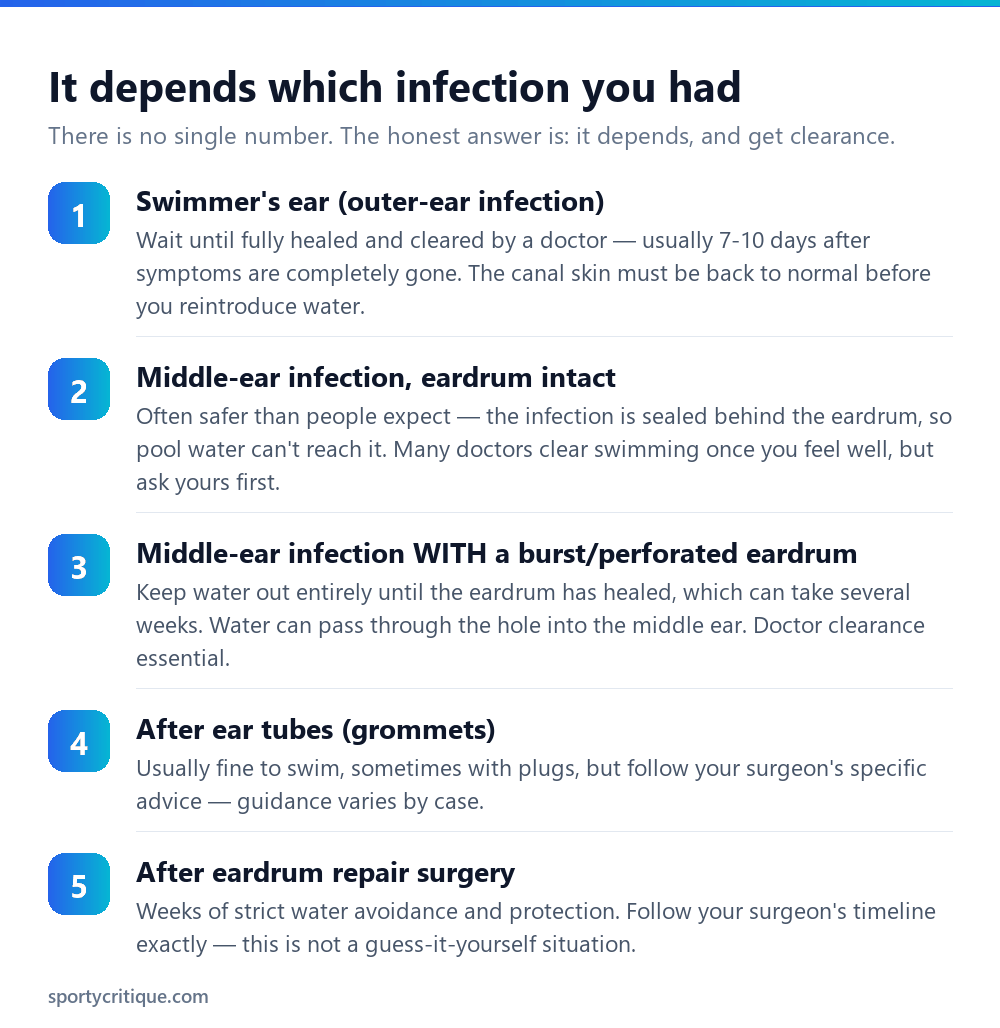
The three common scenarios need genuinely different answers, so start by identifying yours.
Swimmer’s ear is an infection of the outer ear canal — the part water actually touches. Because swimming is often what caused it, and because the canal skin needs to fully recover its natural protective barrier, you wait until it’s completely healed: no pain, no itching, no discharge, and generally 7 to 10 days after symptoms have fully resolved, with a doctor’s okay. Getting back in too early, while the canal is still fragile, is a reliable way to bring it straight back. Our guide to relieving swimmer’s ear covers the infection itself.
A middle-ear infection (otitis media) is deeper — behind the eardrum — and it’s the common childhood ear infection. Here’s the surprise: if the eardrum is intact, the middle ear is sealed off, and pool water simply can’t reach the infection. Many doctors are relaxed about swimming with a middle-ear infection once the person feels well enough, precisely because the water and the infection never meet. The caveat is that you should feel well — swimming while feverish and miserable is unwise for other reasons — and you should confirm the eardrum is intact, which brings us to the crucial factor.
The eardrum is what really decides it
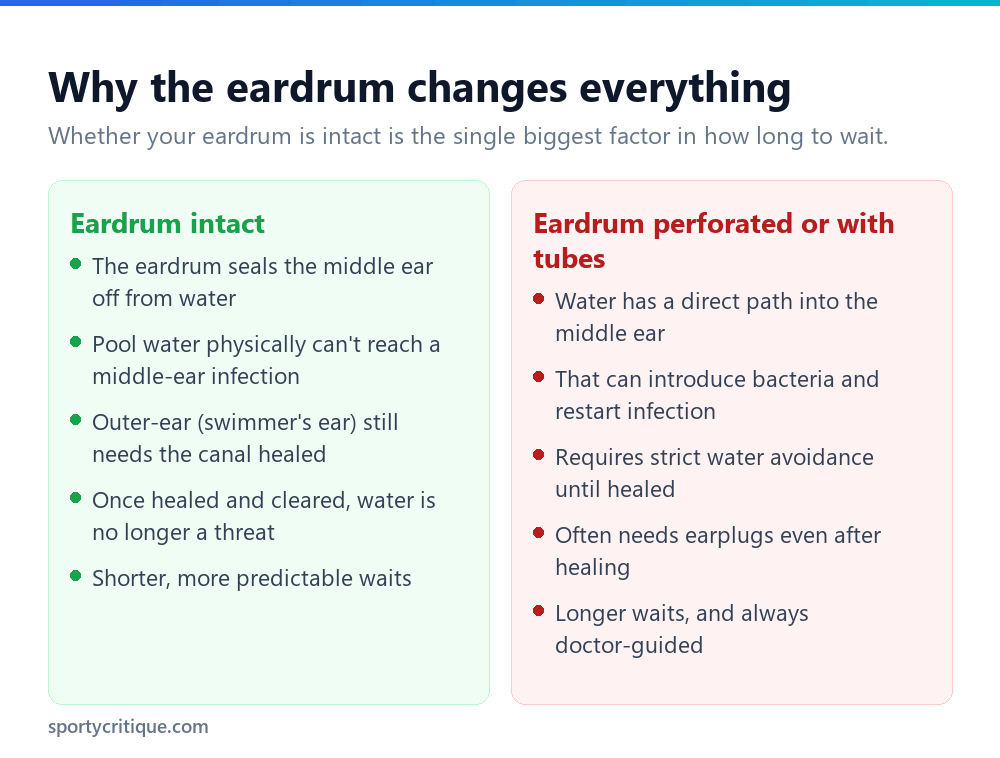
If you take one thing from this article, it’s that the state of your eardrum matters more than the type of infection or the number of days.
An intact eardrum is a watertight seal between the outer ear (where water goes) and the middle ear (where otitis media lives). As long as that seal is whole, water in your ear canal cannot reach the middle ear, which is why a middle-ear infection behind an intact eardrum isn’t made worse by swimming.
A perforated eardrum — a hole, whether from a severe infection that burst it, an injury, or surgery — removes that seal. Now water in the canal has a direct path into the middle ear, where it can introduce bacteria and cause or restart an infection. This is why a perforated eardrum means keeping water out of the ear entirely until it has healed, which commonly takes several weeks and must be confirmed by a clinician. The same logic applies to ear tubes (grommets), which are deliberate openings in the eardrum: guidance varies, many children with tubes swim freely, but you follow the surgeon’s specific advice rather than a general rule.
Intact eardrum: water can’t reach the middle ear, so waits are shorter. Perforated eardrum or tubes: water has a path in, so waits are longer and always doctor-guided.
⚠️ Watch out: You cannot reliably tell whether your own eardrum is intact — a severe or very painful ear infection can perforate the eardrum without you being certain it happened. This is a large part of why “get it checked before you swim” isn’t just caution: a doctor can actually see the eardrum, and you can’t.
Not sure which type you had?
Plenty of people finish a course of ear drops without ever being clear on what exactly they had. A few pointers can help you place it — though none replace asking the doctor who treated you.
Swimmer’s ear typically follows swimming or water exposure, and the pain is on the outside: it hurts when you tug your earlobe or press the flap in front of the ear canal, and there’s often itching and sometimes discharge from the canal itself. If your infection came on after a swim and the ear was tender to touch, it was most likely swimmer’s ear.
A middle-ear infection more often follows a cold or respiratory bug rather than swimming, is common in children, and the pain feels deeper and doesn’t change when you tug the ear. It may come with a blocked feeling, reduced hearing, and fever. If you were prescribed oral antibiotics (tablets or liquid), it was probably a middle-ear infection; swimmer’s ear is usually treated with drops rather than tablets, which is itself a useful clue about which you had.
If a middle-ear infection was severe and the pain suddenly dropped along with some discharge, that can signal the eardrum perforated and released the pressure — which is exactly the situation where you must keep water out and get it checked. When you genuinely can’t tell, treat it as the more cautious case and get clearance before swimming.
Children and swim lessons
This question comes up most for parents, because children get ear infections constantly and swim lessons are hard to pause. The reassuring news is that the same rules apply, and they’re often more permissive than parents fear.
A child with a middle-ear infection and an intact eardrum can usually continue swimming once they feel well enough to enjoy it, because the pool water never reaches the sealed-off infection. Many swim schools and paediatricians take exactly this view. The practical limiter is usually how the child feels: a feverish, miserable, or clearly unwell child should stay home and rest regardless of the ear specifics, and a child in pain shouldn’t be pushed into the water.
The situations that genuinely require keeping a child out of the water are the same as for adults: swimmer’s ear until the canal is healed, and any perforated eardrum until confirmed healed. Children with ear tubes are a common special case — most swim freely, some are advised to wear earplugs for deeper water — and it’s worth getting the surgeon’s specific guidance once, then following it. When in doubt with a child’s ear, a quick check with the doctor or nurse is always the right call rather than guessing.
Signs you’re ready to get back in
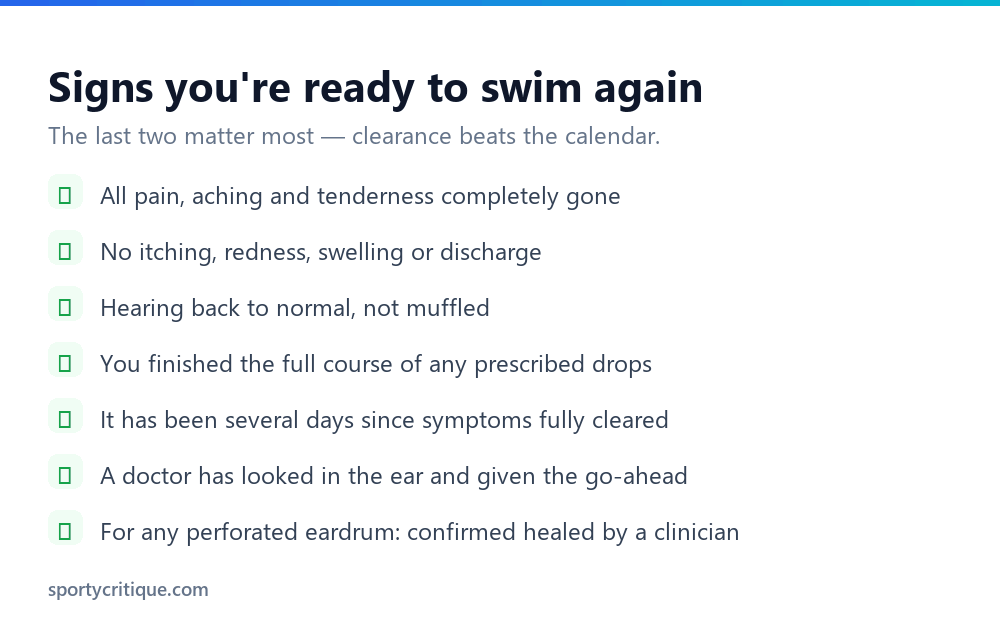
Regardless of type, a few things should all be true before you swim again.
The symptoms should be completely gone — no lingering pain, tenderness, itching, redness, swelling, discharge, or muffled hearing. You should have finished the full course of any prescribed ear drops or antibiotics, not stopped when it felt better. And it should have been at least a few days since the last symptoms cleared, giving the tissue time to fully recover rather than swimming the moment you feel human again.
The two that matter most, though, are the last two: for anything involving a possible perforated eardrum, that it has been confirmed healed by a clinician, and in general that a doctor has looked in the ear and cleared you. A calendar rule is a starting point; a doctor looking at your actual ear is the real answer, because they can see what you can’t.
Getting back in safely
Once you’re cleared, a few habits reduce the chance of a repeat — especially important if you got swimmer’s ear, which loves to recur.
📊 Note: This article is general information, not medical advice, and ear infections vary a great deal between people and especially in children. The safe and simple rule that covers every scenario here is to get your own doctor’s clearance before returning to the water — they can assess your specific ear and give you a timeline that fits it.
Frequently asked questions
How long should I wait to swim after an ear infection?
It depends on the type. For swimmer’s ear (outer-ear), usually 7 to 10 days after symptoms fully clear, with a doctor’s okay. For a middle-ear infection with an intact eardrum, often once you feel well, since water can’t reach it. For a perforated eardrum or ear tubes, keep water out for weeks until it’s healed. In every case, get clearance from your doctor before swimming.
Can I swim with a middle-ear infection?
If the eardrum is intact, often yes — the infection is sealed behind the eardrum and pool water can’t reach it, so many doctors don’t object once you feel well enough. But you should feel well, not feverish, and you should confirm the eardrum isn’t perforated, which you can’t reliably tell yourself. Check with your doctor, particularly for a child.
Why does a perforated eardrum change things?
Because it removes the watertight seal between your ear canal and middle ear. With a hole in the eardrum, water in the canal can pass into the middle ear and introduce bacteria, potentially causing or restarting an infection. That’s why a perforated eardrum means keeping water out entirely until it’s confirmed healed — usually several weeks — and often wearing earplugs even afterward.
Can I swim with ear tubes (grommets)?
Often yes, and many children with tubes swim freely, but guidance genuinely varies by case — some surgeons advise earplugs, especially for diving or deep water, while others don’t. Because tubes are deliberate openings in the eardrum, this is one to follow your own surgeon’s specific advice on rather than a general rule.
How do I know my ear has fully healed?
All symptoms gone — no pain, itching, redness, swelling, discharge, or muffled hearing — the full course of any medication finished, and several days passed since the last symptoms. But the reliable confirmation, especially for a possible perforated eardrum, is a doctor looking in your ear. You can’t see your own eardrum, so clearance from someone who can is the real green light.
What happens if I swim too soon?
For swimmer’s ear, reintroducing water to a canal that hasn’t fully recovered often brings the infection straight back. For a perforated eardrum, water entering the middle ear can cause a fresh infection. Neither is worth the few days saved — you risk a longer, more painful problem than the one you just got over. Wait for clearance.
- →Relieving swimmer’s ear — treating the infection itself
- →Getting water out of your ear — the prevention routine
- →How to breathe while swimming — back to the technique