How Long for a Tattoo to Heal Before Swimming (And Why You Can’t Rush It)

Wait until your tattoo is fully healed before swimming — generally 2 to 4 weeks for a chlorinated pool, a bit longer for saltwater, and up to 4–6 weeks for large tattoos or ones over a joint. It’s healed when all redness, scabbing, itching, and flaking are gone and the skin looks smooth. And no, you can’t reliably “waterproof” a fresh tattoo to swim sooner — a new tattoo is an open wound, covering it for submersion traps bacteria and moisture, and chlorine fades the ink. There’s no safe shortcut; the only answer is to wait.
This is one of those questions with an answer people don’t want to hear: you have to wait, and there’s no clever workaround. A fresh tattoo is an open wound, and swimming with an open wound in shared water — chlorinated or not — risks infection and can ruin the tattoo you just paid for.
So this guide covers how long to actually wait, how to tell when you’re clear, and why the “just waterproof it” advice you’ll find online is a bad idea rather than a shortcut.
- →Wait until fully healed — usually 2 to 4 weeks, longer for big or joint tattoos.
- →A fresh tattoo is an open wound; submerging it risks infection.
- →Chlorine and salt irritate healing skin and can fade new ink.
- →You cannot reliably waterproof a fresh tattoo to swim sooner — don’t try.
- →It’s healed when redness, scabbing, itching and flaking are all gone.
- →Follow your tattoo artist’s specific aftercare over any general timeline.
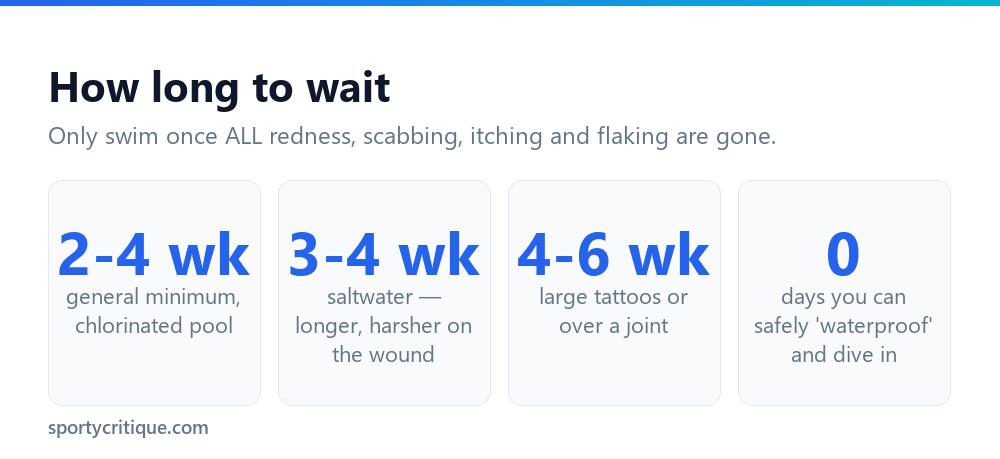
Table of Contents
Why you can’t just get in the water
It helps to understand what a fresh tattoo actually is, because “it’s just some ink” badly undersells it.
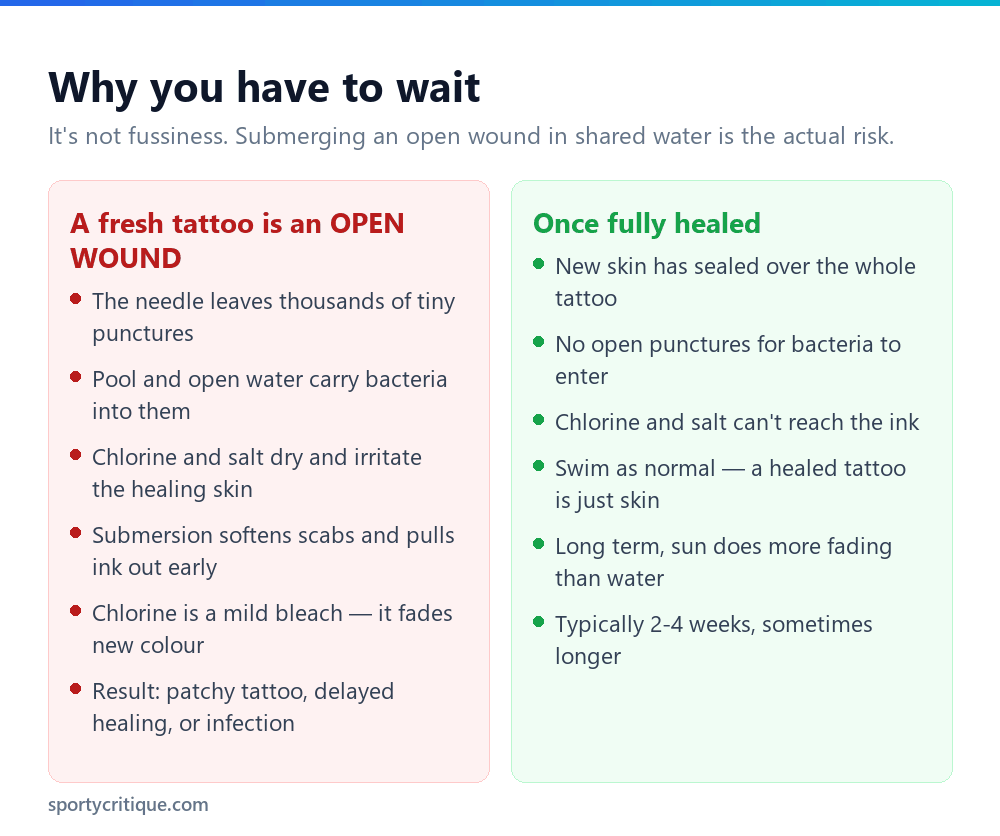
Getting tattooed means a needle punctures your skin thousands of times to deposit ink in the dermis, the layer beneath the surface. For the first few weeks, that leaves your skin as a healing wound — effectively a large, shallow graze. Until new skin seals over it, there are countless tiny openings in your body’s main barrier against infection.
Now submerge that in a pool or the sea. Bacteria in the water — even chlorinated pools aren’t sterile, and lakes and oceans are far worse — have a direct route into those openings, which is how tattoo infections happen. Chlorine and salt dry out and irritate the already-fragile healing skin, delaying recovery and increasing scabbing. Submersion softens the scabs that are protecting the ink, and if they lift or fall away too early, the ink underneath goes with them — leaving patchy, faded areas that need expensive touch-ups. And chlorine is a mild bleaching agent, so it can literally fade the colours of a tattoo that hasn’t sealed yet.
A fresh tattoo isn’t decoration yet — it’s an open wound with your money invested in it. Submerging it risks both an infection and the tattoo itself.
So the wait isn’t your artist being precious. It’s the same logic as not swimming with any open wound, with the added sting that this particular wound cost you money and you’d like it to look good.
How long, exactly
The honest answer is “until it’s healed,” because healing time varies. But here are the realistic ranges:
Two things push the timeline longer than you’d guess. Size: a small wrist tattoo may be surface-healed in a couple of weeks, while a full back piece is weeks further behind. Location: anywhere that bends and stretches constantly — joints, hands, feet — heals slower because the skin keeps moving and reopening. And healing depends on you: keeping it clean, moisturised, and out of the sun speeds it up; picking scabs or neglecting aftercare drags it out.
⚠️ Watch out: Above all, follow your own tattoo artist’s aftercare instructions. They saw the actual work, know its size and placement, and know their own inks and techniques. If their timeline is longer than the general ranges here, theirs wins — a general article can’t see your tattoo.
How to tell it’s healed

Don’t go by the calendar alone — go by how the tattoo looks and feels. A tattoo is healed enough to swim when the skin has fully closed over it, and there are clear signs of that.
The surface should look smooth and matte, like normal skin, rather than shiny, raised, or wet-looking. All scabbing and flaking should be finished — the peeling stage, where the tattoo sheds dry skin like a healing sunburn, must be completely over. The deep, maddening itch of the healing phase should have passed. There should be no redness around the edges and no tenderness when you press it.
If every one of those is true and it’s been at least two weeks, you’re almost certainly fine to swim. If any single one isn’t — a patch still flaking, a lingering red edge, a spot that’s still tender — wait a few more days. The cost of waiting is a slightly delayed swim. The cost of going too early is an infection or a ruined tattoo, so the trade is heavily one-sided.
📊 Note: There’s a difference between surface healing (the top layer you can see, done in 2–4 weeks) and full healing of the deeper skin, which can take several months. You only need surface healing to swim safely — but that surface healing has to be genuinely complete, not almost.
Can’t I just waterproof it?
This is the question everyone asks, usually with a holiday booked, and the honest answer is no — not reliably, and not safely. It’s worth explaining why, because the internet is full of advice suggesting otherwise.
The idea is to seal the fresh tattoo under a waterproof film or bandage and swim regardless. The problem is that no adhesive covering is genuinely reliable for submersion. Water pressure, movement, and time work water under the edges, and once even a little pool or sea water gets trapped against an open wound under a sealed cover, you’ve created a warm, wet, bacteria-friendly pocket pressed against the exact tissue you were trying to protect. That’s arguably worse than a quick unprotected dip, not better.
The genuinely useful distinction: waterproof dressings do have a legitimate role for a healing wound or cut — a graze, a small surgical site — where a proper waterproof bandage can keep it dry for a swim. A fresh tattoo is different because it’s a large, shallow, weeping wound that needs to breathe and stay dry to heal well, and sealing all of it under adhesive for a swim works against that. If you’re dealing with an ordinary wound rather than a tattoo, our guide to waterproofing a wound for swimming covers when that genuinely works.
If you must be near water sooner
Sometimes the tattoo and the holiday collide. A few realistic options that don’t involve submerging an open wound:
💡 Pro tip: The one thing worth internalising: a tattoo is permanent and a delayed swim is not. Waiting an extra week feels frustrating in the moment and is completely forgotten once the tattoo has healed cleanly. Rushing it can leave a patchy, infected mess you’ll look at for the rest of your life. Wait.
What if it already got wet?
Accidents happen — a surprise dip, a friend’s push into the pool, rain on a long walk. If a not-yet-healed tattoo has already been submerged, don’t panic, but do act sensibly.
Get out of the water and rinse the tattoo with clean, lukewarm water to wash off chlorine, salt, or lake water. Pat it dry gently with a clean paper towel — don’t rub — and let it air for a few minutes before applying your usual thin layer of aftercare moisturiser. A single brief exposure followed by prompt cleaning is usually fine; it’s repeated or prolonged submersion that causes the real damage.
Then watch it closely for a few days. The warning signs of a problem are increasing redness spreading beyond the tattoo, swelling, warmth, throbbing pain, pus or unusual discharge, or feeling feverish and unwell. Any of those means a possible infection, and you should see a doctor rather than wait it out — tattoo infections are very treatable early and genuinely serious if ignored. A one-off splash that you clean up and that heals normally, on the other hand, needs nothing more than the usual aftercare.
⚠️ Watch out: If in doubt after an accidental soaking — especially with any sign of infection, or if the water was from a lake, river, or the sea — contact your tattoo artist or a doctor. It’s a quick question that can save a serious problem, and no reputable artist minds being asked.
Frequently asked questions
How long after a tattoo can I swim?
Generally 2 to 4 weeks for a chlorinated pool, and a bit longer for saltwater or open water. Large tattoos and those over joints can take 4 to 6 weeks. But go by healing, not the calendar — only swim once all redness, scabbing, itching and flaking are gone and the skin is smooth. When in doubt, wait, and follow your tattoo artist’s specific advice over any general timeline.
Can I swim if I cover my new tattoo?
No, not reliably or safely. No waterproof covering holds up to full submersion — water works under the edges and then gets trapped against the open wound, which is worse than a quick dip. Second-skin films are designed for showering during aftercare, not for swimming. There’s no covering that makes swimming on a fresh tattoo safe; the only real answer is to wait until it’s healed.
Is chlorine or saltwater worse for a new tattoo?
Both are harmful to an unhealed tattoo, in different ways. Chlorine dries and irritates the skin and can bleach fresh ink; saltwater is harsh on the wound and, in the sea, carries more bacteria than a treated pool. Saltwater and open water generally warrant a slightly longer wait than a chlorinated pool. Neither is safe until the tattoo has fully healed.
What happens if I swim too soon after a tattoo?
You risk an infection from bacteria entering the open skin, and you risk damaging the tattoo itself — chlorine can fade the ink, and softened scabs can lift early and pull ink out, leaving patchy areas that need touch-ups. At best it delays healing; at worst you get an infected, faded tattoo. It’s simply not worth the few days saved.
How do I know my tattoo is healed enough to swim?
When there’s no redness, no scabbing or flaking, no itching, and no tenderness, and the skin looks smooth and matte rather than shiny or raised. That’s usually at least two weeks, often longer for big or joint tattoos. If any healing sign remains, it isn’t ready — wait a few more days. Surface healing is what matters for swimming, but it has to be complete.
Can I shower with a new tattoo?
Yes — normal showering is fine and is part of standard aftercare, as long as you don’t soak or submerge the tattoo. Keep showers reasonably short, use lukewarm water, avoid blasting the tattoo directly with a hard stream, and pat it dry gently. It’s prolonged submersion in pool, sea, or lake water that causes the problems, not clean running water.
- →Waterproofing a wound for swimming — when a dressing genuinely works (ordinary cuts, not tattoos)
- →Getting water out of your ear after swimming — another swimmer’s common problem
- →How to breathe while swimming — the technique guide