Badminton Leg Strength Training: Lunges, Landings, and Court Speed

Badminton legs need three things in order: strength to hold a deep lunge, eccentric control to brake and land safely, and elastic power to push back out and repeat it. Train it with Bulgarian split squats, Romanian deadlifts, and heavy squats for the base; single-leg landings and slow eccentrics for the brakes; lateral bounds and skater hops for the speed. Bodyweight lunges alone won’t get you there — and plyometrics before you can land quietly is how knees get hurt.
Badminton is a leg sport that happens to involve a racket. The shuttle only travels a few metres, but you cover somewhere around four to six kilometres of stop-start movement in a serious match, almost all of it in short bursts with a hard brake at the end. Your legs are the engine, the suspension, and the brakes all at once.
This guide is specifically about the lower body. For the whole picture — upper body, shoulder health, programming, and periodisation — start with our complete badminton strength training guide.
- →The lunge is badminton’s signature movement — and it is an eccentric, single-leg braking task.
- →Heel first, knee tracking over the foot, chest up. Bad lunge mechanics compound over hundreds of repetitions.
- →Train single-leg. You never jump, land, or lunge off two legs in a rally.
- →Build strength before power, and power before speed. The order is not optional.
- →Calves and hip flexors are the two most-neglected muscles in badminton legs.
- →Shadow footwork is the highest-transfer drill in the sport and costs nothing.
Table of Contents
What your legs actually do out there
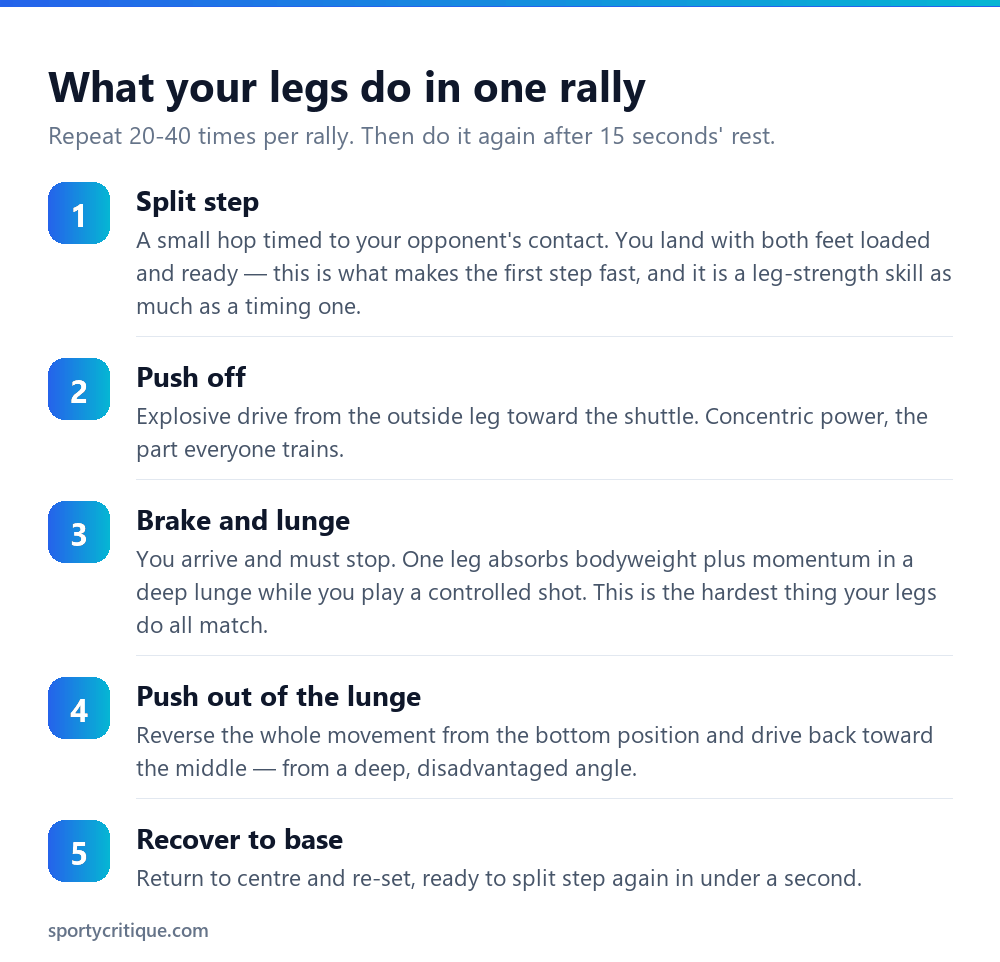
Read that sequence again and notice how much of it is stopping rather than starting. Two of the five phases are pure deceleration, and they’re the two that hurt. The push-off gets all the training attention because it feels like the athletic part, but the brake is where matches are lost and knees are injured.
There’s a second thing hiding in that sequence: it’s asymmetric. Movement to your forehand side loads different structures than movement to your backhand side, and the lunging leg is almost always the same one — your racket-side leg. Nearly every badminton player has a measurably stronger dominant leg. That’s normal, but a large gap is worth closing, because the weaker side is where things tear.
Two of the five phases of badminton footwork are deceleration. Almost all training addresses the other three.
The lunge: get this right first
If you fix one thing about how your legs work on court, make it lunge mechanics. You’ll perform several hundred lunges in a hard match, and the difference between a sound one and a sloppy one is the difference between playing at forty and not.
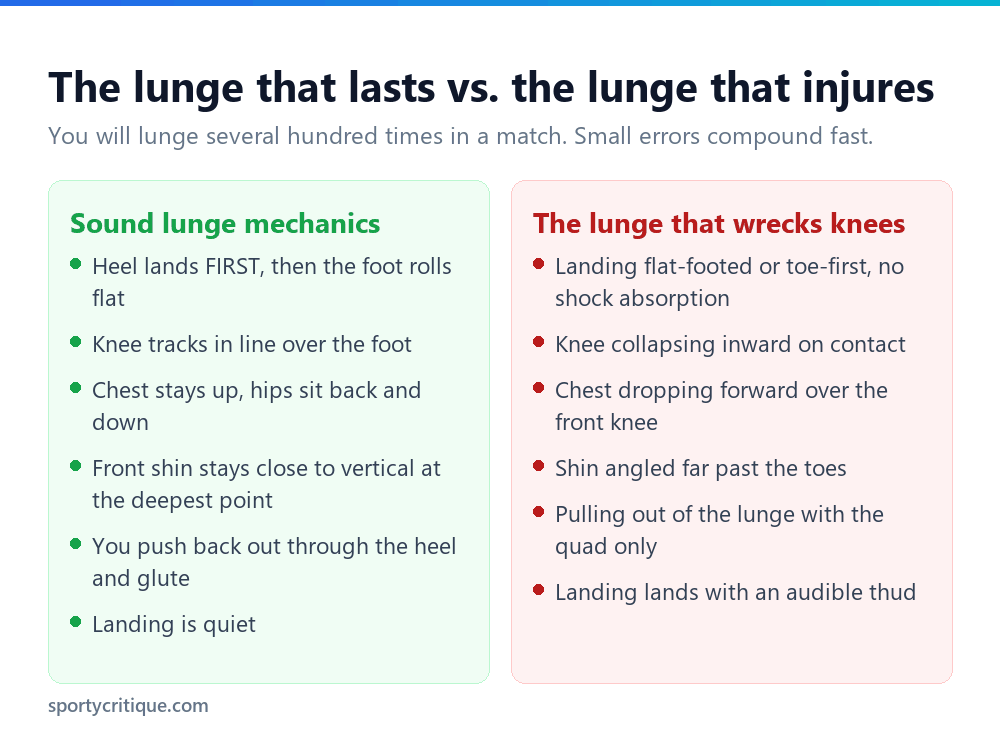
Heel first is the detail most players have never been told. When you lunge into the net, the front heel should contact the floor first, then the foot rolls flat as the knee bends. That sequence lets the whole leg act as a spring, spreading the load across the quad, glute, and hamstring over time. Landing flat or on the toes delivers the force straight into the knee joint in a fraction of a second.
The knee tracks over the foot. Under fatigue, knees drift inward — the technical term is valgus collapse, and it’s the single strongest predictor of knee injury in jumping and lunging sports. It’s usually a glute strength problem rather than a knee problem, which is why the fix lives in your hip work.
Chest up, hips back. Diving chest-first into a lunge puts your weight ahead of your base, which means you have to drag yourself back out with the quad alone. Keeping the chest tall and sitting the hips down keeps your glutes and hamstrings involved in the recovery, and they’re far stronger than your quad on its own.
⚠️ Watch out: Pain at the front of the knee after sessions usually traces back to lunge mechanics, not to volume. Before you cut back on playing, film yourself lunging from the side and check the heel contact and shin angle. Most people are surprised by what they see.
The exercises that build badminton legs
- Single leg, deep range, directly mirrors the lunge
- Exposes and corrects the left-right gap
- 3 x 8 each leg, lowering under control
- Builds the raw force everything else draws on
- 4 x 5 heavy, with a 3-second lowering phase
- The eccentric tempo is what makes it badminton-specific
- Your primary braking muscles
- Directly reduces hamstring strain risk
- 3 x 6, hinge at the hips, flat back
- Trains the deep positions you actually reach on court
- Add dumbbells once bodyweight is easy
- Focus on the heel-first landing every rep
- Every split step and push-off runs through the calf and achilles
- Do them straight-legged AND bent-knee for the soleus
- 3 x 12, slow lowering — achilles injuries are season-enders
- Recovering from a deep lunge is a hip flexor action
- Standing band knee drives, hanging knee raises
- Chronically tight and weak in most players simultaneously
- Badminton moves sideways; almost no gym lift does
- Push off, land, stick it, hold for a beat
- 4 x 4 each side, quality over quantity
- Fast ground contacts, minimal time on the floor
- Trains the elastic quality that makes footwork feel light
- 3 x 6 each side, only when fresh
📊 Note: Two muscles get neglected almost universally: calves and hip flexors. Calves take enormous load in every split step, and achilles problems end seasons. Hip flexors do the work of pulling you out of deep lunges, and they’re usually both tight and weak — which feels like tightness, so people stretch them and never strengthen them.
The progression: why order matters
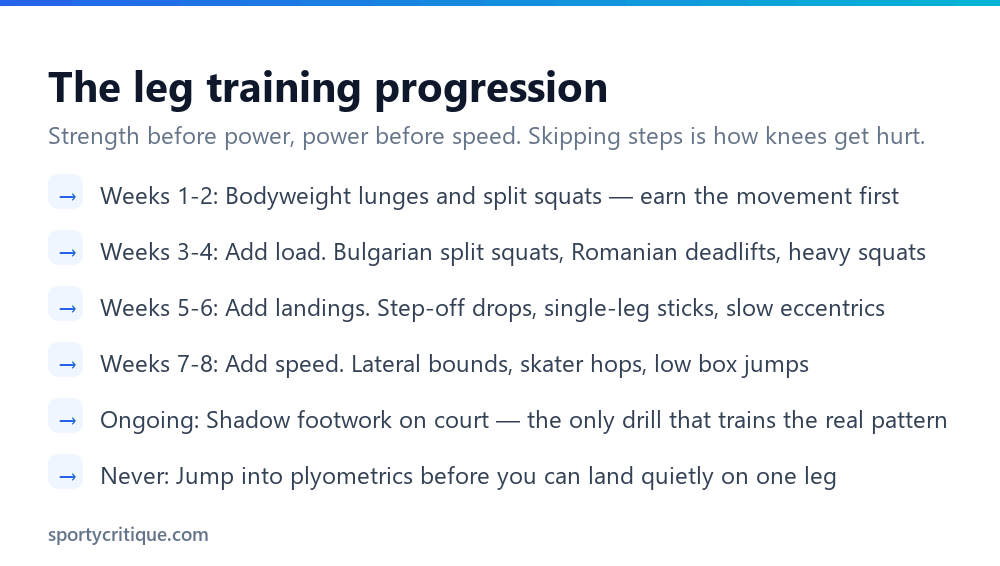
The temptation with leg training is to go straight to the exciting part — jumps, bounds, explosive work. It’s the most badminton-looking training and it’s genuinely effective. It’s also how people get hurt, because plyometrics are fundamentally a landing exercise, and landing is a skill you have to build.
The test for whether you’re ready to add jumps is simple and strict: step off a low box and land on one leg. If the landing is silent, controlled, and you can hold the position for two seconds without your knee wobbling inward, you’re ready. If it thuds, or your knee travels, you’re not — go back to strength work for a few more weeks. Noise is unabsorbed force, and unabsorbed force goes into joints.
This is also why the progression puts strength before power. Plyometric training makes you better at using the strength you have; it doesn’t create much strength on its own. Running explosive work on weak legs produces a small improvement and a large injury risk.
Ankles: badminton’s most common injury, and nobody trains for it
Ask any club what injury it sees most and the answer is the ankle. Badminton’s movement profile — hard lateral pushes, landings from jump smashes, awkward stretches into corners — loads the ankle in exactly the way that produces lateral sprains. And a strength article that talks about squats and hamstrings while ignoring ankles is missing where the actual damage happens.
The mechanism is nearly always the same: you land on the outside edge of the foot, the ankle rolls outward, and the ligaments on the outside take the load. Often it happens landing on your own foot or a partner’s in doubles. What makes it worse is that ankle sprains recur — the first one damages the joint’s position sense, so the ankle is slower to correct itself next time, and a player who has sprained one ankle is substantially more likely to do it again.
The training answer is proprioception: teaching the ankle to react. Single-leg balance work is the whole intervention, and it’s absurdly simple. Stand on one leg for 30 seconds. When that’s easy, close your eyes — which removes visual correction and forces the ankle to do the work. When that’s easy, do it on a cushion or folded towel. When that’s easy, have someone gently push you off balance while you hold it. Three minutes, a few times a week.
⚠️ Watch out: Do not go back on court in a supportive brace and call the problem solved. A brace helps mechanically while you rehabilitate, but it doesn’t restore position sense — and an ankle that can’t correct itself is an ankle that sprains again. Rehab the proprioception, then wean off the brace.
Why stronger legs didn’t make you faster
A frustration worth addressing, because it comes up constantly: players do eight weeks of squats, add real weight to the bar, and find their court speed hasn’t changed. It’s not that the training failed. It’s that court speed and leg strength are only loosely related.
Getting to the shuttle sooner is mostly a function of three things that aren’t strength at all. Anticipation — reading your opponent’s racket face early buys you more time than any amount of leg power. The split step — if it’s mistimed or absent, you start every movement flat-footed, and no strength compensates for that. Movement efficiency — taking four steps to a corner that needs three costs you time on every single rally.
Strength raises the ceiling on all three, but it doesn’t build them. It makes each lunge cheaper, each landing safer, and the tenth rally feel like the second — which is why late-match durability is usually the first improvement people notice from gym work, well before raw speed. If you want to be faster next month rather than next year, spend the time on your split step timing and shadow footwork; the gym pays out over a longer horizon.
Shadow footwork: the drill that beats everything
For all the gym work above, the highest-transfer leg training in badminton needs no equipment at all. Shadow footwork — moving to each of the six corners of the court without a shuttle, playing the shot, and recovering to base — trains strength, endurance, movement pattern, and technique simultaneously, in exactly the pattern the sport uses.
💡 Pro tip: Film one round of shadow footwork from the side, every few weeks. It’s the cheapest coaching available — you’ll spot a collapsing knee, a missing split step, or a lazy recovery immediately, and none of those are visible from the inside.
Frequently asked questions
How do I stop my legs burning out in the third game?
Usually it’s not endurance — it’s inefficiency. Players who fade late are often those taking too many steps, missing their split step, and recovering to base slowly. Fix movement efficiency first and interval conditioning second. Strength helps too, because a stronger leg works at a lower percentage of its maximum on every single lunge, which delays fatigue across the whole match.
Are squats or lunges better for badminton?
Both, for different reasons. Squats build the raw strength base efficiently and let you load heavy. Lunges and split squats transfer more directly because they’re single-leg and match the on-court movement. If you can only do one, choose the Bulgarian split squat — it’s closest to what you actually do, and it forces both legs to earn their own strength.
How do I improve my jump smash height?
Jump height comes from strength plus rate of force development — heavy squats and deadlifts to build the force, then plyometrics to make it fast. But check the sequence too: many players lose jump height to a rushed approach rather than weak legs. Our smash training guide covers the kinetic chain side.
My knees hurt after playing. What should I do?
Look at lunge mechanics before you look at volume — heel-first landings and knees tracking over the foot solve a large share of badminton knee pain. Strengthen the glutes, since inward knee collapse is usually a hip problem. And if the pain persists beyond a few days or swells, see a physiotherapist rather than training around it.
How often should I train legs for badminton?
One dedicated heavy session and one lighter power session per week is plenty alongside court time. Legs recover more slowly than most people expect, and you’re already loading them hard every time you play. If your footwork feels heavy on court, you’re training legs too close to your sessions — not too little.
Do I need to train legs if I play three times a week?
Playing builds the endurance side, but it doesn’t build maximum strength — the loads simply aren’t high enough, and you plateau. The players who keep improving after the first year almost all add strength work. It’s also the most effective injury prevention available, which matters more each year you keep playing.
- →Complete badminton strength training guide — the full program and periodisation
- →Smash power training — the kinetic chain from the ground up
- →How to hold a badminton racket — pronation and where power comes from
- →How to play badminton — rules, scoring, and court positioning