Badminton Smash Power: Train the Kinetic Chain, Not Your Biceps

Smash power comes from a kinetic chain that runs legs → hips → trunk → shoulder → forearm pronation → wrist — and the biggest single contributor is forearm pronation, not arm strength. Before you train for a harder smash, check your grip: a panhandle grip physically prevents pronation and caps your power no matter how strong you get. Once technique is sound, train rotational power (medicine ball throws, slams, woodchops) and pulling strength, not biceps and bench press.
Here’s an uncomfortable fact about smash training: most of the people searching for it don’t have a strength problem. They have a sequencing problem, and the gym can’t fix it.
Elite players generate shuttle speeds well beyond anything a club player produces, and they don’t do it with visibly bigger arms. They do it by timing six body segments so each one arrives at peak speed at exactly the right moment, ending in a violent forearm rotation at contact. Power is a coordination skill first and a strength quality second.
So this guide covers both halves, in the order that actually works: what the chain is and where yours is probably breaking, then the training that genuinely adds speed once the chain is intact. For the broader program, see our complete badminton strength training guide.
- →Smash power is a whip, not a push — six body segments firing in sequence.
- →Forearm pronation is the largest single contributor to racket head speed.
- →A panhandle grip makes pronation mechanically impossible. Fix that before anything else.
- →Train rotation: medicine ball throws, slams, woodchops. Not curls, not bench press.
- →A relaxed grip that tightens only at contact is faster than a tight one throughout.
- →Racket and string setup change smash speed more than most players realise.
Table of Contents
The kinetic chain, link by link
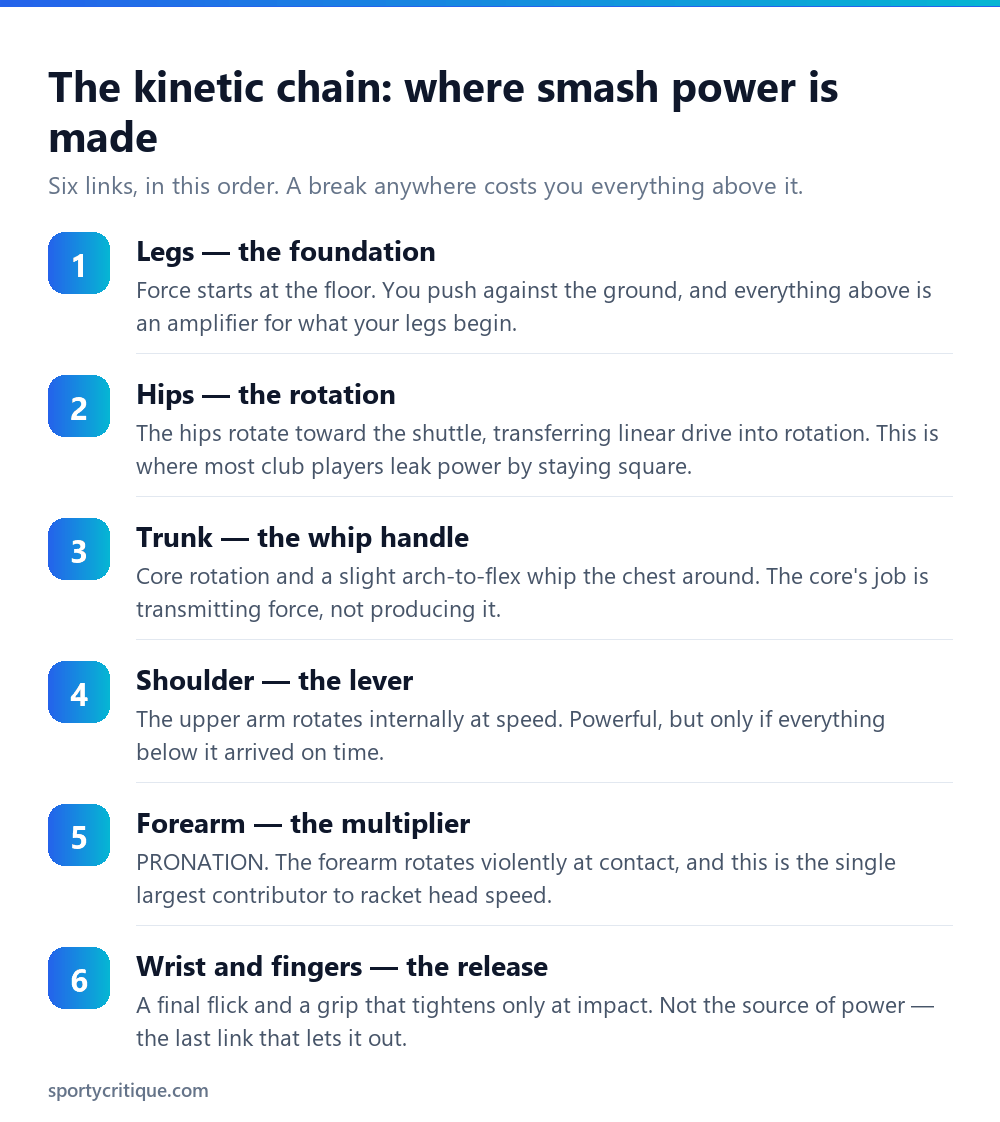
The word that matters here is sequence. Each link accelerates, transfers its momentum upward, and then decelerates — passing energy along like a whip travelling down a rope. The racket head reaches enormous speed in the final few inches because it’s the end of a chain that’s been building since your foot pushed against the floor.
Which means a break anywhere costs you everything above it. If your hips don’t rotate, your trunk has less to amplify, your shoulder less still, and your forearm is multiplying a smaller number. This is why the arm-only smash feels so effortful for so little result — you’re generating power with one link instead of six, and asking your shoulder to do work your legs should have started.
The racket head accelerates enormously in the last few inches. That acceleration is rotational, and it comes from the forearm — which is why grip determines your ceiling.
Pronation: the link that decides your ceiling
If you take one thing from this article, take this. Forearm pronation — the rotation that turns your palm from facing up to facing down — is where badminton power is finally released. It happens in a fraction of a second at contact, and it contributes more to racket head speed than any other single joint action.
And it’s completely dependent on your grip. Hold the racket panhandle style — face flat in your palm, like a frying pan — and your forearm is already rotated to the end of its available range at the moment you need it to rotate. There’s nowhere left to go. You can be enormously strong and still have no smash, because the joint has no room to move.
Switch to a proper forehand grip, with the racket handle angled across the fingers, and the forearm starts supinated with a full range of rotation available. Now the whip has a final link. Our guide to holding a badminton racket covers exactly how to find and check it, and it’s the highest-value fifteen minutes available to most club players.
Where club players actually leak power
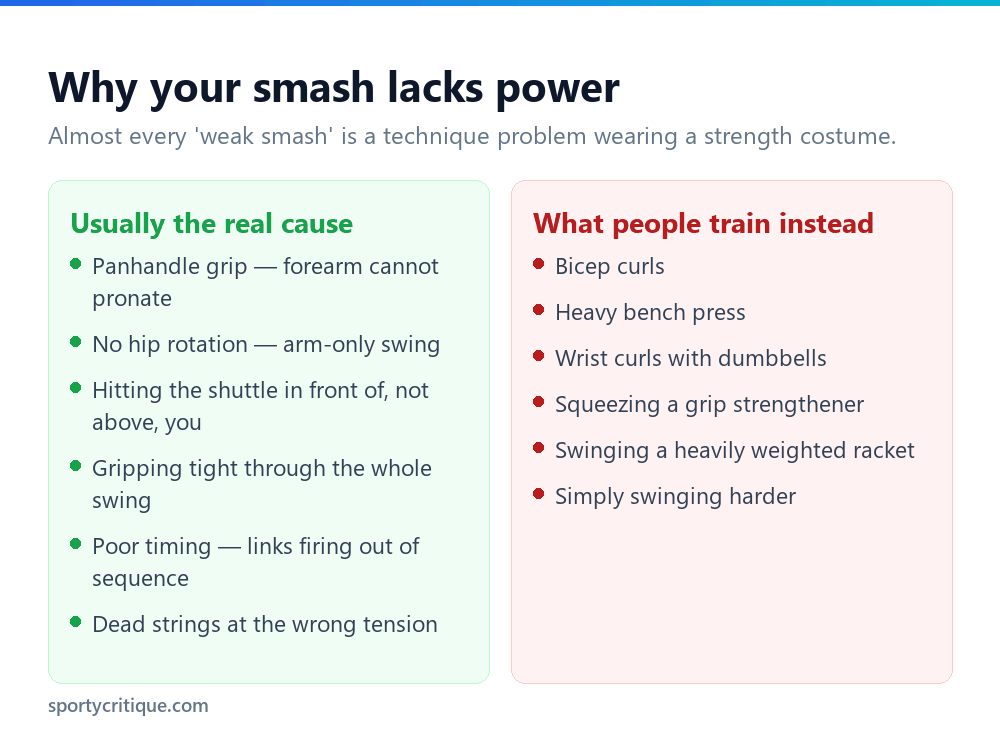
Beyond the grip, three leaks account for most missing smash speed.
No hip rotation. Watch a club player smash and you’ll often see the hips stay square to the net while the arm does all the work. The fix is to turn side-on as the shuttle rises, get your non-racket shoulder pointing at it, then drive the rotation from the ground up. The chest should finish facing the net having started facing the side wall — if it doesn’t, you skipped a link.
Contact point too far forward. The shuttle should be met above and slightly in front of your hitting shoulder, at the highest point you can comfortably reach. Reaching too far forward means contacting on the way down, past your peak, and steeper angles become impossible. Too far back and you can’t get on top of it at all.
A tight grip throughout the swing. This one is counterintuitive and it’s everywhere. A tightly gripped racket cannot accelerate freely — a rigid forearm resists the rotation you need. The grip should be relaxed through the swing and tighten only at the instant of contact. Think of it as a pulse rather than a clamp. Players who learn this often report an immediate jump in shuttle speed while feeling like they swung softer.
💡 Pro tip: Test your grip pressure by having someone try to pull the racket out of your hand mid-preparation. If they can’t budge it, you’re strangling it. A relaxed grip is faster, and it’s also what allows the fine adjustments that disguise your shots.
The training that does add power
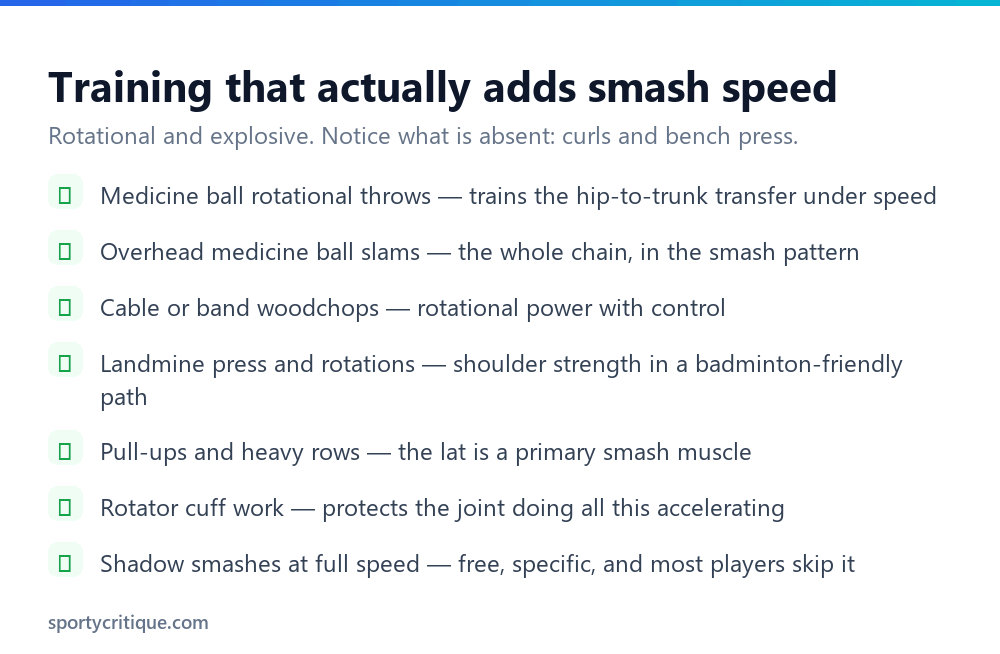
Once the chain is intact, strength work has something to amplify. The principle is that badminton power is rotational and explosive, so the training should be too.
- Stand side-on to a wall, rotate and throw hard
- Trains the hip-to-trunk transfer at speed
- 3-4 sets of 5 each side, maximum intent every rep
- Reach overhead, slam down with everything
- Mirrors the smash pattern closely
- 4 x 5, and genuinely try to break the floor
- High-to-low diagonal, matching the smash path
- Trains rotation with a longer time under tension
- 3 x 8 each side
- The lat drives the arm down and through
- Most underrated upper-body lift for badminton
- 4 x 5, weighted once bodyweight is easy
- Builds overhead strength without the impingement risk
- Easier on shoulders than strict overhead pressing
- 3 x 6 each arm
- You are accelerating a joint violently, repeatedly
- External rotations, face pulls, band pull-aparts
- 2-3 x 15, light, several times a week
⚠️ Watch out: Do not train with a heavily weighted racket. Adding significant weight changes the timing of your swing and grooves a slower motor pattern — you can train yourself into a worse smash. Slightly weighted rackets for short, controlled sessions are debated; heavy ones are not worth the risk to your technique or your shoulder.
Equipment: the part you can change today
Technique first, training second — but equipment is the variable that changes fastest, and it’s genuinely significant for smash speed.
The most common self-inflicted problem here is string tension. Players read that professionals string at very high tensions and copy it, not realising that high tension only produces power if you generate enough racket head speed to deform the string bed. Below that threshold, high tension just makes the racket feel dead and costs you power. Most club players are better served dropping a few pounds than adding them.
A four-week smash power block
📊 Note: Notice that the first week contains no strength training at all. That ordering is deliberate and it’s the part most people skip. Amplifying a broken sequence just produces a faster broken sequence, usually with a sorer shoulder attached.
Frequently asked questions
Why is my smash so weak even though I’m strong?
Almost certainly grip or sequencing. If you hold the racket panhandle-style, your forearm physically cannot pronate through contact, and pronation is the biggest contributor to racket head speed — strength is irrelevant against a mechanical block. Check the grip first, then whether your hips rotate or your arm is doing all the work.
Do wrist exercises improve smash power?
Barely. The wrist contributes a final flick, but the power is generated by rotation further down the chain, particularly forearm pronation and hip rotation. Wrist curls with dumbbells train a movement badminton doesn’t use. Forearm rotation exercises — rotating a light dumbbell or hammer held at the end — are marginally more relevant, but shadow swings beat both.
How fast is a professional badminton smash?
Recorded smash speeds are the fastest in racket sports, well over 300 km/h off the racket — though the shuttle decelerates dramatically in flight, which is why a smash that leaves at extreme speed arrives far slower. It’s worth knowing those figures come from initial racket-head speed, so comparisons with other sports’ ball speeds aren’t apples to apples.
Should I jump when I smash?
Not until the standing smash is solid. Jumping adds height, which adds angle, which is what makes a smash hard to defend — but it also adds timing difficulty and reduces your recovery, and a mistimed jump smash is weaker than a well-struck standing one. Build the sequence on the ground first. Our leg training guide covers building the jump itself.
How long until my smash gets noticeably harder?
If the cause is technique — grip or hip rotation — days to weeks, and the change can be dramatic. If the chain is already sound and you’re adding strength, expect six to eight weeks for a modest gain. That asymmetry is exactly why the technique audit comes first: it’s where the large, fast improvements are.
Is a stiffer racket better for smashing?
Only if your technique can load it. A stiff shaft returns energy efficiently for players who generate high racket head speed with precise timing; for everyone else, it feels harsh and produces less power than a medium-flex racket would. Most club players smash harder with a more flexible shaft, whatever the marketing implies.
- →How to hold a badminton racket — the grip that makes pronation possible
- →Complete badminton strength training — the full program
- →Leg strength and jump training — building the jump smash
- →Restringing your racket — tension, timing, and hidden power loss
- →How to play badminton — rules and tactics