How to String a Badminton Racket — and Whether You Should DIY

Quick Answer: You can string a badminton racket at home, but without a stringing machine you shouldn’t — hand-pulled tension is uneven and warps frames. Realistic options: pay a stringer ($15–30 including string), buy a machine if you restring often, or hand-string only as a weekend rescue. And whatever you do, don’t chase high tension: lower tension gives you more power, not less.
🏸 Badminton Hub: Explore all 34 racket reviews, stroke mechanics, and drills in our Complete Badminton Resource Hub.
Every guide on this topic cheerfully explains the weaving pattern and skips the question that actually matters: should you be doing this yourself? Having watched a friend turn a perfectly good racket into a banana with pliers and optimism, let’s answer that first — and then get to the numbers that decide how your racket actually plays.
Table of Contents
DIY or pay a stringer? The honest math
| Option | Cost | Quality | Makes sense when |
|---|---|---|---|
| Pro stringer | $15–30 with string | Consistent, frame-safe | Almost everyone |
| Your own machine | $150–1,000+ once, then ~$8/string | Great, after 20 rackets of practice | You restring monthly, or string for a club |
| Hand stringing | $8 + patience | Uneven tension, real frame risk | Emergency only |
Run the numbers on your own play. A club player restringing three or four times a year spends roughly $100 annually at a stringer. A machine pays for itself only if you’re stringing for teammates too, or if you genuinely enjoy this sort of thing — and plenty of people do; it’s meditative work and there’s real satisfaction in playing with a racket you strung.
But be honest about the learning curve. Your first machine job will take 90 minutes and produce a worse result than the shop. A practised stringer does a racket in 15–20 minutes with tension consistent to within a fraction of a pound. That gap takes about twenty rackets to close.
⚠️ Why hand-stringing is genuinely risky: a badminton frame is under enormous, precisely balanced compression when strung — roughly 24 lbs pulling inward from every direction at once. A machine mounts the frame at multiple support points and applies each pull at a measured, constant tension. Your hands can’t do either. Uneven tension pulls the head out of shape, and a warped frame is finished — you can’t unbend it.
🏸 Essential Stringing & Racket Accessories
String tension and string gauge directly affect sweet-spot repulsion and arm comfort. Pair your restringing with these key accessories for maximum durability and vibration reduction:
Protect your elbow and forearm joints by filtering harsh string harmonics on off-center hits.
Proper bevel alignment prevents racket twisting when playing with high-tension strings.
When does a racket actually need restringing?
Two answers, and most players only know the obvious one.
The obvious: a string broke. Cut all the strings out soon after — snip them in an X pattern from the centre outward. Leaving a racket half-strung means the remaining strings are pulling the frame unevenly, and that’s exactly the warping you’re trying to avoid.
The sneaky one: tension loss. Strings shed tension continuously from the moment they’re installed — through play, and even sitting in a bag. A racket strung at 24 lbs six months ago might be playing at 19 lbs now, and the change is so gradual you’ll never notice the day it happened. What you’ll notice instead is that your clears keep landing short and you assume you’re tired, or getting old, or your technique has fallen apart.
It isn’t your arm. It’s your strings. This is the single most common invisible equipment problem in club badminton — players fighting a dead racket and blaming themselves.
The rule of thumb worth knowing
💡 Restring as many times per year as you play per week. Play twice a week? Restring twice a year. Play four times a week? Four times a year. It’s a crude rule and it’s remarkably good — it scales with actual usage rather than the calendar, and it’s the guideline most coaches give.
The other tells: fraying near the centre of the string bed, a dull thud at contact instead of a crisp ping, strings that have visibly moved out of their grid and stay there, or noticeable notching where the mains and crosses meet.
Tension: the number that decides how your racket plays
| Level | Tension | What it feels like |
|---|---|---|
| Beginner | 18–21 lbs | Big sweet spot, free power, very forgiving |
| Intermediate | 22–24 lbs | Better control, still lively |
| Advanced | 25–28 lbs | Precision and feel; punishes off-centre hits |
| Professional | 28–35 lbs | Don’t copy them. Genuinely |
⚠️ Higher tension does NOT mean more power. It’s the opposite for almost everyone, and it’s the most damaging myth in badminton equipment. Low tension = more trampoline effect = the string bed does the work and returns energy to the shuttle. High tension = a stiffer bed that barely deflects, which means you have to supply all the power yourself.
So why do professionals string at 30 lbs? Because they generate so much racket-head speed that a loose bed becomes a liability — the shuttle sinks in, dwells too long, and flies unpredictably. At their speed, a stiff bed gives control and a precise, repeatable response. At your speed, that same bed is just a wall that eats your clears.
The pattern is depressingly predictable: a club player watches a professional interview, learns their idol strings at 30, jumps from 22 to 27, and immediately can’t reach the back line. They assume they need to get stronger. They actually need to go back to 22.
💡 Move in 1–2 lb increments, and only when you have a reason. A good reason: ‘my shots are flying long and I want more control.’ A bad reason: ‘a YouTuber plays at 28.’ And if you’re new, start at 20–22 and stay there for a year — you’ll learn more about shuttle contact on a forgiving bed than a punishing one.
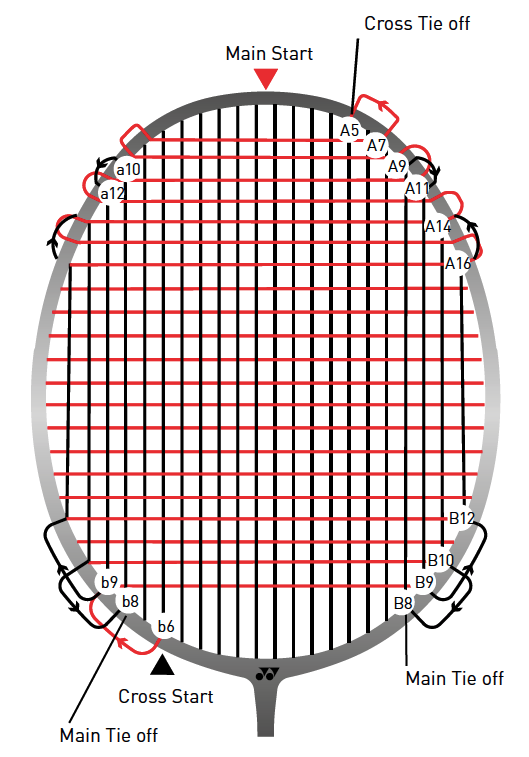
The process (what your stringer does)
Worth understanding even if you never do it yourself, because it tells you what you’re paying for:
- Cut out the old strings from the centre outward in an X, so tension releases evenly rather than yanking the frame to one side.
- Unblock and inspect the grommets — the plastic eyelets the string passes through. Cracked or sharp grommets will saw through new string in a week. Replacing them is cheap and most stringers do it as a matter of course.
- Mount the frame in the machine at all its support points. This is the step hand-stringing cannot replicate, and the reason frames warp without it.
- String the mains (the vertical strings) first, working from the centre out, each pulled to the target tension.
- Weave the crosses over-under, alternating the pattern each row, tensioning row by row.
- Tie off inside the frame — never on the outside. Outside knots concentrate stress on the frame and are a classic amateur mistake.
- Trim the tails clean and check the string bed is a true grid.
You’ll also hear about 2-knot vs 4-knot stringing. Two-knot (one-piece) is generally considered kinder to the frame because tension stays balanced through the process; four-knot (two-piece) is faster and lets you use different strings for mains and crosses. For a normal player, either is fine — let your stringer use what they’re best at.
How strings actually die
Understanding this changes how you think about restringing, because ‘my string broke’ turns out to be the least common way a string bed reaches the end of its useful life.
Tension loss starts immediately. A freshly strung racket sheds a noticeable amount of tension within the first 24–48 hours as the nylon settles and stretches — this is normal and stringers account for it. It then continues to bleed away steadily for the rest of the string’s life, through every impact and simply through the polymer relaxing over time.
Heat accelerates everything. A racket left in a car boot in summer will lose tension dramatically faster than one kept indoors. Same for a bag left in direct sun at an outdoor session. If you’ve ever had a racket feel oddly dead after a hot weekend, that’s not imagination — the string bed genuinely aged months in an afternoon.
Notching kills feel before it kills the string. Where the mains and crosses cross each other, they saw into one another with every shot. Long before anything snaps, those notches change how the strings move at contact — the bed stops sliding and snapping back, and your shots lose the crispness you can’t quite name. Run a fingernail across the intersections; if you can feel grooves, the bed is past its best regardless of what it looks like.
The upshot: a string bed that has never broken can still be thoroughly dead. Players who restring only on breakage are, by definition, always playing on the worst string bed they’ll ever have — because the only way it ends is by getting worse until it fails.
Diagnosing your own racket
Quick checks you can do right now, in about a minute:
- The ping test. Tap the string bed with a fingernail. A healthy bed gives a clear, high ping. A dead one gives a dull thud. It’s crude, it works, and after a few rackets you’ll be able to guess tension within a couple of pounds by ear.
- The push test. Press your thumb into the centre of the bed. It should feel firm with a little give. If it deflects easily and slowly, tension has gone.
- The grid test. Look at the string bed. Are the strings a neat grid, or have they wandered and stayed wandered? Strings that no longer snap back to position have lost their elasticity.
- The notch test. Fingernail across the intersections. Grooves mean the bed is worn even if nothing has broken.
- The honest test. Have your clears been landing short for a few weeks? Before you rebuild your technique, restring the racket. It costs $20 and it’s the answer more often than anyone expects.
String choice, briefly
Badminton strings are essentially all multifilament nylon; what varies is gauge (thickness) and construction:
| Gauge | Character | Suits |
|---|---|---|
| 0.70 mm (thick) | Durable, less feel, lower repulsion | Beginners, string-breakers |
| 0.66–0.68 mm | The all-round sweet spot | Most players |
| 0.61–0.65 mm (thin) | More spin, more repulsion, more feel — snaps sooner | Advanced players who accept breakage |
The genuine advice: a durable all-round string in the 0.66–0.68 range is right for the overwhelming majority of club players, and the classic BG65-type strings have been the default for decades precisely because they last and behave predictably. Thin ‘feel’ strings are a real upgrade once your contact is consistent — and an expensive lesson before that, because you’ll break them on mishits.
Ignore anything marketed primarily on ‘power’. Power comes from grip and pronation and from technique, not polymer. A string that promises smash speed is selling you the thing you have to build yourself.
Frequently asked questions
Can I play with one broken string ‘just for today’?
You can, and your frame may quietly pay for it — the remaining strings pull the head out of shape. Cut them all out and borrow a racket instead.
Why did my string break in the first week?
Usually mishits near the frame (completely normal for beginners), a sharp grommet sawing at it, or tension too high for that string’s gauge. If it snaps in the same place repeatedly, show your stringer — that’s a grommet problem, not a you problem.
Is factory stringing any good?
Serviceable and low-tension — genuinely fine while you’re learning. Worth replacing once you can feel the difference, and by then you’ll know what tension you want.
How often should I restring if I don’t break strings?
As many times per year as you play per week. Strings lose tension whether you break them or not, and playing on a dead bed for a year is a slow, invisible handicap.
Will higher tension improve my smash?
Almost certainly not — it’ll cost you power unless you already generate elite racket-head speed. Control, yes. Power, no. This is the myth that costs club players more than any other.
How long does restringing take?
15–20 minutes for a practised stringer. Most shops turn it around same-day, and many clubs have someone who’ll do it while you play.
Should I buy a stringing machine?
Only if you restring monthly or you’re stringing for others — otherwise the maths never works and you’ll produce worse rackets for your first twenty attempts. If you’re choosing a new frame instead, our racket guide covers weight and balance.