How to Get Water Out of Your Ear After Swimming (Safely)


To get water out of your ear after swimming, tilt your head so the ear faces down and let gravity drain it, gently wiggling your earlobe to help. If that fails, make a seal with a cupped palm and use gentle suction, or dry the canal with warm air from a hair dryer on its lowest setting held a foot away. Drying drops (half white vinegar, half rubbing alcohol) work well — but only if your eardrum is intact. Whatever you do, never put a cotton swab or any object into your ear. And if pain or blockage lasts more than a day or two, see a doctor.
Water trapped in the ear after a swim is one of the most common and irritating after-effects of the pool. That plugged, muffled feeling, sometimes with a faint sloshing when you move your head, is usually harmless and clears on its own — but it’s annoying enough that everyone wants it gone now.
Most of the time a simple tilt does it. When it doesn’t, there are a handful of safe escalations. And there’s one thing you must never do, which happens to be the first thing most people reach for.
- →Start with gravity: tilt the ear down and wait — most water clears this way.
- →Wiggling the earlobe and gentle suction handle most of the rest.
- →Vinegar-and-alcohol drops dry the ear — but never with tubes or a perforated eardrum.
- →Never use a cotton swab or any object — it pushes water and wax deeper.
- →Persistent pain, discharge, or muffled hearing may be swimmer’s ear — see a doctor.
- →The best fix is prevention: dry your ears after every single swim.
Table of Contents
Why water gets stuck in the first place
Your ear canal isn’t a straight tube — it has a slight bend, and it produces earwax, which is water-repellent. Usually water runs straight back out. But sometimes it gets held past the bend by surface tension, or trapped behind a plug of earwax, and there it sits, creating that blocked, full sensation.
It’s more likely after swimming than after a shower because you spend longer submerged and your head is at more angles. People with narrower ear canals or more earwax are more prone to it, which is why some swimmers get it constantly and others almost never. None of that is a problem in itself — trapped water is benign. It just needs coaxing out.
⚠️ Watch out: The reason it matters to get water out reasonably promptly is that a warm, wet ear canal is the ideal environment for the bacteria that cause swimmer’s ear — an infection of the canal. The trapped water isn’t the danger; the moisture lingering for hours or days is. Drain it, dry it, and the risk drops sharply.
The methods, in order
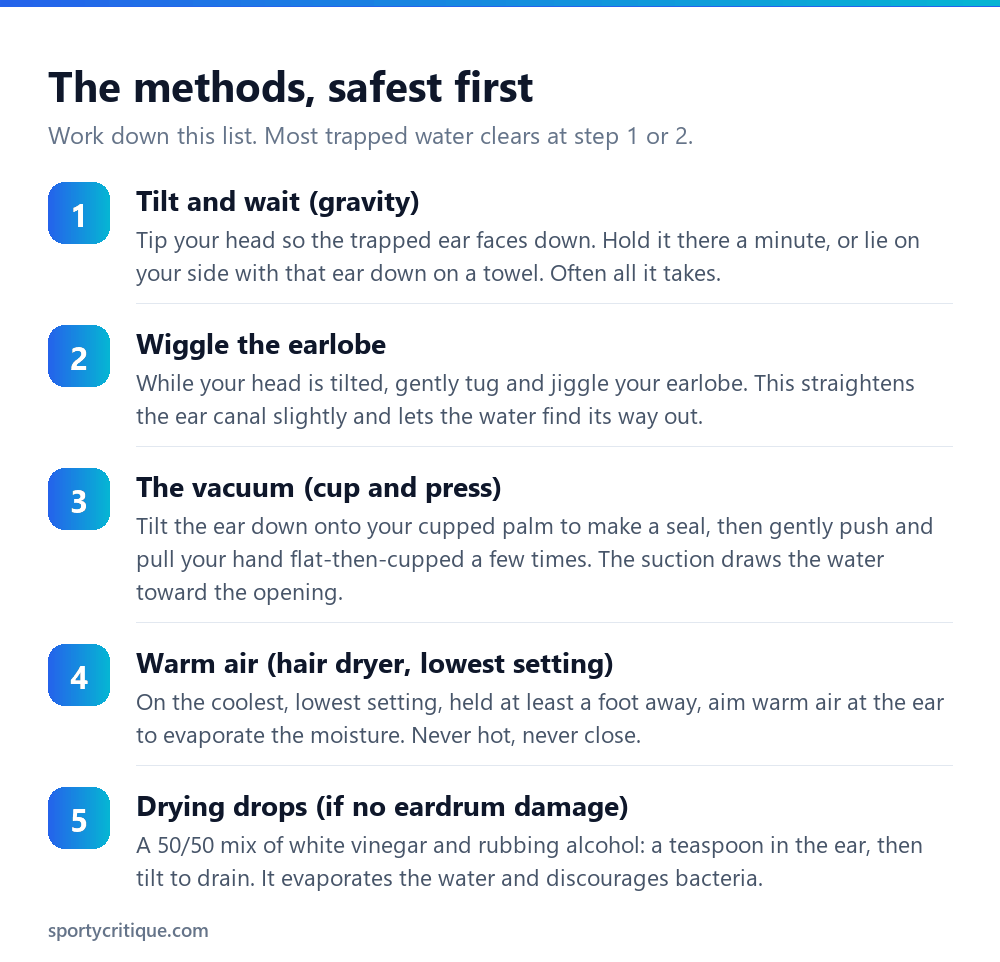
Work down this list — the gentlest methods clear most trapped water, and you rarely need to go far.
Gravity is the first and best tool. Tip your head sharply to the side so the blocked ear points at the floor, and hold it there. Hopping gently on one foot, or lying down with that ear pressed to a towel, gives the water time and a downhill path. Add a gentle tug and wiggle of the earlobe to open the canal and break the surface tension holding the water in place. This alone solves the large majority of cases.
The vacuum method is the next step. Tilt the affected ear down toward your cupped palm and press your hand flat against the ear to form a tight seal, then push and pull your hand — flattening as you push in, cupping as you pull away — a few times to create gentle suction. Then tilt your head and let the loosened water run out. It sounds fiddly and works surprisingly well.
Warm air evaporates what won’t drain. Set a hair dryer to its lowest heat and speed, hold it at least a foot from your ear, and aim the warm stream at the opening for a minute or so, moving it around. The gentle warmth dries the residual moisture. The rules here are non-negotiable: lowest setting, well back from the ear — the ear canal skin burns easily.
Drying drops are the swimmer’s classic. A 50/50 mix of white vinegar and rubbing alcohol does two jobs: the alcohol displaces and evaporates the water, and the vinegar’s acidity discourages the bacteria and fungi behind swimmer’s ear. Tilt your head, put about a teaspoon in the ear, wait 30 seconds, then tilt back and let it drain. Commercial swimmer’s-ear drops work the same way.
⚠️ Watch out: Do NOT use drops of any kind — homemade or commercial — if you have ear tubes, a known perforated (burst) eardrum, or any history of a hole in the eardrum. The liquid can pass into the middle ear and cause harm. If you’re not certain your eardrum is intact, skip the drops and use the physical methods, or ask a doctor.
What never to do
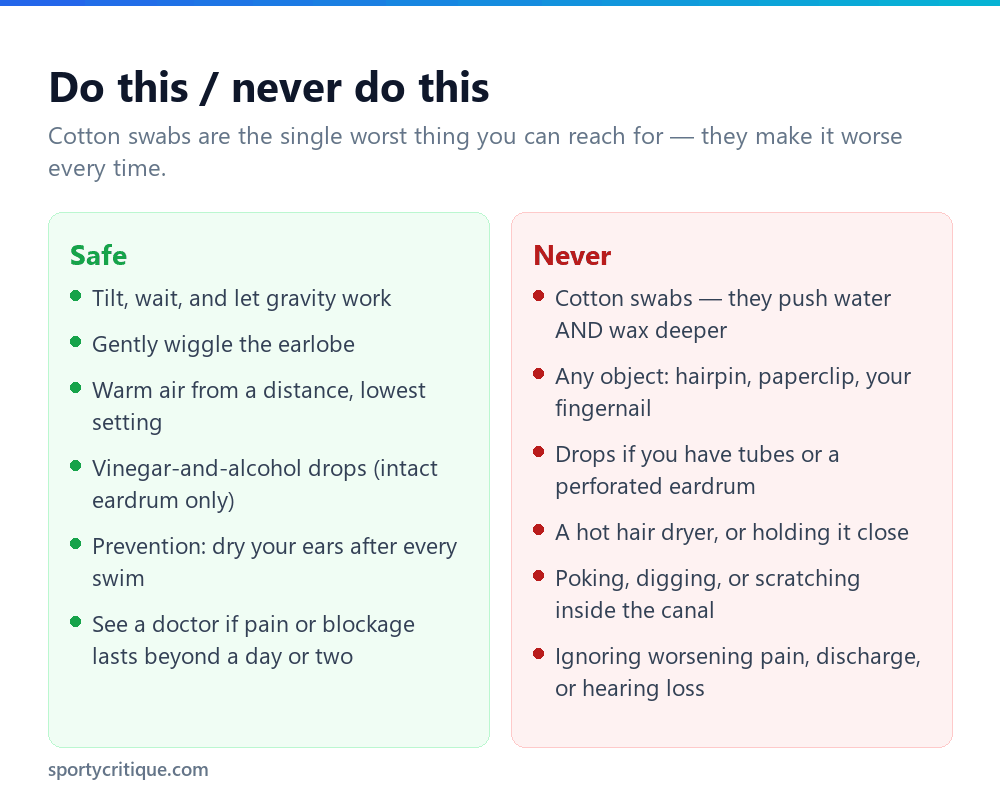
The single most important rule: never put anything into your ear canal to get water out. Not a cotton swab, not a twisted tissue, not a finger, not a hairpin.
It feels logical — there’s water in there, so reach in and mop it up — and it’s exactly wrong. A cotton swab pushes the water further in rather than absorbing it, packs your earwax deeper into a plug that traps the water even more effectively, and can scratch the delicate canal skin, giving bacteria an entry point. It can also, in the worst case, reach and damage the eardrum. Every ear specialist gives the same advice: nothing smaller than your elbow goes in your ear. Drain and dry from the outside only.
The other quiet mistake is simply ignoring it. Trapped water that won’t clear for more than a day or two, especially with any pain, is worth taking seriously rather than living with — not because trapped water is dangerous, but because persistent symptoms often mean it’s stopped being just trapped water.
When it’s swimmer’s ear, not trapped water
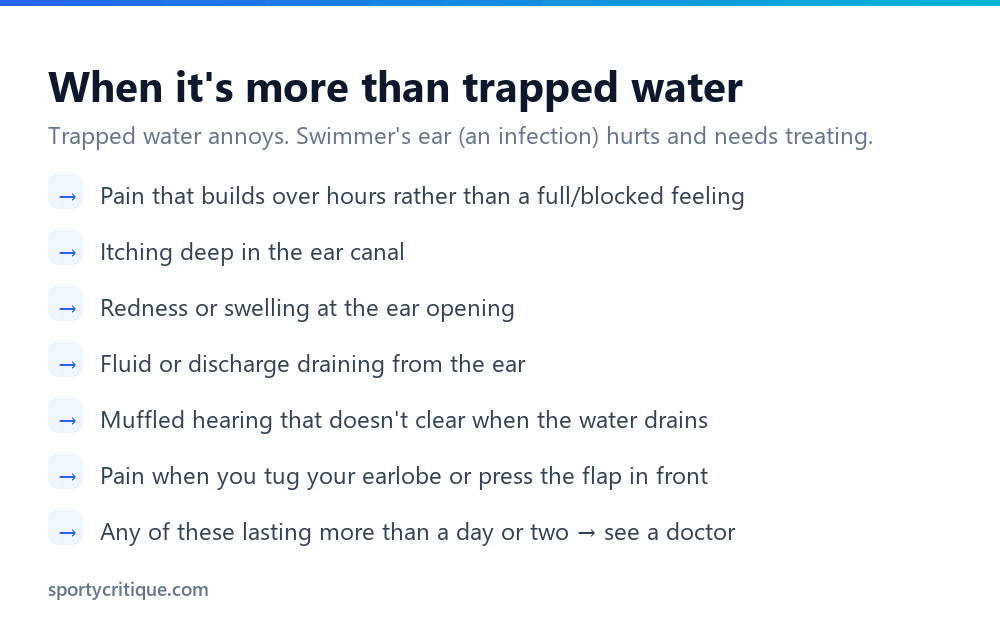
Trapped water and swimmer’s ear feel different, and telling them apart matters because they need different responses.
Trapped water feels full, blocked, and muffled, sometimes with a sloshing sensation. It’s annoying but not really painful, and it clears — suddenly and satisfyingly — once the water drains. Swimmer’s ear (its medical name is otitis externa) is an infection of the ear canal, and it builds over hours into genuine pain, itching, redness, and sometimes discharge. A classic tell: it hurts to tug your earlobe or press the little flap of cartilage in front of the ear canal. That tenderness points to infection rather than water.
Swimmer’s ear needs treating, usually with prescription antibiotic ear drops, and it won’t resolve by draining water — there’s no water left to drain, it’s an infection of the canal lining. If you have the warning signs above, or symptoms lasting more than a day or two, see a doctor or pharmacist. Our guide to relieving ear pain after swimming covers it in more depth, and if you’ve had a recent ear infection, when it’s safe to get back in the water is covered in our timing guide.
📊 Note: This article is general information, not medical advice. Ears vary, and pain, discharge, hearing loss, dizziness, or symptoms in a child warrant seeing a healthcare professional rather than self-treating. When in doubt, get it looked at — ear problems are cheap to treat early and miserable to leave.
Preventing it next time
If you get trapped water regularly, a few habits reduce it dramatically — and the same habits prevent swimmer’s ear, so they’re doubly worth it.
💡 Pro tip: Swimmers who fight this every session usually solve it permanently with a decent pair of moulded earplugs plus a quick after-swim ear dry. It’s a two-minute habit that ends a recurring annoyance — and sidesteps the far worse problem of repeated swimmer’s ear.
Special cases: kids, earwax, and repeat offenders
A few situations deserve their own note, because the standard advice needs adjusting.
Children. Kids get water trapped constantly — they swim more, and their ear canals are narrower. The gentle physical methods are fine for them, but be even more insistent about the no-objects rule, since children (and well-meaning parents with cotton buds) are exactly who ends up with pushed-in wax and scratched canals. Children are also more prone to swimmer’s ear, so if a child complains of ear pain after swimming rather than just a blocked feeling, have it checked promptly rather than waiting.
Earwax buildup. If water gets trapped every single time you swim, a wax plug is often the real culprit — the water sits behind it and can’t drain. The fix is not to dig the wax out yourself, which packs it tighter, but to have it softened with proper drops or removed professionally. Once the plug is gone, many chronic sufferers find the trapped-water problem simply disappears.
Repeat offenders and open-water swimmers. If you swim in lakes, rivers, or the sea, the water carries more bacteria than a chlorinated pool, which raises the swimmer’s-ear risk from any lingering moisture. Drying drops after every session and good earplugs matter more for open-water swimmers than for pool swimmers. If you get recurrent swimmer’s ear despite prevention, it’s worth seeing an ear specialist to check for an underlying cause like eczema or a persistently narrow, wax-prone canal.
Frequently asked questions
How do I get water out of my ear fast?
Tilt your head so the ear faces down and gently tug your earlobe — gravity plus a slightly opened canal clears most trapped water within seconds to a minute. If that doesn’t work, try the cupped-palm suction method or warm air from a hair dryer on its lowest setting held well back. Don’t reach for a cotton swab; it makes things worse.
Is it bad to leave water in your ear?
A short time is harmless — it usually drains on its own. But water lingering in the ear canal for hours or days creates the warm, moist environment that bacteria love, which can lead to swimmer’s ear. So it’s worth draining and drying reasonably promptly, especially if you’re prone to ear infections. The water itself isn’t the danger; the lingering moisture is.
Do vinegar and alcohol ear drops really work?
Yes, for trapped water and as swimmer’s-ear prevention, if your eardrum is intact. The alcohol displaces and evaporates the water and the vinegar’s acidity discourages bacteria and fungi. Mix equal parts, put a teaspoon in the ear, and let it drain. Never use it if you have ear tubes or a perforated eardrum — the liquid can reach the middle ear and cause harm.
Why can’t I use a cotton swab?
Because it does the opposite of what you want. A swab pushes water deeper, packs earwax into a plug that traps water even better, can scratch the canal and let bacteria in, and can reach the eardrum. Ear specialists are unanimous: never put a swab or any object into your ear canal. Drain and dry from the outside only.
How do I know if it’s swimmer’s ear?
Trapped water feels full and muffled but not painful, and clears when it drains. Swimmer’s ear builds into genuine pain, itching, and sometimes discharge over hours, and classically hurts when you tug your earlobe or press the flap in front of the ear. If you have those signs, or symptoms lasting more than a day or two, see a doctor — swimmer’s ear needs antibiotic drops, not draining.
How can I stop getting water in my ears when I swim?
Well-fitted swimming earplugs (silicone or moulded) are the most reliable prevention. Beyond that, dry your ears after every swim by tilting and dabbing, and if you’re prone to it, use preventive vinegar-and-alcohol drops after swimming (intact eardrums only). The combination stops the problem before it starts and also prevents swimmer’s ear.
- →Relieving ear pain after swimming — when it’s swimmer’s ear, not trapped water
- →How long to avoid swimming after an ear infection — getting back in safely
- →How to breathe while swimming — the technique guide