Ear Pain After Swimming: Relieving Swimmer’s Ear (And When to See a Doctor)


Ear pain after swimming is usually swimmer’s ear (otitis externa) — an infection of the ear canal, not just trapped water. To relieve it: keep the ear dry, use a warm compress and over-the-counter painkillers (paracetamol or ibuprofen) for the pain, and see a doctor, because it usually needs prescription antibiotic ear drops to actually clear. Home measures ease the pain but don’t cure the infection. Never put a cotton swab in the ear, and don’t keep swimming. See a doctor promptly if the pain is severe, spreading, feverish, or lasts more than a day or two.
🏊 Swimming Hub: Explore all 35 stroke tutorials, aquatic gear reviews, and pool maintenance guides in our Complete Swimming Resource Hub.
There’s an important difference between the harmless blocked feeling of water stuck in your ear and genuine ear pain after swimming. The first drains and forgets about itself. The second is usually an infection, and it needs more than a head tilt — it needs treating properly.
This guide covers how to tell which you’ve got, what genuinely relieves the pain, and — importantly — why the honest answer for most people includes a trip to the doctor rather than a home remedy alone.
- →Ear pain after swimming is usually swimmer’s ear — an infection, not trapped water.
- →Pain is the tell: trapped water feels blocked; swimmer’s ear hurts and builds.
- →Home measures — dry ear, warm compress, OTC painkillers — ease the pain.
- →The infection itself usually needs prescription antibiotic ear drops from a doctor.
- →Never use a cotton swab, and stop swimming until it’s fully healed.
- →Severe, spreading, or feverish symptoms — or any in a child — need prompt care.
Table of Contents
| Clinical Cause | Primary Symptoms | Immediate Relief Protocol | Safe Home Remedies | When to See a Physician |
|---|---|---|---|---|
| Trapped Water Sensation | Sloshing sound, fullness, mild discomfort | Tilt head, apply warm compress, pull earlobe | 50/50 Isopropyl alcohol and white vinegar drops | Water remains trapped over 48 hours |
| Acute Swimmer’s Ear (Otitis Externa) | Sharp pain when pulling earlobe (tragus), itching, redness | Oral analgesics (Ibuprofen / Acetaminophen) | Avoid all water entry; keep canal strictly dry | Discharge, fever, severe escalating pain |
| Impacted Cerumen (Swollen Earwax) | Muffled hearing, dull aching pressure | Warm shower steam, mineral oil drops | Carbamide peroxide 6.5% earwax softening drops | Total hearing loss, dizziness or tinnitus |
| Barotrauma (Middle Ear Pressure) | Sharp stabbing pressure post-diving | Gentle swallowing, chewing, Valsalva maneuver | Decongestant nasal sprays (short term only) | Sudden hearing drop, severe nausea, bleeding |
Is it swimmer’s ear or just trapped water?
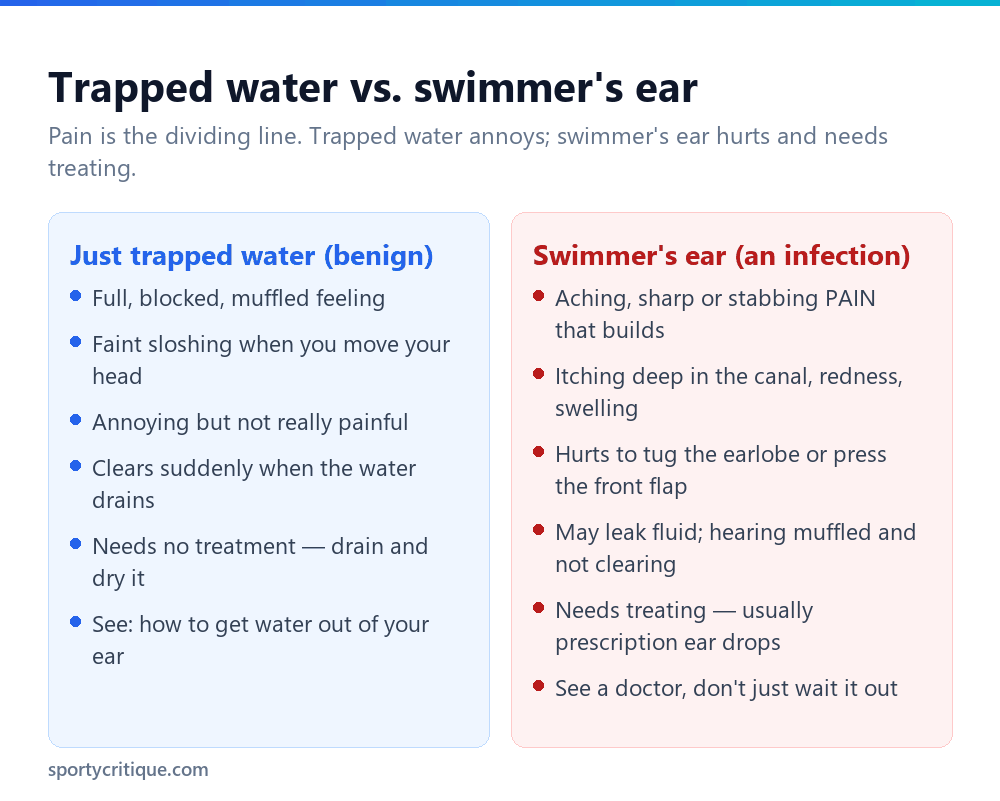
This is the first thing to sort out, because the two need completely different responses.
Trapped water feels full, blocked, and muffled, often with a faint sloshing as you move your head. It’s irritating but not genuinely painful, and it resolves — usually all at once — when the water finally drains. If that’s what you have, our guide to getting water out of your ear covers it, and you don’t need this article.
Swimmer’s ear is different. It’s an infection of the ear-canal skin, and it hurts — an aching, sometimes sharp or stabbing pain that builds over hours rather than a simple blocked feeling. There’s often itching deep in the canal, redness, and swelling, and the giveaway sign is that it hurts to tug your earlobe or press the little flap of cartilage in front of the ear opening. It may leak fluid, and hearing can be muffled in a way that doesn’t clear when you tilt your head. That’s an infection, and it won’t drain away.
Pain is the dividing line. If it merely feels blocked, it’s water. If it genuinely hurts — especially when you tug your ear — treat it as an infection.
Why swimmers get it
Understanding the mechanism explains both the treatment and the prevention.
Your ear canal has natural defences: earwax is water-repellent and slightly acidic, which discourages bacteria. Swimming disrupts both. Water lingering in the canal washes away that protective wax and raises the moisture and pH, creating a warm, damp environment where bacteria (and sometimes fungi) multiply. Once they take hold in the canal skin — especially if that skin is already slightly scratched or irritated — you have an infection.
This is why it’s called swimmer’s ear, and why the people who get it repeatedly are often those who swim a lot, have narrow or wax-prone canals, or — crucially — use cotton swabs, which scratch the canal and strip the protective wax, handing bacteria both an entry point and a welcome. It’s also more common after swimming in lakes, rivers, or the sea, which carry more bacteria than a chlorinated pool.
Relieving the pain
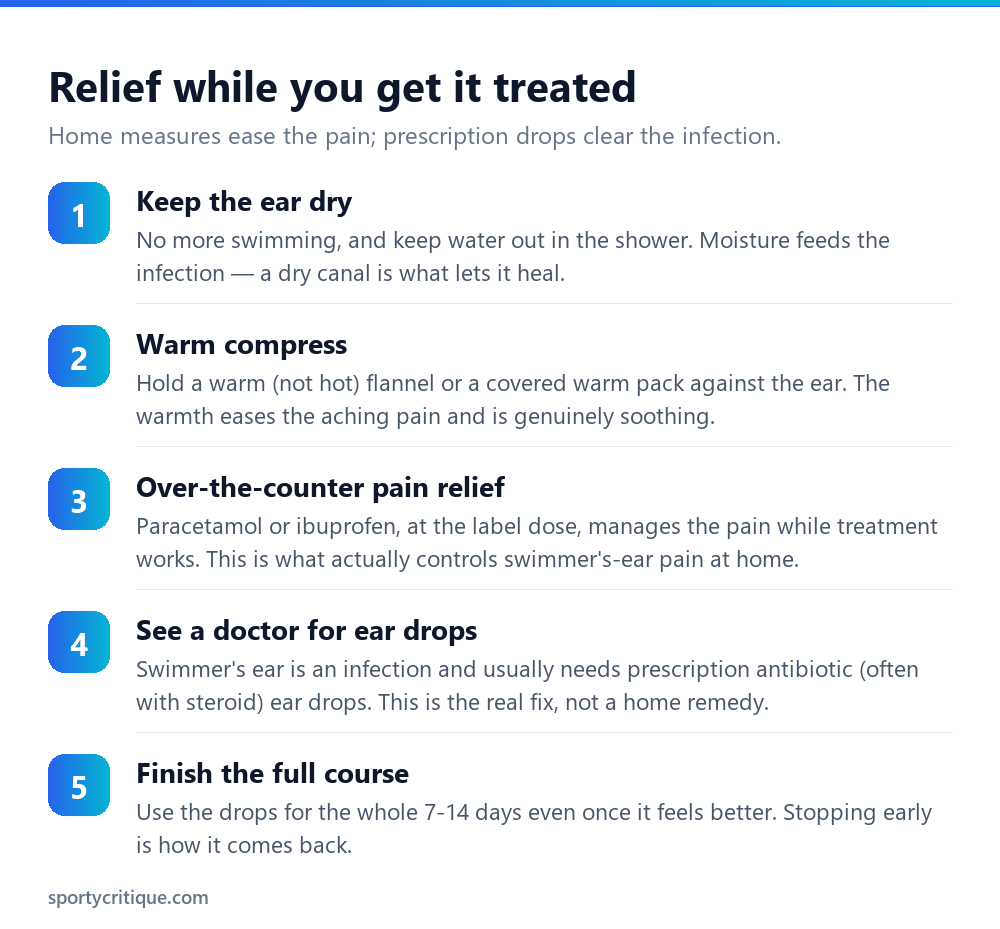
Here’s the honest structure of it: home measures manage the pain, and prescription ear drops clear the infection. You need both, and the home measures are what get you through comfortably until the drops take effect.
Keep the ear dry. Stop swimming entirely, and keep water out during showers — a cotton-wool ball smeared with a little petroleum jelly at the ear opening works. Moisture is what feeds the infection, so a dry canal is a precondition for healing.
Use warmth for the ache. A warm (never hot) flannel or a covered warm pack held against the ear is genuinely soothing and eases the deep aching pain. It’s simple and it works.
Take over-the-counter painkillers. Paracetamol or ibuprofen at the recommended dose is what actually controls swimmer’s-ear pain at home, and it’s appropriate to use while you arrange treatment. Swimmer’s ear can be genuinely painful, and there’s no need to tough it out.
Get the ear drops. This is the part home remedies can’t replace. Swimmer’s ear is a bacterial infection, and it’s normally treated with prescription antibiotic ear drops — often combined with a steroid to reduce swelling — used for 7 to 14 days. With proper treatment it usually clears within about a week. A doctor or, in many places, a pharmacist can sort this quickly.
⚠️ Watch out: Finish the entire course of drops even once the pain has gone — usually the full 7 to 14 days. Stopping early because it feels better is one of the most common reasons swimmer’s ear recurs, sometimes worse than the first time.
What not to do
A few instincts make swimmer’s ear worse, and they’re worth naming plainly.
Don’t put anything in your ear. No cotton swabs, no fingers, no twisted tissue. It’s tempting to try to clean or scratch an itchy, sore canal, but doing so damages the already-inflamed skin, pushes debris deeper, and can spread the infection. This is the single worst thing you can do, and it’s also a leading cause of getting swimmer’s ear in the first place.
Don’t keep swimming. Every swim reintroduces moisture and bacteria to an infected canal. Stay out of the water until it has fully healed — our guide on how long to wait covers getting back in safely.
Don’t rely on home remedies alone for an established infection. The vinegar-and-alcohol drops that help prevent swimmer’s ear and dry out trapped water are not a treatment for an active infection, and they should never go into an ear that’s already sore and inflamed, or one where the eardrum might be perforated. Once it’s infected and painful, it needs proper medical drops, not DIY ones.
📊 Note: This is general information, not a diagnosis. Ear pain has several possible causes — a middle-ear infection, a boil, or a foreign object can feel similar — and only a clinician looking in your ear can be sure. If you’re in pain, the reliable move is to have it looked at rather than guess.
When it’s more than routine swimmer’s ear

Most swimmer’s ear is straightforward and clears with drops. But some situations need prompt medical attention rather than watchful waiting, and it’s worth knowing them.
See a doctor promptly — the same day if you can — if the pain is severe or worsening, if redness and swelling are spreading beyond the ear, if you develop a fever or feel generally unwell, if there’s significant discharge, or if you have hearing loss or dizziness. And there’s one higher-risk group that should never wait: people with diabetes or a weakened immune system, in whom swimmer’s ear can occasionally progress to a serious infection of the surrounding tissue and bone. If that’s you, treat any ear-canal infection as a same-day medical issue.
Children with ear pain after swimming should also be seen rather than self-treated, both because they can’t always describe symptoms accurately and because ear pain in children can stem from a middle-ear infection that needs different treatment. When in doubt, get it checked — ear infections are cheap and quick to treat early, and miserable to leave.
Preventing the next one
If you’ve had swimmer’s ear once, you’ll want to avoid the encore. The prevention is the same routine that keeps trapped water at bay, which is why it’s doubly worthwhile:
💡 Pro tip: Regular swimmers who keep getting swimmer’s ear usually break the cycle with two habits: proper earplugs while swimming, and drying drops afterward. It’s a two-minute routine that prevents a painful, week-long problem — and if it keeps recurring despite that, an ENT specialist can check for an underlying cause like eczema in the canal.
Frequently asked questions
How do I get rid of swimmer’s ear fast?
The fastest real fix is prescription antibiotic ear drops from a doctor — swimmer’s ear usually improves within about three days of starting them and clears in a week. While you get them, keep the ear dry, use a warm compress, and take paracetamol or ibuprofen for the pain. Home measures ease symptoms but don’t clear the infection on their own, so don’t rely on them alone.
Can swimmer’s ear go away on its own?
Mild cases sometimes settle if you keep the ear dry, but it often needs antibiotic ear drops to clear properly, and waiting risks it worsening or spreading. Because it’s genuinely painful and easy to treat, seeing a doctor or pharmacist is the sensible move rather than hoping it resolves. Don’t leave a painful, swelling, or discharging ear untreated.
What’s the difference between swimmer’s ear and water in my ear?
Trapped water feels blocked and muffled but isn’t really painful, and it clears when it drains. Swimmer’s ear is an infection: it hurts, often with itching, redness, and swelling, and classically it’s painful to tug the earlobe or press the flap in front of the ear. Pain is the key difference. Trapped water needs draining; swimmer’s ear needs treating.
Can I use home remedies for ear pain after swimming?
For the pain, yes — a warm compress, keeping the ear dry, and over-the-counter painkillers all help. But home remedies don’t cure the underlying infection, and you should never put vinegar-and-alcohol drops into an ear that’s already sore, inflamed, or possibly has a perforated eardrum. Use home measures for comfort while you get proper antibiotic drops from a clinician.
How long does swimmer’s ear last?
With proper treatment, swimmer’s ear usually clears within 7 to 10 days, and the pain often eases within the first few days of starting antibiotic ear drops. Use the full course even once it feels better, or it can come back. Untreated, it can persist and worsen, which is why early treatment is worth it.
When should I worry about ear pain after swimming?
See a doctor promptly if the pain is severe or worsening, if redness or swelling spreads beyond the ear, if you have a fever, discharge, hearing loss, or dizziness, or if symptoms last more than a day or two. People with diabetes or a weakened immune system, and children, should be seen without delay — in higher-risk people swimmer’s ear can occasionally become serious.
- →Getting water out of your ear — when it’s trapped water, not an infection
- →How long to avoid swimming after an ear infection — getting back in safely
- →How to breathe while swimming — the technique guide