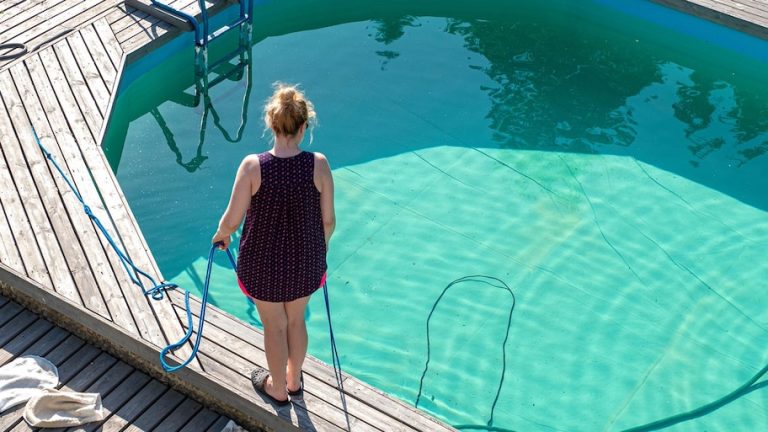
How to Keep Ducks Away From Swimming Pool: What Works


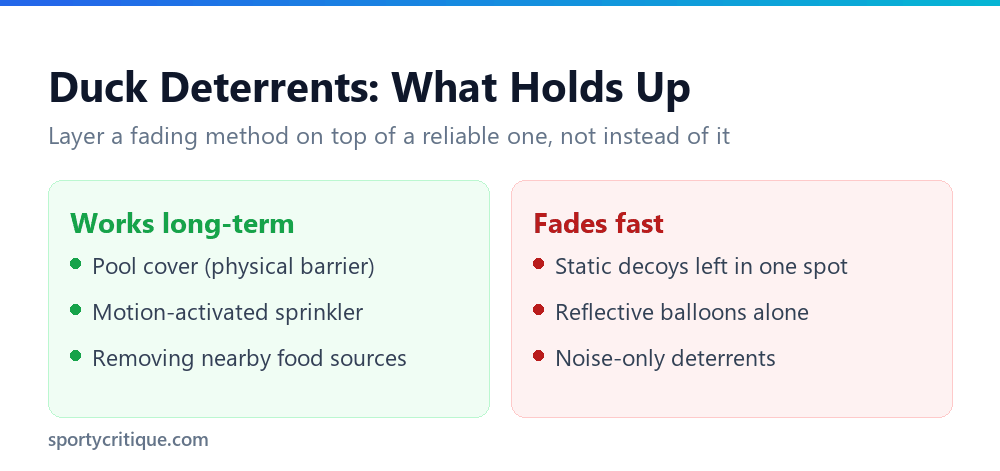
A physical pool cover is the most reliable way to keep ducks off a pool since it removes the option to land at all. Motion-activated sprinklers are the strongest active deterrent otherwise; static decoys help short-term but usually stop working within days to weeks on their own.
If you want to keep ducks away from swimming pool water for good, it helps to understand why they showed up in the first place. Ducks show up at pools for the same reasons they show up at any open water: it looks like a safe place to land, rest, and sometimes nest nearby. A pool with no cover, calm water, and a quiet yard reads to a duck as no different from a pond. Once a pair or a small group finds your pool and nothing chases them off, they tend to come back, sometimes daily, and they leave droppings in the water and on the deck that are a genuine mess to deal with, not just an inconvenience.
The honest problem with most lists on this topic is that they treat every deterrent as equally effective, when in practice some methods work reliably and others mostly make the person doing them feel like they are taking action. This breaks down what actually keeps ducks away long-term versus what tends to stop working after the ducks get used to it.
- →Physical barriers, a pool cover, work more reliably than any visual scare tactic because ducks cannot land on a covered pool at all.
- →Motion-activated sprinklers are one of the more effective active deterrents, since the startle response does not wear off as fast as a static decoy does.
- →Plain decoys alone usually stop working within days to a couple of weeks once ducks realize nothing is actually threatening.
- →Combining two or three methods works better than relying on any single one, because ducks that get used to one deterrent are still deterred by another.

Table of Contents
Why ducks pick your pool in the first place
A pool is most attractive to ducks when it sits uncovered, has calm undisturbed water, and is near some food source, whether that is a nearby pond, a bird feeder, or even just a well-kept lawn ducks graze on. Water movement from a running pump and skimmer helps somewhat, since ducks generally prefer still water, but an otherwise attractive yard will still draw them in during the still hours when the pump is off.
Spring is the season this shows up most, when mating pairs are looking for a nesting spot near water and a pool reads as a safe option with fewer predators around than an open pond. If you notice ducks appearing every spring and disappearing by early summer, that pattern lines up with nesting behavior rather than a permanent infestation. A pool near a golf course, a retention pond, or any other body of open water tends to see this more than one sitting in an isolated yard, simply because there are more ducks in the immediate area scouting for a second landing spot.
What actually works long-term
Pool covers: the most reliable option
A duck cannot land on, or get into, a pool that is physically covered. A solar cover, safety cover, or automatic cover all work for this purpose, though a solar cover left floating loose can sometimes still let a duck land on top of it, so a taut, well-secured cover works better than a loose one. This is the single most effective method on this list because it removes the option entirely rather than trying to scare the duck off after it has already decided to land.
Motion-activated sprinklers
These trigger a burst of water when they detect movement nearby, startling the duck without harming it. Unlike a static object, a motion sprinkler keeps reacting every time a duck approaches, so it does not lose effectiveness the way a decoy does once the animal realizes nothing is actually there. Placement matters: put units where ducks are actually landing or walking, usually pool edges and any nearby lawn area they use to approach, not just pointed at the water’s center.
Decoys and predator mimics: use them, but do not rely on them alone
Floating predator-eye balloons and fake owls or alligators are popular because they are cheap and easy to set up, and they do work initially. The problem is consistent across most reports from pool owners and pest-control sources alike: a decoy that never moves, never reacts, and never actually catches anything stops registering as a threat once the ducks have had a few uneventful encounters with it. Some people get a full season out of a decoy; others see ducks land within a few feet of it inside a week. There is no way to predict which outcome you will get for your specific yard.
💡 Pro tip: Move static decoys to a new spot every few days rather than leaving them fixed in one place. Ducks pattern-match a stationary object faster than one that keeps appearing somewhere new.
Methods that mostly do not hold up
- ✓Cover the pool whenever it is not in active use
- ✓Combine a motion sprinkler with a decoy for layered deterrence
- ✓Relocate static decoys every few days so ducks cannot pattern-match them
- ✓Remove standing food sources nearby, spilled birdseed, exposed pet food
- ✕Rely on a single fixed decoy and expect it to work all season
- ✕Assume a floating pool toy alone will discourage a determined duck
- ✕Leave the pool uncovered with calm water sitting still for days
- ✕Feed ducks, even accidentally, near the pool area
Reflective tape, floating pool toys, and letting a dog out occasionally can help at the margins, but none of these are strong enough on their own to count as a reliable solution if ducks have already decided your pool is a good spot. They work best layered on top of a cover or a motion-activated deterrent, not as standalone fixes.
Landscaping choices that make ducks less likely to stay
Ducks feel safest landing somewhere they can see approaching predators from a distance. Tall shrubs or dense plantings right at the pool’s edge, which sounds counterintuitive, actually work in your favor here by blocking a duck’s clear sightline and making the spot feel less secure to land and rest at. Open, mowed lawn running right up to the water is the more inviting setup from a duck’s point of view.
Avoid fruit- or seed-bearing plants near the pool area if you are dealing with a recurring problem, since they double as a food source that keeps ducks coming back even after you have solved the landing problem itself. The same goes for bird feeders positioned anywhere near the pool; spilled seed on the ground under a feeder is exactly the kind of easy food source that extends a duck’s visit.
Cleaning up after ducks that already visited
Duck droppings carry bacteria that are worth taking seriously, not just an aesthetic nuisance. Skim visible droppings out of the water promptly, run the filter, and shock the pool if a group of ducks has been in the water for any length of time, since normal chlorine levels can be overwhelmed by a sudden organic load like this. Hose off deck droppings before they dry, since dried residue is more likely to become airborne dust when disturbed.
Test your water after a duck visit rather than assuming normal chemical levels are still accurate. A pool that tested fine the day before can shift noticeably after a flock spends an afternoon in it.
Robotic pool cleaners as a secondary deterrent
A robotic pool cleaner running its normal cycle moves in a pattern that is not obviously predictable to a duck, and the disturbance alone can be enough to make an already-hesitant duck move along, especially paired with the water movement from a running pump. This is a secondary benefit rather than a reason to buy one on its own; if you already run a robotic cleaner regularly, scheduling it for the times of day ducks tend to visit is a reasonable low-effort addition to whatever main deterrent you are using.
It is not a substitute for a cover or a motion-activated sprinkler. A duck that lands while the cleaner is not running gets the same calm, inviting water as it would otherwise, so treat this as a minor layer, not a primary strategy.
A legal note before you consider anything more aggressive
📊 Note: Most duck species common around residential pools in the US, including mallards, are protected under the Migratory Bird Treaty Act. Harming, trapping, or removing ducks or their eggs without a permit is illegal in most circumstances. Every method in this guide is a non-lethal deterrent for that reason; if you are dealing with an unusually persistent situation, contact your local wildlife agency rather than attempting removal yourself.
A motion-activated sprinkler that fits this use
If you are picking one active deterrent to start with, a motion-activated sprinkler covers more ground than a static decoy and keeps working after the first few encounters, which is the main weakness of decoys alone.
This motion-activated sprinkler, sold as a two-pack covers a wider area than a single unit, useful for pools with more than one landing approach; check the detection range and battery or hose-connection requirements against your yard’s layout before buying.
As an Amazon Associate, we earn from qualifying purchases through links on this page.
Frequently asked questions
Do decoys actually keep ducks away?
Only for a short time in most cases. A static decoy that never moves or reacts tends to stop working within days to a couple of weeks once ducks realize it poses no real threat. Pair a decoy with a cover or motion-activated sprinkler for something more durable.
Is it legal to remove ducks from my pool?
Most ducks commonly found around US residential pools are protected under federal migratory bird law, so harming, trapping, or removing them without a permit is generally illegal. Stick to non-lethal deterrents, and contact your local wildlife agency for persistent situations.
Why do ducks keep coming back to the same pool every spring?
This pattern usually lines up with nesting season, when mating pairs look for water sources they consider safe. A pool that worked as a landing spot once tends to get revisited the following spring unless the conditions that attracted them, an uncovered pool and calm water, have changed.
What is the single most effective way to keep ducks out of a pool?
A physical pool cover, since it removes the option to land at all rather than trying to scare a duck off after it has already landed. Motion-activated sprinklers are the strongest active deterrent if covering the pool every time is not practical.
Is duck poop in a pool actually a health concern?
Yes, treat it as more than a cosmetic problem. Droppings carry bacteria that a normal chlorine level is not necessarily calibrated to handle if a group of ducks has spent real time in the water. Skim what you can, run the filter, and shock the pool rather than assuming the existing sanitizer level has it covered.